
Getting a spill containment shed in Houston specified correctly the first time requires working through more variables than most buyers expect. The Houston Ship Channel corridor, Pasadena, Deer Park, La Porte, and the surrounding industrial areas carry one of the densest concentrations of chemical storage and processing operations in the country, and that density translates into regulatory scrutiny that is both federal and state in origin.
A facility manager in this market is not just navigating OSHA and NFPA. They are working with the Texas Commission on Environmental Quality, EPA Region 6, the Houston Fire Department, and in some cases the Harris County Fire Marshal, depending on jurisdiction and site location.
US Hazmat Storage works with EHS teams across this region, and what we see consistently is that the facilities with the fewest compliance problems are the ones that resolved the regulatory question before they resolved the procurement question.
What Qualifies as a Spill Containment Shed Under Houston and Texas Requirements
A spill containment shed in Houston is not a single product category with a universal definition. At the federal level, EPA 40 CFR Part 112, the Spill Prevention, Control, and Countermeasure rule, governs above-ground storage of oil and oil-equivalent materials and requires secondary containment as part of a documented SPCC plan.
OSHA 29 CFR 1910.106 addresses flammable liquid storage and sets container, ventilation, and construction requirements by location type. NFPA 30 provides the technical foundation for most local fire codes, including Houston’s adopted version of the International Fire Code.
At the state level, the TCEQ enforces Texas Water Code provisions and 30 TAC Chapter 335, which covers hazardous waste storage and secondary containment for facilities that generate or accumulate regulated materials.
TCEQ requirements for containment structures in Texas exceed federal minimums in certain material categories, and a facility near a waterway or in a flood-prone area, which describes a meaningful portion of the greater Houston industrial footprint, may face additional performance requirements tied to stormwater management and industrial discharge permits.
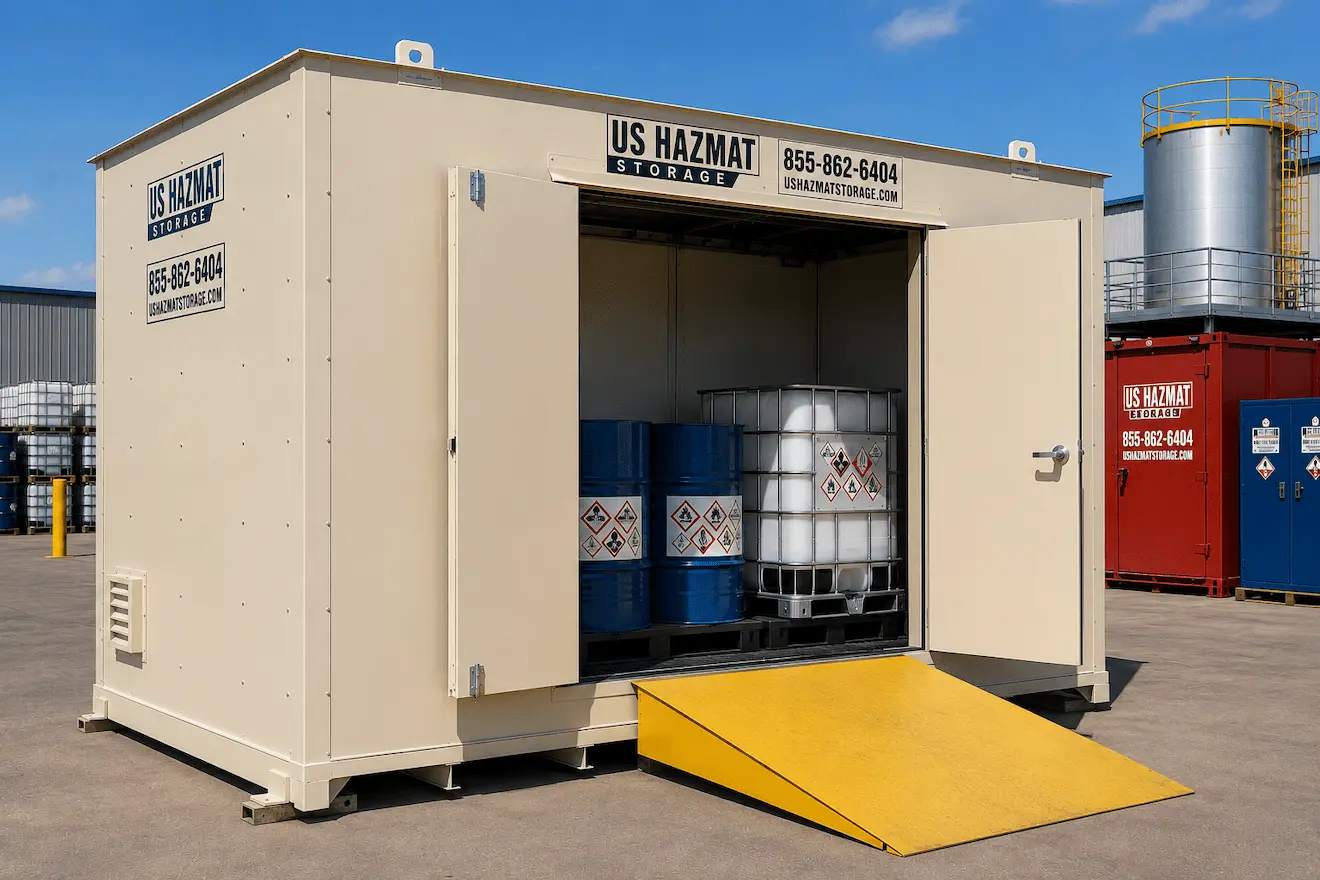
A structure that qualifies as a compliant spill containment shed Houston operations can rely on under all applicable frameworks typically combines a fire-rated building envelope, a secondary containment sump with documented volume capacity, mechanical ventilation appropriate for the stored materials, and electrical components rated for the hazardous location classification.
The Houston Climate Variable That Changes Structural Requirements
Houston’s climate is not a footnote in a containment shed specification. The combination of high ambient temperatures and the region’s history of flooding, including the structural and chemical release consequences that followed Hurricane Harvey in 2017, has made elevated floor designs, flood-resistant anchorage, and enhanced drainage planning practical expectations for any above-ground chemical storage structure in this market.
A Houston spill containment shed that sits at grade level without flood-resistant design features is a liability in a region where FEMA flood zone designations cover substantial portions of Harris County and the surrounding industrial areas. The sump capacity calculation for a containment shed here cannot rely solely on the EPA 40 CFR 264.175 formula for the largest single container.
It needs to account for the realistic probability of the shed being tested by a flood event rather than an internal spill, and what that means for secondary containment integrity during an extended inundation.
Heat is the other Houston-specific variable. Materials stored in an uninsulated or inadequately ventilated containment shed in a Texas summer face ambient temperatures that can accelerate vapor pressure buildup, degrade container seals, and push certain flammable materials closer to ignition thresholds.
A spill containment shed in Houston without thermal management in its design is an incomplete specification regardless of how well the containment volume calculation was handled.
How Secondary Containment Volume Gets Calculated in Texas
The secondary containment sump in a Houston spill containment shed must hold the volume of the largest single container stored inside, plus a margin for precipitation in outdoor or semi-exposed applications. This is the federal EPA baseline per 40 CFR 264.175.
TCEQ guidance for storage facilities under a Texas hazardous waste permit may require a more conservative calculation depending on material classification and the facility’s proximity to surface water or municipal storm drains.
For drum-based storage, which represents the majority of spill containment shed configurations in the 55-gallon range, a single-drum sump rated at 66 gallons or more typically satisfies the EPA floor requirement. Multi-drum configurations scale proportionally, and the calculation uses the largest single container in the arrangement, not an average. A shed storing 55-gallon drums alongside a 330-gallon IBC tote must size the sump for the tote.
The sump material must be compatible with what is stored above it. A steel sump in contact with corrosives will degrade the containment structure itself. Poly sumps handle most corrosives but may not be appropriate for certain solvents or petroleum products. For facilities storing oxidizing agents such as sodium hypochlorite or similar materials, compatibility between the stored substance and every structural component of the shed requires individual confirmation.
Resolving material compatibility parallel to the volume calculation, not after it, is the sequence that prevents a costly redesign once equipment is on order.
Ventilation and Electrical Classification for Houston Industrial Sites
Ventilation separates a compliant Houston spill containment shed from one that passes a visual inspection but fails under operational conditions. NFPA 30 requires that flammable liquid storage areas maintain vapor concentrations below 25 percent of the lower flammable limit, and achieving that in a Houston summer requires a mechanical ventilation design that accounts for ambient temperature and the shed’s solar heat gain exposure.
Natural ventilation is permitted under certain conditions in NFPA 30, but the passive airflow assumptions that work in temperate climates do not translate reliably to Houston’s summer heat profile. A shed that vents adequately in March may accumulate dangerous vapor concentrations in August when ambient temperatures push into the mid-nineties and the interior is significantly hotter.
Electrical classification follows the ventilation design. The interior of a spill containment shed storing flammable or combustible materials is typically classified as a Class I, Division 1 or Division 2 hazardous location under NFPA 70. All electrical fixtures, switches, outlets, and conduit fittings inside or adjacent to the classified area must carry that rating.
Standard commercial electrical components in a classified hazardous location are both a fire risk and a code violation. The Houston Fire Department’s hazmat storage permit review includes the electrical classification documentation as a standard checklist item.
Local Permitting: HFD, TCEQ, and What the Process Actually Looks Like
Permitting a spill containment shed in Houston involves at minimum a review by the Houston Fire Department Fire Prevention Bureau for any facility storing hazardous materials above threshold quantities under the Houston Fire Code. The HFD review covers building construction classification, stored materials, quantities and segregation, ventilation, and fire suppression or detection provisions.
TCEQ involvement depends on the material classification and the facility’s existing environmental permits. Facilities operating under a TCEQ industrial permit or a Texas Pollutant Discharge Elimination System permit may need to document the containment shed in their stormwater pollution prevention plan or their secondary containment program.
This requirement is separate from the HFD permit and operates on TCEQ’s own review timeline, which can affect project scheduling if both are needed before the shed goes into service.
EPA Region 6, which covers Texas, has jurisdiction over SPCC-regulated facilities storing oil above the thresholds in 40 CFR Part 112. If the containment shed is part of an SPCC-covered facility, its design and sump capacity must be reflected in the current SPCC plan.
Any change to storage configuration may require a plan amendment reviewed by a licensed Professional Engineer. Engaging your EHS team and the relevant agencies early is consistently faster than navigating amendment requirements after installation.
Spill Containment Workstation Configurations for Houston Operations
Not every facility in the Houston area needs a standalone shed. For operations where drum storage happens at a fixed work point rather than in a dedicated storage building, a spill containment workstation provides integrated secondary containment, drum access, and working surface in a single footprint.
This configuration is common in the Ship Channel corridor and Pasadena industrial areas, where facilities manage active drum dispensing at the point of use without routing materials through a separate storage room for every draw.
A spill containment workstation shed for Houston conditions requires the same material compatibility, with the added requirement that the structure supports the operational workflow without creating ergonomic or access problems at the dispensing point.
Our 55-gallon drum storage solutions include workstation-compatible containment configurations built to meet OSHA and NFPA requirements under the material and environmental demands that Houston industrial sites present.
The workstation approach is not appropriate for every situation. If stored quantity or material classification requires a dedicated storage building under NFPA 30 or the Houston Fire Code, a workstation configuration does not substitute for that requirement. Confirming which approach your storage scenario permits is a conversation for your EHS team and the HFD Fire Prevention Bureau before any equipment is ordered.
Cost Drivers and Lead Times for Houston Containment Shed Projects
The cost of a spill containment shed in Houston varies based on size, construction rating, sump capacity, ventilation system complexity, electrical classification, and whether the structure needs to meet flood-resistant design criteria for the site’s FEMA flood zone designation.
A single-drum containment unit in standard construction occupies a different cost tier than an engineered multi-drum shed with mechanical ventilation, Class I electrical components, and a reinforced sump designed for Harris County flood conditions.
Lead times in this market reflect the demand from the Ship Channel corridor and the supply chain dynamics for engineered storage structures. Off-the-shelf containment pallets and workstation products typically ship within standard windows. Custom-engineered shed structures with site-specific requirements take longer, and the HFD or Harris County permitting timeline adds calendar time independent of manufacturing.
Beginning the specification and permitting process before the shed is needed, not when it is already overdue, is the decision that most directly controls whether the project lands on schedule.
Getting the Specification Right Before Committing to a Product
A spill containment shed in Houston that meets the full scope of applicable requirements, from OSHA and NFPA to TCEQ and EPA Region 6, starts with a complete picture of the stored materials, the site’s regulatory status, and the specific local requirements for that address. None of those inputs can be replaced by a product brochure or a generic specification.
They require a site-specific review that accounts for what makes Houston’s regulatory environment, climate, and industrial context distinct from any other market.
US Hazmat Storage serves facilities across the Houston area and understands what a compliant containment shed specification looks like in this market. If you are in the planning phase and need to confirm the right configuration for your site and materials, contact US Hazmat Storage to check availability and lead times near you.
Any final containment configuration should be reviewed by a licensed EHS professional, your AHJ, and where SPCC applies, a licensed Professional Engineer before any commitment is made.
FAQ
What is a spill containment shed used for in Houston industrial facilities?
A Houston spill containment shed provides secondary containment for drums, totes, and chemical storage at facilities subject to OSHA, NFPA 30, EPA SPCC, and TCEQ requirements. It captures releases before they reach drains, soil, or waterways.
Does Houston have specific codes for spill containment shed installations?
Yes. The Houston Fire Code, administered by the HFD Fire Prevention Bureau, governs hazardous material storage permits. TCEQ and EPA Region 6 add state and federal requirements depending on material type, quantity, and facility permit status.
How large does a spill containment sump need to be in Texas?
Under EPA 40 CFR 264.175, the sump must hold the volume of the largest single container. TCEQ may require additional capacity for facilities near waterways. Size the sump to the largest container in the arrangement, not an average.
Does a spill containment shed in Houston need mechanical ventilation?
In most cases involving flammable or volatile materials, yes. Houston’s summer temperatures and heat gain make passive ventilation unreliable for maintaining vapor concentrations below NFPA 30 thresholds. Mechanical ventilation is the more defensible design choice for this climate.
What role does TCEQ play in spill containment shed permitting?
TCEQ enforces 30 TAC Chapter 335 and may require documentation of secondary containment structures in a facility’s stormwater pollution prevention plan or environmental permit. This review runs on a separate track from the HFD permit.
Do I need a PE to sign off on my containment shed in Houston?
If your facility is subject to the EPA SPCC rule under 40 CFR Part 112, a licensed Professional Engineer must certify your SPCC plan, and any change to storage configuration may require a PE-reviewed plan amendment.
How does Houston’s flood risk affect containment shed design?
Harris County’s FEMA flood zone designations require above-grade or flood-resistant design for chemical storage structures in many industrial areas. Sump calculations should account for potential flood inundation, not only internal spill volumes.
Can a spill containment workstation replace a dedicated storage shed?
Not always. If stored quantity or material classification triggers dedicated storage building requirements under NFPA 30 or the Houston Fire Code, a workstation configuration does not satisfy that obligation. Confirm with your AHJ before selecting an approach.