
Specifying a 50 gallon drum for your operation should be one of the more routine tasks on a facility manager’s plate. In practice, it rarely unfolds that way. The unit arrives, the containment pallet does not fit the footprint, the closure type conflicts with the dispensing setup, or the AHJ walks in and the entire storage arrangement needs to be redone before the drum sees a single workday.
These outcomes follow a predictable pattern: someone purchased the drum before confirming what the drum needed to work with.
US Hazmat Storage has had this conversation with enough facility managers and EHS teams to recognize that the evaluation gap almost never lives in the product itself. It lives in the sequence of decisions that led up to the purchase order. What follows is the sequence that tends to catch those gaps before they become field problems.
Why the Capacity Number Is Only the Starting Point
The phrase “50 gallon drum” shows up regularly in procurement specs and facility planning documents. What it does not always do is map cleanly to a single SKU or a single regulatory reference. The de facto standard in North American industrial storage is the 55-gallon drum.
That is the format most containment pallets are engineered around, the size most drum lockers and flammable liquid storage buildings accommodate, and the capacity most OSHA 1910.106 and NFPA 30 references have in mind when they address drum-based storage quantities.
A buyer specifying a 50 gallon drum is often working from a volume estimate rather than a precise measurement. The previous container was roughly that size. A process requires a certain quantity. A space constraint in the storage room suggests a slightly smaller unit would fit more cleanly. None of those are poor reasons. .
Before committing to any specific drum size, check the interior sump dimensions of your containment equipment. Measure the clearance height in your storage room or locker. Look at what drum handling equipment is already on the floor. If all of that was sized for a 55-gallon drum and you bring in a 50 gallon drum with different geometry, you have introduced a fit problem that requires additional equipment or a return shipment.
Material Compatibility: The Specification That Comes Before Everything Else
Every purchase decision for a 50 gallon drum starts with the Safety Data Sheet for the material going inside it. The drum’s construction, whether carbon steel, stainless steel, high-density polyethylene, or a lined variant, must be chemically stable in contact with that specific substance at the temperatures and concentrations your operation involves.
Incompatible materials do not always fail visibly or all at once. A drum wall can degrade gradually, the closure seal can soften over weeks, or the interior lining can absorb trace amounts of the stored liquid and complicate both performance and disposal.
Steel drums are the standard for most flammable liquids and petroleum-based products. They dissipate electrostatic charge, which matters significantly for solvents and low-flash-point materials, and they hold up mechanically under the conditions found in most industrial environments. Poly drums handle corrosives, acids, and water-based materials that would attack a steel wall over time.
Lined drums, where a separate interior barrier layer sits between the stored substance and the drum wall, cover cases where neither standard steel nor poly is a clean match. When evaluating a 50 gallon drum for a corrosive or reactive material, construction type is the first filter, not the last.
The complication grows when a facility stores multiple materials and tries to consolidate around a single drum format. What works for your lubricant inventory may be entirely wrong for your cleaning chemical storage. Each material requires its own compatibility review. Your chemical supplier’s technical team is a reliable first call, and the drum manufacturer’s specification sheet will list compatible chemical classes and known exclusions.
The Regulatory Picture: More Than One Agency Has a Say
A 50 gallon drum used to store hazardous materials sits at the intersection of several overlapping regulatory frameworks. OSHA 29 CFR 1910.106 governs flammable liquid storage in general industry, covering quantity limits, ventilation requirements, and container specifications by storage location type. EPA 40 CFR Part 265 applies when the drum accumulates hazardous waste.
NFPA 30 provides the most detailed technical guidance on flammable and combustible liquid storage, covering drum spacing, fire protection requirements, and the conditions that distinguish compliant indoor storage from outdoor arrangements. DOT 49 CFR Part 178 becomes relevant if the drum will ever move the material off-site.
Your Authority Having Jurisdiction, whether that is the local fire marshal, the building official, or both, interprets these codes for your specific address. The same storage configuration that passes inspection in one jurisdiction may require additional controls, modified spacing, or different fire suppression in another.
The AHJ conversation should happen before any equipment is purchased, before any storage layout is finalized, and before any construction begins.
Secondary Containment: The Spec That Trips Up More Inspections Than Any Other
Secondary containment is the element of 50 gallon drum storage specifications that most often fails during regulatory review, usually not because the facility had no containment system in place. The more common finding is that the containment was not sized for the actual drum volume, was not rated for the stored material, or had not been maintained in a condition where it could hold a full release.
EPA 40 CFR 264.175 requires that secondary containment hold the volume of the largest single container in the storage area, with additional margin for precipitation in outdoor applications.
For a 50 gallon drum, the sump capacity needs to exceed the drum’s full liquid volume. A single-drum containment pallet rated at 66 gallons or more provides the necessary margin while accounting for the drum’s own displacement within the sump. Multi-drum configurations scale that requirement proportionally, with the minimum sump volume based on the largest single container in the group.
Load rating is equally critical: a full steel drum in this size range weighs between 400 and 500 pounds depending on liquid density, and containment pallets rated below that combined load are a structural risk.
For facilities where drums travel regularly between a receiving dock, a storage room, and a use point, a drum containment cart with an integrated sump handles both the handling and the containment requirement in one piece of equipment.
Our drum storage and containment solutions are built around standard drum formats and include both static and mobile containment configurations sized for real industrial floor plans. Confirming sump volume, load rating, and material compatibility before placing the order eliminates the reorder cycle that costs more than the review itself.
UN Certification, DOT Classification, and What the Markings Actually Tell You
If a 50 gallon drum will carry hazardous material in transport at any point in its service life, UN certification is not optional. DOT requires that containers used for transporting hazardous materials meet UN performance standards, and the markings on the drum communicate everything a compliance review needs: the container type, the construction material, the hazard classes it is rated for, the maximum gross mass it can carry, and the testing standard it was built to.
Using an unmarked or improperly rated drum for a regulated material in transport is a per-package, per-day violation. For a 50 gallon drum that remains on-site, the UN performance standard still serves as a useful benchmark. A drum certified for Packing Group I material, the highest hazard classification, has been subjected to drop, leakage, and stacking tests that exceed what PG II or PG III certification requires.
If the material you are storing falls into a high-hazard category, selecting a drum tested to that level provides documented performance assurance that no marketing copy can substitute for.
Finalizing a 50 gallon drum specification when the stored material is a mixture or proprietary blend requires an EHS professional to confirm the classification before the drum spec is submitted. Packing group classification follows the physical and chemical properties of the material: flash point, vapor pressure, and reactivity profile, all of which appear on the SDS.
Paint Lockers and Dedicated Structures for Flammable Drum Storage
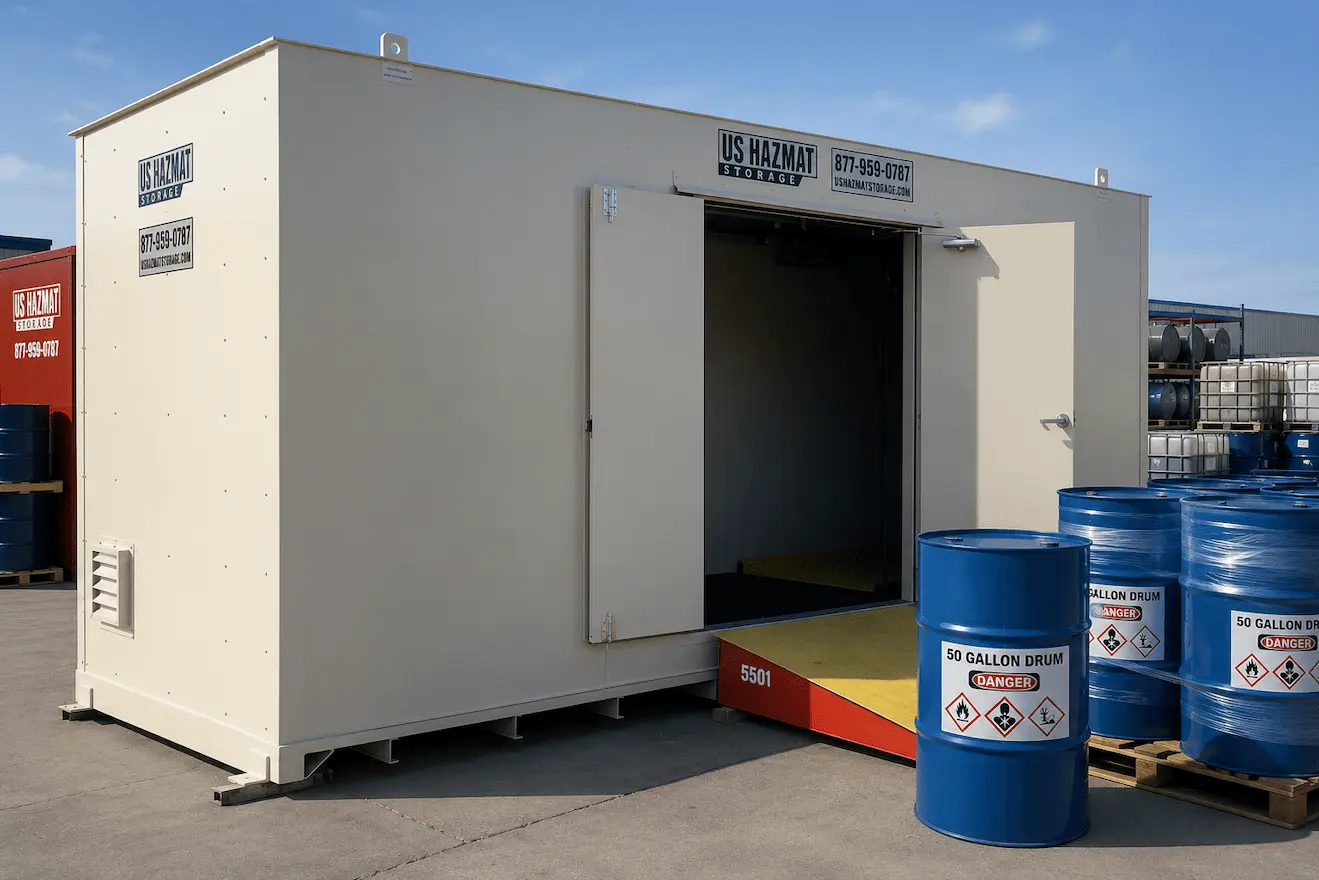
Facilities that store paints, thinners, solvents, and coating materials in drum quantities need a purpose-built structure. NFPA 30 distinguishes clearly between small-quantity flammable liquid storage in approved safety cabinets and larger drum quantities that require a dedicated storage room or a standalone flammable liquid storage building.
A single 50 gallon drum of flammable liquid represents a fire load that triggers structural and systems requirements a row of one-gallon cans would never reach.
A paint locker or drum storage building built to those requirements includes fire-rated wall and door assemblies, mechanical ventilation sized to prevent vapor accumulation, lighting and electrical components rated for Class I hazardous locations, and integrated secondary containment in the floor or sump.
Each of those four elements is necessary independently. A locker with fire-rated walls but no compliant ventilation, or correct ventilation with standard electrical fixtures, is not a compliant structure regardless of how well it was constructed in every other respect.
If your current arrangement stores flammable liquid drums in a general area or in a cabinet not rated for drum-scale quantities, a gap assessment against NFPA 30 and your AHJ’s local amendments is the right starting point. The cost of a compliant structure is plannable. The cost of a stop-work order or a post-incident investigation is not.
Cart Containment, Drum Handling, and the Compliance Gap in Transit
A full drum in the 50-to-55-gallon range is heavy enough to cause a serious injury if it tips or rolls uncontrolled during handling. At 400 to 500 pounds depending on liquid density, it exceeds what any reasonable ergonomic program permits for unassisted manual movement. Drum carts and drum trucks provide the mechanical advantage that makes safe movement possible, but the handling equipment decision and the containment requirement are not separate considerations.
A standard drum cart moves the 50 gallon drum. A cart containment unit moves the drum and captures any incidental release during transit. For operations where drums travel regularly between a receiving area, a storage room, and a use point, the containment requirement follows the drum through each leg of that journey. A cart without a containment sump creates a compliance gap every time the drum is in motion.
When specifying cart containment for a 50 gallon drum application, confirm that the sump volume is proportional to the drum capacity, that the cart’s load rating accounts for the drum, the liquid, and any travel surface conditions along the path, and that the cart’s construction material is compatible with the stored substance. Sloped floors, floor drains, dock plates, and threshold transitions all belong in the selection conversation before the cart is ordered.
How the Buying Sequence Determines the Outcome
Purchasing the drum first and fitting containment, handling equipment, and storage structure around it afterward is the pattern that generates the most corrective action in drum storage procurement.
The sequence that produces fewer field problems works in the other direction: start with the material and its regulatory classification, confirm the storage location and what it requires by code, determine the containment and handling infrastructure those requirements demand, and then select the drum format that fits the full configuration. The 50 gallon drum is the final decision, not the first.
That order surfaces conflicts early. If the location your team has in mind cannot accommodate the ventilation requirement for the material you plan to store, discovering that before a drum is in the building is substantially less disruptive than discovering it after. If the containment pallet already on your floor is not rated for the liquid density of your material, that is a faster and cheaper correction when the drum is still on order.
Your EHS team, your fire marshal, and your AHJ are the appropriate resources for confirming that the full configuration meets the requirements for your specific material, location, and operation. These conversations are consistently shorter and less disruptive than the ones that follow a citation or a storage incident that a better specification sequence would have prevented.
A Spec Decision That Earns Its Keep
A correctly specified 50 gallon drum becomes a reliable, low-maintenance piece of your storage infrastructure. One selected without working through the full set of variables for a 50 gallon drum becomes a recurring source of compliance exposure and inspection findings that the original evaluation process would have eliminated.
US Hazmat Storage works with facility managers, EHS professionals, and operations teams navigating exactly this kind of decision. If you have a drum storage configuration to evaluate and want experienced input before you commit, contact US Hazmat Storage and book a call with our engineering team. Any final storage arrangement benefits from review by a qualified EHS specialist, fire marshal, or AHJ before any commitment is made.
FAQ
What is a 50 gallon drum typically used for in industrial settings?
A 50 gallon drum is used to store bulk liquids including solvents, chemicals, lubricants, and water-based materials. The specific use determines the drum material, closure type, and required containment configuration.
Is a 50 gallon drum the same as a 55-gallon drum?
No. A 50 gallon drum has a smaller nominal capacity. The 55-gallon format is the North American industry standard, and most containment pallets, drum lockers, and regulatory references are built around it.
Does a 50 gallon drum require secondary containment?
Yes, in most regulated storage situations. EPA and NFPA guidelines require secondary containment for hazardous material drum storage, sized to hold at least the full volume of the largest single container.
What regulations apply to 50 gallon drum storage?
Depending on the material, OSHA 1910.106, EPA 40 CFR Part 265, and NFPA 30 may all apply. Your AHJ may also have local code requirements that exceed federal minimums.
What does UN certification mean on a drum?
UN certification indicates the drum has been independently tested to meet international performance standards for transporting a specific hazard class of material at a given packing group level.
Can I store a flammable liquid drum in a standard warehouse?
Generally, no. Flammable liquid drum storage requires a purpose-built or AHJ-approved structure with rated construction, compliant ventilation, and proper electrical classification per NFPA 30.
How much does a full 50 gallon drum weigh?
Weight depends on the liquid density. A drum filled with water-equivalent liquid typically weighs 420 to 450 pounds. Denser materials increase that. Any containment pallet or cart must be load-rated accordingly.
What is the difference between open-head and tight-head drums?
Open-head drums have a removable lid for full interior access. Tight-head drums have a sealed top with small access bungs. The right choice depends on the material, dispensing method, and applicable regulatory requirements.