
Outdoor propane storage in Miami operates under a code stack that most facilities don’t map correctly. The federal baseline requirements are established by NFPA 58 (Liquefied Petroleum Gas Code). The Florida Fire Prevention Code takes on these requirements and makes amendments at the state level. Miami-Dade County Fire Rescue implements the code having applied its own amendments and possessing the authority to carry out site-specific reviews.
To get outdoor propane storage in Miami approved correctively involves going through all three levels, not merely the national standard. A specification that complies with NFPA 58 by itself may still be rejected in a Miami-Dade permit review.
US Hazmat Storage collaborates with facilities in Florida, industrial operators, and project managers who need outdoor propane storage arrangements that are specified in accordance with the full code stack applicable to Miami and South Florida.
NFPA 58 as the Baseline for Outdoor Propane Storage in Miami
The Liquefied Petroleum Gas Code, known as NFPA 58, is the basic regulatory document that Miami facilities concerned with outdoor propane storage must take into account. The 2021 version, which has been incorporated into the Florida Fire Prevention Code, sets out minimum separation distances, the requirements for container installation, and equipment standards that apply to the storage of LP gas in any amount exceeding a certain threshold.
The core separation distances for LP-gas containers from buildings, property lines, ignition sources, and other hazards are given in NFPA 58 Table 6.2.1. Aboveground containers with a capacity between 251 and 500 gallons must be at least 10 feet from occupied buildings, while those with a capacity between 501 and 2,000 gallons must be at least 25 feet from such buildings.
These represent the federal baseline separation distances. In certain types of occupancy or in high-density urban areas, both Florida and Miami-Dade may require greater separation, and the site plan review carried out by Miami-Dade Fire Rescue might necessitate adjustments taking into account local access, exposure, and density conditions.
When determining the separation distances for outdoor propane storage in Miami, the measurements should be taken from the nearest point on the container shell and not from the fill valve or the vapor return line. Although a great many facilities measure from the nearest fitting, this results in an underestimation of the required separation distance and means that the container is placed closer to the building than is permitted by code.
Florida Fire Prevention Code: What Changes at the State Level
Florida has incorporated NFPA 58 into the Florida Fire Prevention Code, which is managed by the State Fire Marshal’s Office. However, this incorporation is not a word-for-word one. The Florida Fire Prevention Code contains amendments that are specific to the state and which alter the provisions of NFPA 58 to take into account Florida’s conditions, such as the coastal and hurricane exposure requirements that are pertinent to the outdoor propane storage in Miami.
Florida Rule 69A-3 includes reference to NFPA 58 together with its amendments. The state-level requirements add wind load design criteria for containers and their anchorage systems. In Miami-Dade County, the High-Velocity Hurricane Zone (HVHZ) design requirements of the Florida Building Code apply to structures associated with propane storage, including equipment enclosures, regulators, manifold systems, and any shelter structures built over outdoor propane storage in Miami systems.
The HVHZ design wind speed for Miami-Dade is currently 185 mph (3-second gust at 33 feet), which affects how anchorage, piping, and accessory structures for propane storage must be designed and documented.
Outdoor propane storage in Miami installations must have approved shutoff valves, pressure relief valve discharge directed away from ignition sources and occupied areas, and container installation that meets the HVHZ anchorage requirements. These requirements apply whether the installation is new construction or the replacement or repositioning of existing containers.
Miami-Dade Fire Rescue Permit Process and Plan Review
Outdoor propane storage in Miami projects require a permit from Miami-Dade Fire Rescue for containers above the threshold quantities specified in NFPA 58 and the Florida Fire Prevention Code. The permit process includes a plan review that evaluates the site plan showing container location, separation distances from property lines and structures, access for fire department response, and the design documentation for the installation.
Miami-Dade Fire Rescue applies the Florida Fire Prevention Code and local ordinances during plan review. Local amendments adopted by Miami-Dade County may impose requirements beyond the state code, particularly for containers located within setback distances of property lines in high-density commercial and industrial zones common in Doral, Hialeah, and the Port of Miami industrial corridor.
The plan review package for a new outdoor propane storage in Miami installation typically includes: a certified site plan showing all separation distances; the container specification sheet from the manufacturer; the installation design drawing showing anchorage, piping, regulator location, and pressure relief valve discharge direction; and documentation that the installation meets HVHZ design requirements if any associated structure is included.
Projects in the City of Miami rather than unincorporated Miami-Dade may also require a permit from the City of Miami Fire Rescue and Zoning Department, in addition to the county-level review.
Chemical Locker and Modular Housing Configurations for Propane Ancillary Equipment
A complete outdoor propane storage in Miami installation includes not only the container but the ancillary equipment that makes the system safe and functional: regulators, manifolds, emergency shutoff valves, meters, and in some configurations, dispenser equipment. This equipment requires protection from Miami’s humidity, salt air, and storm conditions.
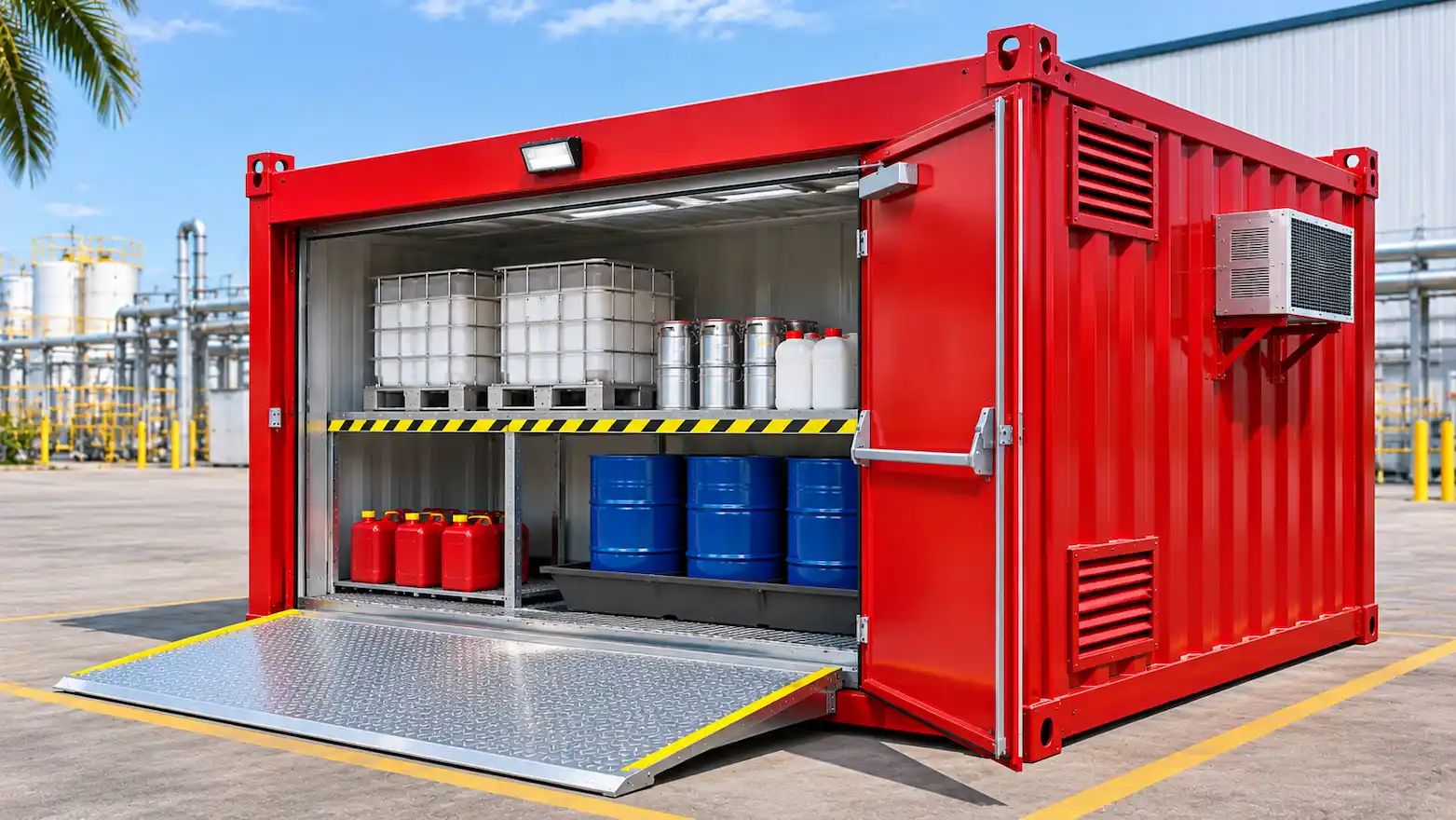
For outdoor propane storage in Miami systems, a chemical locker or equipment enclosure for propane ancillary equipment must be ventilated, constructed of corrosion-resistant materials appropriate for the coastal atmosphere, and sited in accordance with NFPA 58 requirements for the equipment it houses.
Enclosures that contain regulators or piping connected to the propane system are within the NFPA 58 classified location requirements. Any electrical equipment inside the enclosure must be listed for Class I, Division 2, Group D service under NEC Article 500. Standard industrial electrical equipment is not compliant inside a propane equipment enclosure.
Modular housing units for oilfield and industrial applications follow the same LP-gas equipment enclosure design logic when used in conjunction with propane systems: corrosion-resistant construction, proper ventilation, classified location electrical, and anchorage designed for the wind exposure of the site. In Miami’s coastal environment, all hardware, fasteners, and enclosure components must be rated for salt-air exposure.
US Hazmat Storage’s chemical storage solutions include enclosure and storage system configurations designed for South Florida’s coastal conditions, with material specifications that account for the humidity and salt-air exposure that standard catalog products don’t address.
NEC Article 500 and Electrical Classification Around Propane Storage
NFPA 58 Chapter 6 defines the classified locations around outdoor propane storage systems for electrical equipment purposes. LP-gas is a Class I flammable gas (vapor density approximately 1.5 relative to air), and the zone within 5 feet of a pressure relief valve discharge, within 15 feet of a container fill or vapor return valve, and within 5 feet of a fixed maximum liquid level gauge is classified as a hazardous location.
For any outdoor propane storage in Miami project, this classification affects outdoor lighting, security cameras, electrical conduit fittings, junction boxes, and any other electrical equipment installed in proximity to the storage area.
All electrical equipment within classified zones must be rated for Class I, Division 1 or Division 2 service, depending on the zone. A facility that installs standard outdoor LED area lighting within the classified zone of its propane storage area has an NEC violation regardless of whether the light is operating when gas is present.
The classified location boundaries must be documented as part of the installation design and maintained in the facility’s electrical drawings. When propane storage quantities, container configurations, or container locations change, the classified location boundaries must be re-evaluated and the electrical drawings updated.
US Hazmat Storage’s explosion-proof chemical storage configurations address the full NEC Article 500 classified location design requirements for high-hazard outdoor storage applications, including the electrical system integration that most catalog propane enclosures don’t document.
Secondary Containment for Liquid Propane and LP-Gas Condensate
Liquid propane storage presents a secondary containment consideration that differs from flammable liquid storage. Propane is stored as a liquid under pressure and vaporizes when released to atmospheric pressure. The secondary containment requirement under SPCC (40 CFR Part 112) applies to facilities storing petroleum products, and propane (classified as a petroleum product under EPA guidance) falls within that framework above SPCC threshold quantities.
For outdoor propane storage in Miami sites, secondary containment typically takes the form of a concrete dike or earthen berm surrounding the storage area, designed to contain the liquid volume of the largest container in the event of a catastrophic failure.
Miami’s flat topography and high water table affect secondary containment design: earthen berms may not be practicable at sites with seasonal high groundwater near the surface, and Miami-Dade’s stormwater management requirements may interact with how secondary containment is designed and drained.
Sites in Miami-Dade’s Wellfield Protection Zones (established under the county’s Ground Water Protection Program) have additional requirements for any chemical storage installation that could affect groundwater. Outdoor propane storage in Miami installations near Wellfield Protection Zone boundaries require review against those requirements as part of the permitting process.
Chemical Storage Solution Configuration for South Florida Sites
A complete chemical storage solution for a South Florida facility that includes outdoor propane storage in Miami as one component of a larger chemical inventory must address the segregation requirements of NFPA 58, NFPA 400, and the Florida Fire Prevention Code simultaneously. LP-gas containers must be separated from flammable liquid storage, oxidizer storage, and corrosive storage by the distances and barriers that each applicable standard specifies.
The site planning sequence that produces a compliant multi-chemical storage installation in Miami runs: inventory all chemicals stored on site, classify each by hazard class and applicable standard, map the separation distances for each material, overlay those distances on the available site footprint, and identify the configuration that satisfies all separation requirements simultaneously within the available space.
In Miami-Dade’s dense industrial corridors, that footprint analysis frequently reveals that the available space cannot accommodate the required separations for all chemicals, and the facility must either reduce quantities, stack chemicals vertically in compliant structures, or identify an off-site storage arrangement.
Hurricane Preparedness and Storm Procedures for Propane Containers
Miami-Dade County’s history of hurricane impacts creates operational requirements for outdoor propane storage in Miami facilities that go beyond the construction and installation standards. Miami-Dade County requires that emergency action plans for facilities storing hazardous materials address hurricane preparedness procedures, including procedures for securing containers and isolating systems before storm arrival.
NFPA 58 requires that containers be secured against movement, and Miami-Dade’s HVHZ design requirements address the structural aspects of that requirement. The operational aspect (who is responsible for securing valves, what sequence of steps is followed, and when that sequence is initiated relative to the county’s mandatory evacuation orders) must be documented in the facility’s emergency action plan and reviewed with Miami-Dade Fire Rescue as part of the hazardous materials facility registration process.
Outdoor propane storage in Miami containers that are properly anchored, with valves closed and system isolated, present a manageable risk during a hurricane event. Containers that are not anchored, improperly anchored, or left with open valves and connected piping represent a post-storm hazard that the county’s incident command system has had to respond to in prior hurricane seasons.
Closing: Local Code Knowledge Is Part of the Specification
Outdoor propane storage in Miami isn’t a national standard problem with a local permit attached. Getting outdoor propane storage in Miami right means every code layer is addressed before the permit application is submitted.
Miami-Dade’s HVHZ requirements, the county’s Ground Water Protection Zones, Miami-Dade Fire Rescue’s plan review process, and the operational requirements of hurricane preparedness planning are all specification inputs that don’t appear in NFPA 58. A facility that specifies to the national standard alone will face corrections at the local plan review stage.
US Hazmat Storage works with South Florida facilities on propane and chemical storage system configurations that are specified to the full code stack from the start. Get a custom proposal for your facility and avoid the correction cycle that starts when a national-standard specification meets a Miami-Dade permit review.
FAQ
What NFPA 58 separation distances apply to outdoor propane storage in Miami installations?
NFPA 58 Table 6.2.1 sets minimum separation distances from occupied buildings: 10 feet for 251 to 500-gallon containers, 25 feet for 501 to 2,000-gallon containers. Miami-Dade Fire Rescue may impose greater separation during plan review based on local site conditions, occupancy density, and access requirements. Separation distances are measured from the nearest point of the container shell, not from valves or fittings.
Does Miami-Dade require a permit for outdoor propane storage?
Yes. Outdoor propane storage in Miami installations above the threshold quantities in NFPA 58 and the Florida Fire Prevention Code require a permit from Miami-Dade Fire Rescue. Projects in the City of Miami may require a separate city-level permit. The permit process includes a plan review that evaluates site layout, separation distances, HVHZ anchorage design, and documentation of the installation.
What are the HVHZ requirements for propane storage in Miami-Dade?
The High-Velocity Hurricane Zone (HVHZ) requirements of the Florida Building Code apply to structures associated with propane storage in Miami-Dade County. The design wind speed is 185 mph (3-second gust at 33 feet). Equipment enclosures, manifold structures, and any shelter structures built over outdoor propane storage in Miami systems must be designed and documented for HVHZ wind loading. Container anchorage must also be designed for HVHZ conditions.
What electrical classification applies inside a propane equipment enclosure?
Equipment enclosures housing propane regulators, valves, or piping are within the classified location zone defined by NFPA 58 Chapter 6. All electrical equipment inside the enclosure must be listed for Class I, Division 1 or Division 2, Group D service under NEC Article 500. Standard outdoor-rated electrical equipment is not acceptable. The classified location zone extends 5 feet from pressure relief valve discharge points and 15 feet from fill and vapor return valves.
Do Miami’s Wellfield Protection Zones affect propane storage permitting?
Yes. Sites near Miami-Dade’s Wellfield Protection Zone boundaries require review against the county’s Ground Water Protection Program requirements as part of the permitting process for outdoor propane storage in Miami installations. The Wellfield Protection Zones are established to protect the county’s drinking water supply, and any chemical storage installation within or adjacent to those zones requires additional evaluation regardless of the chemical stored.