
Paint lockers fail inspections for predictable reasons: The wrong construction material, no self-closing door mechanism, inadequate ventilation or missing secondary containment. These aren’t obscure code requirements. They appear in NFPA 30 and OSHA 29 CFR 1910.106, two standards that apply directly to any facility storing flammable or combustible coatings in an enclosed structure.
A unit that arrives on-site without meeting these specifications creates a citable violation before it stores a single can. Understanding what the codes actually require is cheaper than learning it from an AHJ. US Hazmat Storage works with facility managers who need compliant paint locker configurations specified to their site conditions and regulatory basis.
Why Paint Is Classified as a Flammable or Combustible Liquid
Most architectural and industrial paints contain solvents with flash points that place them under NFPA 30 regulation. Alkyd paints and oil-based coatings use mineral spirits or naphtha as a carrier, with flash points typically between 100°F and 140°F, which classifies them as Class II or Class IIIA combustible liquids.
Lacquers use acetone, MEK (methyl ethyl ketone), or toluene, with flash points well below 73°F, placing them in Class I. Primers and many industrial coatings contain xylene, whose flash point is 81°F, making it a Class IC liquid.
A paint locker holding a mixed paint inventory will typically contain materials across two or three NFPA 30 liquid classes simultaneously. The regulatory requirements that apply to the structure are determined by the most hazardous class present. If any Class I liquid is in the locker, the entire structure is governed by Class I requirements, including the ventilation rate, electrical area classification, and fire rating of the door assembly.
NFPA 30 Construction Requirements That Apply to a Paint Locker
NFPA 30’s requirements for inside storage rooms (Section 9.4) establish the construction baseline for any enclosed flammable liquid storage structure. The standard specifies that inside storage rooms must be constructed to meet the fire resistance requirements of the applicable building code, with a minimum 2-hour fire resistance rating for rooms storing more than the exempt quantities, and a minimum 1-hour rating for rooms at or below exempt quantities.
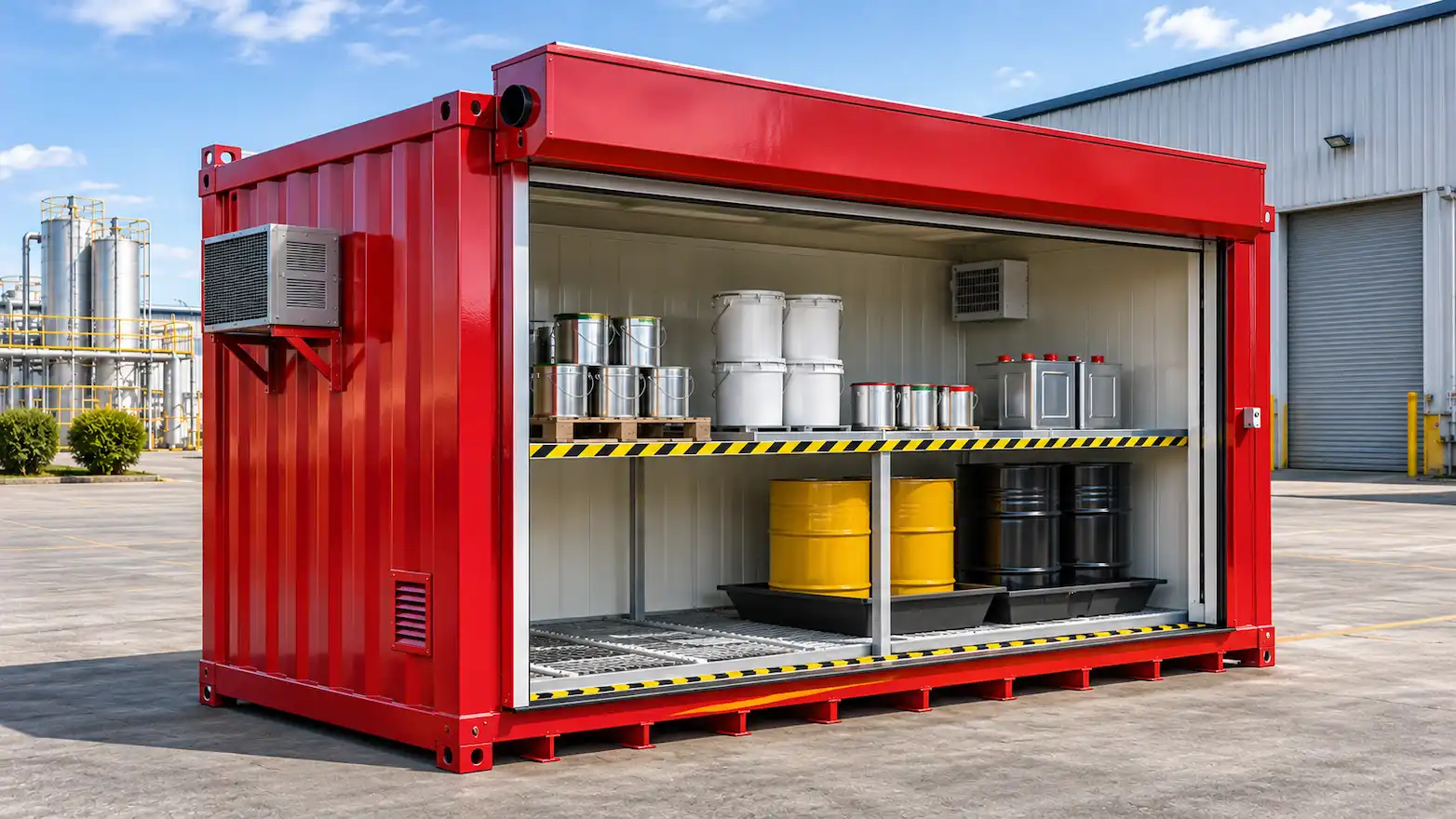
For a paint locker specifically, the relevant NFPA 30 requirements include: walls constructed to the required fire resistance rating; a 4-inch concrete or equivalent liquid-tight curb at all door openings to contain spills; a self-closing, fire-rated door that closes automatically on release; ventilation at a minimum rate of 1 cubic foot per minute per square foot of floor area (minimum 150 CFM total); and electrical equipment within the room rated for Class I, Division 2 hazardous locations under NEC Article 500 if any Class I liquids are stored.
The exempt quantity under NFPA 30 for a single storage room containing Class I liquids is 120 gallons for liquids in containers up to 5 gallons, or 60 gallons if any containers exceed 5 gallons. A storage room holding more than those quantities must meet the full construction requirements for inside storage rooms, including the 2-hour fire rating. Many facilities storing paint in gallon cans and 5-gallon pails are within exempt quantities.
Ventilation Design: Where Most Paint Lockers Fall Short
Ventilation is the most common deficiency in paint locker installations. NFPA 30 requires mechanical exhaust ventilation for inside storage rooms holding Class I or Class II liquids, with the exhaust located at floor level to capture vapors heavier than air. Solvent vapors from most coatings are heavier than air (vapor density greater than 1.0) and will accumulate at the floor unless actively exhausted from that level.
A unit with roof-only vents or high-wall ventilation openings is not meeting the floor-level exhaust requirement. The vent ports on many catalog locker models are positioned for cooling, not for solvent vapor removal. Verifying that exhaust ports are located within 12 inches of the floor, and that the exhaust rate meets the 1 CFM per square foot requirement, is part of the site acceptance inspection for any new installation.
Makeup air must also be addressed. Exhausting air from a sealed structure without an equal makeup air inlet creates negative pressure that makes door operation unsafe and reduces actual exhaust flow. The makeup air inlet should be located on the opposite wall from the exhaust outlet, positioned high to avoid introducing fresh air at floor level where vapors are present.
OSHA 1910.106 and What It Adds to NFPA 30
OSHA’s flammable liquids standard at 29 CFR 1910.106 adopts NFPA 30 by reference for most construction requirements but adds its own layer of OSHA enforcement authority. For these storage applications, OSHA 1910.106(d)(3) covers inside storage rooms in detail and mirrors the NFPA 30 requirements for construction, ventilation, and quantity limits.
Where OSHA 1910.106 adds requirements beyond NFPA 30 is in the area of incidental storage. Under 1910.106(e)(2), quantities of flammable or combustible liquids in excess of 25 gallons stored in a building that isn’t a specifically constructed storage room must be stored in an approved inside storage cabinet. This type of storage structure is what makes quantities above 25 gallons compliant. Without it, every can stored above that threshold is an OSHA violation.
OSHA also requires that inside storage rooms be supervised when in use and that quantities removed for use be limited to what is needed for one day’s operations. These operational requirements affect how the storage area is managed, not just how it’s constructed, and they’re often overlooked by facilities that focus on the structural compliance aspects of the locker specification.
US Hazmat Storage’s 55-gallon drum storage solutions address the overlap between flammable coating storage configurations and drum storage where coatings are purchased in bulk, including secondary containment requirements that apply when paint is stored in full drums alongside pails and cans.
Electrical Classification Inside a Paint Locker
A paint locker containing Class I flammable liquids (such as lacquers, solvent-based primers and acetone-based products) is classified as a Class I, Division 2 area according to NEC Article 500. In a Class I, Division 2 area, flammable concentrations are not normally found but may be present under abnormal conditions, for example in the case of a container failing or spilling. All the electrical equipment located inside the locker must be approved for use in a Class I, Division 2, Gas Group D environment at least (Group D includes many common solvents such as toluene, xylene and naphtha).
It is not permissible to use standard lighting fittings, standard outlets, or standard switches within a Class I, Division 2 classified structure; this is the most frequent electrical compliance failure. If a facility installs a unit that is in itself acceptable and then adds a standard LED light fixture for internal lighting together with an outlet for a battery charger, the locker will at once become non-compliant with the NEC.
All electrical components that are installed inside must be checked to ensure that they are suitable for the relevant Division and Group before they are installed.
According to NFPA 77, the Standard on Static Electricity, and NFPA 30, metal storage lockers must have bonding and grounding connections since static discharge can act as an ignition source for solvent vapours and therefore present a risk when the containers are being handled or the liquids are being transferred, especially in the case of unpainted metal lockers which lack grounding connections.
Propane Tank Storage Racks and Chemical Racks Inside a Paint Locker
These enclosures are often used for storing not only paint but also various associated chemicals, such as acetone for cleaning brushes, thinners, and in some cases aerosol propellants. The fact that propane is stored in cylinders beside flammable coatings results in a combined hazard, a risk that is separately covered by NFPA 30 and OSHA 1910.101 (comprising compressed gases).
The use of racks for storing propane tanks in a paint locker is usually not in accordance with code. According to OSHA 1910.101, compressed gas cylinders must be stored separately from flammable liquids, and NFPA 58 (the Liquefied Petroleum Gas Code) bans the storage of LP-gas cylinders in the same room as flammable liquids or in areas where vapours could collect.
A storage rack for propane tanks that is located next to or within such a structure breaches both OSHA and NFPA requirements no matter how the rack is constructed.
The chemical cabinets built into the locker may be used for holding containers, but they have to be made from non-sparking materials (wood or coated metal are typical) and must not obstruct access to the ventilation ports, the spill containment lips, or the automatic door-closing device. Installing shelves that go all the way to the floor in front of the ventilation exhaust outlet undermines the ventilation system by blocking the airflow at the important area where the air is collected.
1,000-Gallon Sodium Hypochlorite Storage and Segregation From Paint
A paint locker is a flammable liquid storage structure. Sodium hypochlorite (bleach) is an oxidizing liquid, not a flammable one, but its proximity to flammable materials creates a significant chemical incompatibility hazard.
The 1,000-gallon sodium hypochlorite storage tank that many industrial facilities maintained for disinfection or water treatment must be located and segregated according to NFPA 400 (Hazardous Materials Code) and IFC Chapter 50, both of which prohibit storage of oxidizing liquids in proximity to flammable or combustible materials.
The paint locker should never be sited adjacent to, inside the same structure as, or sharing a ventilation system with a sodium hypochlorite storage area.
Hypochlorite vapors in contact with flammable solvents can accelerate ignition, and hypochlorite decomposition under heat (such as from a fire event in the adjacent structure) produces chlorine gas and additional oxygen that intensifies combustion. Siting the locker away from the sodium hypochlorite storage area, with physical separation appropriate to the quantities and location, is a basic safety planning requirement.
US Hazmat Storage’s fire-rated hazmat locker configurations are built for the chemical storage segregation challenges that multi-hazard facilities face, including where flammable coating storage and incompatible chemical areas must be positioned relative to each other on the same site.
Secondary Containment Requirements for a Paint Locker
SPCC (40 CFR Part 112) secondary containment requirements apply to oil-containing materials, which includes oil-based paints and coatings under EPA’s broad definition of oil. Facilities above SPCC threshold quantities must provide secondary containment for storage areas, and a locker holding significant quantities of oil-based coatings is within that framework.
NFPA 30 addresses secondary containment for inside storage rooms through the 4-inch curb requirement at all door openings, which provides a minimum containment volume (minimum 110% of the largest container). A floor sump, containment pan, or integral containment floor may be required depending on inventory volume and SPCC applicability.
Specification Is Faster Than Remediation
A paint locker specified correctly from the start passes its first inspection. One specified from catalog defaults, then modified at inspection, costs the modification, the downtime, and the inspection revisit fee. NFPA 30, OSHA 1910.106, and NEC Article 500 are consistent standards that have been in place long enough that compliant configurations are well documented. The specification is not ambiguous, and there is no technical reason to get it wrong.
US Hazmat Storage builds paint locker configurations specified to the regulatory basis, chemical inventory, and site conditions of each project. Reserve your unit or building before the next order cycle and get a compliant configuration quoted to your site, not to a catalog default.
FAQ
What NFPA 30 fire rating does a paint locker need?
The fire rating depends on the quantity stored. A flammable storage unit holding Class I or Class II liquids at or below the exempt quantity (120 gallons in containers up to 5 gallons, or 60 gallons if any container exceeds 5 gallons) requires a minimum 1-hour fire resistance rating. A unit storing above exempt quantities requires a 2-hour rating. The door assembly should be both fire-rated and self-closing no matter which threshold is in question.
How much ventilation does a paint locker need under NFPA 30?
The NFPA 30 specifies that mechanical exhaust ventilation should have a minimum rate of one cubic foot per minute for each square foot of floor area, with the total exhaust volume having to be at least 150 CFM. The exhaust openings have to be situated at floor level in order to collect the solvent vapors, since these vapours are denser than air and therefore gather at the floor.
Makeup air inlets must be installed on the opposite wall to avoid the development of negative pressure. Gravity vents or openings in a high wall do not meet this requirement when it comes to Class I liquid storage.
Is it possible to store propane cylinders in the same paint locker as flammable coatings?
The regulation specified in OSHA 1910.101 states that compressed gas cylinders must be stored apart from flammable liquids, while NFPA 58 makes it prohibited to keep LP-gas cylinders in the same room as flammable liquids; therefore, having a propane rack inside or in a room immediately next to the storage area which contains flammable coatings breaches both standards and results in a combined fire and explosion hazard.
What electrical rating is necessary in a paint locker which contains lacquers or solvent-based primers?
A storage room containing Class I flammable liquids is considered to be a Class I, Division 2 hazardous location according to NEC Article 500; all electrical equipment within the room, such as lighting, outlets, and switches, has to be approved for use in a Class I, Division 2 environment and for the relevant gas group (Group D for the majority of common solvents). It is not permissible to use standard commercial or industrial electrical fittings inside a locker that stores Class I liquids.
Does a paint locker need secondary containment for oil-based paints?
Yes, in most cases. NFPA 30 requires a minimum 4-inch liquid-tight curb at all door openings. SPCC (40 CFR Part 112) may require containment equal to 110% of the largest container if the facility’s total oil-containing material inventory meets threshold quantities. A storage unit holding significant quantities of oil-based coatings should be evaluated against the facility’s SPCC plan to determine whether the standard curb provides adequate containment volume.