
Flammable storage cabinets are the workhorse of chemical safety in Pittsburgh shops, labs, and plants, and the piece most facilities assume takes care of itself on arrival. A listed unit rolls off the truck already meeting the federal construction standard. What it does not do is stay compliant on its own. Compliance is decided by how the cabinet is filled, where it sits, and what surrounds it, each a facility decision, not a manufacturing one.
This gap trips up careful Pennsylvania operations. The cabinet passed a fire test in a lab. The workplace it lands in has to satisfy OSHA, the local fire code, and the Pittsburgh Fire Bureau inspector who walks the floor. Delivery is the easy part. Meeting 29 CFR 1910.106 in daily practice is the work, and it starts before the unit is ordered.
At US Hazmat Storage we spend our early conversations with Pittsburgh facilities on that distinction, because a cabinet specified against an accurate picture of the inventory and the room keeps working, while one chosen on price and dropped anywhere becomes a citation waiting for an inspector. What follows covers what actually governs flammable storage cabinets once they are on your floor.
How OSHA Reaches a Pittsburgh Employer
Pennsylvania does not run its own OSHA program for private sector employers, so federal OSHA applies directly to nearly every Pittsburgh business. The agency keeps an area office on Liberty Avenue downtown, and its general industry standard, 29 CFR 1910.106, is the legal baseline for storing flammable liquids in almost any workplace that is not a covered exception. Keep a gallon of lacquer thinner on a shelf and the standard already reaches you.
That standard is where flammable storage cabinets get their federal definition, setting construction, capacity, and labeling rules whether the liquid is a drum of solvent or a few quart cans in a lab. The penalties are not abstract. A single serious violation now runs to five figures, and willful or repeated citations reach six, which is why flammable liquid storage is among the most frequently cited areas in general industry.
No state buffer sits between a Pittsburgh facility and the federal rule. What OSHA writes is what applies, interpreted on your floor by a federal compliance officer. Understanding the standard before purchasing is far cheaper than learning it during an inspection, and the details that matter most are the ones a delivery does not resolve.
The Capacity Limits That Govern Each Cabinet
The number most people remember about flammable storage cabinets is the right one to start with. A single approved cabinet may hold no more than 60 gallons of Category 1, 2, or 3 flammable liquids, or 120 gallons of Category 4, under 1910.106(d)(3). That capacity is per cabinet, counting container volume, not how full each container happens to be.
Categories matter for flammable storage cabinets because they change the math. OSHA classifies liquids by flash point and boiling point, and the lower the flash point, the more readily a liquid ignites at room temperature. A cabinet of Category 1 solvent and one of Category 4 are treated very differently, and each product’s category comes from its Safety Data Sheet.
One piece of misinformation is worth correcting, because it fills vendor copy. The often quoted rule of no more than three cabinets in a single area comes from OSHA’s construction standard, 1926.152, not the general industry standard most Pittsburgh plants and labs fall under. General industry 1910.106 does not itself cap the cabinet count per fire area.
That does not make unlimited cabinets wise, and local fire codes and NFPA 30 frequently do impose limits, which is why the local authority belongs in the conversation.
Construction Details That Make a Cabinet Approved
Not every metal box marketed for chemicals is an approved flammable storage cabinet. OSHA specifies what earns that designation, and knowing the details protects a Pittsburgh buyer from a unit that will not survive an inspection. An approved cabinet is either listed by a recognized testing laboratory or built to OSHA’s own construction specification, a difference worth confirming before purchase.
The specification is concrete: double wall construction with a defined air space, a raised liquid tight sill to contain leaks, self closing or self latching doors, and a design that limits internal temperature during a standardized fire test. The label reading “Flammable, Keep Fire Away” is not decorative. It is part of the requirement.
These details are why flammable storage cabinets exist as a category rather than ordinary shelving. Each element buys time and containment during the scenario the cabinet is meant to survive, a fire in the surrounding space. A unit missing the sill, the double wall, or the fire tested door may look identical from across the room and fail when it matters, and an inspector who opens the door knows what to look for.
Placement Decides Whether the Cabinet Keeps Working
A compliant cabinet becomes a problem the instant it is placed badly, and placement is where delivery ends and the facility’s judgment begins. Flammable storage cabinets kept near exits, stairwells, or egress paths can obstruct escape during the emergency they exist to contain. Positioning near ignition sources, heat, or electrical panels undercuts the point. The unit did not change. Its context did.
Ventilation is the placement question facilities most often get wrong. OSHA does not require every cabinet be vented, and venting one incorrectly can reduce its fire performance by compromising the enclosure. Whether to vent, and how, depends on the liquids, the vapors, and local requirements, a call to make deliberately rather than by default. Bungs left open or a shop rigged vent can turn a compliant unit into a weaker one.
The Aggregation Trap That Catches Growing Shops
Aggregation is the quiet failure that catches growing operations. Two cabinets here, one in the lab, another by the paint area, and a facility that never crossed a threshold on any single purchase finds its total flammable inventory in one fire area beyond what the room, the local code, or an insurer will accept. Flammable storage cabinets accumulate one honest decision at a time, and nobody recalculates the whole.
The fire area is the unit of measurement that matters, and it is larger than most teams picture. Every cabinet, every safety can, and every drum staged nearby counts toward the same total when they share that area. A room that felt orderly can hold more than the code allows without one container looking out of place. This is the review that pays for itself before an inspection rather than during one.
Pittsburgh’s Local Authority and Why It Overrides Assumptions
For flammable storage cabinets, OSHA is only the worker safety floor in Pittsburgh, and treating it as the whole picture is how facilities get surprised. Pennsylvania regulates construction and fire through the Uniform Construction Code, codified at 34 Pa. Code and built on the International Fire Code, and enforcement runs locally. Allegheny County and the City of Pittsburgh adopt their own codes rather than defaulting to the statewide set, so the applicable requirements are genuinely local.
In practice the Pittsburgh Fire Bureau and the Bureau of Building Inspection enforce fire code on your site. Where OSHA sets the federal baseline, the local code may impose stricter quantity limits, separation, or permitting OSHA never addresses. When the two differ, you satisfy the stricter one, and in most rooms full of flammable storage cabinets that is the local rule, not the federal minimum.
So bring the local authority in early. Confirming how the Fire Bureau reads your layout, quantities, and occupancy before the units arrive prevents the expensive version of that conversation after they are installed and full. The authority having jurisdiction has the final word on the floor, and designing around it beats colliding with it.
Reading Your Inventory Before You Order
The strongest flammable storage cabinets specification starts with a count, not a catalog. A Pittsburgh facility needs each liquid’s OSHA category from its Safety Data Sheet, the maximum quantity on hand at any time, and where those materials live across the building. That inventory determines how many cabinets, what capacity, and whether cabinets alone are even the right answer.
Counting to the peak rather than the average separates a durable plan from a fragile one. Codes work from the largest quantity present at any moment, including the day a bulk order lands before the previous stock is drawn down. A facility that sizes to its middle is out of compliance precisely when it is fullest, which is when a fire would be worst.
The inventory also reveals when the answer has outgrown cabinets. Flammable storage cabinets are the smallest step in a hierarchy climbing through inside storage rooms to separate buildings, and volume eventually pushes a facility up that ladder. Recognizing that early, rather than lining up an unworkable row of cabinets, separates a plan that scales from one redone later.
When Cabinets Are Not Enough
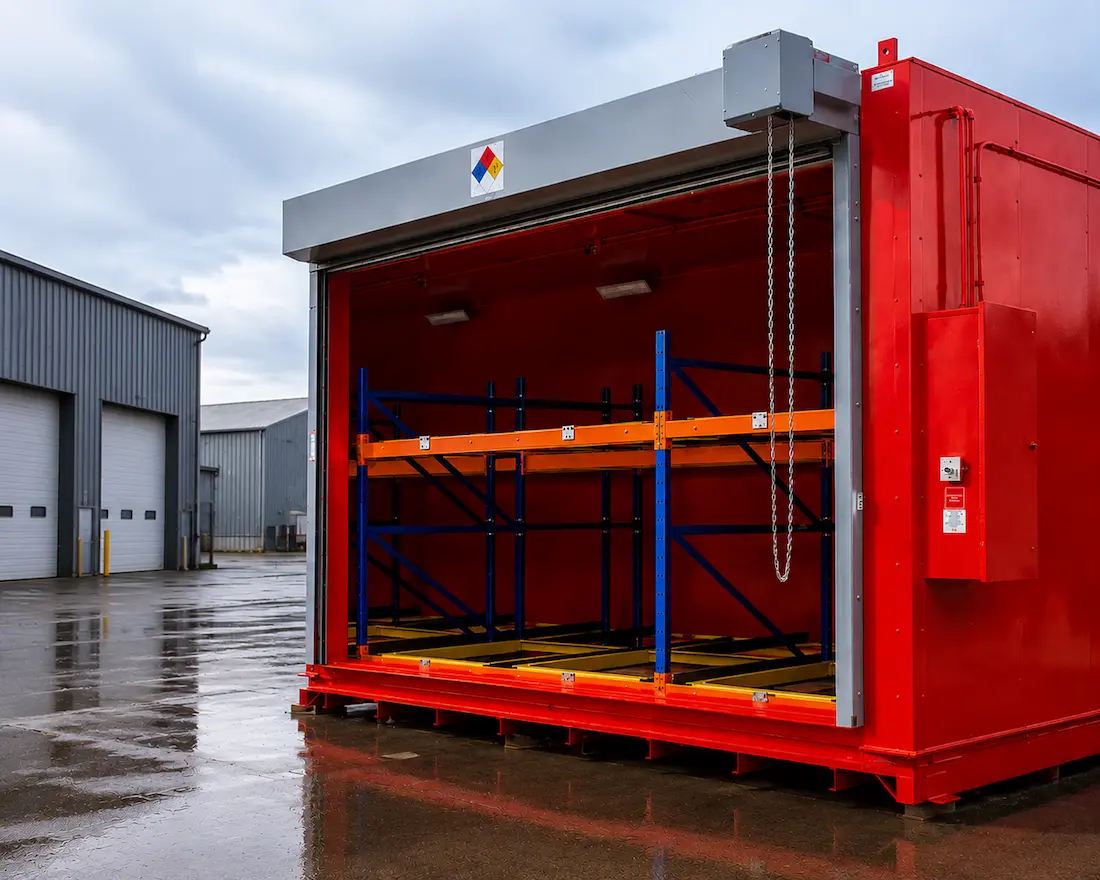
There is a threshold where adding another of your flammable storage cabinets stops solving the problem and starts creating one. When a Pittsburgh operation’s flammable inventory outgrows what cabinets can lawfully hold in a given area, the honest next step is an inside storage room or a dedicated building engineered for the quantity. Crowding more cabinets into a fire area to avoid that step is how facilities back into a violation.
The signals are visible before an inspector points them out: cabinets multiplying in one room, materials staged outside because they are full, and totals that no longer fit the local fire code. Our OSHA flammable storage solutions span that range, from compliant cabinets to engineered rooms and buildings, and the right choice depends on the inventory and the site, not on what is easiest to order.
Choosing well among flammable storage cabinets and larger options protects more than a compliance record. A properly sized approach keeps a fire contained to the storage area instead of reaching production or people, the outcome that satisfies an insurer and keeps one incident from taking an operation down. The cabinet was never the goal. Controlling the hazard was, and cabinets are one tool among several.
Documentation, Training, and Keeping Compliance Alive
Getting flammable storage cabinets into a Pittsburgh facility is only the first step. The real compliance work begins once the cabinets are filled, placed, labeled, inspected, and used by the team every day. OSHA capacity limits, local fire code expectations, SDS records, employee training, ventilation decisions, extinguisher access, and total inventory in the fire area all shape whether the setup still works after delivery.
US Hazmat Storage helps facilities look beyond the cabinet itself and review the storage plan around real quantities, liquid categories, site layout, and inspection expectations. Contact our team to walk through your flammable storage cabinets, inventory, and facility layout before ordering or adding more cabinets to an already crowded fire area.
FAQ
How much can one flammable storage cabinet hold under OSHA?
No more than 60 gallons of Category 1, 2, or 3 flammable liquids, or 120 gallons of Category 4, per cabinet, under 1910.106(d)(3).
Does Pennsylvania have its own OSHA program for private employers?
No. Federal OSHA covers private sector workers in Pennsylvania directly, enforced through its area office in Pittsburgh. There is no separate state plan for private employers.
Is there a three cabinet limit per room?
That limit comes from OSHA’s construction standard, 1926.152, not general industry 1910.106. Many local fire codes and NFPA 30 do cap quantities, so confirm with the Pittsburgh Fire Bureau.
Who enforces fire code for chemical storage in Pittsburgh?
The Pittsburgh Fire Bureau and Bureau of Building Inspection enforce fire and building codes locally, under Pennsylvania’s Uniform Construction Code and Allegheny County’s adopted codes.
Do flammable storage cabinets need to be vented?
OSHA does not require it, and improper venting can reduce fire performance. Whether and how to vent depends on the liquids and local requirements, so decide deliberately.
When should a facility move beyond cabinets?
When flammable inventory in a fire area exceeds what cabinets can lawfully hold, an inside storage room or dedicated building is the next step, not more cabinets.