
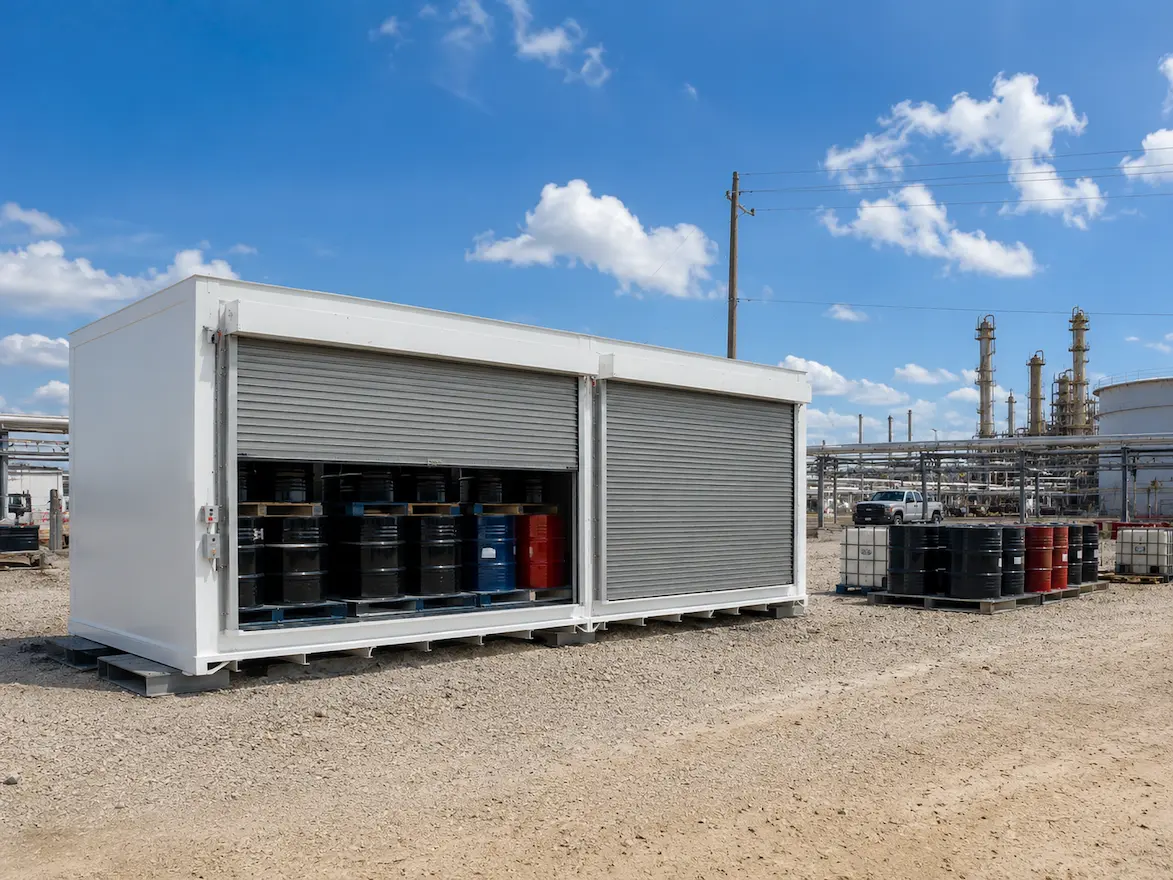
Drum storage near Houston rarely deals with simple storage conditions. A single site may handle lubricants, solvents, drilling additives, production chemicals, waste materials, cleaning agents, fuel-related products, and maintenance fluids in 55-gallon drums. When those drums are staged without the right containment, separation, access control, and engineering, a small leak can become a worker safety issue, an environmental concern, or a failed inspection.
That is why finding these storages is not only about buying a locker or placing drums in a convenient area. It is about matching the storage system to the chemicals, volumes, site layout, fire risk, spill response plan, and local operating conditions. In oil and gas, the storage area has to support both daily workflow and compliance discipline.
US Hazmat Storage helps industrial teams choose engineered 55-gallon drum storage solutions for higher-risk environments where durability, containment, ventilation, fire protection, and inspection readiness matter. For Houston-area oil and gas sites, the right system can reduce risk while keeping drums organized, accessible, and easier to manage.
Why Drum Storage Near Houston Requires a Heavier Compliance Lens
Houston’s oil and gas environment brings together refineries, service yards, pipeline operations, fabrication shops, chemical suppliers, drilling support companies, transportation hubs, and maintenance facilities. These operations often move fast, but drum storage cannot be treated as temporary clutter.
A compliant storage plan needs to account for:
- Chemical type and hazard class
- Total gallons stored on-site
- Whether materials are flammable, corrosive, reactive, toxic, or oily
- Drum condition and compatibility
- Indoor versus outdoor placement
- Proximity to ignition sources, traffic lanes, drains, and occupied structures
- Spill containment capacity
- Fire protection and emergency access
- Employee handling procedures
- Documentation, labeling, and Safety Data Sheet access
The search for drum storage near Houston should begin with those conditions, not just with available square footage. A drum storage unit that works for general maintenance oil may not be appropriate for flammable solvents, incompatible chemicals, or drums staged near active hot work.
For oil and gas companies, the goal is not only storage. The goal is a controlled system that protects people, limits spill exposure, and gives supervisors a clear structure for daily inspections.
The Core Standards That Shape Oil and Gas Drum Storage
Several compliance frameworks can affect how Houston-area oil and gas teams store drums. The exact requirements depend on the chemicals, quantities, site jurisdiction, building layout, and local fire code enforcement, but most storage decisions are shaped by OSHA, EPA, NFPA, and local authority review.
| Compliance Area | What It Influences | Why It Matters for Drum Storage |
| OSHA | Worker safety, flammable liquids, hazard communication, access, training | Helps reduce fire, exposure, handling, and workplace injury risks |
| EPA | Spill control, hazardous waste storage, container management, environmental protection | Helps prevent releases into soil, water, drains, and surrounding areas |
| NFPA 30 | Fire safety for flammable and combustible liquids | Guides storage design, separation, protection, and fire-rated decisions |
| Local fire authority | Permits, placement, inspections, local code interpretation | Determines what is acceptable for the specific site and jurisdiction |
| SDS requirements | Chemical classification, handling, PPE, incompatibilities | Drives storage separation, labeling, and emergency planning |
When comparing options for drum storage near Houston, oil and gas teams should avoid assuming one code covers everything. OSHA may address worker safety, EPA may focus on containment and environmental protection, NFPA may influence fire safety, and local officials may apply additional rules based on the facility.
A strong storage system is built to satisfy those requirements together, not one at a time.
Engineering Requirements for Heavy-Duty Drum Storage
Oil and gas drum storage needs to handle more than the weight of full 55-gallon drums. It must withstand daily industrial use, weather exposure, forklift activity, chemical risk, and long-term operational pressure.
A full 55-gallon drum can be heavy, difficult to move manually, and hazardous if damaged. Storage equipment should be selected with structural performance in mind.
Key engineering considerations include:
- Heavy-duty steel construction for industrial durability
- Chemical-resistant sump liners when required
- Secondary containment sized to the stored volume
- Forklift-accessible base or handling design
- Weather-resistant enclosure for outdoor placement
- Lockable access control
- Ventilation options for vapor management
- Fire-rated construction when storing flammable or combustible liquids
- Drum racks, shelves, or containment platforms suited to the workflow
- Clear interior layout for inspection and spill response
For high-volume oil and gas sites, 55-gallon drum storage should be planned around real movement patterns. Drums may arrive by truck, move by forklift, sit in staging areas, and then be transferred into active use. If the storage system does not support that flow, employees may start placing drums outside designated areas.
That is where compliance usually begins to weaken.
Containment Requirements: The Detail That Protects the Entire Site
Secondary containment is one of the most important parts of drum storage near Houston because oil and gas operations often store liquids that can create environmental, safety, and cleanup problems if released.
A good containment system should do more than catch a small drip. It should be designed to hold leaking liquids long enough for detection, response, and removal. For outdoor storage, the system may also need to account for rainwater or prevent accumulated precipitation from mixing with stored chemicals.
In practical terms, containment planning should answer these questions:
- What is the largest single drum volume?
- What is the total drum volume stored in the unit?
- Are the drums elevated above the containment sump?
- Can employees inspect the sump easily?
- Can spilled liquid be removed safely?
- Are incompatible liquids separated?
- Is the containment material compatible with the stored chemicals?
- Is the unit protected from vehicle impact and unauthorized access?
For oil and gas facilities, containment should never be treated as an accessory. It is the part of the system that protects floors, drains, soil, stormwater pathways, and nearby work areas from preventable releases.
Matching Drum Storage to Chemical Risk
Not every drum creates the same storage risk. A drum of motor oil, a drum of solvent, a drum of corrosive cleaner, and a drum of hazardous waste may all require different handling and separation decisions.
The table below gives a practical starting point.
| Material Type | Common Oil and Gas Use | Storage Priority |
| Lubricants and oils | Equipment maintenance, machinery support | Containment, labeling, spill control |
| Flammable solvents | Cleaning, degreasing, maintenance | Fire-rated storage, ventilation, ignition control |
| Corrosive chemicals | Cleaning, treatment, process support | Chemical compatibility, corrosion-resistant containment |
| Waste liquids | Maintenance waste, used chemicals, contaminated fluids | Container integrity, labeling, waste management procedures |
| Additives and specialty chemicals | Production or drilling support | SDS review, compatibility separation, controlled access |
This is why the best drum storage near Houston is not selected by volume alone. Two facilities may each store twenty drums, but one may need a fire-rated chemical storage building while the other may need corrosion-resistant containment and stricter waste labeling controls.
Before choosing a unit, teams should review the SDS for every stored material. The SDS will identify hazards, flash point, compatibility concerns, PPE needs, and emergency response information.
Indoor vs. Outdoor Drum Storage Near Houston
Houston-area facilities often choose outdoor drum storage because interior floor space is limited, operations are spread across yards, or chemicals need to be separated from occupied buildings. Outdoor storage can work well, but only when the unit is engineered for the conditions.
Outdoor drum storage near Houston should account for heat, humidity, rain, industrial traffic, and storm exposure. A basic shed or improvised enclosure is rarely appropriate for regulated chemicals because it may lack containment, ventilation, fire protection, structural strength, signage, and controlled access.
| Storage Location | Best Use Case | Key Concerns |
| Indoor cabinet | Smaller volumes, controlled indoor workflow | Quantity limits, ventilation, fire separation |
| Outdoor drum locker | Moderate drum volumes, yard-based operations | Weather protection, sump capacity, access control |
| Fire-rated storage building | Flammable or combustible drum storage | Fire rating, separation distances, local code approval |
| Custom chemical storage building | High-volume or mixed chemical operations | Engineering review, compatibility, ventilation, workflow |
For oil and gas companies that need safer capacity without sacrificing usable facility space, engineered outdoor storage can be a strong option. The system can keep drums away from production zones while still making them accessible for trained personnel.
Safety Protocols That Support Compliance
Even the best storage unit cannot carry the entire compliance program by itself. Oil and gas teams also need procedures that keep the system working every day.
A practical drum storage protocol should include:
- Receiving inspection for damaged, leaking, or unlabeled drums
- Verification that each drum matches the approved storage area
- Clear labels and hazard markings
- SDS access for all stored chemicals
- Compatibility checks before placing drums together
- Spill kit placement near the storage area
- PPE requirements for handling and transfer
- Grounding and bonding procedures when dispensing flammable liquids
- Forklift and traffic control around the storage unit
- Weekly visual inspections
- Written records for training, spills, and corrective actions
When companies search for drum storage near Houston, they should also ask how the unit will fit into these protocols. A storage building should make inspections easier, not harder. It should help employees understand where drums belong, how spills are contained, and who is allowed to access the materials.
Common Drum Storage Problems in Oil and Gas Facilities
Many storage issues start small. A drum is set beside a wall for convenience. A label fades. A sump is not checked after rain. A flammable liquid is stored near an electrical panel. A leaking drum is moved into a general storage area until someone “has time” to deal with it.
These shortcuts can turn into serious compliance issues.
Common problems include:
- Drums stored directly on bare ground
- Missing secondary containment
- Incompatible chemicals stored together
- Unlabeled or poorly labeled drums
- Damaged containers left in service
- Flammable liquids stored near ignition sources
- Blocked emergency access
- Spill kits too far from the storage area
- Outdoor storage exposed to rain without proper containment management
- No inspection log or training record
A well-designed system for drum storage near Houston helps reduce these issues by creating a dedicated, controlled space. That does not eliminate the need for training, but it gives employees a safer framework to follow.
What to Look for in a Heavy-Duty Drum Storage Solution
For high-volume drum storage, oil and gas teams should look beyond basic capacity. A unit that holds the right number of drums may still fail operationally if it does not support safety, movement, and compliance.
A strong storage solution should include:
- Capacity matched to current and near-future drum volume
- Secondary containment appropriate for the stored materials
- Durable construction for industrial environments
- Chemical compatibility with stored liquids
- Fire-rated options when required
- Ventilation when vapor control is needed
- Lockable doors for access control
- Clear signage areas
- Forklift-compatible handling
- Easy inspection access
- Flexible layouts for drums, pallets, or dispensing needs
The best drum storage near Houston should also support future growth. Oil and gas operations can change quickly, especially when contracts, maintenance schedules, or production demands shift. Choosing equipment with the right capacity and configuration from the start can prevent costly replacements later.
US Hazmat Storage provides engineered 55-gallon drum storage solutions built for regulated industrial environments. For Houston-area oil and gas teams, that means storage designed around containment, chemical risk, durability, and compliance support.
A Practical Pre-Purchase Checklist for Houston Oil and Gas Sites
Before choosing a storage unit, review the site conditions and materials carefully.
| Question | Why It Matters |
| How many 55-gallon drums are stored at peak volume? | Determines capacity and containment needs |
| Are any liquids flammable or combustible? | May trigger fire-rated storage, ventilation, and separation requirements |
| Are corrosives, oxidizers, or reactives involved? | Requires compatibility planning and separation |
| Will drums be stored indoors or outdoors? | Affects weather protection, placement, and inspection routines |
| Will employees dispense from drums inside the unit? | May require grounding, bonding, ventilation, and spill controls |
| Is the storage area near drains, traffic, or occupied structures? | Influences placement, barriers, and local code review |
| Who will inspect the unit and how often? | Supports documented compliance and maintenance |
| What does the local fire authority require? | Helps avoid permit or inspection delays |
This checklist should be reviewed before ordering equipment, not after delivery. It is easier to select the right storage system upfront than to modify a unit that does not meet site conditions.
Build Drum Storage That Can Stand Up to Houston Oil and Gas Demands
Finding drum storage near Houston is not only a purchasing decision. For oil and gas operations, it is a safety, compliance, and continuity decision. The right 55-gallon drum storage system can help control spills, reduce fire risk, organize hazardous materials, support inspections, and give employees a safer way to manage daily chemical handling.
A strong storage plan starts with the actual materials on-site, then works outward into containment, construction, ventilation, fire protection, access control, and documentation. That approach helps companies avoid one-size-fits-all equipment and build a system that fits the real risk profile of the operation.
US Hazmat Storage supports industrial teams with engineered 55-gallon drum storage solutions designed for hazardous material storage, oil and gas operations, and compliance-focused environments. If your Houston-area facility needs stronger containment, safer organization, or a better system for high-volume drums, review the 55-gallon drum storage options and choose a solution built for the way your site actually works.
FAQ
What is the best drum storage near Houston for oil and gas sites?
The best option depends on chemical type, drum volume, fire risk, containment needs, and whether storage is indoor or outdoor.
Do 55-gallon drums need secondary containment?
Yes, regulated liquid drums often need secondary containment to help control leaks, spills, and accumulated liquids before they spread.
Can oil and gas drums be stored outside?
Yes, but outdoor storage should use engineered units with containment, weather protection, access control, and code-appropriate placement.
When is fire-rated drum storage required?
Fire-rated storage may be needed when drums contain flammable or combustible liquids, especially near buildings, people, or ignition sources.
What should be checked before buying drum storage?
Review SDS data, total gallons, chemical compatibility, containment volume, site layout, fire code needs, and inspection procedures.
Does US Hazmat Storage offer 55-gallon drum storage solutions?
Yes. US Hazmat Storage provides engineered 55-gallon drum storage solutions for industrial and hazardous material storage applications.