
A steel door does not automatically qualify as door security steel. That distinction seems obvious until you are looking at a product catalog where a standard commercial hollow metal door and a reinforced security-grade assembly appear side by side at different price points, and the specification decision that separates them is not always explained.
The gap matters in practice. A standard steel door installed on a chemical storage building satisfies the material requirement but may fall short on gauge, latching integrity, or hinge reinforcement when the actual threat profile, whether wind-borne debris, forced entry, or fire exposure, exceeds what a commercial-grade door was designed to resist.
US Hazmat Storage builds storage solutions and shelter configurations where the door assembly is specified to match both the code requirement and the operational risk, not just the lowest line item that fits the budget. Getting that specification right starts with understanding what door security steel actually means across its different applications.
What Makes a Steel Door a Security Door
Door security steel is not a single product category with a uniform definition in the regulatory or construction standards world. It is a descriptor that applies to steel door assemblies where the construction, hardware, and installation are intentionally configured to provide performance beyond the baseline commercial specification.
The Steel Door Institute defines four construction levels in ANSI/SDI A250.8, from Level 1 standard-duty through Level 4 maximum-duty, with steel gauge increasing from 20-gauge face sheets at Level 1 to 14-gauge at Level 4. A door security steel specification typically starts at Level 3 or Level 4, where the face sheet gauge and core construction provide meaningful resistance to physical stress, whether that stress comes from a 100-mph debris projectile, a prying tool, or a sustained forced-entry attempt.
The hardware on a security-grade steel door is as important as the door itself. A 14-gauge steel door with a single-point latch is not as secure as it appears, because a single latch bolt provides one engagement point that can be defeated by concentrated lateral force. Multi-point latching systems engage the door frame at three or more contact points simultaneously, distributing the force required to defeat the closure across the entire frame perimeter.
This is the latching approach that NFPA 30 requires for flammable liquid storage cabinets, that ICC 500 requires for community storm shelter doors, and that physical security standards recommend for high-value storage applications. The specification and the regulatory compliance requirement converge at the multi-point latch.
Hinge reinforcement is the third element that distinguishes a security-grade door assembly from a standard commercial installation. Standard hinges attach the door leaf to the frame at three points along the hinge side. A determined forced-entry attempt targets the hinge side when the latch side is adequately secured, applying leverage to separate the door from the frame without defeating the latch at all.
Continuous hinges, which run the full height of the door leaf, or heavy-duty security hinges with non-removable pins, eliminate this attack vector. Both are standard specifications for door security steel in high-value or high-risk applications.
The Storm Shelter Application: ICC 500 and FEMA P-361 Requirements
A steel safe room door is one of the most demanding applications for door security steel because it must simultaneously perform as a physical barrier against wind-borne debris and as a reliable emergency access point that occupants can open and close quickly under stress. ICC 500-2020 Chapter 5 sets the performance criteria for storm shelter door assemblies: the door must pass the same debris impact test as the shelter walls, which means resisting penetration by a 15-pound 2×4 timber projectile traveling at 100 mph. That test is not about the door gauge alone.
FEMA P-361 guidance on above-ground safe rooms recommends continuously welded steel construction for shelter doors and frames, with the door and frame tested and specified as a single assembly rather than as independent components.
A reinforced door assembly specification for a community storm shelter or a steel safe room that sources the door and frame separately, without confirming that the assembled unit meets the debris impact criteria as a complete system, introduces a performance uncertainty that the debris test is designed to eliminate.
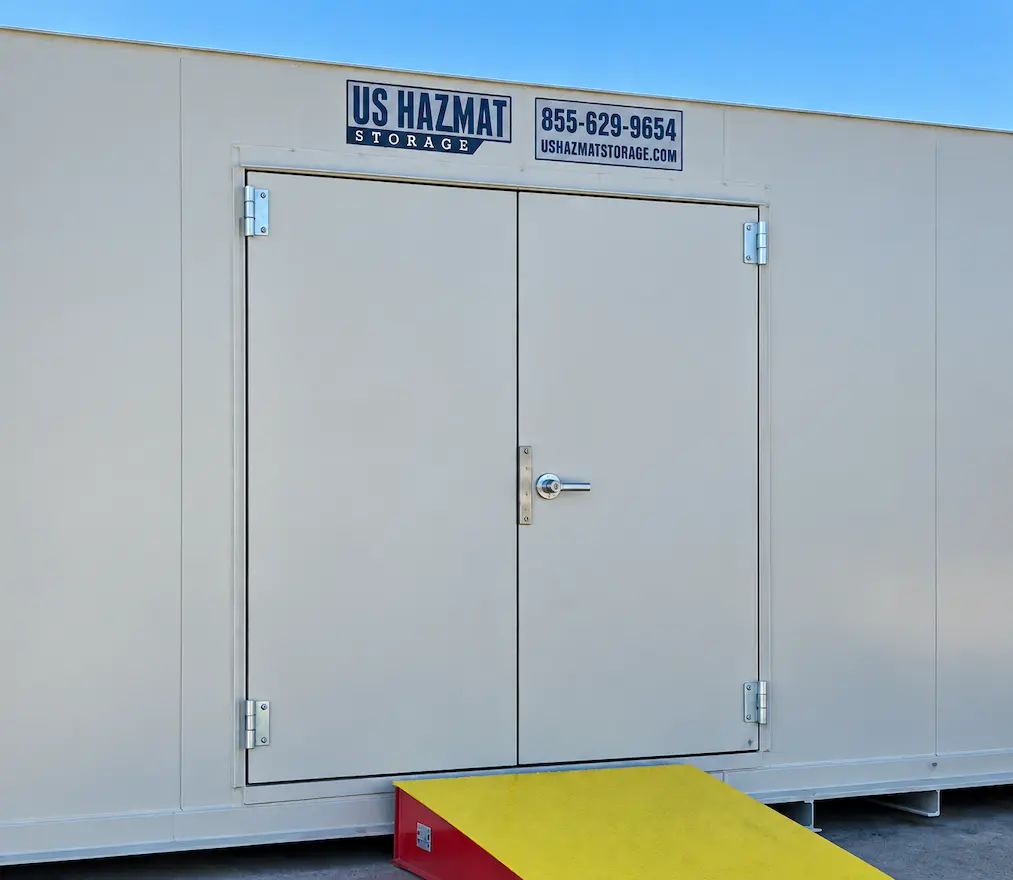
Double steel entrance doors at community shelter facilities serve both an egress function and a security function. A wider opening allows faster loading of large groups during an event, and the paired configuration supports the access time requirements that FEMA P-361 recommends for community shelter installations.
For door security steel in a double-door shelter configuration, the inactive leaf must be flush-bolted at both the top and the bottom of the frame, not only at the top, to eliminate the leverage gap that a single flush bolt creates at the unbolted end.
The Industrial Storage Application: NFPA 30 and Physical Security
For industrial chemical storage buildings, hazmat lockers, and flammable liquid storage cabinets, door security steel serves a dual function that the applicable standards do not always address explicitly in combination.
NFPA 30 Section 9.5.3.1 requires that the door of a listed flammable liquid storage cabinet be self-closing with a positive latch, constructed of steel, and contributing to the cabinet’s fire-resistive rating as demonstrated through a UL 1275 listing or FM Approval. That requirement defines the fire compliance dimension of the door.
The physical security dimension is governed by the site’s risk profile, not by a fire code. Industrial facilities storing chemical precursors, high-value solvents, controlled substances, or materials that represent a theft or diversion risk face a different threat from the fire scenario that NFPA 30 addresses.
A security-grade door specification for those applications adds gauge, multi-point latching, and hinge reinforcement beyond the NFPA 30 minimum because the fire code minimum is not designed to resist a prying tool or a bolt cutter. A door security steel assembly on an industrial storage cabinet satisfies the fire compliance requirement of NFPA 30 while also providing the physical barrier that the facility’s risk assessment identifies as necessary.
For stainless steel cabinet applications in pharmaceutical manufacturing, food processing, and cleanroom environments, door security steel takes on a third dimension: corrosion resistance. A security-grade door in a washdown environment must resist both physical attack and the chemical exposure from the cleaning agents, acids, and sanitizers that these environments use routinely.
Stainless steel construction with security hardware rated for corrosive environments provides the compliance, security, and durability performance that a standard carbon steel security door does not maintain over time in these settings.
Gauge Selection: The Construction Decision That Drives Every Other Specification
Steel gauge is the starting point of any security door specification, because gauge determines the door’s inherent resistance to physical stress and its contribution to fire-resistive performance. Gauge numbers run counterintuitively: lower numbers mean thicker steel. A 14-gauge steel door face is approximately 0.075 inches thick.
A 20-gauge face is approximately 0.036 inches thick, roughly half the material. The difference in resistance to prying, impact, and thermal transfer between these gauges is not a matter of degree. It is a difference in the category of threat the door can resist.
For chemical storage and industrial security applications, 16-gauge is the practical minimum for a door security steel specification, and 14-gauge is appropriate where high-frequency impact exposure, elevated physical security requirements, or heavy-duty operational conditions apply.
For storm shelter and safe room applications, the gauge is determined by the debris impact test results for the complete assembly: no minimum gauge is specified by ICC 500 independent of test performance, but the 100-mph debris test requirement drives practical specifications toward 10-gauge or 12-gauge for the shelter door construction.
Core construction affects thermal performance and sound attenuation alongside structural rigidity. A steel-stiffened core provides the highest structural rigidity for security applications. A mineral core provides fire resistance appropriate for rated fire door assemblies.
A polyurethane foam core provides thermal insulation for applications where temperature control is a factor. Selecting the core type as part of the specification, rather than accepting the manufacturer’s default, is how the door performs correctly across all requirements simultaneously.
Frame Integrity: The Variable That Most Specifications Underestimate
A security-grade door without a frame matched to the door’s security specification is an incomplete installation. A 14-gauge steel door in a standard 16-gauge knockdown frame with insufficient anchor points provides less security than the door’s own construction suggests, because the frame is the structural anchor for the latch, the hinges, and the door’s resistance to inward or outward forced entry.
Welded frames arrive at the job site as a pre-assembled unit, with all frame components welded into a rigid structure before installation. Knockdown frames suit standard commercial applications where installation flexibility outweighs the rigidity difference; for shelter and high-security industrial applications, the welded frame is the correct choice.
For door security steel applications, the welded frame provides superior rigidity and eliminates the potential for frame component separation under forced-entry stress.
Frame anchoring ties the entire door security steel assembly to the surrounding structure. For storm shelter applications, the frame anchor schedule must satisfy ICC 500’s structural requirements for the shelter as a whole, which means the anchor points and their load capacity are part of the engineered shelter design, not field decisions.
For industrial storage applications, the anchor schedule must account for the seismic requirements of the applicable building code and the mechanical loads from the door’s operating frequency and closure force. An under-anchored frame degrades the door security steel assembly’s performance over time regardless of the door’s own construction quality.
Ventilation, Sealing, and the Secondary Functions Door Security Steel Must Serve
A door security steel specification for chemical storage and shelter applications must address secondary functions alongside the primary structural performance. For flammable liquid storage cabinets and buildings under NFPA 30, the door must not allow vapor to accumulate inside the enclosure to concentrations within the flammable range.
Ventilation provisions at the door perimeter, where passive ventilation relies on the gap between door edge and frame, must balance vapor management with the sealing requirements that fire resistance and weather protection impose.
For storm shelter applications, the door seal must prevent wind-driven rain from entering the shelter interior during the peak event. An installation that meets the ICC 500 debris impact criteria but allows water infiltration through a degraded perimeter seal leaves occupants in a wet environment during a potentially extended shelter period.
Intumescent seals, which expand during fire exposure and also provide a degree of weather sealing in shelter applications, should be specified to address both the fire exposure and wind-driven rain scenarios.
For temperature-controlled enclosures, the door assembly’s thermal break between core and frame perimeter must be specified explicitly. A thermally conductive frame creates a condensation point and thermal loss that undermines the enclosure’s temperature management, particularly in cold storage and climate-controlled chemical storage applications.
Getting the Full Specification Right Before Ordering
A complete door security steel specification addressing gauge, core, hardware, frame, anchoring, and sealing requirements produces a door assembly that performs correctly across the full range of conditions it will face.
A specification that addresses only the fire code minimum or only the physical security requirement produces a door that satisfies one performance dimension while leaving others unaddressed, and those gaps appear during inspections, post-event assessments, or the first serious forced-entry attempt.
US Hazmat Storage works with facility managers, EHS professionals, and shelter project teams working through door assembly specifications for chemical storage, secure industrial enclosures, and community shelter installations.
If your facility or project needs a door security steel specification that aligns with the applicable code requirements and the site’s actual risk profile, contact US Hazmat Storage and get a custom proposal for your facility. Any final door security steel specification should be reviewed by a qualified fire protection engineer, your AHJ, and where storm shelter or ICC 500 applications are involved, a licensed structural engineer before any installation commitment is made.
FAQ
What is door security steel and how does it differ from a standard steel door?
Door security steel refers to steel door assemblies with enhanced gauge, multi-point latching, and hinge reinforcement that go beyond the commercial baseline. Standard steel doors meet the material requirement for many applications but may not provide the structural or physical security performance that high-risk or code-critical installations require.
What gauge steel is appropriate for a security door on a chemical storage building?
16-gauge is the practical minimum for chemical storage and industrial security applications. 14-gauge is appropriate for high-frequency impact exposure or elevated physical security requirements. Storm shelter doors are typically specified at 10- or 12-gauge based on ICC 500 debris impact test performance.
Does NFPA 30 require a security-grade door on flammable liquid storage cabinets?
NFPA 30 requires a self-closing steel door with a positive latch and a fire-resistive rating demonstrated through UL 1275 listing or FM Approval. Physical security features beyond the NFPA 30 minimum are site-specific decisions based on the facility’s risk profile, not a code mandate.
What ICC 500 requirements apply to storm shelter doors?
ICC 500-2020 Chapter 5 requires that shelter doors meet the same debris impact test as the shelter walls: resistance to a 15-pound 2×4 projectile at 100 mph. The door must be tested as a complete assembly with the frame and hardware, not as an independent component.
Why must a double steel entrance door have flush bolts at both top and bottom?
Flush-bolting the inactive leaf only at the top creates a leverage gap at the unbolted lower end. A forced-entry attempt can exploit that gap to pry the inactive leaf open, defeating the security of the entire door pair. Flush bolts at both top and bottom eliminate this vulnerability.
Does door security steel apply to stainless steel cabinet applications?
Yes. Pharmaceutical, food processing, and cleanroom chemical storage applications require stainless steel construction to resist corrosion and meet washdown standards. A security-grade door on a stainless steel cabinet must also be rated for the corrosive environment, using appropriate hardware materials and seals.
What frame specification should accompany a door security steel installation?
The frame gauge should equal or exceed the door gauge, and welded frames are preferred over knockdown frames for security applications. The frame anchor schedule must satisfy the building code’s seismic requirements and the mechanical loads from the door’s operating conditions.
What sealing provisions are required for door security steel in shelter applications?
Storm shelter door seals must prevent wind-driven rain infiltration during the peak event. Intumescent seals that expand during fire exposure also provide weather sealing in shelter applications. The seal specification should address both fire exposure and wind-driven rain scenarios as simultaneous performance requirements.