
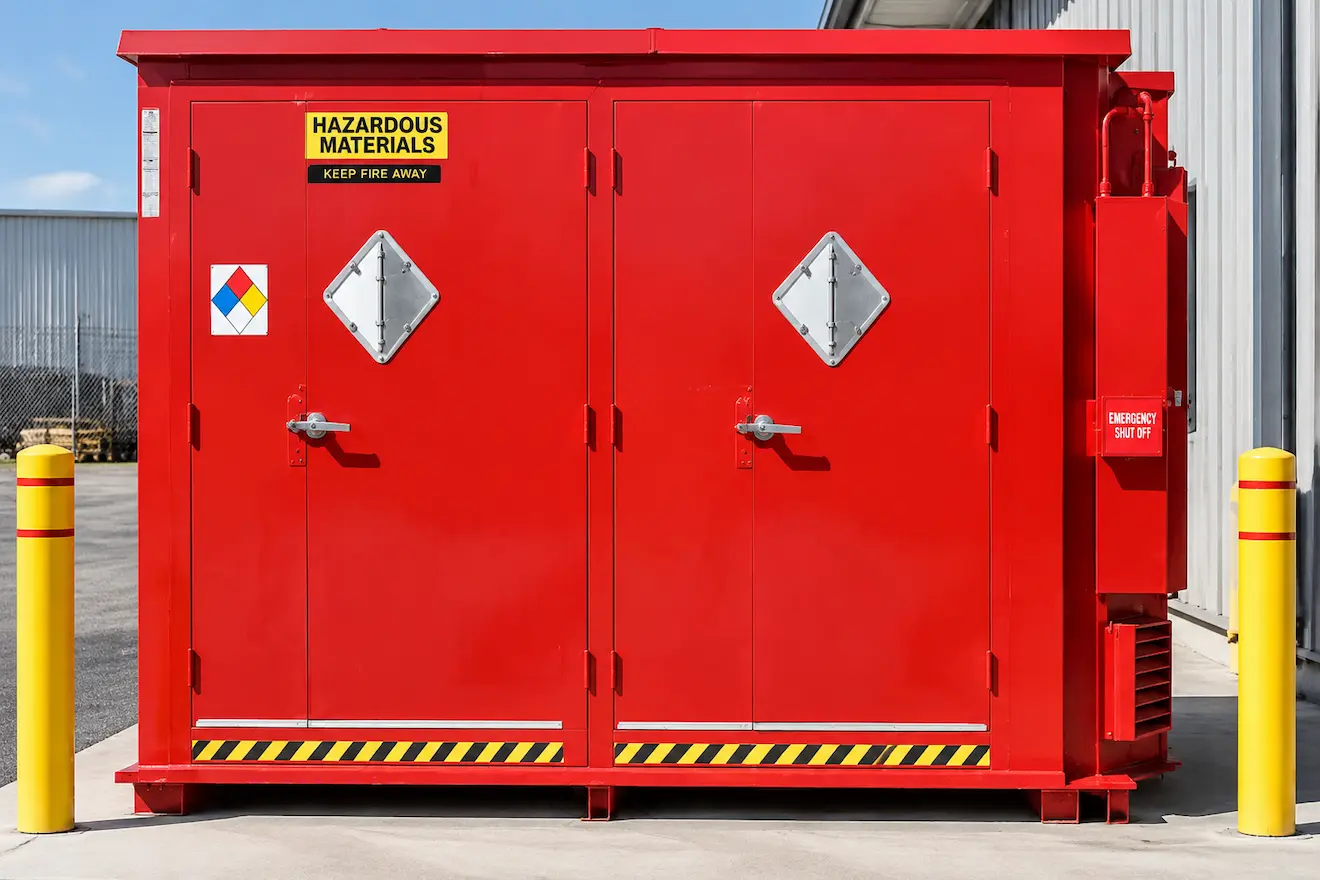
An industrial storage cabinet in Los Angeles is not just a metal box with a latch. It is a structure subject to Cal/OSHA Title 8, the California Fire Code as adopted by the Los Angeles Fire Department, and a seismic anchoring requirement that does not exist at the same level anywhere else in the country.
Los Angeles runs on industrial activity that most visitors never see. Behind the logistics hubs of Carson and Compton, the food processing corridors of Vernon and Commerce, the aerospace operations near El Segundo, and the construction push reshaping everything from downtown to the Port, there are thousands of facilities storing flammable liquids, corrosives, and regulated chemicals that must be kept in compliant containers.
US Hazmat Storage works with EHS managers and facility leads across the LA basin, and what we see most consistently is that buyers who treat the storage cabinet as a compliance system, not a commodity purchase, are the ones who avoid the enforcement findings, the insurance complications, and the post-earthquake chemical release scenarios that their counterparts face.
What Cal/OSHA Requires and Why It Differs From Federal OSHA
California operates under Cal/OSHA, the state-plan OSHA program enforced by the Division of Occupational Safety and Health. Cal/OSHA covers all employers in California, public and private, and is authorized to set requirements that exceed the federal OSHA baseline.
For industrial storage cabinet selection in Los Angeles, the governing Cal/OSHA provision is Title 8 CCR Section 5189, which adopts NFPA 30 as the applicable standard for flammable and combustible liquid storage and applies it to cabinet construction, quantity limits, and ventilation requirements. An LA facility that believes federal OSHA compliance is sufficient has misread its regulatory exposure.
NFPA 30 Section 9.5.3.1 sets the construction requirements that a flammable liquid storage cabinet must meet to qualify as compliant: double-walled steel construction with an air space between walls, a raised sill or recessed bottom to contain spills, self-closing doors with a positive latch, and a fire-resistive rating demonstrated through either a UL listing under UL 1275 or FM Approval under FM 6050. Both ratings are accepted under Cal/OSHA and the California Fire Code.
What matters for an industrial storage cabinet Los Angeles facilities specify is not which rating mark appears on the label, but whether the cabinet’s construction delivers the thermal performance that rating represents.
Quantity limits under NFPA 30 and Cal/OSHA vary by liquid class, storage room type, and the presence or absence of sprinkler protection. A 45 gallon flammable storage cabinet is the most common configuration in LA’s commercial and industrial sector precisely because it fits within the quantity limits for most Type I and Type II storage areas without triggering the requirement for additional fire suppression upgrades.
The LAFD Layer: Permits, BEP Requirements, and Local Enforcement
The Los Angeles Fire Department adds a local compliance dimension that operates independently of Cal/OSHA. The LAFD enforces the Los Angeles Fire Code, which adopts the California Fire Code with LA-specific amendments, and issues Hazardous Materials Storage Permits for facilities storing regulated materials above threshold quantities.
For an industrial storage cabinet in Los Angeles that holds flammable liquids, the LAFD permit process requires documentation of the cabinet’s construction rating, the quantities stored, the material classification, and the storage location’s compliance with setback and ventilation requirements.
Facilities that store regulated hazardous materials above specific thresholds in LA are also required to maintain a Business Emergency Plan, a document that describes the materials on-site, their storage locations, the quantities, and the emergency response procedures. The BEP must be submitted to the LAFD and updated annually or whenever a material change in stored quantities or locations occurs.
An industrial storage cabinet in Los Angeles added to a facility without a BEP update and a corresponding permit modification is an unauthorized storage change regardless of the cabinet’s own compliance status. LAFD inspectors cross-reference permitted quantities against field observations, and the discrepancy between a BEP and an actual inventory is a citation trigger.
The LAFD and Cal/OSHA can both inspect the same facility on separate schedules, and a finding by one agency does not preclude a separate citation from the other for the same condition. LA facilities that maintain two separate compliance tracks, one for the LAFD’s fire and hazmat permit requirements and one for Cal/OSHA’s worker safety provisions, are the ones that close multi-agency inspection visits without findings.
Seismic Anchoring: The Los Angeles Variable That Most Buyers Miss
Los Angeles sits in one of the highest seismic hazard zones in the United States. Most of the LA basin falls within Seismic Design Category D or E under the California Building Code, and the requirement to anchor freestanding equipment, including industrial storage cabinets in Los Angeles, to resist seismic forces is a CBC Section 1613 obligation that applies to commercial and industrial facilities throughout the city.
A flammable liquid storage cabinet that tips over during a seismic event releases its contents onto a surface where ignition sources may be present, and the post-earthquake fire scenario that follows is precisely the failure mode that the anchoring requirement is designed to prevent.
Cal/OSHA Title 8 CCR Section 3290 addresses the bracing and anchoring of stored materials in industrial settings, and LAFD inspectors routinely check cabinet anchoring as part of hazardous materials storage permit reviews. An industrial storage cabinet Los Angeles facilities must address this requirement specifically, not as a general best practice, because both the regulatory and the physical risk profiles are more acute here than in non-seismic markets.
A cabinet that is correctly listed, correctly sized, and correctly placed but unanchored in an LA industrial facility is an incomplete installation.
The anchoring specification for any industrial storage cabinet Los Angeles buyers install depends on the cabinet’s weight when fully loaded, the type of floor structure it sits on, and the seismic design parameters for the specific address. Concrete slab anchoring uses different hardware than a raised wood-frame floor, and both differ from steel-framed mezzanine installations.
A licensed structural engineer or a contractor familiar with CBC Section 1613 requirements should review the anchoring plan for any storage cabinet installation in the LA area, particularly in the older industrial buildings of Vernon, Commerce, and the downtown industrial corridor where floor conditions vary significantly.
Cabinet Selection: 45-Gallon, Stainless Steel, and Application-Specific Options
The 45 gallon flammable storage cabinet is the workhorse configuration across LA’s industrial market. Its capacity fits within NFPA 30 quantity limits for most single-cabinet installations in unsprinklered Los Angeles industrial spaces, it is available with UL 1275 or FM listings in standard and heavy-duty configurations, and its footprint fits the space constraints of the older industrial buildings that dominate the Vernon-Commerce industrial corridor.
A stainless steel storage cabinet is the appropriate specification for LA facilities in the pharmaceutical, biotech, and food processing sectors where standard carbon steel construction creates contamination or corrosion concerns.
The pharma and biotech corridor stretching from El Segundo through the South Bay, and the food processing concentration in Vernon and Commerce, both include operations where cabinet surface compatibility with washdown protocols, cleaning agents, and sterile environment requirements is as important as the NFPA 30 construction rating.
A stainless steel storage cabinet carries the same Cal/OSHA and LAFD compliance obligations as its carbon steel counterpart; the material selection is a durability and sanitation decision, not a compliance one. LA’s construction boom, which spans the SoFi Stadium area, the LAX modernization, Metro expansion projects, and a sustained run of commercial development, has increased the demand for specialized storage across jobsites in the basin.
A fall protection storage cabinet, used to store harnesses, lanyards, and anchoring equipment required under Cal/OSHA Title 8 CCR Section 1670, is a familiar element on Los Angeles industrial storage cabinet sites where Cal/OSHA actively enforces fall protection compliance. While distinct from a flammable liquid storage cabinet in its regulatory basis, it represents the same principle: a purpose-built enclosure that keeps regulated safety equipment organized, protected, and accessible in a compliant configuration.
Door Security Steel: Why Cabinet Door Specification Matters in LA
The security of the cabinet door is a specification element that LA buyers are increasingly treating as a compliance consideration rather than simply a hardware preference.
Facilities in the Vernon, Commerce, and South LA industrial corridors have experienced break-ins targeting stored chemicals that serve as precursor materials for illicit manufacturing, and an industrial storage cabinet in Los Angeles with a standard single-point latch provides a meaningfully lower barrier than one equipped with a steel security door featuring reinforced construction and multi-point latching.
A steel security door on an industrial storage cabinet combines the compliance function of the self-closing, positive-latching requirement under NFPA 30 with an enhanced physical barrier that a standard commercial latch does not provide. The reinforced steel construction resists prying, the multi-point latch engages the frame at multiple contact points rather than a single latch bolt, and the door’s overall weight and construction make forced entry substantially more difficult.
For LA facilities storing controlled substance precursors, high-value solvents, or materials that represent a theft or misuse risk, the door security steel specification is a risk management investment that goes beyond the fire code minimum.
This is not a requirement that Cal/OSHA or the LAFD mandates explicitly, but it is one that insurance underwriters for LA industrial facilities increasingly ask about, and one that facility security assessments for operations in mixed-use industrial zones typically recommend. Specifying an industrial storage cabinet Los Angeles facilities equip with door security steel from the outset costs less than retrofitting a security cage or secondary locking mechanism after a break-in has occurred.
Our OSHA flammable storage compliance resources address the full cabinet specification framework that governs LA facilities, from the NFPA 30 construction requirements to the Cal/OSHA quantity limits that determine how many cabinets a space can hold.
Permits, Inspections, and Getting the Installation Right
An industrial storage cabinet installation in Los Angeles that is correctly rated, correctly sized, correctly anchored, and included in a current LAFD Business Emergency Plan is a compliant installation that holds up through a Cal/OSHA inspection, an LAFD permit review, and a post-earthquake safety assessment. One that was selected by catalog number, placed without a permit review, and left unanchored is an enforcement finding waiting to be documented by either agency.
The LADBS building permit process applies to permanent installations where a cabinet is anchored to a floor or wall structure in a way that constitutes a structural modification. For portable or freestanding cabinets, the building permit requirement may not apply, but the LAFD hazmat storage permit and BEP update requirements apply regardless of how the cabinet is secured. Engaging both LADBS and LAFD early, rather than at the inspection stage, is how Los Angeles industrial storage cabinet installations reach compliance without the redesign cycle.
US Hazmat Storage serves industrial and commercial facilities throughout the Los Angeles basin, including the industrial corridors of Vernon, Commerce, Carson, and El Segundo, with storage cabinet solutions specified for the Cal/OSHA, LAFD, and seismic anchoring requirements that define this market.
If your facility is evaluating an industrial storage cabinet for Los Angeles and needs a proposal that reflects the full compliance picture, contact US Hazmat Storage to start your quote request. Any final installation should be reviewed by a qualified EHS professional, the LAFD Fire Prevention Division, and where seismic anchoring applies, a licensed structural engineer before any commitment is made.
FAQ
What Cal/OSHA standard governs industrial storage cabinet selection in Los Angeles?
Cal/OSHA Title 8 CCR Section 5189 adopts NFPA 30 as the applicable standard for flammable and combustible liquid storage in California. It requires UL 1275-listed or FM-approved cabinet construction for flammable liquid storage and sets quantity limits by liquid class and storage room type.
Does a new industrial storage cabinet in Los Angeles require an LAFD permit?
Yes, if the cabinet stores regulated hazardous materials above LAFD threshold quantities. The permit application requires documentation of cabinet construction rating, quantities stored, material classification, and storage location compliance. The facility’s Business Emergency Plan must also be updated to reflect the new storage.
Why is seismic anchoring required for storage cabinets in LA?
Most of the LA basin falls within Seismic Design Category D or E under the California Building Code. CBC Section 1613 and Cal/OSHA Title 8 CCR Section 3290 require that freestanding equipment, including storage cabinets, be anchored to resist seismic forces. An unanchored cabinet that overturns during a seismic event can release flammable chemicals near ignition sources.
What size flammable storage cabinet is most common for LA industrial facilities?
The 45 gallon flammable storage cabinet is the most widely specified size in LA’s commercial and industrial sector. It fits within NFPA 30 quantity limits for most Type I and Type II storage areas without triggering additional fire suppression requirements.
When is a stainless steel storage cabinet appropriate for an LA facility?
A stainless steel storage cabinet is the right choice for pharmaceutical, biotech, and food processing facilities where carbon steel construction creates corrosion or contamination concerns. It carries the same Cal/OSHA and LAFD compliance requirements as standard steel cabinets; the material choice addresses durability and sanitation, not compliance status.
What is door security steel and why does it matter for LA industrial storage cabinets?
Door security steel refers to reinforced steel cabinet doors with multi-point latching that resists prying and forced entry. In LA’s industrial corridors, where break-ins targeting chemical precursors have occurred, a cabinet with door security steel provides a meaningfully stronger physical barrier than a standard single-point latch while still satisfying NFPA 30’s self-closing and positive-latching requirements.
Can a fall protection storage cabinet be stored near a flammable liquid cabinet in LA?
Yes, provided the two cabinets are segregated appropriately and the combined storage arrangement satisfies the fire area quantity limits under NFPA 30 and Cal/OSHA. Fall protection storage cabinets storing non-hazardous PPE do not contribute to the flammable liquid quantity calculation.
What is an LAFD Business Emergency Plan and when is it required?
A Business Emergency Plan is a document describing hazardous materials stored at a facility, their locations, quantities, and emergency response procedures. LA facilities storing regulated hazardous materials above LAFD threshold quantities must submit and maintain a current BEP. Any change to stored quantities or locations, including adding a new storage cabinet, requires a BEP update.