
The request comes in often enough to have a pattern. A facility needs to store chemicals outside the main building, someone searches for outdoor lockers, and the first results are gym lockers and school furniture. The buyer finds their way to industrial storage products eventually, but the next gap opens almost immediately.
Not all weatherproof steel enclosures marketed for industrial storage are compliant chemical storage solutions. Some are built for tool storage or equipment security. Some lack the secondary containment, ventilation, or listing that OSHA, EPA, and NFPA require when regulated materials go inside.
The difference between a storage enclosure and a compliant chemical locker is not always visible in a product photograph, and it is never visible on a price sheet. US Hazmat Storage works with EHS managers and facility leads trying to close that gap correctly, before a regulated material enters the enclosure rather than after the first inspection.
What Outdoor Lockers Are in the Industrial Context
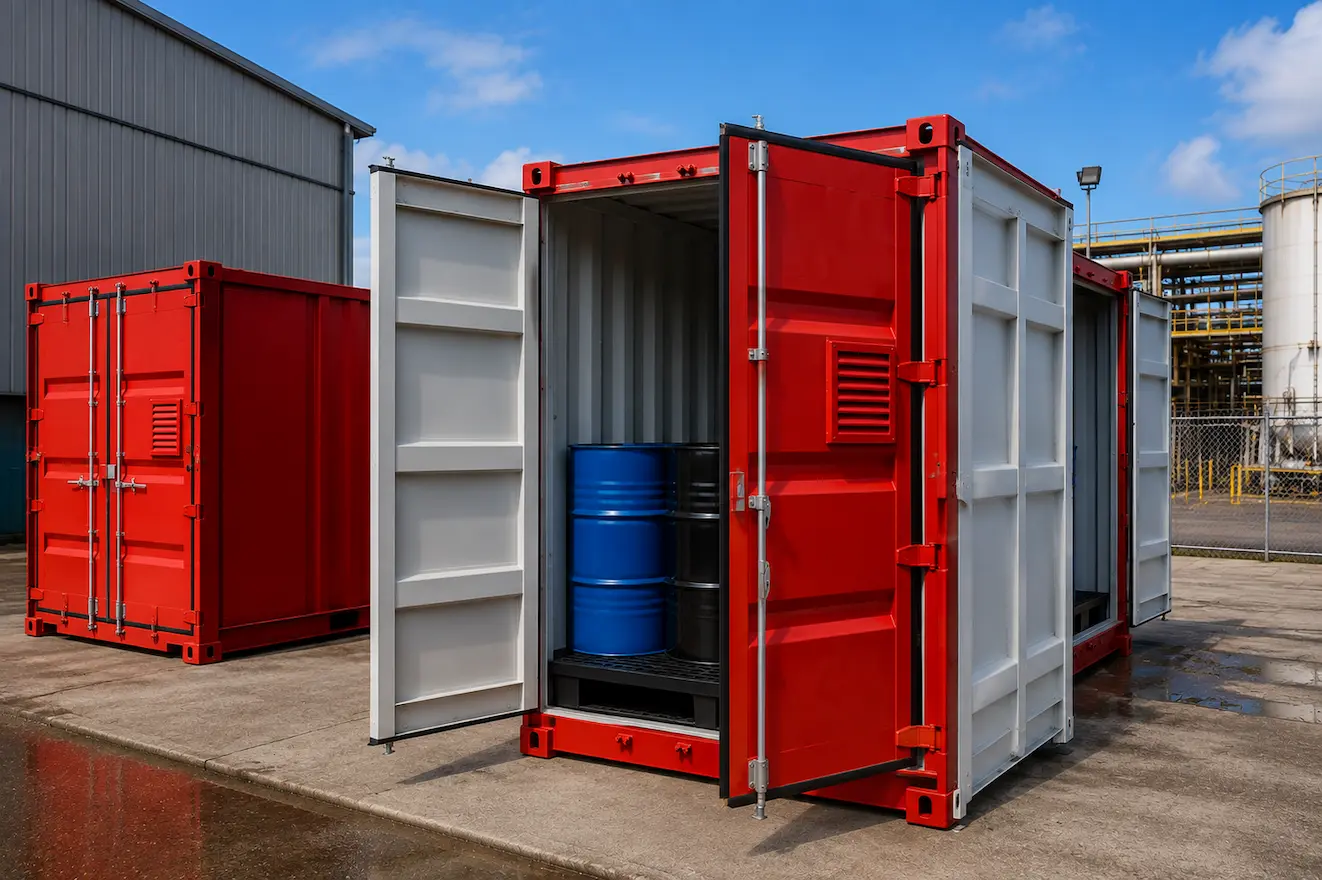
In industrial and commercial settings, outdoor lockers are weatherproof steel enclosures designed to store materials, equipment, or chemicals at or near the point of use, outside a permanent building. The category is broad. We stock flammable liquid storage cabinets with canopy roofs, corrosive storage enclosures with poly liners and containment sumps, general-purpose weatherproof storage for tools and PPE, and heavy-duty chemical storage buildings.
All of these types of outdoor chemical storage enclosures are typically exposed; they must perform in sun, rain, temperature extremes, and wind without compromising the safety of the contents or the surrounding area.
A locker that stores only hand tools and personal protective equipment (PPE) is subject to no hazardous material storage regulations other than those that require the storage to be secure and protected from the weather. A chemical storage locker that contains flammable liquids at quantities above the small quantity permittee established by OSHA 29 CFR 1910.106 must be constructed and listed to NFPA 30 standards, ventilated to prevent vapor accumulation, and sited at code-required distances from ignition sources and building openings.
A unit storing oil-based materials above the threshold quantities in EPA 40 CFR Part 112 must be part of a documented SPCC plan with secondary containment sized for the largest single container. The outdoor exposure does not reduce these requirements. In several respects it intensifies them.
Material Classification: Where Every Specification Starts
Every outdoor locker specification for chemical storage begins with the regulatory classification of what will be stored. OSHA 1910.106 defines four classes of flammable and combustible liquids by flash point, and each class carries different storage quantity limits, container requirements, and cabinet construction specifications.
A Class IA liquid like diethyl ether and a Class IIIB liquid like a heavy fuel oil both go in steel containers, but they require very different storage enclosures. Applying the same locker specification to both materials is a compliance error that an inspector familiar with the flash point classification system will identify on sight.
NFPA 400, the Hazardous Materials Code, covers a wide array of hazardous materials such as oxidizers, corrosives, compressed gases, and water-reactive materials that are not classified as flammable liquids. A chemical locker storing sulfuric acid for example is not covered primarily by NFPA 30.
It is governed by NFPA 400, which requires material compatibility between the stored substance and the locker construction, ventilation to prevent acid vapor accumulation, and separation from incompatible materials. Applying a flammable liquid locker specification to a corrosive storage application produces a mismatch that NFPA 400-trained inspectors find routinely.
The Safety Data Sheet for each stored material provides the classification data that drives the specification. Flash point, vapor density, reactivity group, DOT hazard class, and incompatibility notes in Section 7 are the inputs. Running the SDS review before evaluating enclosure options eliminates the step where a buyer selects an outdoor locker, receives the material, and discovers the construction is incompatible with what it is supposed to contain.
Construction and Listing Requirements
A chemical locker used for flammable liquid storage must meet the construction requirements of NFPA 30 Section 9.5.3.1: double-walled steel construction with an air space between the inner and outer walls, a raised sill or recessed bottom to contain spills, a self-closing door, and a fire-resistive rating demonstrated through a UL listing under UL 1275 or FM Approval under FM 6050. These requirements exist because the outdoor locker for flammable liquid storage functions as a small fire-rated storage structure, not just a weatherproof box.
The listing mark matters beyond the regulatory checkbox it provides. A UL 1275-listed outdoor storage unit has been independently tested to confirm that its construction limits internal temperature rise to not more than 325 degrees Fahrenheit during a 10-minute fire exposure. An unlisted enclosure with similar physical appearance has made no such performance commitment.
For chemical storage solutions involving corrosives, oxidizers, or materials incompatible with standard steel construction, the listing requirement shifts from UL 1275 to the applicable NFPA 400 provisions, which may require poly-lined interiors, stainless steel construction, or separate compartments for incompatible materials. A general-purpose enclosure without these features is not a compliant chemical storage solution for those materials regardless of its weatherproofing quality.
Secondary Containment and EPA Obligations
Any outdoor locker used to store regulated hazardous substances above EPA threshold quantities must include secondary containment sized to hold the volume of the largest single container in the enclosure. For oil and oil-equivalent materials subject to the SPCC rule under 40 CFR Part 112, the containment volume must also account for precipitation, which for an outdoor installation means either an enclosed sump that prevents rainwater entry or an open sump sized to hold the spill volume plus the volume of a 25-year storm event for the location.
Secondary containment for outdoor lockers can be integral to the unit or separate. Some configurations include a built-in sump as part of the locker’s floor construction. Others use a containment pallet or berm beneath a portable unit. Both approaches can satisfy EPA requirements when the sump material is chemically compatible with the stored substance, the volume calculation accounts for all containers in the locker, and the drainage provisions do not allow a release to reach a storm system without passing through appropriate secondary containment.
An enclosure that is correctly listed and constructed but sited on a concrete pad with an unprotected floor drain connecting to a storm sewer is a regulatory exposure regardless of the locker’s own listing status. OSHA inspectors and EPA auditors both review secondary containment as part of outdoor chemical storage compliance evaluations, and the siting conditions around the locker are part of what they assess.
Ventilation for Vapor and Corrosive Control
Outdoor lockers storing flammable or volatile materials require ventilation provisions that prevent vapor accumulation inside the enclosure from reaching concentrations within the flammable range. NFPA 30 permits outdoor chemical storage units to use passive ventilation through screened openings at the top and bottom of the enclosure, relying on ambient air movement for dilution. This approach works when the locker is sited where air can circulate freely and when the stored material’s vapor density and quantity do not exceed the passive dilution capacity.
Materials with vapor density greater than one, which includes most common industrial solvents, produce vapors that settle toward the lower vents and can accumulate if circulation is restricted. For these materials, a chemical locker with forced-air ventilation connected to an exhaust fan rated for the hazardous location classification provides more reliable vapor management. All electrical components inside a forced-air ventilated outdoor locker must be rated for Class I, Division 1 or Division 2 hazardous locations under NFPA 70.
For corrosive outdoor lockers, ventilation removes acid or caustic vapors that would otherwise corrode structural components and create inhalation exposure risk for personnel opening the unit. Corrosive vapor ventilation must terminate where the exhaust does not create a secondary exposure hazard for nearby personnel or equipment.
Siting, Setbacks, and AHJ Permit Requirements
Placing an outdoor locker at a facility is not simply choosing a convenient location near the point of use. NFPA 30 sets minimum separation distances between outdoor flammable liquid storage and building openings, property lines, and ignition sources, varying by the quantity and classification of the stored material. The local AHJ may require additional setback distances based on local fire code amendments or site-specific conditions.
Many jurisdictions require a building or zoning permit for an outdoor storage structure, even when it is prefabricated and portable. The permit requirement is typically triggered by the size of the structure, the materials being stored, or both. For units used as chemical storage solutions at permitted industrial facilities, the addition of a new outdoor storage unit may also require modification of the facility’s operating permit, hazardous materials business plan, or SPCC plan if the stored quantity changes the facility’s regulatory status.
On oilfield sites where modular housing units for oilfield operations establish the site infrastructure, outdoor lockers serve as the primary compliant chemical storage solution for drilling chemicals, production chemicals, and utility materials that cannot be stored safely inside living or working modules.
The applicable regulations at remote oil and gas sites include both OSHA 1910.106 and the state oil and gas regulatory authority’s requirements, which vary significantly across Texas, Colorado, California, and North Dakota. Confirming the applicable state regulatory framework before specifying outdoor lockers for a remote oilfield application prevents the situation where a locker that passes federal OSHA review fails a state inspection.
Temperature, Weather, and Outdoor Exposure Factors
Chemical outdoor lockers face conditions that indoor cabinets do not, and some of those conditions directly affect the safety of the stored material. A locker in direct sun in a high-temperature climate can reach internal temperatures 30 to 50 degrees above the ambient air temperature. For materials with low flash points, that temperature increase meaningfully raises vapor pressure inside the enclosure and increases the rate at which vapor accumulates near the lower vents.
Insulated outdoor lockers, which incorporate a thermal insulation layer between the inner and outer walls, moderate interior temperature and reduce thermal gain from sun exposure. For facilities in warm climates or locations where the locker is in direct sun for extended periods, an insulated chemical locker is the more defensible specification for volatile materials. The insulation does not change the fire rating, but it reduces vapor concentration inside the unit and slows degradation of temperature-sensitive materials.
UV exposure affects the exterior finish and gasket materials of outdoor lockers over time. A powder-coat finish not rated for extended UV exposure degrades within two to three years in direct sun, which accelerates corrosion of the steel substrate. Stainless steel or galvanized construction eliminates this concern for applications where finish longevity is a primary factor.
Our chemical storage solutions cover the range of outdoor locker configurations that serve industrial chemical storage requirements, from listed flammable liquid chemical lockers with integral containment sumps to weatherproof general-purpose units for non-regulated materials. The specifications are matched to the regulatory framework, not just the physical dimensions, and the selection process starts with the stored material, not with the enclosure.
Getting to the Right Chemical Storage Solution
A facility that works through the SDS review, regulatory classification, listing requirements, and siting analysis before placing an order avoids the corrective action cycle that begins when a regulated material enters an uncompliant enclosure. That cycle involves a citation, an order to remove the stored material, a replacement product order, and an installation restart, at a cost that consistently exceeds what the specification process would have required.
If your operation is evaluating outdoor lockers for a chemical storage application and wants input before committing to a product, contact US Hazmat Storage and compare options with a free consultation. Any final outdoor locker configuration should be reviewed by a qualified EHS professional, your AHJ, and where SPCC or RCRA obligations apply, an environmental compliance specialist before any commitment is made.
FAQ
What makes an outdoor locker different from an indoor flammable liquid safety cabinet?
An outdoor locker is designed to withstand weather exposure including rain, UV, and temperature extremes while maintaining compliance with NFPA 30 or NFPA 400 construction requirements. Indoor cabinets are not weatherproofed and do not include the roof, drainage, and corrosion-resistant finish provisions required for outdoor installation.
Do outdoor lockers require secondary containment?
Yes, when they store regulated hazardous substances above EPA threshold quantities. The secondary containment must hold the volume of the largest single container and account for precipitation in outdoor installations per 40 CFR Part 112 and EPA secondary containment guidance.
What NFPA standard governs outdoor lockers storing flammable liquids?
NFPA 30, Flammable and Combustible Liquids Code, Section 9.5.3.1 governs outdoor flammable liquid storage units. The construction must be listed under UL 1275 or FM Approved under FM 6050 to satisfy NFPA 30’s requirements for fire-resistive outdoor storage structures.
Do outdoor lockers need ventilation?
When storing flammable or volatile materials, yes. NFPA 30 permits passive ventilation through screened top and bottom vents for outdoor installations. When passive ventilation is insufficient for the vapor density and quantity of stored material, forced-air ventilation with Class I-rated electrical components is required.
Can outdoor lockers be used on oilfield sites without a permanent building?
Yes. On remote oilfield sites where modular housing units for oilfield operations provide site infrastructure, outdoor lockers are the standard compliant chemical storage solution for drilling and production chemicals. Both federal OSHA 1910.106 and the applicable state oil and gas regulatory authority’s requirements govern these installations.
How close can outdoor lockers be placed to a building or property line?
NFPA 30 sets minimum separation distances based on the quantity and classification of stored material. The local AHJ may require additional setback distances. Confirm the separation requirements with your AHJ before siting the unit, not after it is delivered.
When does an outdoor locker installation require a permit?
In most jurisdictions, when the structure exceeds a size threshold, stores regulated materials, or changes the facility’s hazardous materials inventory above permit trigger levels. Contact your local building and safety or fire prevention office before placing a permanent or semi-permanent outdoor storage unit.
What is the difference between an outdoor locker and a chemical storage solution building?
An outdoor locker is typically a single-unit enclosure sized for one to several drums or containers. A chemical storage solution building is a larger prefabricated structure that functions as a small storage room with full compliance provisions for multiple storage categories, larger quantities, and multiple occupancy points. The applicable OSHA and NFPA standards are the same; the scale and infrastructure differ.