
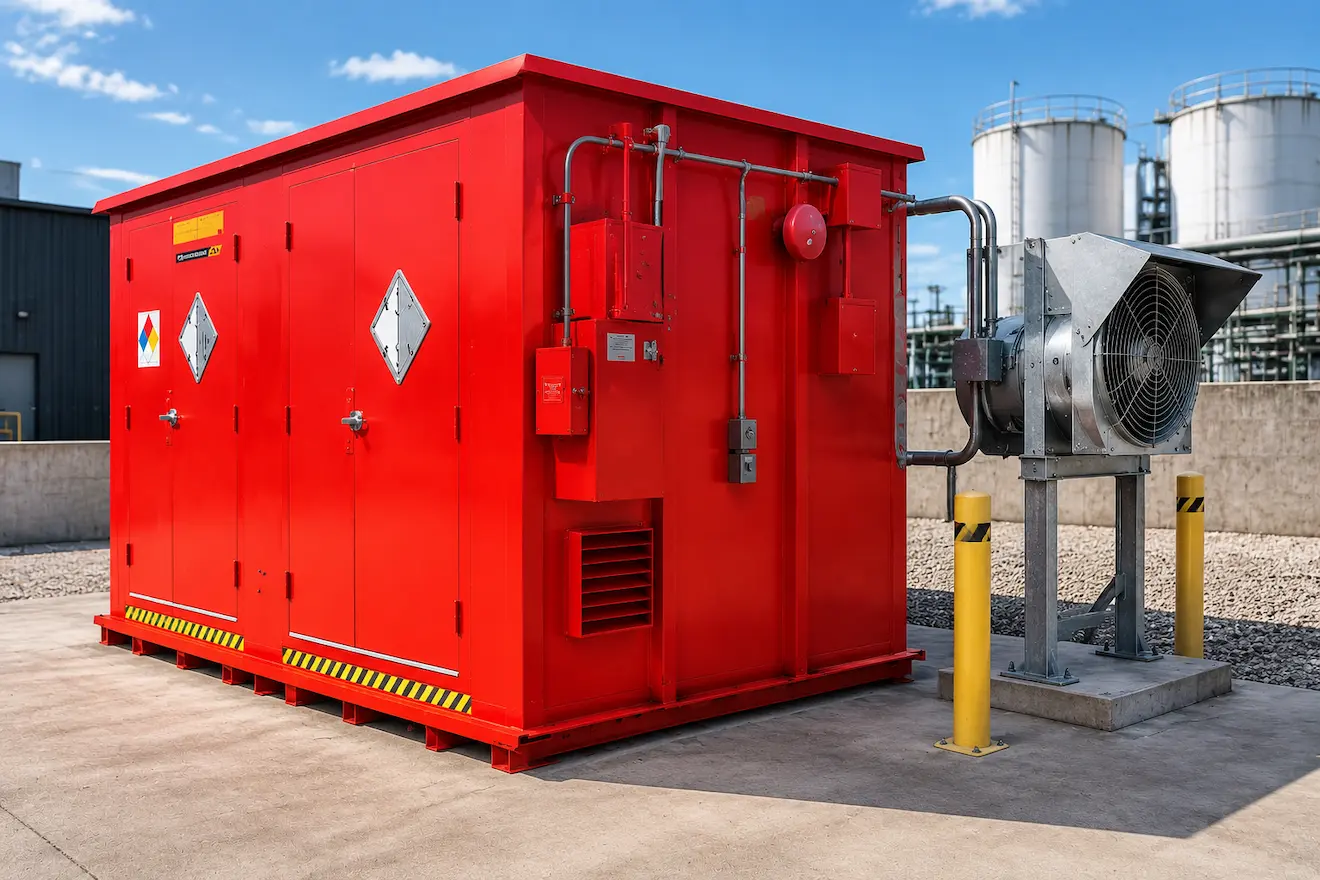
Hazardous location exhaust fans are not simply powerful ventilation units. They are rated electrical assemblies, specified to match the classification of the area they serve, and they require a power supply infrastructure, a ductwork termination, and a maintenance program that all carry the same classified-area requirements the fan itself does. A facility installs a ventilation fan in a flammable liquid storage room and calls it compliant. The fan moves air. The motor has a standard enclosure.
The wiring runs through conduit that terminates without a seal fitting at the classified area boundary. Six months later, an OSHA inspector or an insurance engineer walks through and finds the installation. None of those components are rated for the hazardous location they are operating in, and every one of them is a potential ignition source in the vapor environment the fan was installed to manage.
US Hazmat Storage works with EHS managers and facility teams who are building compliant ventilation systems for chemical storage buildings, flammable liquid rooms, and hazmat storage areas, and the gap between a standard exhaust fan and a compliant hazardous location installation is where most ventilation citations originate.
The NEC Classification System: What the Fan Actually Has to Be Rated For
NFPA 70, the National Electrical Code, defines the hazardous location classification that determines what electrical equipment, including hazardous location exhaust fans, can legally operate in a given area. Class I locations contain flammable gases or vapors. Class II locations contain combustible dust. Class III locations contain ignitable fibers.
Each class is further divided by the frequency of the hazardous condition: Division 1 locations are those where the flammable material is present under normal operating conditions, and Division 2 locations are those where it is present only under abnormal conditions, such as during equipment failure or accidental release.
For most chemical storage buildings and flammable liquid storage rooms, the classification is Class I, Division 1 or Division 2. A room where flammable liquids are dispensed or where drums are routinely opened is typically Class I, Division 1 near the vapor source and Division 2 in the surrounding area.
The boundary between the two divisions, and the extent of each classified area, must be documented in a site-specific area classification drawing prepared by a qualified electrical engineer. Fans specified without a current area classification drawing are being selected for an assumed location category, not a verified one, and the assumption frequently understates the actual classification.
The alternative Zone classification system, defined in NFPA 70 Article 505 and based on IEC standards, provides Zone 0, Zone 1, and Zone 2 designations that roughly correspond to Division 1 and Division 2 with finer distinctions. Some internationally sourced equipment carries ATEX ratings rather than UL listings, and while ATEX-rated equipment can be accepted by some AHJs, the default standard in U.S. installations is NEC Class/Division with UL or FM listing.
Fan Construction: What “Explosion-Proof” Actually Means
The term “explosion-proof” as applied to hazardous location exhaust fans refers specifically to the motor and electrical enclosure, not to the fan blade, housing, or ductwork. An explosion-proof motor is constructed so that any internal arc or ignition is contained within the motor enclosure and cannot propagate to the surrounding atmosphere.
The enclosure does not prevent sparks from occurring inside the motor. It prevents those sparks from reaching the vapor in the surrounding classified area. This distinction matters because a fan with an explosion-proof motor and a non-sparking aluminum or plastic blade assembly is a different specification from one with an explosion-proof motor and a steel blade that can generate a spark on contact with the housing.
UL 674 covers electric motors for use in Division 2 hazardous locations. UL 705 covers power ventilators. UL 1836 provides the outline of investigation for fans and blowers specifically listed for hazardous locations. A fan that carries a UL listing should specify which standard it was tested under and for which Class and Division.
The housing material and blade material complete the explosion-proof specification. Cast iron, aluminum, and fiberglass are all used for hazardous location fan housings, each with different chemical compatibility and corrosion resistance profiles. For chemical storage environments where the exhaust stream carries acidic vapors or aggressive solvents, the housing material must be compatible with the chemical being vented, not just rated for the electrical classification.
A fan housing that corrodes in contact with the exhaust vapor compromises the structural integrity of the unit and may produce metal particles that become ignition sources in the classified area.
CFM Sizing: NFPA 30 Requirements and the Calculation That Actually Governs
NFPA 30 Section 9.4.2.3 sets the ventilation requirements for indoor flammable liquid storage areas that use mechanical ventilation. The standard requires a minimum of one cubic foot per minute of exhaust per square foot of floor area, but not less than 150 cubic feet per minute total. It also requires a minimum of six air changes per hour. For a given room, the design airflow rate is the greater of the floor-area-based calculation and the air-change-based calculation.
Static pressure is the calculation variable that most ventilation specifications underestimate. The fan’s airflow output is rated under a specific static pressure condition, and ductwork length, fittings, screen guards, and the exhaust termination louver all add static pressure resistance that reduces the fan’s effective delivery.
A fan rated at 300 cfm in free air may deliver 220 cfm at the static pressure produced by the ductwork in a given installation. Selecting these units requires specifying them at the static pressure of the actual installation, not at the free-air rating on the product data sheet.
Exhaust placement within the classified area is the third sizing variable NFPA 30 addresses. Flammable liquid vapors are denser than air and accumulate at floor level. The exhaust inlet must be positioned at or near floor level to capture vapors before they reach concentrations within the flammable range.
A ceiling-mounted exhaust fan in a flammable liquid storage room moves air efficiently but draws from the upper portion of the space, leaving the vapor-dense floor zone largely unvented. This is a common installation error that produces a technically operating ventilation system with minimal effectiveness in the zone where the vapor actually accumulates.
Hazardous Location Power Supply: The Infrastructure the Fan Requires
Hazardous location exhaust fans cannot be powered by standard residential or commercial wiring methods in a classified area. NFPA 70 Article 501 governs wiring methods for Class I locations and requires rigid metal conduit, intermediate metal conduit, or Type MI cable for most Class I, Division 1 applications. Flexible connections are permitted under specific conditions at the motor terminal, but the primary supply wiring must meet the Article 501 requirements throughout the classified area.
Seal fittings are required at every point where conduit crosses the boundary of a classified area, and at specific locations within the classified area where the conduit could provide a path for vapor migration to a non-classified space. NFPA 70 Article 501 specifies the locations and types of seals required, and an installation without properly placed and filled conduit seals is a violation regardless of the fan’s own rating.
The hazardous location power supply for a ventilation system is not just the fan’s motor disconnect and circuit breaker. It is the entire wiring path from the panelboard to the motor terminal, including every fitting, seal, junction box, and conduit run that lies within or crosses the classified area boundary.
Equipment grounding for hazardous location exhaust fans is a mandatory element of the power supply specification. Static charge accumulation during high-velocity airflow in ductwork is a real ignition risk in classified areas, and the fan housing, motor frame, and ductwork must all be bonded to the facility ground. NFPA 77, Recommended Practice on Static Electricity, provides guidance on grounding and bonding for hazardous area ventilation systems, and its provisions should be part of the electrical design specification alongside the NEC Article 501 wiring requirements.
Secondary Containers, Dispensing Operations, and Ventilation Load
What components are required on secondary containers for flammable liquids is a question that connects directly to ventilation system sizing. A secondary container, defined under OSHA 29 CFR 1910.1200 and 1910.106 as a portable container used for transferring or dispensing a flammable liquid from its original container, must be an approved container with a self-closing lid, a label identifying the contents, and a construction material compatible with the stored substance.
Dispensing operations from secondary containers represent the highest vapor generation event in a flammable liquid storage room under normal conditions. NFPA 30 Section 5.3.4 addresses ventilation during dispensing, and the cfm requirement during active dispensing may exceed the baseline storage room ventilation rate because the open container surface area and liquid agitation during transfer both accelerate evaporation.
Hazardous location exhaust fans sized only to the storage room baseline rate, without accounting for the increased vapor load during dispensing operations, produce a ventilation system that is technically compliant at rest and practically inadequate during the highest-risk operational moments.
A review of the secondary container requirements alongside the ventilation design is part of the comprehensive approach to chemical storage compliance that our OSHA hazardous chemical storage resources address in detail, covering the storage room construction, containment, labeling, and ventilation requirements that govern flammable liquid handling from receipt through disposal.
Hazardous Location Exhaust Fans: Emergency Integration and Exhaust Termination
Hazardous location exhaust fans are part of the facility’s emergency response infrastructure as much as they are a ventilation component. During a chemical release event, the fan’s primary function shifts from routine vapor management to emergency dilution, pulling the vapor concentration in the classified area below the lower flammable limit as quickly as the airflow rate allows.
American emergency products used at hazmat facilities, including emergency eyewash stations, spill containment equipment, and emergency shutoffs, are positioned and specified in relation to the hazard they address. Exhaust fans must be positioned and terminated so that they work with, not against, those emergency response elements.
The exhaust termination point receives less attention in most ventilation specifications than the fan and ductwork, but it is where the hazardous vapor is released to the atmosphere, and its location carries both safety and regulatory implications.
NFPA 30 requires that exhaust from flammable liquid storage areas terminate at least five feet from any building opening, property line, or ignition source, and that it discharge away from areas where people congregate or where the vapor could re-enter the building. A termination point that discharges toward an emergency assembly area, an HVAC air intake, or an occupied outdoor space creates a secondary exposure problem that the ventilation system was installed to prevent.
Getting the Full System Right Before Installation
An installation that addresses the NEC area classification, the UL or FM listing for the specific Class and Division, the NFPA 30 cfm sizing at actual static pressure, the classified-area wiring and sealing requirements of NEC Article 501, the exhaust placement at floor level, and the termination point away from building openings and ignition sources is a compliant hazardous location exhaust fans installation. One that addresses only some of those elements produces a partial installation that performs inconsistently and generates citations in the elements it missed.
US Hazmat Storage supports EHS teams and facility managers working through ventilation specifications for chemical storage buildings and flammable liquid storage rooms. If your operation is evaluating hazardous location exhaust fans and wants to confirm the classification, sizing, and power supply requirements before committing to a product, contact US Hazmat Storage and get a custom proposal for your facility. Any final installation should be reviewed by a qualified electrical engineer, your AHJ, and a fire protection professional familiar with NFPA 30 and NEC Article 501 before any installation commitment is made.
FAQ
What makes an exhaust fan rated for a hazardous location exhaust fans?
Hazardous location exhaust fans have a motor and electrical enclosure listed for the specific NEC Class and Division of the area it serves, non-sparking blade and housing materials, and compatible power supply infrastructure including classified-area wiring and conduit seals.
What is the difference between Class I Division 1 and Division 2 for exhaust fans?
Division 1 locations contain flammable vapors or gases under normal operating conditions. Division 2 locations contain them only during abnormal conditions. Fans rated for Division 1 meet a higher standard and can be used in Division 2 areas, but the reverse is not permitted.
What cfm does NFPA 30 require for a flammable liquid storage room?
NFPA 30 Section 9.4.2.3 requires at least one cfm per square foot of floor area, not less than 150 cfm total, and at minimum six air changes per hour. The governing airflow rate is the greater of the floor-area calculation and the air-change calculation for the specific room dimensions.
Why must exhaust fans in flammable storage areas pull from floor level?
Flammable liquid vapors are denser than air and accumulate near the floor. A floor-level exhaust inlet captures vapors before they reach ignition concentrations. A ceiling-mounted fan moves air but leaves the vapor-dense floor zone unvented, which undermines the purpose of the ventilation system.
What wiring is required for hazardous location exhaust fans under NEC?
NFPA 70 Article 501 requires rigid metal conduit, intermediate metal conduit, or Type MI cable in Class I, Division 1 areas. Conduit seal fittings are required at classified area boundaries. Standard NM cable or open wiring is not permitted in classified locations.
How do secondary container dispensing operations affect fan sizing?
Opening secondary containers for dispensing generates a localized vapor release that can exceed the baseline storage room ventilation rate. NFPA 30 Section 5.3.4 addresses dispensing-time ventilation, and fans sized only to the storage room baseline may be inadequate during the highest-vapor-generation moments of normal operations.
What are the exhaust termination requirements for hazardous location ventilation?
NFPA 30 requires that exhaust from flammable liquid storage areas terminate at least five feet from building openings, property lines, and ignition sources, and discharge away from occupied areas and HVAC air intakes. Improper termination creates a secondary exposure hazard in the area the ventilation system is designed to protect.
Is an ATEX-rated fan acceptable in U.S. hazardous location installations?
ATEX ratings are European certifications. The U.S. standard is NEC Class/Division with UL or FM listing. Some AHJs accept ATEX equipment under specific conditions, but this must be confirmed with your local AHJ before specifying an ATEX-rated fan for a U.S. installation.