
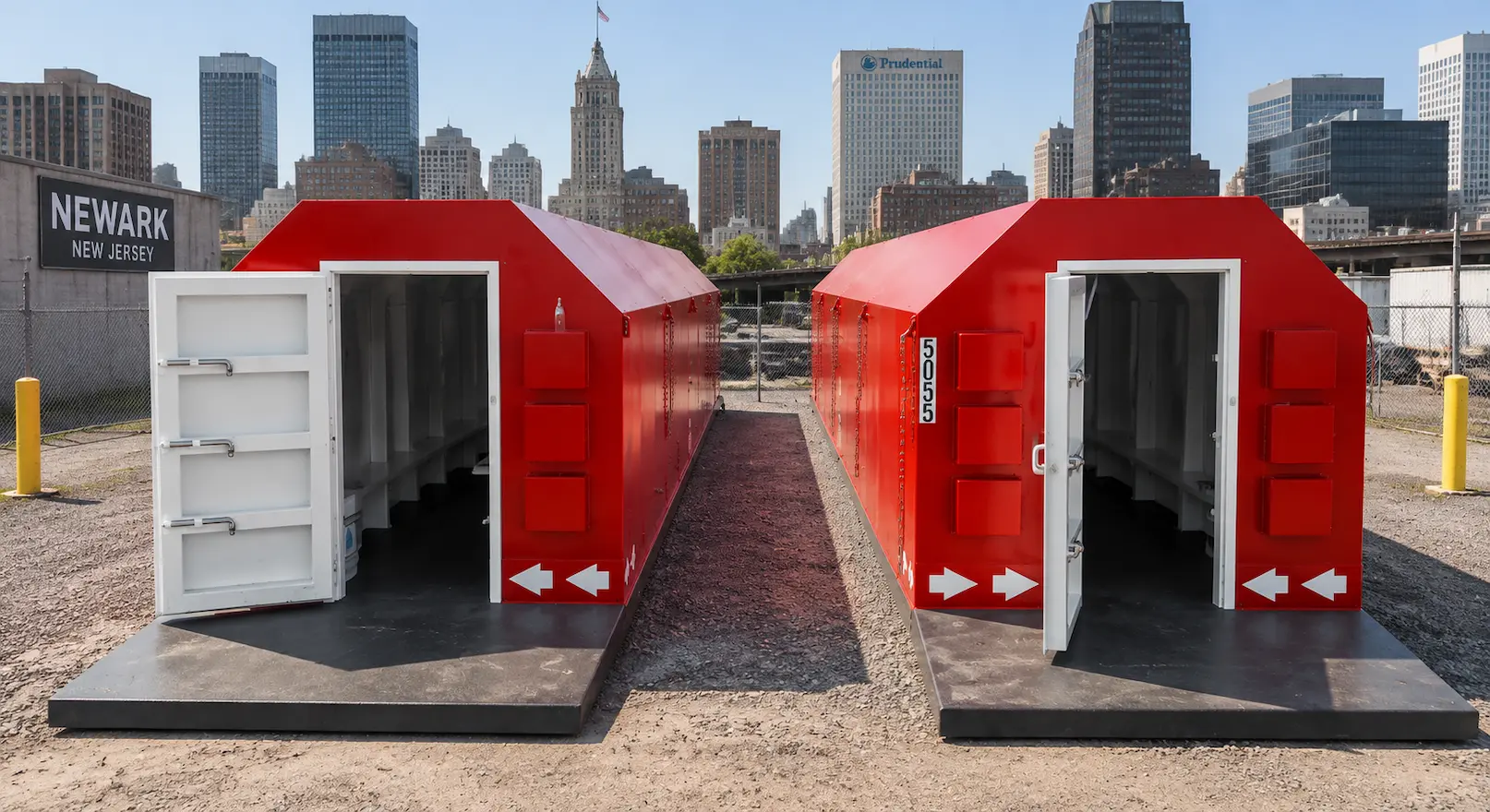
The above ground tornado shelter cost in Newark is not the straightforward number that a Google search makes it appear. It depends on the structure’s occupancy rating, whether it meets ICC 500 community shelter standards or FEMA P-361 design criteria, the specific site conditions of an urban Newark lot, and whether FEMA Hazard Mitigation Grant Program funding is in the picture.
Superstorm Sandy made this conversation real for New Jersey. Before October 2012, the idea of a community storm shelter in Newark or Essex County felt like a precaution for somewhere else, a response to a risk that lived in the Midwest, not the Mid-Atlantic. After Sandy, and again after Tropical Storm Ida in 2021 brought EF-category tornadoes to southern New Jersey, facility managers and school administrators across the state started asking questions about above-ground shelter options that they had not thought to ask before.
US Hazmat Storage works with facilities across the New Jersey region on shelter specification and procurement, and what we see consistently is that the buyers who understand the cost drivers before the first vendor call are the ones who avoid the budget surprises that derail shelter projects after they are already in progress.
Above Ground Tornado Shelter Cost Newark: What New Jersey’s Weather Profile Actually Requires
Newark is not Tornado Alley, and no honest shelter assessment should pretend otherwise. Essex County averages far fewer tornado events than the tornado-prone regions of the south-central United States, and the tornadoes that do occur in New Jersey tend to be shorter-path EF0 and EF1 events with limited destruction corridors.
What Newark and the surrounding area do face with regularity is a different but still significant severe weather profile: nor’easters with sustained winds in the 50-to-70-mph range and gusts that can exceed 80 mph, the residual wind and flooding from tropical systems that push inland from the Atlantic coast, and the severe thunderstorms that produce microbursts, hail, and straight-line wind damage across Essex and Hudson Counties.
FEMA’s above ground tornado shelter cost Newark design standard, FEMA P-361, was written for the full spectrum of high-wind events, not exclusively for tornadoes. The structural performance criteria it sets, including the requirement that community shelters be designed to withstand the equivalent of EF5 wind loads, make an above-ground shelter certified to FEMA P-361 effective against the nor’easter wind speeds, tropical storm remnants, and severe convective events that New Jersey experiences regularly.
The “tornado shelter” label in the product name reflects the heritage of the safe room concept, not a limitation on the events the structure can protect against.
This distinction matters for buyers in Newark evaluating the above ground tornado shelter cost because it expands the pool of facilities for whom a shelter investment is justifiable. A school that would not fund a tornado-specific structure because New Jersey’s tornado risk seems remote may reach a different conclusion when the same structure is framed as a high-wind emergency shelter that FEMA’s own guidance recommends for all communities, regardless of their position on the tornado risk map.
ICC 500 and FEMA P-361: The Standards That Drive the Cost Floor
How much to build a tornado shelter depends, more than any other single factor, on which performance standard the structure must meet. The ICC 500-2020, Standard for the Design and Construction of Storm Shelters, is the primary consensus standard for community shelter design.
Its Chapter 3 requirements for community shelters of more than 16 occupants include a wind load design of 250 mph, a debris impact test that requires the structure’s walls and door assemblies to resist penetration by a 15-pound 2×4 projectile traveling at 100 mph, and specific ventilation, lighting, and occupancy density provisions. A shelter that meets ICC 500 Chapter 3 has been engineered to a defined performance standard, not simply constructed from heavy materials.
FEMA P-361 reinforces and builds on ICC 500, providing guidance on site selection, access path analysis, warning time calculations, and the documentation required to support FEMA Hazard Mitigation Grant Program funding. A facility evaluating in Newark the above ground tornado shelter cost for FEMA HMGP funding will need documentation that the shelter meets FEMA P-361 criteria, and the cost of producing that documentation, including the engineered drawings prepared by a licensed New Jersey professional engineer, is part of the project budget that buyers frequently underestimate in early estimates.
The cost of storm shelter projects that do not meet ICC 500 is lower at the time of purchase and higher over the lifetime of the installation. A prefabricated enclosure that provides protection from standard weather without meeting the debris impact test or the wind load requirement is not a compliant community shelter under ICC 500, cannot be funded through FEMA HMGP, and may not satisfy the coverage requirements that some institutional insurers are beginning to apply to their Newark-area clients.
The Newark Site Variables That Drive Cost Above the Floor
The above ground tornado shelter cost in Newark reflects an urban environment with constrained lots, dense adjacent structures, aging foundation infrastructure, and installation logistics that simply do not appear in national shelter pricing guides. Those guides are written for the open-lot suburban and rural sites where most community shelter installations occur. Newark is a fundamentally different operating environment, and the cost difference between a rural shelter specification and an urban Newark installation is real and significant.
Urban lot constraints affect shelter siting in ways that matter for cost. FEMA P-361 requires that the shelter be accessible to its intended occupants within the available warning time, which for many Newark severe weather events may be ten minutes or less from NWS alert to peak intensity.
A shelter sited at the far corner of a campus lot because it is the only location that clears the required setback distances from adjacent structures adds travel time to the access calculation and may require covered walkways or route improvements that add to the overall project cost.
Foundation conditions in Newark’s urban core frequently involve compacted urban fill, concrete slabs from prior structures, and soil conditions that vary significantly across short distances. The anchor bolt schedule for a cost in above ground tornado shelter Newark must be engineered for the actual soil bearing capacity at the installation site, not a generic specification.
Soil borings or geotechnical testing, which a rural site might avoid, are often necessary in Newark to produce an anchor schedule that a licensed PE will stamp and that the Newark Division of Engineering will accept in a permit application.
FEMA HMGP Funding and Its Effect on Newark Project Economics
The cost of storm shelter construction in Newark can be substantially offset by FEMA Hazard Mitigation Grant Program funding, which New Jersey has accessed following both Superstorm Sandy and Tropical Storm Ida. HMGP funding covers up to 75 percent of eligible projects for above ground tornado shelter cost Newark qualifying community shelter installations, with the remaining 25 percent provided by the project sponsor as a non-federal match.
For a Newark school or community center evaluating a $150,000 shelter installation, HMGP funding could reduce the net cost to the facility to approximately $37,500 before additional state or local match programs are considered.
The HMGP application process runs through the New Jersey Office of Emergency Management and requires documentation that the project meets FEMA P-361 criteria, that the shelter will serve a defined community of beneficiaries, and that the project’s cost-benefit analysis demonstrates a positive hazard mitigation outcome.
The application timeline, which can run 12 to 24 months from initial submission to award, is independent of the construction timeline and must be factored into the project schedule for any Newark facility relying on HMGP funding to close the budget gap. Beginning NJOEM engagement before selecting a shelter product keeps the above ground tornado shelter cost Newark project aligned with the funding application rather than requiring retroactive redesign to meet HMGP eligibility criteria.
New Jersey state hazard mitigation funding programs, administered through the NJ Department of Community Affairs and NJOEM, may provide additional match support or supplemental grants for qualifying Newark facilities. Confirming what state and local funding is available before finalizing the project budget is a step that can meaningfully change the net cost for eligible institutions.
Door Specification and the Stainless Steel Option in Newark’s Environment
The door line item in the above ground tornado shelter cost Newark estimate can vary significantly. A stainless steel door on an above-ground community shelter in Newark provides a meaningful service-life advantage that becomes visible in the total cost of ownership over a 20-to-30-year shelter lifespan. Newark’s coastal-influenced climate, with its combination of humidity, salt air from New York Harbor, and the aggressive urban environment, accelerates corrosion on standard carbon steel finishes faster than the same specification would degrade in an inland location.
The initial cost premium for a ss steel door over a galvanized steel alternative typically runs 25 to 40 percent higher for the door assembly alone. Over the shelter’s service life, however, the reduced maintenance cost, elimination of repainting cycles, and extended time before door replacement becomes necessary can make the stainless specification cost-competitive or cost-advantaged relative to the standard option. A stainless steel door on a Newark shelter is not simply an upgrade; it is a climate-appropriate specification decision.
Newark’s pharmaceutical and biotech facilities, concentrated in the city’s industrial zones and in adjacent communities, often specify stainless steel doors as a standard for any new structure on their campuses. The corrosion-resistance and cleanability requirements of their operating environments make stainless the default material for all exterior steel components, and a community storm shelter on those campuses follows the same specification logic.
Permitting and NJ Code Requirements for Newark Shelter Projects
An above-ground community shelter installation in Newark requires a building permit from the Newark Division of Engineering, and the permit application must include engineered drawings prepared by a licensed New Jersey professional engineer demonstrating compliance with the 2021 NJ Uniform Construction Code, which is based on the 2018 International Building Code. The structural drawings must address the wind load design, debris impact criteria, foundation anchorage, and occupancy provisions applicable to the shelter’s classification under the NJ UCC.
Newark’s permit review for community shelter structures typically involves plan review by both the building subcode official and the fire subcode official, given the structure’s intended use as an emergency assembly area. The fire subcode review addresses egress requirements, signage, and the ventilation provisions that ICC 500 requires for community shelter occupancy. Facilities that engage the Newark Division of Engineering in a pre-application meeting before submitting drawings report a faster review process and fewer correction cycles than those who submit without prior agency contact.
For Newark schools and public facilities, the project may also require review by the New Jersey Department of Education under the Educational Facilities Construction and Financing Act, depending on the project scope and funding source. Engaging all relevant agencies early in the design process, not at the permit application stage, is the consistent practice of Newark shelter projects that close without unexpected delays.
Our community storm shelter solutions are engineered to ICC 500 and FEMA P-361 criteria and can be configured to support the Newark Division of Engineering permit process, including the documentation that FEMA HMGP applications require. The shelter capacity, door specification, and site anchoring plan can be matched to Newark’s specific urban site conditions and the institutional requirements of the facility requesting the installation.
Getting to a Real Number Before the Proposal Arrives
The above ground tornado shelter cost Newark buyers should plan for is not a single number, and any vendor who offers one without first understanding the site, the occupancy requirements, the permit pathway, and the funding strategy is providing a price, not a project cost.
A shelter that meets ICC 500 for a 50-person community occupancy, installed on a Newark urban lot with geotechnical testing, engineered foundation drawings, permit fees, and a stainless steel door assembly, will cost more than a rural equivalent of the same shelter. It will also serve a facility that has a 20-year service life ahead of it, a FEMA P-361 documentation set that supports HMGP funding, and a structure that holds up in Newark’s coastal climate without the corrosion management costs that a standard steel finish requires.
US Hazmat Storage works with Newark-area facilities, schools, and community organizations navigating exactly this cost and compliance picture. If your facility is evaluating an above-ground shelter and needs a proposal that reflects Newark’s actual site conditions, permit requirements, and funding options, contact US Hazmat Storage and get a custom proposal for your facility.
FAQ
How much does an above ground tornado shelter cost in Newark, NJ?
The cost of storm shelter construction in Newark ranges from $20,000 for small prefabricated units to over $150,000 for community shelters meeting ICC 500 Chapter 3 standards. Urban site factors including foundation conditions, lot constraints, and permit requirements add to the cost above published national benchmarks.
Does Newark, NJ have enough tornado risk to justify a shelter investment?
Newark’s tornado risk is lower than the central U.S., but the area faces significant severe weather including nor’easters, tropical system remnants, and microbursts. FEMA P-361 shelters protect against all high-wind events, not only tornadoes, making them appropriate for New Jersey’s actual weather profile.
What standards must a community storm shelter meet in New Jersey?
ICC 500-2020 and FEMA P-361 are the primary standards. The NJ Uniform Construction Code governs the permit process, and engineered drawings from a licensed NJ professional engineer are required for Newark building permits for community shelter structures.
How much does FEMA HMGP funding cover for Newark shelter projects?
FEMA Hazard Mitigation Grant Program funding covers up to 75 percent of eligible project costs, with the remaining 25 percent provided by the project sponsor as a non-federal match. New Jersey has accessed HMGP funds following Superstorm Sandy and Tropical Storm Ida. Applications run through the NJ Office of Emergency Management.
Why would a Newark shelter use a stainless steel door instead of standard steel?
Newark’s coastal climate, with humidity and salt air from New York Harbor, accelerates corrosion on standard carbon steel finishes. A steel door costs 25 to 40 percent more initially but reduces lifetime maintenance costs and extends the door’s service life significantly in Newark’s corrosive urban environment.
What permits does an above-ground community shelter require in Newark?
A building permit from the Newark Division of Engineering is required, including engineered drawings from a licensed NJ PE demonstrating compliance with the 2021 NJ Uniform Construction Code. Plan review typically includes both building and fire subcode officials given the structure’s emergency assembly use.
How long does the HMGP application process take for a Newark shelter project?
The NJOEM HMGP application timeline typically runs 12 to 24 months from initial submission to award. This timeline is independent of the construction schedule and must be integrated into the project plan for any facility relying on HMGP funding to close the budget gap.
Can a Newark school qualify for state funding for a storm shelter?
Yes. New Jersey state hazard mitigation programs administered through the NJ Department of Community Affairs and NJOEM may provide additional match support or supplemental grants for qualifying educational facilities. Newark schools should also confirm whether NJ DOE review is required under the Educational Facilities Construction and Financing Act.