
Specifying an explosion vent for an Atlanta facility without a completed NFPA 68 deflagration analysis is the most common point of failure in industrial ventilation projects at the permitting stage. The explosion vent Atlanta requirement is not a generic pressure relief provision. It is a calculated assembly, sized to a specific enclosure volume, a specific fuel’s combustion characteristics, and a specific maximum pressure the structure can withstand before the vent must activate.
Atlanta’s pharma research corridors, food manufacturing plants, and specialty chemical storage buildings all represent scenarios where an explosion vent Atlanta specification is either required under NFPA 68 and the Georgia Fire Code or strongly indicated by the risk profile of the stored materials. US Hazmat Storage supports EHS managers and facility engineers across the Atlanta metro area who are working through deflagration vent specifications and need guidance that starts with the applicable standard, not with the product catalog.
What NFPA 68 Governs and Why Atlanta Facilities Must Follow It
NFPA 68, the Standard on Explosion Protection by Deflagration Venting, is the primary technical standard governing any explosion vent Atlanta design in the United States. It defines the calculation methodology for determining vent area, the performance criteria for vent panels and assemblies, the structural requirements for the protected enclosure, and the siting requirements for vent discharge. The standard applies to enclosures, rooms, buildings, and process equipment where a deflagration is possible and where flammable vapors, gases, mists, or combustible dusts may be present.
In Atlanta, the International Fire Code is adopted statewide with Georgia-specific amendments, and NFPA 68 is the referenced standard for explosion protection systems. The Atlanta Fire Rescue Department serves as the Authority Having Jurisdiction for facilities within city limits, and AFD fire protection engineers evaluate NFPA 68 design documentation during plan review for any new explosion protection installation.
NFPA 68 vs. NFPA 69: Understanding the Distinction Before Specifying
The distinction between NFPA 68 and NFPA 69 must be resolved before any explosion vent Atlanta project begins. NFPA 68 governs deflagration venting, which is a passive relief strategy: the vent panel opens at a preset activation pressure, releasing the deflagration wave and combustion products to a safe area before enclosure pressure exceeds the structure’s capacity. NFPA 69 governs explosion prevention systems, including chemical suppression, oxidant concentration control, and combustible concentration control.
These are active prevention strategies that stop the deflagration from developing in the first place. A facility must determine which approach is appropriate for the specific application before any product selection begins, because the two standards govern fundamentally different engineering strategies and require different documentation, inspection programs, and AHJ submittals.
OSHA and PSM Requirements for Atlanta Facilities
Georgia operates under federal OSHA, not a state plan, meaning federal regulations apply directly to private-sector employers throughout the state. For Atlanta facilities with processes covered under OSHA’s Process Safety Management standard, 29 CFR 1910.119, the mechanical integrity requirements apply to explosion protection systems as a covered item.
PSM-covered facilities must document, inspect, and maintain their deflagration venting systems as part of their mechanical integrity program. That documentation trail runs from the initial NFPA 68 design calculation through the installation inspection and into the recurring maintenance cycle, and it is subject to audit during OSHA PSM compliance reviews.
The Four Technical Variables in Every Explosion Vent Calculation
Every explosion vent Atlanta installation must resolve four technical variables before a vent area can be calculated under NFPA 68: the Kst value of the flammable material, the Pmax for that material, the Pred the protected structure can withstand, and the volume of the enclosure being protected. Each variable is specific to the application and cannot be assumed without introducing unquantifiable error into the design.
Kst is the deflagration index, expressed in bar-meters per second, that describes how quickly pressure rises during a dust or vapor explosion for a specific material in a specific concentration and particle size distribution. For flammable vapors and gases, including acetonitrile and the class IB solvents common in Atlanta’s pharmaceutical and biotech sectors, the equivalent parameter is the laminar burning velocity.
These values come from standardized laboratory testing or published databases maintained by organizations such as the National Institute of Standards and Technology. Using a value from an incorrect source, or applying a published value for a different particle size or purity level than what is present in the enclosure, produces a vent area calculation that may be significantly undersized.
Pmax is the maximum pressure developed when the material deflagrates in a completely closed vessel under worst-case ignition. Pred is the reduced pressure that will develop inside the vented enclosure during a deflagration event when the vent activates correctly.
Pred must remain below the enclosure’s structural failure pressure, which is a function of the building’s construction materials, wall panel connections, and foundation attachment design. For prefabricated chemical storage buildings, the manufacturer’s engineering documentation typically provides the structural failure pressure value.
Atlanta’s Climate Factors: Thermal Cycling and Corrosion
Atlanta’s climate creates two site-specific considerations for any explosion vent Atlanta specification that national guides do not address in sufficient detail. The first is thermal cycling. Atlanta experiences summer temperatures regularly exceeding 90 degrees Fahrenheit with high relative humidity, followed by winter drops near or below freezing.
Explosion vent panels, particularly thin aluminum or polymer film types, are rated for a specific activation pressure at a reference temperature. Significant deviations from that reference, in either direction, can shift the panel’s actual activation pressure relative to its rated Pstat.
Corrosion is the second factor. Atlanta’s high humidity, combined with chemical vapors present in the exhaust stream at a chemical storage or processing facility, creates a corrosive exposure condition that carbon steel hardware does not resist reliably over a multi-year service life. Stainless steel hardware and frame components, or appropriately coated aluminum construction, are the material specifications that perform correctly in this environment. A vent panel that fails due to hardware corrosion before a deflagration event has eliminated the protection the system was designed to provide.
Siting the Vent Discharge on Atlanta Industrial Properties
The siting of the explosion vent discharge is a code-governed decision that AFD’s plan review evaluates directly. NFPA 68 requires the discharge area to be free of obstructions and the discharge must not create a secondary hazard by directing combustion products toward occupied areas, ignition sources, or adjacent structures.
Atlanta’s industrial facilities frequently feature dense site plans with multiple structures in close proximity. The discharge siting analysis must confirm that the geometry of adjacent buildings and site features does not create a pocket where unburned fuel or combustion products could accumulate after a vent activation. This analysis is part of the plan submittal documentation that AFD requires before issuing a permit for a new explosion protection installation.
AFD Permit Process and Georgia Fire Code Requirements
For a new explosion vent Atlanta installation, the permit process involves plan submittal to the AFD Fire Prevention Bureau, plan review by a fire protection engineer on staff, and a site inspection upon completion. The submittal must include the NFPA 68 design calculation documenting the basis for the vent area, the vent panel manufacturer’s listing information and performance data, the structural documentation for the protected enclosure, and the discharge siting analysis.
For Atlanta-area facilities in Fulton County but outside city limits, the applicable AHJ shifts to the Fulton County Fire Department. Facilities located in surrounding municipalities such as Smyrna, Kennesaw, or Peachtree City must confirm their specific AHJ before submitting permit documents, because the relevant office determines both the review timeline and the specific code amendments that apply to the project.
OSHA 29 CFR 1910.106 governs flammable and combustible liquid storage and references the ventilation and explosion protection requirements for storage rooms and buildings. For Atlanta facilities where the explosion vent in Atlanta is protecting a flammable liquid storage area, the OSHA 1910.106 documentation requirements apply alongside the NFPA 68 design documentation and the AFD permit. Maintaining a complete set that satisfies all three frameworks simultaneously is the approach that closes inspection visits without findings.
Vent Panel Types and Their Application Range
Selecting the right panel type is a core decision in any explosion vent Atlanta project, and the configurations available cover a wide range of applications. The most common are single-use rupture panels, which open permanently when the deflagration pressure reaches Pstat and must be replaced after any activation; hinged vent panels, which swing open during an event and can be returned to service if the panel is undamaged; and composite panels, which combine a structural outer layer with a pressure-sensitive inner membrane.
For an explosion vent in Atlanta at a chemical storage building handling acetonitrile and class IB solvents common in the city’s pharma and biotech sectors, the specification must account for the material’s vapor characteristics. Acetonitrile has a flash point of 2 degrees Celsius and a vapor density greater than air, meaning vapor accumulates at floor level and the deflagration scenario involves a pressure wave originating at floor level and traveling upward through the enclosure. This affects both the placement of the vent and the discharge direction relative to egress points.
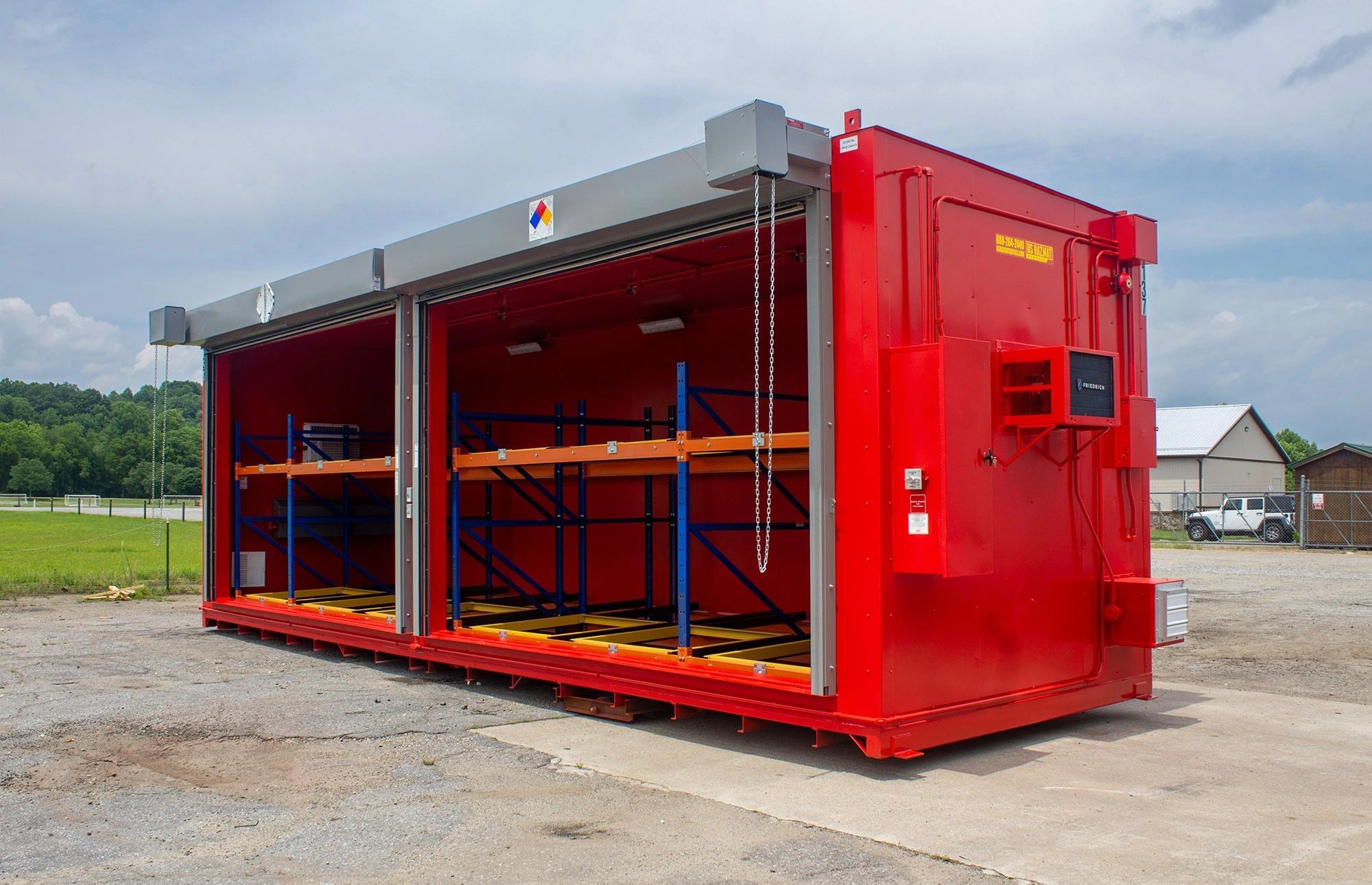
Different types of industrial cabinets used for flammable liquid storage, including standard UL 1275-listed safety cabinets and larger prefabricated chemical storage buildings, present different explosion vent requirements based on their volume and construction.
Small safety cabinets storing quantities below NFPA 30 limits are not typically required to include deflagration venting, because the quantity of material is insufficient to sustain a deflagration event exceeding the cabinet’s inherent structural capacity. Larger prefabricated storage buildings that exceed those limits are the primary application for an explosion vent Atlanta specification in the chemical storage sector.
Our specialized chemical storage resources address the storage requirements for acetonitrile and other class IB flammable solvents in detail, including the ventilation, containment, and explosion protection provisions that apply to Atlanta facilities handling these materials.
Maintenance, Inspection, and Documentation Standards
An explosion vent in Atlanta is not a set-and-forget installation, and treating any explosion vent Atlanta system as if it were is one of the most common compliance gaps inspectors find. NFPA 68 requires periodic inspection to confirm that vent panels have not been damaged, obstructed, or modified in a way that would affect their activation pressure or their ability to open freely during a deflagration event. For PSM-covered facilities, those inspections and their documentation are subject to audit during OSHA PSM reviews.
Common inspection findings at Atlanta facilities include paint overspray on vent panel surfaces, which raises the effective activation pressure above the rated Pstat; debris accumulation in the vent discharge path, which can restrict the panel’s opening or redirect the discharge; and corrosion of the panel’s frame or mounting hardware.
Replacement panels must match the original design specification in every parameter: material, thickness, activation pressure, and listing. Substituting a panel of different construction without verifying that the replacement meets the original NFPA 68 design calculation is a modification that requires re-evaluation; any explosion vent Atlanta replacement must fully satisfy the original design basis.
Maintaining the complete documentation chain from the initial calculation through every replacement panel installation keeps the explosion vent Atlanta record defensible during OSHA and AFD audits years after the original installation.
Starting the Atlanta Specification Correctly
The combination of NFPA 68’s calculation requirements, AFD’s plan review process, OSHA’s documentation expectations, and Atlanta’s climate and site factors makes the explosion vent Atlanta specification a multi-layered technical exercise that rewards facilities working through it systematically before ordering equipment.
A vent panel selected by catalog number without a completed NFPA 68 design calculation is a product without a defensible engineering basis. A vent panel selected after a proper deflagration analysis, with an AFD-reviewed permit and a complete documentation set, is a safety system that performs correctly when the scenario it was designed for occurs.
US Hazmat Storage works with Atlanta-area EHS managers, facility engineers, and project managers navigating explosion vent specifications for chemical storage buildings, process enclosures, and specialty storage applications. If your Atlanta facility needs a deflagration venting evaluation, contact US Hazmat Storage and schedule a free site consultation today.
Any final explosion vent in Atlanta should be reviewed and stamped by a licensed fire protection engineer, confirmed with the AFD Fire Prevention Bureau, and, where PSM-covered processes are involved, integrated into the facility’s Process Hazard Analysis before any installation commitment is made.
FAQ
Does NFPA 68 apply to all Atlanta chemical storage buildings?
NFPA 68 applies when a deflagration is possible inside an enclosure. Buildings storing flammable vapors, gases, mists, or combustible dusts above ignitable concentrations fall within its scope. Consult the AFD and a fire protection engineer to confirm applicability for your specific facility.
What is the difference between a deflagration vent and an explosion suppression system?
A deflagration vent (NFPA 68) is a passive panel that opens to relieve pressure during a combustion event. Suppression (NFPA 69) uses active chemical agents or atmospheric controls to prevent ignition. The two are governed by separate standards and serve different risk scenarios.
Who is the AHJ for explosion vent permits in Atlanta?
For facilities within Atlanta city limits, the Atlanta Fire Rescue Department is the AHJ. For facilities in unincorporated Fulton County, the Fulton County Fire Department applies. Municipalities in the metro area, including Smyrna and Kennesaw, have their own AHJs.
How often should explosion vent panels be inspected?
NFPA 68 requires periodic inspection of vent panels to confirm no damage, obstruction, or modification has occurred. Frequency is part of the facility’s mechanical integrity program; for OSHA PSM-covered operations, inspection records must be maintained and are subject to audit.
Can a standard safety cabinet be fitted with an explosion vent?
Small UL 1275-listed safety cabinets storing quantities below NFPA 30 single-cabinet limits are not typically required to include deflagration venting. Larger prefabricated storage buildings that exceed those thresholds are the primary application for explosion vent specifications.