
A spill containment workstation sits at the crossroads of three regulatory regimes which are almost never cited together: SPCC under 40 CFR Part 112, OSHA 29 CFR 1910.106 for the handling of flammable liquids and EPA’s hazardous waste accumulation rules under RCRA.
The vast majority of facilities will buy a workstation on the basis of the product spec sheet and then discover at inspection that the unit they’ve bought conforms to one of the frameworks and not the other two. What the regulations actually require of a spill containment workstation will vary depending on what you’re storing, how much you’re storing and how you store and dispense those materials.
US Hazmat Storage works with facility managers, EHS teams and ops leads who need drum storage configurations that meet the full regulatory stack rather than just the bits and pieces that are in a catalog description.
What “Spill Containment Workstation” Means in Regulatory Terms
The term spill containment workstation does not appear in OSHA, EPA or NFPA by that name. It’s a product category in the commercial sector describing a secondary containment platform (typically for 55 gallon drum storage) with a work surface, drum dispensing equipment and a sump or bunded base to capture any spills or leaks that might occur during the dispensing of liquids.
Regulatorily the unit is secondary containment under SPCC (40 CFR Part 112.7(c)) where it contains oil or petroleum products in quantities above the SPCC threshold and is a hazardous waste satellite accumulation area under RCRA where it contains hazardous waste at the point of generation. It is a flammable liquid dispensing station under OSHA 1910.106(d)(2) when it is used for the transfer of flammable or combustible liquids.
Each of those functions has different requirements with respect to the workstation construction, grounding, labelling and sump capacity. The first step in specifying the unit is to determine what the workstation is actually going to be used for and which regulatory regime it will be operating under.
SPCC Secondary Containment Requirements for Drum Storage
Under SPCC (40 CFR Part 112) the secondary containment for aboveground oil storage must be designed to hold the volume of the largest single container plus sufficient freeboard to allow for precipitation. For a standard 55 gallon drum storage situation that would mean the sump or bunded base of the spill containment workstation would have to be capable of holding at least 66 gallons (110% of the drum capacity) plus whatever freeboard is specified in the facility’s SPCC plan.
The vast majority of commercial units will state their sump capacity in gallons. What they don’t always make very clear is whether that capacity is based on the sump with the grating in place or whether the grating itself reduces the actual volume of liquid the sump can hold.
A 30 gallon sump with the grating in place may be sufficient to meet the SPCC 110% rule for a half full drum but wouldn’t be sufficient for a full 55 gallon drum. The facility’s SPCC plan will have to specify the minimum sump capacity required.
SPCC also requires that the secondary containment be visually inspected for accumulation and that any liquid which accumulates in the sump be dealt with in accordance with the relevant waste disposal or spill reporting requirements.
A spill containment workstation which collects product and is not routinely inspected and emptied will give rise to a second regulatory issue in that the accumulated liquid in the sump may result in the workstation becoming a hazardous waste generator under RCRA if the product being collected is a listed or characteristic hazardous waste.
OSHA 1910.106 Requirements for Flammable Liquid Dispensing Stations
When a spill containment workstation is used for dispensing flammable or combustible liquids, OSHA 29 CFR 1910.106 applies. The dispensing station requirements under 1910.106(d)(2) include bonding and grounding connections between the drum and the receiving container, a self-closing faucet or pump mechanism, and a fire extinguisher within 10 feet of the dispensing area.
Bonding and grounding are the most commonly missed requirements. Static electricity generated during liquid transfer between a metal drum and a metal receiving container can accumulate to ignition-capable levels before the transfer is complete. OSHA 1910.106(d)(2)(iii) requires that the drum be bonded to the receiving container during transfer, and that both be grounded.
A spill containment workstation used for the dispensing of flammable liquids must have integrated or add-on bonding cable attachment points and the site must have documented procedures for bonding and grounding prior to each transfer.
Lots of commercial workstations are designed for the storage of corrosive or non-flammable liquids and have no bonding/grounding provisions. Using such a unit for the dispensing of flammable liquids would constitute an OSHA violation at the very first inspection. Same product category, totally different regulatory regime.
US Hazmat Storage’s 55 gallon drum storage configurations incorporate drum handling, dispensing and secondary containment systems specifically specified to the OSHA 1910.106 requirements for flammable liquid operations, not just the SPCC secondary containment standard.
RCRA Satellite Accumulation Area Rules
A spill containment workstation used at the point of waste generation would be considered a satellite accumulation area (SAA) under RCRA, as long as it satisfies the requirements of 40 CFR 262.15. The SAA rules permit the accumulation of up to 55 gallons of hazardous waste at or near the point of generation without the full 90 day generator requirements having to be met.
The SAA requirements for a spill containment workstation configuration are that the containers must be in good condition and be compatible with the waste being stored; the containers must be closed except when waste is being added to or removed from the container; the SAA must be under the control of the operator generating the waste; and any containers that reach the 55 gallon limit must be labelled and moved to the facility’s main accumulation area within 3 days.
A workstation which is used to store used solvents, spent cleaning liquids or other process generated hazardous waste is an SAA regardless of whether it is labelled as such. RCRA inspection citations for SAA violations are very common at facilities which didn’t realise that their drum workstation was in fact an SAA.
Drum Storage Area Layout and Separation Requirements
The drum storage area that surrounds or incorporates a spill containment workstation must meet separation requirements from ignition sources, electrical panels, and other hazard classes. NFPA 30 Table 9.3.2 sets the minimum separation distances for flammable and combustible liquid drum storage in indoor locations based on liquid class and storage configuration.
For Class I flammable liquids (flash point below 73°F) the NFPA 30 requirements are that they cannot be stored within 10 feet of an open flame or heating equipment and that for outdoor drum storage they must be a minimum of 25 feet from a public way. For an indoor spill containment workstation the 10 foot clearance from ignition sources is required in all directions, not just between the workstation and the nearest heat source.
NFPA 400 has segregation requirements for drum storage areas where hazard classes are mixed. Flammable liquids must be segregated from oxidisers, corrosives must be segregated from reactive materials and the layout of the drum storage area must reflect those segregation requirements in the way the workstations and racks are physically arranged.
US Hazmat Storage’s secondary spill containment solutions are in the form of bunded storage configurations which meet the NFPA 30 and NFPA 400 drum storage area layout requirements as well as the secondary containment capacity requirements.
Oxygen Cylinder Storage Rack Integration and Separation
Any facilities that have the oxygen cylinders stored in proximity to the drum workstations will be subject to the compressed gas segregation requirement which will supersede the drum storage area layout. NFPA 55 requires that oxidising gases (including oxygen) be stored at a minimum of 20ft from flammable gases and 20ft from flammable or combustible liquids or separated by a non-combustible barrier of at least 5ft high and with a fire resistance rating of at least 0.5 hours.
An oxygen cylinder storage rack positioned adjacent to a spill containment workstation which is holding flammable liquids is a violation of NFPA 55 unless the 20ft separation or the rated partition is in place. A lot of sites find themselves in this situation at inspection as the workstation and the cylinder rack have simply been placed where they are due to the available floor space.
The compliance solution is either physical relocation to achieve the 20ft separation, or the installation of a compliant partition between the two storage options.
The partition requirement has an impact on the design of the drum storage area. The partition must be non-combustible (metal, masonry or rated drywall assembly), must extend 5 feet above grade and must have a fire resistance rating that can be documented. A standard metal shelving unit or a polyethylene barrier between the workstation and the cylinder rack will not satisfy NFPA 55.
Spill Containment Drum Shed: When Indoor Storage Requires a Building
A spill containment drum shed becomes necessary when the quantities of flammable or hazardous materials stored in a drum storage configuration exceed the Maximum Allowable Quantities (MAQ) for the occupancy type. NFPA 30 and IFC Chapter 50 set MAQs for flammable liquid storage inside buildings that vary by building construction type and occupancy classification.
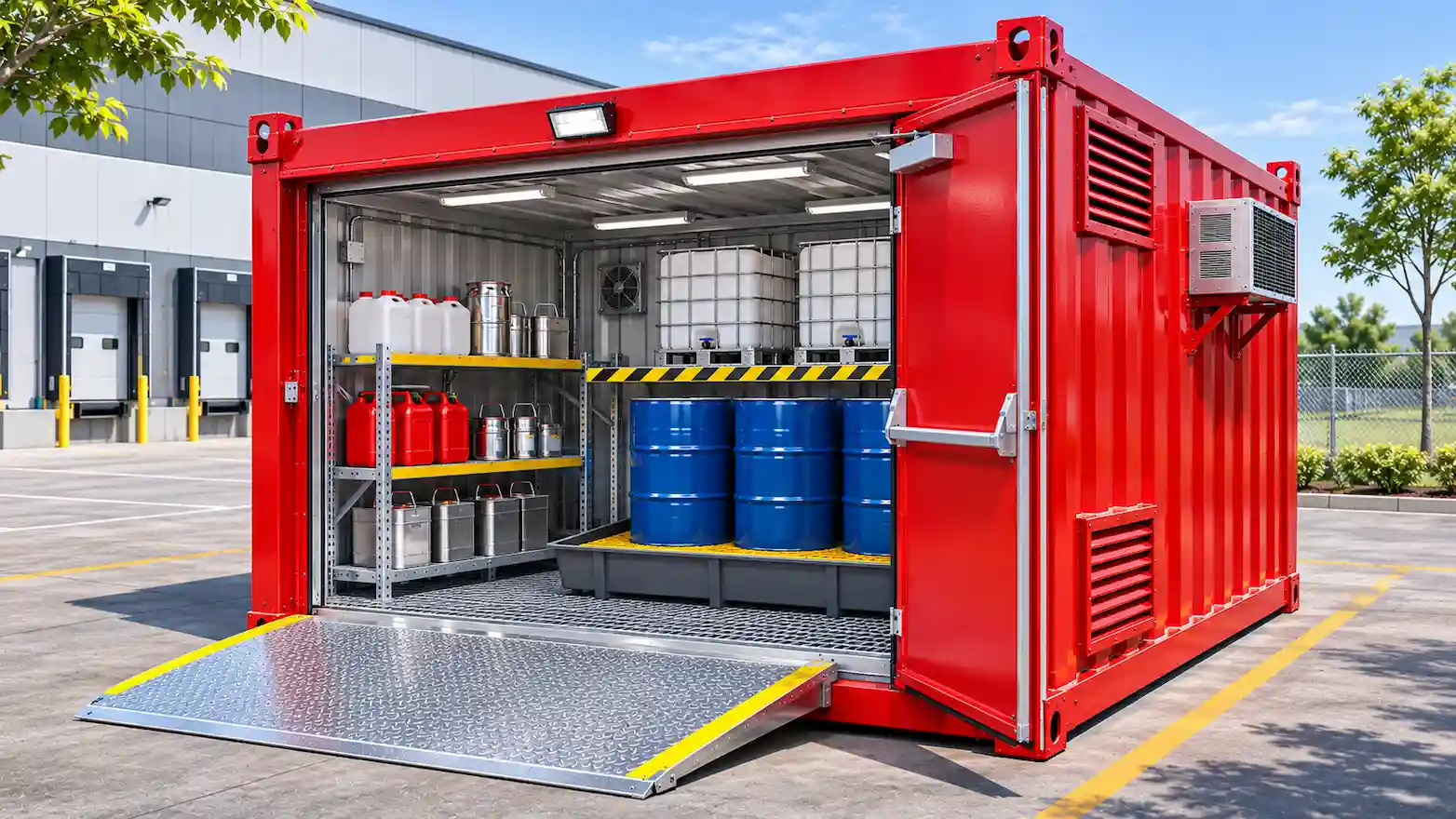
When drum quantities exceed the MAQ for the building, the drums must be stored in a separate storage room, a detached accessory structure, or a compliant outdoor drum shed. A spill containment workstation remains the dispensing point, but the bulk storage relocates to a structure that meets NFPA 30 Chapter 9 (inside storage) or Chapter 15 (outside storage) requirements.
The transition from workstation-only storage to a drum shed configuration requires a new fire safety evaluation that addresses the shed’s construction, ventilation, fire suppression, and secondary containment as an integrated system.
A detached spill containment drum shed must have secondary containment for 110% of the largest container, ventilation to maintain vapor concentrations below 25% of the LEL during normal operations, and electrical equipment rated for the classified location as defined by NEC Article 500 based on the flash point of the liquids stored.
Grounding, Bonding, and Static Control Requirements
Static control is the technical requirement most frequently omitted from commercial spill containment workstation specifications. NFPA 77 and OSHA 1910.106(d)(2)(iii) require that containers dispensing Class I flammable liquids be bonded and grounded before each transfer begins.
The bonding connection equalizes the electrical potential between the drum and the receiving container, eliminating the differential that causes static charge accumulation during liquid flow. The grounding connection dissipates that equalized charge to earth ground, preventing accumulation to ignition-capable levels. Both connections must be made before liquid flow begins and must be maintained for the duration of the transfer.
A spill containment workstation for flammable liquid dispensing must have an integrated grounding lug connected to a facility ground, and must include bonding cable attachment points on the drum platform. The facility’s operational procedure must require that bonding and grounding be verified before each dispensing operation. A unit with no grounding lug that is not connected to a verified facility ground, does not meet OSHA 1910.106.
Closing: Specification Starts with Regulatory Classification, Not Product Selection
The mistake most facilities make with a spill containment workstation isn’t buying the wrong product. It’s buying a product before classifying what regulatory frameworks apply to how the unit will actually be used. A workstation used for oil storage under SPCC, flammable liquid dispensing under OSHA 1910.106, and hazardous waste accumulation under RCRA has three sets of requirements that must be satisfied simultaneously.
US Hazmat Storage works with EHS teams and facility managers to specify drum storage and secondary containment configurations that satisfy the full regulatory stack from the start. Reserve your unit or building before the next order cycle and get a configuration that holds up at inspection.
FAQ
How much containment capacity is required for a spill containment workstation under the SPCC?
Under SPCC (40 CFR Part 112.7(c)) secondary containment must be capable of holding 110% of the volume of the largest single container. For a 55 gallon drum that’s 110% would be 60.5 gallons. That’s the minimum effective sump capacity required. The rated capacity of the sump must be verified with all grating, work surfaces and equipment in their installed positions as these will all reduce the effective liquid volume.
Does a spill containment workstation for flammable liquids require bonding and grounding?
Yes. OSHA 1910.106(d)(2)(iii) requires bonding between the drum and the receiving container and grounding to earth for all Class I flammable liquid dispensing operations. The workstation must have integral or add-on bonding cable attachment points and a grounding lug connected to a verified facility ground. Standard drum workstation products for corrosive and non-flammable liquids will often not have these provisions.
What’s the difference between a spill containment workstation and a spill containment drum shed?
A spill containment workstation is a secondary containment platform for drum dispensing and handling at a single drum or a small cluster of drums. A spill containment drum shed is a separate structure which is used where the quantities of drums to be handled exceed the Maximum Allowable Quantities for the building occupancy under NFPA 30 or IFC Chapter 50. The workstation is still the dispensing point, the drum shed is for the bulk storage of drums which cannot legally be kept in the building.
Can a spill containment workstation be used as a RCRA satellite accumulation area?
Yes, as long as it satisfies the requirements of 40 CFR 262.15. The containers must be in good condition and compatible with the waste, closed when not in use, located at or near the point of generation and under the control of the operator generating the waste. When the volume of hazardous waste at the SAA reaches 55 gallons the containers must be labelled and moved to the main accumulation area of the facility within three days.
What separation is required between a drum workstation and an oxygen cylinder storage rack?
NFPA 55 requires at least 20 feet of separation between oxidizing gases (including oxygen) and flammable or combustible liquids, or a noncombustible partition at least 5 feet high with a minimum 0.5-hour fire resistance rating. A standard shelving unit or polyethylene barrier between the workstation and the cylinder rack does not satisfy this requirement.