
The purchase order says “200 proof alcohol.” What it does not say is that a Class IB flammable liquid classification follows that line item, along with storage room construction requirements, a federal excise tax question, a TTB permit conversation, bonding and grounding infrastructure, and a containment compatibility check that most buyers discover too late.
Absolute ethanol at full concentration is not a complicated chemical in terms of hazard profile, but the procurement and compliance picture around it is more layered than the product label suggests. Whether the end use is pharmaceutical manufacturing, high-purity synthesis, biotech extraction, or industrial solvent work, the gaps that create inspection findings and operational disruptions almost never appear in the product itself.
They appear in the infrastructure decisions that were made, or skipped, before the drums arrived. US Hazmat Storage works with EHS managers and procurement leads navigating exactly this territory, and the pattern we see consistently is that facilities with clean inspection records resolved the regulatory questions first.
What “200 Proof” Actually Means in Regulatory Terms
200 proof alcohol is anhydrous ethanol, one hundred percent ethyl alcohol with zero water content. That complete absence of moisture is the property that makes it indispensable for processes that require a dry solvent, pharmaceutical excipients, laboratory extractions, electronics-grade cleaning, and high-purity synthesis among them.
It is also the property that places it in a more demanding regulatory category than lower-proof industrial ethanol. NFPA 30 assigns it a Class IB flammable liquid classification based on a flash point of approximately 13 degrees Celsius, or 55 degrees Fahrenheit. Class IB covers the category of industrial solvents with the highest fire sensitivity under the NFPA framework, and the storage requirements that come with that classification are not suggestions.
The Department of Transportation designates it under UN 1170, Ethanol (Ethyl Alcohol), Flammable Liquid, Packing Group II. That designation governs shipping container requirements, transport placarding, and the documentation that must accompany any movement of the material by road, rail, or air.
The NFPA 704 hazard diamond for pure ethanol reads Health 2, Flammability 3, Instability 0, a profile that communicates exactly what it should: the fire risk is the primary concern, the acute health hazard is moderate, and under typical storage conditions the reactivity exposure is negligible.
Knowing these classifications before the purchase order reaches a vendor means knowing what the receiving area needs to be ready for before the shipment arrives. A facility that accepts 200 proof alcohol into a storage area unprepared for a Class IB liquid has a compliance exposure from the moment the pallet hits the dock.
The TTB Variable That Catches Most Buyers Off Guard
Federal excise tax does not come up in most industrial chemical purchases. With 200 proof alcohol, it does, because ethanol is subject to federal excise tax under the jurisdiction of the Alcohol and Tobacco Tax and Trade Bureau, a bureau of the U.S. Department of the Treasury. The TTB controls the conditions under which non-denatured and denatured ethanol can be produced, distributed, and used without triggering that tax, and the permit requirement applies to the buyer, not just the seller.
Non-denatured 200 proof alcohol, the pure form with no adulterant added, carries federal excise tax liability unless the purchasing operation holds an appropriate TTB authorization. Depending on the quantity and intended use, that means a Basic Permit under the Federal Alcohol Administration Act or an Industrial Alcohol User permit.
Denatured 200 proof alcohol sidesteps the excise tax by incorporating an adulterant, typically methanol, isopropanol, or a bittering compound, that renders it unfit for consumption. The TTB permitting complexity drops significantly, and for many industrial applications the denatured form is entirely appropriate. The restriction is on the use side: a pharmaceutical formulation that specifies absolute ethanol as an excipient cannot substitute a denatured version without a documented reformulation review.
A cosmetic manufacturer working under FDA oversight faces a different but equally real constraint. Confirming which form of 200 proof alcohol the application actually requires, and what TTB pathway accompanies that form, belongs in the procurement process before the first vendor conversation, not after the first shipment.
Storage Room Requirements Under NFPA 30 and OSHA
OSHA 29 CFR 1910.106 sets quantity limits for flammable liquid storage by container type, storage location, and room construction. For 200 proof alcohol as a Class IB material, the limits for storage in unprotected areas inside a building are lower than most operations expect, and once those limits are exceeded, storage must move into a compliant flammable liquid storage room. OSHA Table H-12 defines the applicable thresholds.
A flammable liquid storage room for 200 proof alcohol must satisfy the construction, ventilation, and electrical requirements of NFPA 30 Section 9.4. Fire-rated wall and door assemblies, mechanical ventilation calibrated to maintain vapor concentrations below 25 percent of the lower flammable limit, and electrical equipment rated for Class I hazardous locations under NFPA 70 are all mandatory elements.
Ethanol vapor is denser than air. It does not rise and dissipate; it settles toward floor level, collects in low points, and accumulates in corners and under equipment. That behavior directly shapes the ventilation design, which must extract from low points to be effective, and the electrical classification zone around dispensing stations.
Bonding and grounding equipment must be in place before any dispensing or transfer of 200 proof alcohol takes place. Pure ethanol has extremely low electrical conductivity, which allows static charge to build during liquid movement between containers. That accumulated charge is an ignition source if the transfer vessel and receiving container are not bonded to each other and grounded to earth.
Secondary Containment: Volume and Compatibility Are Two Separate Calculations
The secondary containment sump for 200 proof alcohol must meet the EPA volume standard under 40 CFR 264.175: capacity to hold the full volume of the largest single container in the arrangement, with precipitation margin added for outdoor or partially exposed configurations. Facilities regulated under the SPCC rule per 40 CFR Part 112 must also document the containment arrangement in a current SPCC plan, and any modification to storage configuration may require a PE-reviewed plan amendment. Volume compliance is the starting point, not the whole picture.
Material compatibility between the containment structure and stored ethanol is a separate calculation with its own failure mode. High-concentration ethanol attacks Buna-N, the nitrile rubber commonly used for gaskets and seals in standard containment pallets and drum fittings. The degradation is not immediate, but it is progressive, and by the time seal failure becomes visible, the containment integrity has already been compromised.
Anhydrous ethanol is hygroscopic: it draws atmospheric moisture from the surrounding air whenever it is exposed. Opening a drum in a humid environment or failing to reseal it properly dilutes purity over time, which matters enormously for USP-grade material in pharmaceutical or laboratory use.
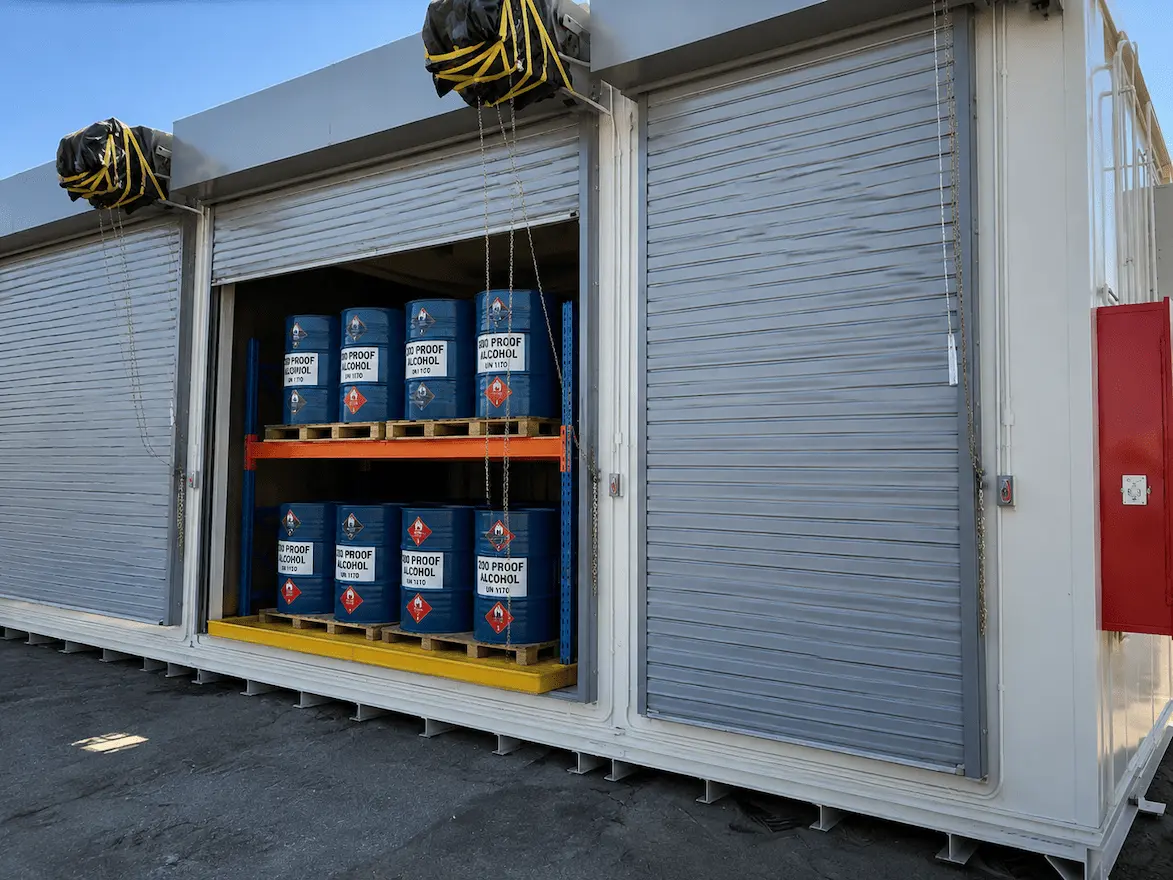
Tight-head steel drums with compatible bung seals and properly maintained closures are the standard container format for bulk storage. Our specialized chemical storage solutions include containment and storage configurations built for high-purity flammable solvents in this classification, covering ethanol and the related materials that appear alongside it in pharmaceutical, biotech, and advanced industrial processing environments.
FDA Compliance When the End Use Is Regulated Manufacturing
The compliance perimeter for 200 proof alcohol expands significantly when the material enters a regulated manufacturing environment. For pharmaceutical operations under current Good Manufacturing Practices, the ethanol used as a solvent, cleaning agent, or excipient must satisfy United States Pharmacopeia specifications.
It must be stored under conditions that protect its grade status, handled with equipment that does not introduce contamination, and documented in a way that supports the facility’s quality system through any audit. A drum that absorbed moisture through an improperly sealed bung, sat in an unclassified storage area, or was sampled outside cGMP procedure has a compromised chain of custody regardless of the CoA that accompanied it at delivery.
Food-grade ethanol carries its own set of storage obligations under FDA 21 CFR Part 110. The storage area, container condition at the time of use, and segregation from incompatible adjacent materials all fall within the scope of a food safety audit. A shared storage room where food-grade ethanol sits beside denatured solvents, pesticides, or other materials with cross-contamination potential is a finding waiting to be written during any FDA inspection.
Laboratory and research applications that rely on 200 proof alcohol add institutional compliance requirements on top of the federal regulatory baseline. While ethanol is not a DEA scheduled substance, many laboratory workflows that use it as a solvent also handle scheduled materials, and the storage arrangement in proximity to those substances may require access controls, inventory documentation, and segregation that go beyond OSHA and NFPA.
Vendor Selection and What the Supply Chain Actually Requires
Sourcing 200 proof alcohol, particularly non-denatured material in bulk configurations, is not the same transactional exercise as ordering a standard industrial chemical. The supply chain is more specialized, the documentation requirements are more extensive, and the lead time can stretch beyond what buyers accustomed to standard procurement windows expect.
A qualified supplier will provide a Certificate of Analysis with every shipment, detailing purity, water content, and confirmation of the absence of adulterants. For USP-grade material, the CoA must reference the applicable USP monograph and confirm specification compliance against it. A supplier who cannot provide that documentation is not an appropriate source for regulated manufacturing applications.
Receiving inspection is a quality checkpoint that belongs in the operational procedure, not reserved for the EHS audit. 200 proof alcohol drums with damaged bungs, visibly compromised seals, or labels that do not match the accompanying CoA may have already lost a portion of their anhydrous character before they are opened.
A receiving protocol that checks bung integrity, closure condition, and label-to-CoA alignment before the material is accepted into inventory costs very little in time and protects the entire downstream process.
TTB-compliant sourcing for non-denatured ethanol requires verified documentation from both buyer and seller, which adds to lead time, particularly for operations establishing a TTB permit for the first time. Building that timeline into the procurement calendar, rather than assuming delivery windows comparable to standard solvent orders, avoids the operational disruption of a manufacturing process stalled on a delayed ethanol shipment.
The Right Sequence Makes the Purchase Straightforward
The procurement decisions that create the fewest downstream problems for 200 proof alcohol all follow the same sequence: resolve the TTB question, confirm the Class IB storage room status, verify the bonding and grounding setup, check containment material compatibility, and engage the AHJ before any equipment is ordered or any configuration is finalized. Every one of those steps is faster and less expensive as a planning task than as a corrective action after an inspection or a delivery.
US Hazmat Storage supports EHS teams and facility managers building compliant storage programs for high-purity flammable solvents, from initial configuration review to engineered storage solutions for materials like 200 proof alcohol and the specialized chemicals that share its storage environment.
If your team is evaluating the infrastructure side of this purchase and wants experienced input before committing, contact US Hazmat Storage and speak with an expert about your specific requirements. Any final storage configuration should be reviewed by a qualified EHS professional, your AHJ, and where SPCC applies, a licensed Professional Engineer before any commitment is made.
FAQ
What is 200 proof alcohol used for in industrial and laboratory settings?
200 proof alcohol serves as a dry solvent in pharmaceutical manufacturing, laboratory extraction, electronics cleaning, and high-purity synthesis. Its complete absence of water makes it necessary for processes where any moisture content would affect the product or outcome.
Does 200 proof alcohol require a dedicated storage room?
Yes, once quantities exceed the inside storage limits in OSHA Table H-12 for a Class IB flammable liquid. The storage room must meet NFPA 30 Section 9.4 requirements for fire-rated construction, mechanical ventilation, and Class I electrical equipment.
Do I need a TTB permit to purchase 200 proof alcohol?
For non-denatured ethanol, yes. The TTB requires an Industrial Alcohol User permit or equivalent for tax-free purchase and use. Denatured versions avoid the excise tax obligation but restrict end-use applications significantly. Confirm permit status before placing any order.
What secondary containment is required for 200 proof alcohol storage?
The sump must hold at least the volume of the largest single container per EPA 40 CFR 264.175. Avoid Buna-N gaskets and seals. Steel, stainless steel, or fluoropolymer-sealed containment units are compatible with high-concentration ethanol.
Can 200 proof alcohol be stored in a standard flammable liquid safety cabinet?
A listed safety cabinet handles small quantities, but drum-scale storage of a Class IB material typically requires a dedicated flammable liquid storage room with rated construction, mechanical ventilation, and Class I electrical components per NFPA 30.
What is the difference between denatured and non-denatured 200 proof alcohol?
Non-denatured is pure ethanol subject to federal excise tax and TTB permit requirements. Denatured contains an adulterant that eliminates the tax obligation but restricts the range of permissible end uses. Pharmaceutical, food-grade, and many laboratory applications require the non-denatured form.
Why does 200 proof alcohol require bonding and grounding during dispensing?
Absolute ethanol has very low electrical conductivity, allowing static charge to accumulate during liquid transfer. That charge is a potential ignition source unless the dispensing container and receiving vessel are bonded to each other and grounded to earth per NFPA 77.
How does ethanol vapor behavior affect storage room ventilation design?
Ethanol vapor is denser than air and settles at floor level rather than dispersing upward. Storage room ventilation must exhaust from low points to capture accumulating vapor and maintain concentrations below NFPA 30 flammable limits.