
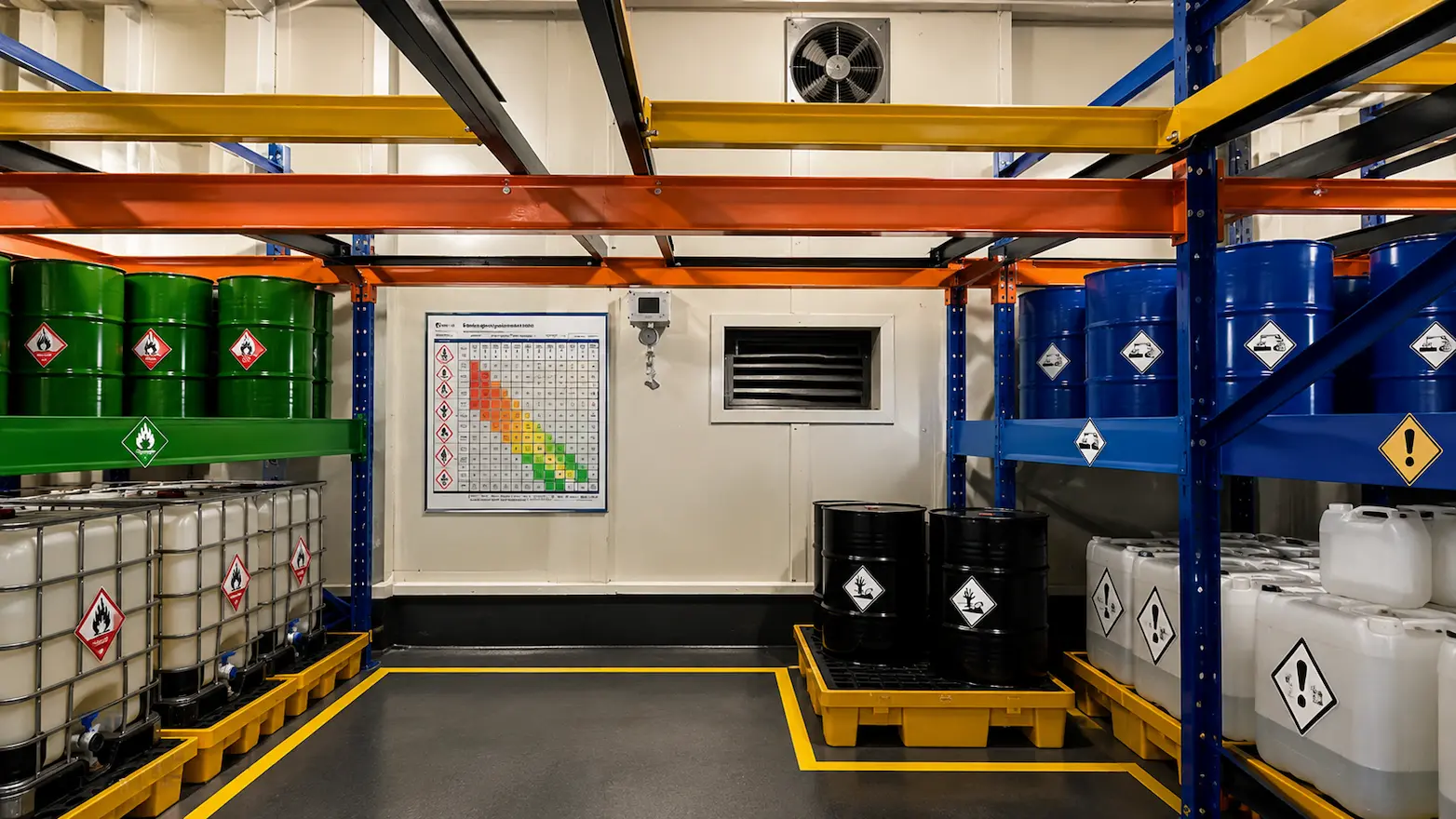
A chemical incompatibility chart is a grid that shows which categories of materials produce dangerous outcomes when they meet. Read one across and down, and each intersection warns of heat, pressure, fire, violent reaction, or toxic gas. It sorts products by how they behave, not by what they are called on the drum.
That distinction changes how a facility uses it. The chart never speaks about a single product in isolation. It speaks about pairs, which is exactly the question storage raises every day: what happens if these two containers fail in the same place at the same time. A cabinet holding one material has no incompatibility problem. Put a second material beside it and the grid becomes the governing document.
At US Hazmat Storage, we spend most of our early conversations with plant and EHS teams here, well before anyone talks about buildings. A chemical incompatibility chart tells you what has to stay apart. The structure is only the answer to that question, and picking the structure first is how facilities end up paying twice.
Why the Chart Belongs to Storage Planning, Not the Lab Bench
Facilities often file the chemical incompatibility chart under process safety and leave it there. That misplaces it. Reactions between stored materials rarely happen in a reactor. They happen on a pallet, in a sump, inside a damaged container, or on a shelf where a jug leaked overnight onto the product below it.
Storage is where incompatible materials sit closest together for the longest time with the least supervision. A drum is unattended for weeks. Nobody is watching the corner of the yard at 2 a.m. when a corroded fitting lets go. The chemical incompatibility chart earns its keep precisely in those uncontrolled hours, which is why it belongs to whoever owns the storage layout.
There is a second reason. Process hazards get engineered controls, interlocks, and written procedures. Storage often gets whatever space is available. Applying the same rigor to the shelf that you apply to the line closes a gap that inspectors, insurers, and fire officials all know how to find.
The Reactivity Groups That Organize Every Chart
Nearly every chemical incompatibility chart resolves into a handful of behavioral families. Acids and bases neutralize violently and generate heat. Oxidizers feed combustion and turn ordinary flammables into a far more energetic fire. Flammables and combustibles supply the fuel. Water-reactive materials release heat or gas on contact with moisture, including humidity. Reactive and unstable products can decompose under conditions that look benign.
The groupings on a chemical incompatibility chart do the heavy lifting because they scale. A facility might hold four hundred distinct products, and no team memorizes four hundred pairwise relationships. Sorted into six or seven families, that same inventory becomes a layout problem a competent team can solve on a whiteboard.
Two pairings deserve particular attention in storage. Oxidizers stored near flammables is the combination that turns a small fire into an unmanageable one, because the oxidizer supplies what suppression is trying to starve. Acids stored near cyanide or sulfide bearing materials can liberate acutely toxic gas. Both belong in the category of separation that distance alone does not solve.
The Regulatory Backbone Behind the Chart
A chemical incompatibility chart is not merely good housekeeping. Under RCRA, incompatible wastes and materials must not be placed in the same container, and a container holding waste incompatible with material stored nearby must be separated from it or protected by a dike, berm, wall, or similar device, per 40 CFR 265.177. The parallel provision at 264.177 applies to permitted facilities.
The regulation also names the reactions it means to prevent: extreme heat or pressure, fire or explosion, violent reaction, and uncontrolled toxic mists, fumes, dusts, or gases. Appendix V to 40 CFR Part 264 lists example groups and the consequences of mixing across them, and EPA states plainly that the list is not exhaustive and that operators must analyze their own materials regardless of what appears on it.
Container material matters as much as neighbor selection. Section 264.172 requires that a container be made of or lined with material that will not react with its contents, so the ability to hold the material is not impaired. A chemical incompatibility chart addresses what sits beside what. Container compatibility addresses what the product is sitting inside. Both questions have to be answered.
Reading the Chart Against Your Safety Data Sheets
A chemical incompatibility chart works at the family level. Your Safety Data Sheets work at the product level, and where the two disagree, the SDS wins. Section 10 identifies incompatible materials and conditions to avoid for that specific formulation. Section 7 covers handling and storage requirements the manufacturer considers necessary.
This matters because formulations are not their labels. Two products in the same hazard family can carry different incompatibilities based on inhibitors, solvents, carriers, or stabilizers. A chemical incompatibility chart cannot see any of that. It sorts by behavior class and stops there, which is exactly what makes it fast and exactly what makes it incomplete.
The working method most reliable teams settle on runs in one direction. Screen the inventory through the chemical incompatibility chart to see the shape of the problem and produce a first grouping. Then verify each grouping against the SDS for every product in it. The chart proposes. The SDS disposes. Reversing that order buries teams in documents before they know what they are looking for.
What the Chart Cannot Do
EPA’s own chemical incompatibility chart carries a caution worth quoting in substance: it indicates some of the hazards expected when mixing chemical wastes, but given the thousands of compounds in circulation, no chart can be definitive or all inclusive. A blank cell does not certify that a mixture is harmless.
That disclaimer is the most useful sentence on the page. A chemical incompatibility chart is a screening instrument, and screening instruments have false negatives by design. Treating a blank as an approval is the error that turns a planning tool into a liability, because the team stops asking questions precisely where the chart stopped having answers.
A chemical incompatibility chart also says nothing about quantity, temperature, container condition, ventilation, or time. Two products may be genuinely fine at bench scale and unacceptable as adjacent pallets of drums in an unconditioned yard in August. Scale and environment are yours to supply. The grid assumes nothing about either.
Turning Groupings Into a Physical Separation Plan
Once the inventory is grouped, the chemical incompatibility chart becomes a floor plan question, and separation runs along a spectrum. The weakest form is aisle distance, which helps with splash and minor spills and does very little in a fire. Stronger forms add a physical barrier, a dike, or a berm, which is the language the regulation itself uses. The strongest form is a separate structure entirely.
Choosing among them is a matter of consequence, not preference. Ask what the realistic worst case looks like if these two groups meet. If the answer is a mess to clean up, distance and containment may be proportionate. If the answer is toxic gas at the property line or a fire that suppression cannot reach, the correct control is a wall or separate building. The severity of the reaction sets the strength of the barrier.
Workflow deserves a vote here too, because separation plans fail operationally more often than they fail technically. If proper segregation means a technician walks an extra four minutes during a production run, materials will drift back toward the door and the plan quietly dies. The layout has to be both defensible on paper and livable at 6 a.m. on a Monday.
The Shared Sump Problem Most Layouts Miss
Secondary containment introduces a failure mode a chemical incompatibility chart exposes but many drawings ignore. Two products separated on the floor are not separated at all if their spills drain to a common sump. Containment gathers liquids. That is its purpose. Gathering incompatible liquids together is the exact event the chart exists to prevent.
The consequence is direct. Incompatible groups need independent containment, not a shared basin with a divider that stops at floor level. That principle drives real design decisions, including separate sumps, individual spill pallets per group, curbing that isolates rather than collects, and drainage that never merges upstream of a treatment or holding point.
It also reaches equipment that most teams never think of as a hazard. An unwashed container that previously held an incompatible material, shared absorbents, a reused funnel, or a common spill kit deployed across two groups can all connect materials the layout worked hard to keep apart. The rule is worth stating simply: anything that can carry residue from one group to another has to be treated as part of the separation plan.
Choosing Storage Once the Chart Is Mapped
Only now does hardware selection become a rational exercise. Grouping determines how many separated environments the site needs, and the answer is almost always more than one. A single cabinet cannot serve four incompatible families no matter how it is labeled. Two groups with mild consequences might share a building with independent containment. Two groups with severe consequences need distance, a rated wall, or their own structures.
Three variables settle most decisions. First, consequence severity, which sets barrier strength. Second, the number of groups, which sets how many separated environments you buy. Third, volume and workflow, which determine whether the answer is a locker at the point of use or a walk-in building near reception. Fire rating enters when a group includes flammables or when the AHJ, code, or an insurer requires it, and plenty of inventories never trigger it at all.
This is where US Hazmat Storage and its chemical storage buildings separate themselves from repurposed containers and general purpose sheds. A structure designed around a compatibility map can deliver independent containment per group, ventilation matched to the vapors present, and access controls that fit the site, rather than forcing a segregation plan into a box that was never drawn for it.
We would rather see a facility’s chart before quoting anything, because the chart is what determines whether one unit or three is the honest answer.
Keeping the Chart Current as the Inventory Moves
A compatibility map is accurate on the day it is drawn and starts aging immediately. Procurement substitutes a product. A vendor reformulates. A new line brings a solvent nobody screened. Waste accumulates in a corner that was never part of the plan. Every one of those events can invalidate a grouping that was correct last quarter.
The practical safeguard is a gate rather than an audit. New products get screened for group assignment before they arrive, not after someone finds a place for them. That single control prevents most drift, because drift almost always enters through receiving. Periodic reconciliation of the physical inventory against the map catches the rest, and it doubles as inspection evidence.
Reviewing a chemical incompatibility chart usually ends with a clearer question than the one a facility started with, and it is rarely the question of which cabinet to buy. If your groupings are pointing toward more separation than your current space can provide, contact US Hazmat Storage and walk us through your inventory, your site, and your workflow. We will help you turn the map into a storage plan.
FAQ
What is a chemical incompatibility chart?
It is a grid showing which material families react dangerously when combined. Each intersection flags outcomes like heat, fire, violent reaction, or toxic gas. It guides separation decisions rather than identifying individual products.
Which chemicals should never be stored together?
Acids and bases, oxidizers and flammables, and acids near cyanide or sulfide materials are the classic pairings. Verify every case against your Safety Data Sheets and applicable regulations before finalizing any layout.
Does EPA require chemical separation in storage?
Yes for hazardous waste. Under 40 CFR 265.177, incompatible materials cannot share a container, and nearby incompatible containers require separation by a dike, berm, wall, or comparable device.
Can a chemical incompatibility chart guarantee safe storage?
No. EPA states its chart cannot be definitive or all inclusive, and blank cells do not confirm safety. Use it to screen, then verify each product against its SDS.
Where do I find incompatibility data for a specific product?
Section 10 of the Safety Data Sheet lists incompatible materials and conditions to avoid. Section 7 covers handling and storage. Product data always overrides a general chart.
Do incompatible chemicals need separate secondary containment?
Generally yes. Shared sumps collect spills into one basin, which defeats floor level separation. Independent containment per incompatible group prevents mixing during the leak the system exists to control.