
For many facilities, not having a modular chemical storage becomes a problem before anyone is ready for a full construction project. Inventory grows, production changes, new materials arrive, an inspection raises concerns, or an outdoor storage area no longer supports the way the site operates. When that happens, the facility needs a safer and more organized storage solution, but traditional construction can take time, budget, approvals, and operational coordination that the business may not have available.
The truth is that results a practical option for facilities that need capacity without waiting through a long buildout. Instead of designing and constructing a storage room from scratch inside the facility, a modular unit can be planned, fabricated, delivered, and positioned according to the site’s storage needs.
For EHS managers, plant managers, operations teams, manufacturers, laboratories, utilities, and industrial sites, the benefit is not only speed. The real value is control. A modular approach helps teams think through chemical compatibility, access, containment, ventilation, fire protection needs, workflow, and future growth before storage becomes a daily problem.
US Hazmat Storage helps facilities evaluate chemical storage solutions that fit real materials, real site conditions, and real operational demands.
Why Traditional Construction Can Slow Down Chemical Storage Planning
Traditional construction has its place, especially when a facility is building a permanent expansion or redesigning a large process area. The challenge is that chemical storage needs often appear faster than construction timelines can move.
A company may need additional space because:
- Chemical inventory has increased
- A new process requires different storage conditions
- Existing storage is overcrowded
- Indoor space is limited
- Materials need better separation
- A temporary workaround has become a long-term risk
- Outdoor storage needs stronger protection
- The facility is preparing for an audit or inspection
- Production changes require faster storage decisions
Traditional construction may involve architectural drawings, permits, site work, contractors, utilities, inspections, scheduling, and disruption to nearby operations. That process can be difficult when the facility already has an active storage concern.
Modular chemical storage gives teams another path. It allows a facility to address storage needs with a purpose-built structure rather than forcing chemicals into rooms, corners, containers, or areas that were never designed for them.
What Modular Chemical Storage Means
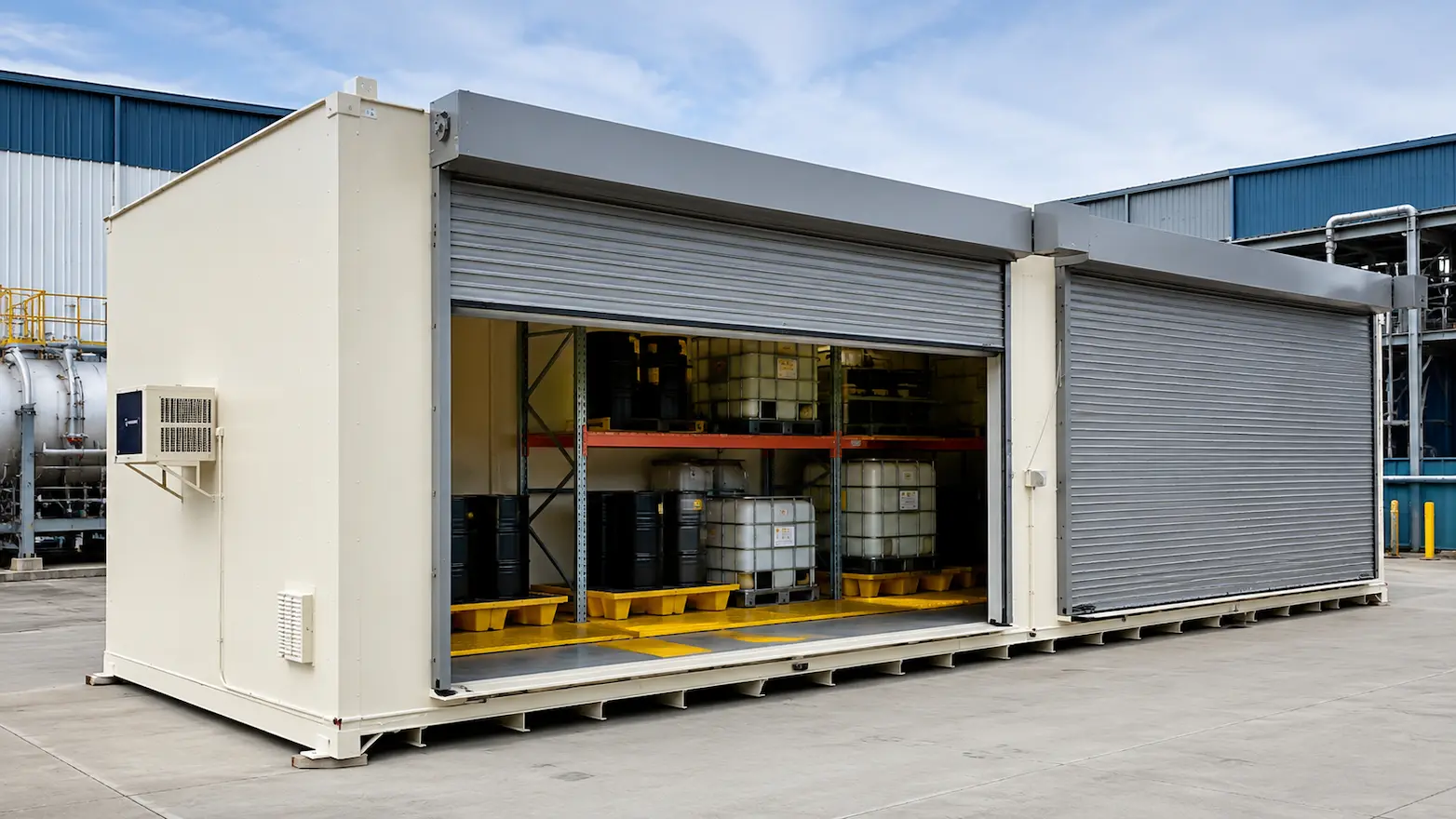
Modular storage refers to a prefabricated or engineered chemical storage structure designed to support safer handling, organization, and containment of hazardous materials. These units can be built for different chemical categories, capacities, and site requirements.
Depending on the application, a modular storage building may support:
- Flammable liquid storage
- Corrosive material storage
- Pesticide or agricultural chemical storage
- Industrial solvent storage
- Drum storage
- IBC storage
- Waste accumulation
- Outdoor hazardous material storage
- Segregated chemical storage zones
A modular structure is not just a box placed outside the building. The right storage solution should be selected around the chemicals, quantities, container types, access needs, local requirements, and daily workflow.
The goal is to create a storage environment that works better than an improvised space and can be integrated into the broader facility safety plan.
Faster Deployment Without Ignoring Planning
Speed is one of the biggest advantages of modular chemical storage, but speed should not mean rushing the decision.
Compared with traditional construction, modular units can often reduce the amount of on-site building work required. This can help facilities move from planning to use more efficiently, especially when storage needs are urgent or tied to a project timeline.
A faster deployment can help when a facility is dealing with:
- New inventory arriving soon
- A production change
- Temporary overstock
- Expansion work
- Seasonal chemical volume
- A shutdown or turnaround
- A compliance-driven storage improvement
The important point is that modular storage still requires proper review. A facility should evaluate the chemicals being stored, the number of containers, compatibility concerns, access requirements, containment needs, and placement on site before choosing a unit.
Fast deployment works best when it is paired with careful storage planning.
Less Disruption to Active Facilities
Traditional construction can disrupt daily operations. Contractors may need access to production areas, walls may need to be modified, utilities may be relocated, and work zones may interfere with employees, deliveries, or material movement.
For active industrial facilities, that disruption can be expensive.
A modular storage solution may reduce that pressure because much of the structure is prepared before it reaches the site. Once delivered, it can often be placed in a designated exterior area, yard, loading zone, or other approved location without requiring major changes to the main facility.
This can be especially useful for facilities that cannot afford long interruptions, such as:
- Manufacturing plants
- Chemical processing sites
- Utilities
- Laboratories
- Warehouses
- Maintenance operations
- Municipal facilities
- Agricultural supply operations
The benefit is practical. The facility can improve storage capacity while reducing the need to disturb the core operation.
Better Flexibility as Chemical Needs Change
Chemical storage rarely stays the same forever. Materials change. Vendors change. Production volumes shift. A product line grows. A facility adds new services. Seasonal demand creates storage peaks. A permanent room built for one workflow may not adapt well when the operation changes.
Modular chemical storage gives facilities more flexibility because units can be selected, configured, or added based on current and future needs.
A facility may start with one structure and later require additional capacity. Another site may need separate units for incompatible materials. A company planning an expansion may need storage support before the new building is completed.
This flexibility is one reason modular storage is useful for long-term planning. It gives decision-makers a way to address immediate needs while leaving room for future changes.
More Purpose-Built Storage Than a General Room
A traditional room may be structurally sound, but that does not mean it is appropriate for chemical storage. Facilities sometimes try to adapt existing rooms, cages, trailers, sheds, or warehouse spaces because they are available. The problem is that available space is not always suitable space.
A purpose-built modular unit can be selected around the hazards involved.
Key planning features may include:
- Secondary containment
- Ventilation considerations
- Fire-rated construction options
- Explosion relief options where applicable
- Spill control planning
- Material separation
- Secure access
- Weather protection
- Drum or IBC layout
- Forklift access
- Clear labeling and placarding locations
Not every unit needs every feature. The right configuration depends on the chemical profile and site conditions. The advantage is that the storage conversation begins with the materials, not with an empty room that must be forced to work.
Improved Chemical Separation and Organization
Chemical compatibility is one of the most important parts of hazardous material storage. Materials that look similar can require different storage conditions. If incompatible products are stored too close together, a leak or spill can create additional risk.
A modular approach can support better separation by giving facilities a dedicated storage area outside of general inventory zones.
For example, a site may need to separate:
- Flammables from oxidizers
- Acids from bases
- Corrosives from incompatible metals
- Pesticides from general supplies
- Waste materials from usable inventory
- Drums from smaller containers
- Bulk storage from daily-use materials
A dedicated unit can make those storage rules easier to follow. Employees are less likely to place chemicals wherever space is available when the facility has a clear, defined storage location.
Comparison: Modular Storage vs Traditional Construction
| Planning Factor | Modular Chemical Storage | Traditional Construction |
| Deployment timeline | Often faster once requirements are clear | Usually longer due to design, labor, and site work |
| Operational disruption | Can reduce construction activity inside the facility | May disrupt active work areas |
| Flexibility | Easier to add capacity or separate storage needs | Less flexible after construction is complete |
| Purpose-built features | Can be selected around chemical storage needs | May require custom design and retrofits |
| Scalability | Additional units can support growth | Expansion may require more construction |
| Site planning | Requires placement, access, and utility review | Requires broader construction coordination |
| Best use case | Fast, flexible, dedicated storage needs | Large permanent facility redesigns |
This comparison does not mean modular storage is always the only answer. It means facilities should compare both options based on the urgency, chemicals, site layout, budget, and operational impact.
Supporting Outdoor Chemical Storage Needs
Outdoor storage can create challenges that indoor rooms do not always face. Weather exposure, drainage, access routes, security, and emergency response all need attention.
A modular unit can help facilities move chemicals out of crowded indoor areas while still keeping them organized and protected. This can be valuable when indoor space is limited or when materials are better managed in a dedicated exterior storage location.
Outdoor placement should consider:
- Distance from occupied buildings
- Fire lanes and emergency access
- Forklift and vehicle routes
- Ground surface and stability
- Drainage and low spots
- Weather exposure
- Security needs
- Access for inspections
- Proximity to work areas
The unit should be convenient enough to support daily operations, but not placed where it creates traffic conflicts, blocks emergency access, or sits in a poor drainage area.
Cost Control and Budget Predictability
Traditional construction can come with changing costs. Site conditions, contractor schedules, material pricing, change orders, utility work, and delays can affect the final budget.
Modular storage may help facilities control costs by narrowing the project scope. Instead of building a storage room from the ground up, the company can evaluate a defined storage product with clearer specifications.
Cost considerations may include:
- Required storage capacity
- Fire rating or ventilation needs
- Containment requirements
- Delivery and installation
- Site preparation
- Electrical or mechanical needs
- Long-term maintenance
- Expansion plans
The lower-cost choice is not always the safest or most practical. The best value comes from choosing a unit that fits the material, workflow, and expected use. A poorly matched storage solution can create costs later through inefficiency, rework, or safety concerns.
Easier Expansion for Growing Facilities
Growth is one of the main reasons facilities outgrow their existing storage areas. A company may add a new product line, serve larger customers, increase inventory, or change production schedules. When storage capacity is already tight, growth can create immediate pressure.
Modular chemical storage can support expansion because facilities can plan storage in stages. Instead of building one large permanent structure before demand is fully known, a site may add dedicated storage capacity as needs become clearer.
This staged approach can be helpful for:
- Growing manufacturers
- Multi-site operations
- Facilities testing new processes
- Seasonal businesses
- Warehouses adding chemical inventory
- Sites managing temporary overflow
- Operations preparing for long-term expansion
The result is a storage strategy that can change with the business rather than locking the facility into one layout too early.
Compliance Starts With the Right Storage Conversation
Chemical storage compliance depends on the materials, quantities, location, building design, local codes, and how the facility operates. No storage product automatically solves every compliance question by itself.
That said, a modular storage unit can make the compliance conversation more practical because the storage area is defined, purpose-built, and easier to evaluate.
Facilities should review:
- Chemical classifications
- Safety Data Sheets
- Container types and volumes
- Incompatible materials
- Required containment
- Fire protection considerations
- Ventilation needs
- Signage and placarding
- Site-specific requirements
- Local authority guidance
US Hazmat Storage helps to prepare your storage planning with these questions in mind, so the selected solution supports the facility’s broader safety and compliance goals.
Common Mistakes Modular Storage Can Help Avoid
A modular storage strategy can reduce several common storage problems, especially when facilities have relied on improvised storage for too long.
Common problems include:
- Storing chemicals in general warehouse areas
- Mixing incompatible materials because space is limited
- Using rooms without proper containment
- Allowing inventory to grow without reviewing capacity
- Keeping drums in traffic-heavy areas
- Choosing storage based only on available floor space
- Delaying action until an inspection or incident
- Forgetting future growth
- Underestimating outdoor placement needs
- Treating temporary storage as informal storage
The biggest mistake is assuming that chemical storage is only a space issue. In reality, it is a safety, workflow, and planning issue.
When Traditional Construction Still Makes Sense
Traditional construction may still be the right choice in some cases. A facility building a large permanent expansion, installing complex process infrastructure, or redesigning a full production area may need a custom-built space.
Traditional construction may make sense when:
- Storage is part of a major building expansion
- The facility needs a highly customized permanent room
- Chemical storage must connect directly to process systems
- The project includes extensive utility integration
- The site has long-term fixed capacity needs
The point is not to reject construction. The point is to avoid defaulting to construction when a modular option may solve the problem faster and with less disruption.
For many facilities, the best decision comes from comparing both paths early.
How US Hazmat Storage Helps Facilities Plan Modular Storage
US Hazmat Storage works with facilities that need chemical storage solutions built around real-world use. A good storage plan begins by understanding the materials, quantities, site layout, access needs, and operational pressures behind the storage challenge.
A facility may need a modular building for flammable liquids. Another may need segregated space for corrosives. Another may need outdoor drum or IBC storage to relieve pressure inside the main building. Each situation requires a different review.
US Hazmat Storage can help teams evaluate:
- Material categories
- Storage volume
- Drum or IBC needs
- Indoor or outdoor placement
- Containment requirements
- Access and workflow
- Fire-rated options
- Ventilation needs
- Site growth expectations
The goal is to match the storage solution to the operation, not force the operation into a generic structure.
Build Storage Capacity Without Slowing the Facility Down
Chemical storage needs do not always wait for long construction timelines. When inventory grows, workflows change, or existing spaces become overloaded, facilities need a practical way to improve storage without creating unnecessary disruption.
Modular chemical storage offers a flexible alternative to traditional construction by helping teams add dedicated storage capacity, improve organization, support separation, and plan around real facility conditions.
US Hazmat Storage helps facilities choose modular chemical storage solutions that align with chemical hazards, site requirements, capacity needs, and future growth. Contact US Hazmat Storage, determinate your storage goals and evaluate a modular solution that supports safer, more organized operations.
FAQ
What is modular chemical storage?
Modular chemical storage refers to prefabricated storage buildings or units designed to store hazardous chemicals in a dedicated, organized environment.
How is modular chemical storage different from traditional construction?
Modular storage is typically prefabricated and delivered to the site, while traditional construction requires more on-site building work and coordination.
Is modular chemical storage suitable for hazardous materials?
Yes, when the unit is selected around the material type, quantity, compatibility needs, containment requirements, and applicable site conditions.
Can modular chemical storage be used outdoors?
Yes. Many modular storage units are designed for outdoor placement, but site conditions, drainage, access, and weather exposure should be reviewed.
Does modular chemical storage help with compliance?
It can support compliance planning by creating a defined storage area, but facilities still need to review applicable codes, chemical data, and local requirements.
Who should consider modular chemical storage?
Manufacturers, laboratories, utilities, warehouses, maintenance departments, agricultural operations, and industrial sites with changing chemical storage needs may benefit.