
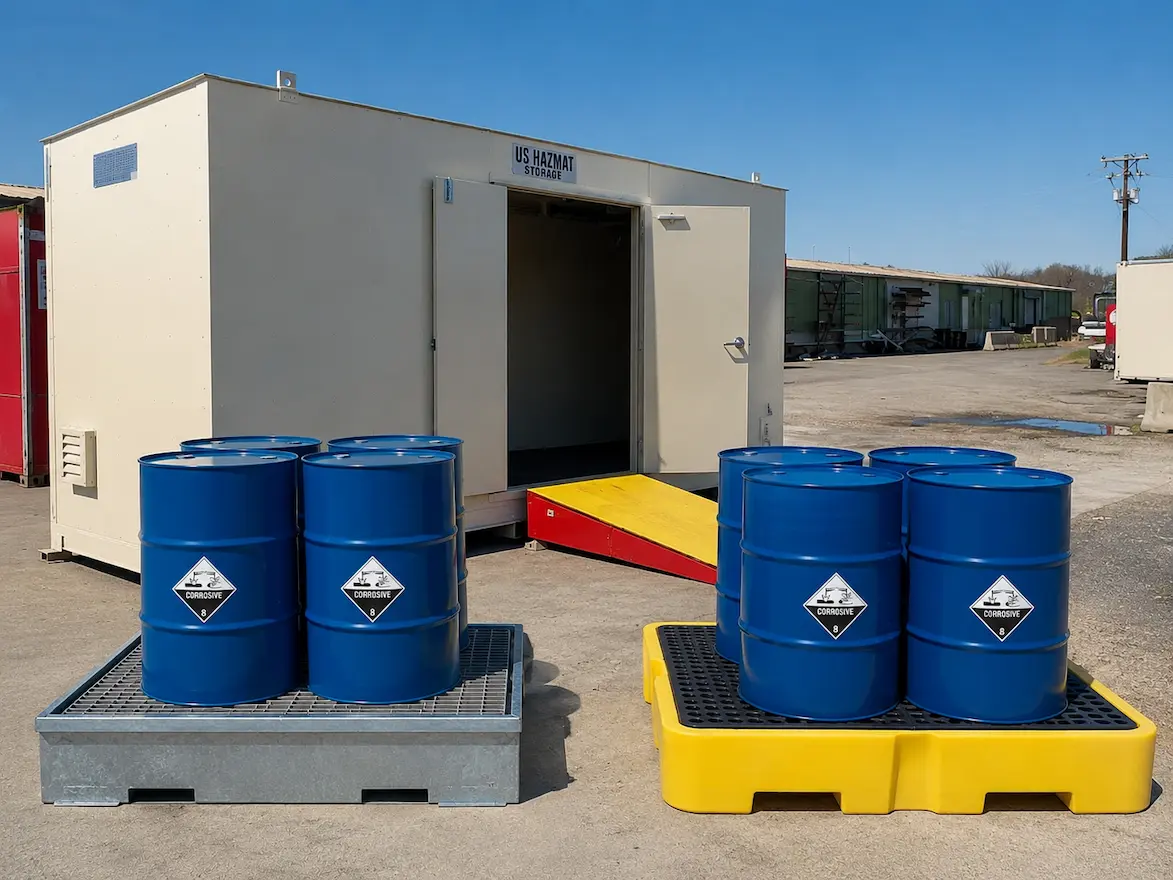
Selecting drum containment pallets for corrosive materials is not just a purchasing decision. It is a compatibility decision, a workflow decision, and a safety planning decision. A pallet that works well for one chemical may be the wrong choice for another if the containment material reacts poorly with the product being stored.
For facility managers, EHS teams, maintenance departments, manufacturers, laboratories, and industrial operators, the question is usually practical: should corrosive drums sit on steel containment or plastic containment?
The answer depends on the chemical, the concentration, the storage environment, the container type, how often drums move, and what the site needs from the pallet during daily operations.
OSHA’s laboratory safety guidance recommends using secondary containment when necessary and keeping incompatible materials separate during storage, use, transport, and disposal. MIT’s chemical storage guidance also notes that acids are commonly stored in vented corrosive cabinets and that incompatible materials should be segregated with secondary containment when needed.
US Hazmat Storage helps facilities think through these details with containment and storage solutions designed to support safer hazardous material management, not just fill floor space.
Why Drum Containment Pallets Matter for Corrosive Materials
Corrosive materials can damage surfaces, containers, racks, flooring, and surrounding equipment if they leak or spill. Even a small release can create a cleanup challenge if the storage area is not designed to control it.
That is why drum containment pallets are used as part of a secondary containment strategy. Their job is to help keep leaks and spills from spreading beyond the storage footprint, giving the facility more control while a response plan is activated.
A good containment decision should consider:
- What chemical is stored
- Whether the chemical is acidic or alkaline
- The concentration of the material
- Drum size and number of drums
- Indoor or outdoor placement
- Frequency of drum handling
- Forklift or pallet jack access
- Spill response procedures
- Compatibility between the pallet and stored material
For corrosive materials, the pallet material matters as much as the pallet capacity.
Steel vs Plastic: The Main Difference
Steel and plastic containment pallets serve the same broad purpose, but they behave differently under corrosive exposure.
Steel is valued for strength, rigidity, durability, and heavy-duty industrial use. Plastic, especially high-density polyethylene in many containment products, is often preferred where corrosion resistance is the priority.
That does not mean plastic is always better or steel is always wrong. It means the storage choice should begin with chemical compatibility.
| Pallet Material | Common Strength | Main Concern With Corrosives |
| Steel | Strong, durable, heavy-duty support | May corrode if exposed to incompatible acids or corrosive liquids |
| Plastic | Corrosion-resistant for many chemicals | May have lower heat tolerance or impact resistance depending on design |
| Coated steel | Added surface protection | Coating damage may expose metal underneath |
| Specialized containment | Matched to specific hazards | Requires careful review of chemical and site conditions |
The best choice depends on the actual chemical profile, not the category name alone.
When Plastic Drum Containment Pallets Make Sense
Plastic drum containment pallets are often considered for corrosive materials because they are less vulnerable to rust and corrosion than bare steel. This can make them a practical option for many acids, caustics, and other corrosive products when the plastic is compatible with the chemical.
Plastic containment can be especially useful when the priority is chemical resistance rather than high structural load performance.
Facilities often consider plastic pallets when they need:
- Corrosion resistance
- Lightweight handling
- Easy cleaning
- Indoor chemical storage support
- Compatibility with many acids or bases
- Reduced concern about rust from incidental exposure
A plastic pallet may be a better fit when drums are handled carefully, stored indoors, and the main concern is preventing corrosive contact with floors or nearby materials.
However, plastic is not automatically compatible with every corrosive. Teams should still review the Safety Data Sheet, manufacturer compatibility charts, chemical concentration, temperature, and expected exposure time before making a selection.
When Steel Drum Containment Pallets May Be Appropriate
Steel containment pallets may be used where durability, impact resistance, and heavy-duty industrial performance are major priorities. In facilities with frequent forklift activity, heavier drums, outdoor exposure, or rugged work conditions, steel can offer practical advantages.
Steel may make sense when the materials being stored are compatible with the pallet design, the finish is suitable, and the facility has a plan to manage corrosion risk.
Steel containment may be considered for:
- Heavy-duty drum handling
- Industrial yards
- Frequent movement
- Higher impact environments
- Long-term structural durability
- Situations where chemical compatibility supports steel use
The concern is corrosive exposure. If an acid, caustic, or other corrosive liquid attacks the steel surface, the containment system can weaken over time. Coatings can help, but coatings also need inspection. Scratches, dents, chips, or worn areas may expose the steel underneath.
For this reason, steel should not be selected only because it looks stronger. It should be selected because it fits the chemical, the environment, and the way the site handles drums.
Chemical Compatibility Comes First
The most important step is checking compatibility before buying or deploying any containment pallet.
Corrosive materials vary widely. Some acids may require one type of containment material, while strong bases may require another. Concentration, temperature, and exposure duration can change the decision.
Facilities should review:
- Safety Data Sheet storage guidance
- Stability and reactivity information
- Manufacturer chemical compatibility charts
- Pallet material specifications
- Drum material and closure type
- Expected spill or leak exposure
- Indoor or outdoor conditions
- Local EHS or authority requirements
Brown University’s chemical storage guidance notes that a properly maintained chemical inventory can reduce inherent hazards, and MIT recommends reviewing SDS stability and reactivity information for compatibility before storage decisions.
This is where many storage mistakes begin. A facility may choose drum containment pallets based on price, load rating, or availability without checking whether the pallet material is suitable for the actual corrosive being stored.
Comparing Steel and Plastic for Daily Facility Use
The best choice is rarely based on one factor. A facility may prefer plastic for corrosion resistance but need steel for rugged handling. Another site may want steel for durability but choose plastic because the chemical profile makes corrosion a bigger concern.
| Decision Factor | Steel Pallets | Plastic Pallets |
| Corrosion resistance | Depends on coating and chemical compatibility | Often strong for many corrosives when compatible |
| Heavy-duty impact resistance | Usually stronger | Varies by product design |
| Weight | Heavier | Lighter |
| Cleaning | May require more attention if coating is damaged | Often easier to rinse and maintain |
| Outdoor durability | Strong, but corrosion must be managed | UV and temperature exposure should be reviewed |
| Chemical compatibility | Must be checked carefully | Must still be checked carefully |
| Best fit | Rugged industrial handling | Corrosive material storage where compatible |
This comparison is a starting point, not a final answer. The actual material stored should guide the decision.
Capacity and Spill Control Considerations
Material compatibility is only part of the decision. Capacity also matters.
A containment pallet should be sized for the number and volume of drums being stored. If a pallet cannot contain a likely release scenario, it may create a false sense of security.
Facilities should evaluate:
- Number of drums stored
- Drum volume
- Pallet sump capacity
- Whether drums are full, partially full, or waste containers
- Drainage or removal procedures
- Spill response equipment nearby
- Accessibility during response
For corrosive storage, capacity and compatibility should be reviewed together. A pallet with adequate volume is still not suitable if the corrosive material can degrade it.
Indoor vs Outdoor Placement
Where the pallet sits can change the best choice.
Indoor areas often have more controlled conditions, less weather exposure, and shorter response distances. Outdoor areas introduce rain, UV exposure, temperature changes, wind, traffic, and surface drainage concerns.
Outdoor storage may require additional planning around:
- Covered storage
- Weather exposure
- Rainwater accumulation
- Ground stability
- Security
- Forklift routes
- Inspection frequency
- Emergency access
Plastic pallets may resist corrosion well, but outdoor UV exposure and temperature extremes should be reviewed. Steel may handle rugged site conditions well, but corrosion risk increases if coatings are damaged or if the pallet is exposed to weather and corrosive materials.
The right drum containment pallets should match both the chemical and the location.
Maintenance and Inspection Practices
Even the right pallet can become a problem if it is not inspected.
Containment systems work best when they are part of a routine review. This does not need to be complicated, but it should be consistent.
A practical inspection should check:
| Inspection Area | What To Look For |
| Pallet surface | Cracks, corrosion, coating damage, warping, or wear |
| Sump area | Liquid accumulation, debris, residue, or staining |
| Drum condition | Leaks, bulging, corrosion, damaged closures |
| Labels | Clear product identification and hazard information |
| Access | Clear aisles and safe drum movement |
| Compatibility | No incompatible materials stored together |
| Spill supplies | Absorbents and response tools available nearby |
Case Western Reserve’s chemical compatibility guidance recommends storing chemicals by hazard class rather than alphabetically, and the University of Maryland notes that secondary containment can help keep incompatible materials from accidentally contacting one another.
Inspection is especially important for corrosive materials because damage may not always be dramatic at first. Small stains, coating wear, or recurring residue can signal a larger compatibility or handling issue.
Common Mistakes When Choosing Drum Containment Pallets
Many facilities make containment decisions under time pressure. A shipment is arriving. A storage room is full. A project starts sooner than expected. In those moments, it is easy to focus on quick capacity instead of long-term suitability.
Common mistakes include:
- Choosing based only on price
- Assuming all plastic pallets handle all corrosives
- Assuming steel is always stronger and therefore safer
- Forgetting chemical concentration
- Ignoring coating damage on steel pallets
- Using pallets with insufficient sump capacity
- Mixing incompatible materials on the same pallet
- Placing pallets where forklifts can easily strike them
- Allowing rainwater to fill outdoor sumps
- Failing to inspect pallets after spills or leaks
Avoiding these mistakes starts with a better review process.
A Practical Selection Framework
Before choosing between steel and plastic, facility teams can use a simple decision path.
| Question | Why It Matters |
| What corrosive material is stored? | Determines compatibility requirements |
| What is the chemical concentration? | Higher concentrations may affect material choice |
| How many drums are stored? | Determines capacity and layout |
| Is storage indoor or outdoor? | Changes weather, UV, corrosion, and access concerns |
| How often are drums moved? | Impacts durability and handling needs |
| Are forklifts used nearby? | Affects impact protection and placement |
| Can the pallet be inspected easily? | Supports maintenance and spill control |
| Are incompatible materials nearby? | Reduces accidental mixing risk |
| Is this temporary or permanent storage? | Guides product choice and investment level |
This framework helps teams evaluate drum containment pallets as part of the storage system, not as isolated equipment.
How US Hazmat Storage Helps Facilities Choose Better Containment Solutions
US Hazmat Storage works with facilities that need more than a generic storage product. Corrosive material storage requires attention to chemical compatibility, containment capacity, access, inspection, and the operating environment.
A manufacturing site may need rugged containment for high-use areas. A laboratory or maintenance department may prioritize corrosion resistance. An industrial facility may need containment pallets as part of a larger chemical storage building, cabinet, or outdoor storage plan.
US Hazmat Storage helps teams evaluate containment options based on:
- Stored chemicals
- Drum volume
- Site layout
- Handling methods
- Indoor or outdoor placement
- Storage duration
- Workflow and access needs
- Broader hazardous material storage goals
The right containment choice supports daily operations while helping reduce unnecessary risk around corrosive materials.
Choose Containment Around the Chemical, Not the Pallet
Steel and plastic both have a place in hazardous material storage, but neither should be selected by habit. For corrosive materials, the safest starting point is always compatibility.
A plastic pallet may be the better choice for many corrosive liquids when the material is compatible. A steel pallet may be appropriate when durability, impact resistance, and site conditions matter, provided the chemical exposure is suitable for that design.
The best decision considers chemical profile, capacity, placement, handling, inspection, and long-term use.
US Hazmat Storage helps facilities choose drum containment pallets and related storage solutions based on real chemical storage conditions, not guesswork. Talk to US Hazmat Storage to review your corrosive material storage needs and choose a containment setup that supports safer, more organized operations.
FAQ
What are drum containment pallets used for?
Drum containment pallets help capture leaks or spills from drums so liquids do not spread across floors, aisles, or nearby storage areas.
Are plastic drum containment pallets better for corrosive materials?
Plastic is often preferred for many corrosives, but compatibility still depends on the exact chemical, concentration, temperature, and exposure time.
Can steel drum containment pallets store corrosive materials?
Sometimes, but only when the chemical is compatible with the pallet design or coating. Corrosive exposure can damage steel over time.
How do I choose between steel and plastic containment pallets?
Start with the Safety Data Sheet, chemical compatibility, drum volume, storage location, handling methods, and inspection requirements.
Do drum containment pallets replace spill response planning?
No. They support spill control, but facilities still need response procedures, trained personnel, inspections, and proper cleanup supplies.
Should incompatible chemicals share the same containment pallet?
No. Incompatible chemicals should be separated to reduce the risk of an accidental reaction if a leak or spill occurs.