
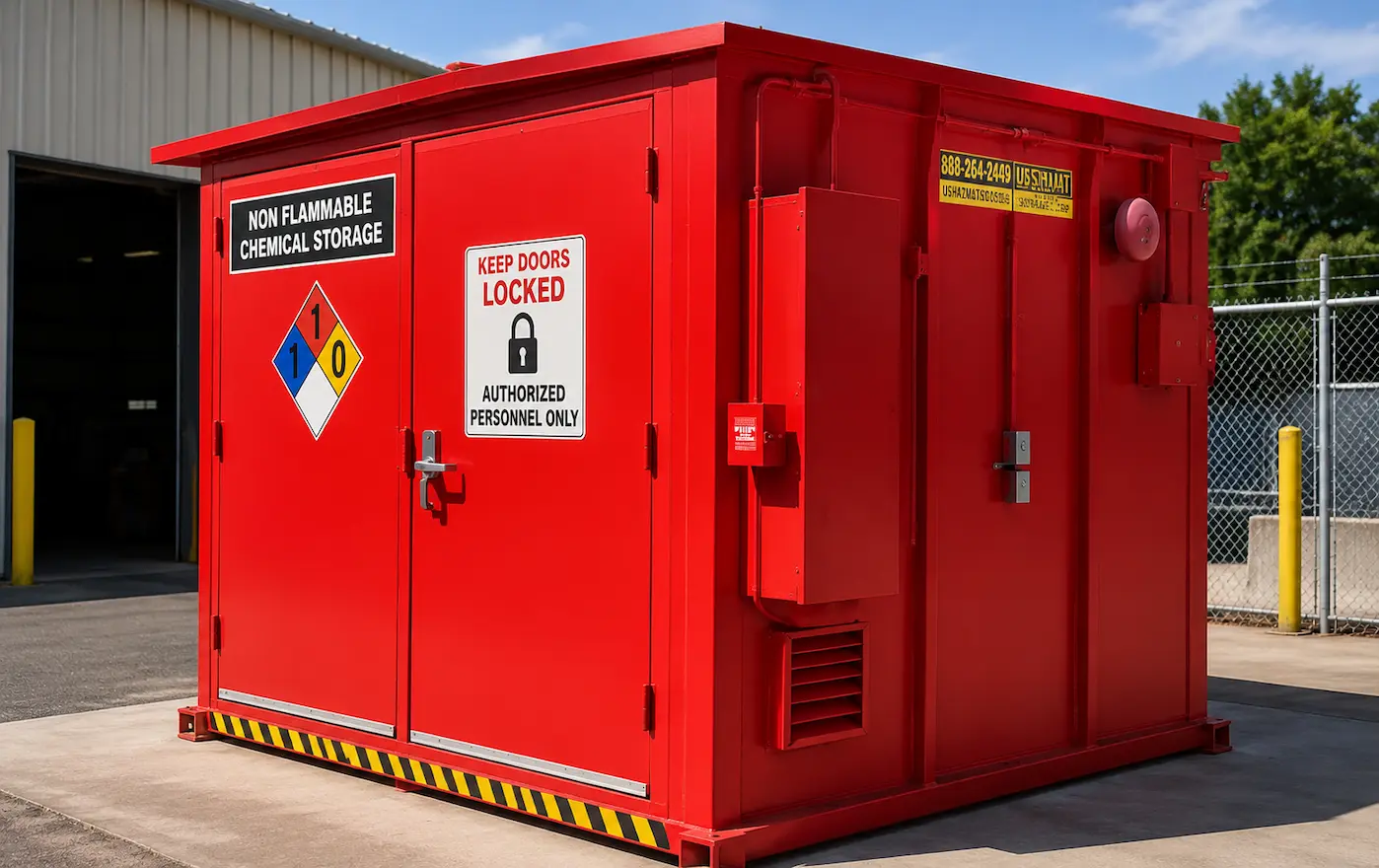
Non flammable chemical storage is the practice of holding materials that will not ignite but remain hazardous in every other way. Corrosives that blind on contact, acutely toxic liquids, oxidizers, pesticides, and industrial concentrates all fall here. The absence of a flash point removes one hazard. It removes nothing else.
That single fact reorders the whole security question. When a building carries a fire rating, the structure itself is doing visible work against the dominant threat. Strip the fire hazard away and the threat that remains is a person: someone who should not have reached the material, whether that person intended harm, wanted to steal something valuable, or simply opened a door out of curiosity and found a drum of concentrated acid.
At US Hazmat Storage we watch this misread often enough to name it plainly. Teams treat a non-flammable chemical storage unit as the low-stakes option and specify it accordingly, with a padlock from the hardware aisle and a spot behind the shop. The materials inside did not agree to be low stakes. We would rather have the harder conversation early, because access control is not a feature you bolt onto these units later. It is the reason they exist.
Why Access Control Carries the Load Here
Every non flammable chemical storage decision distributes protection across some mix of structure, distance, containment, and access. Fire-rated buildings spend most of their budget on the structure because a fire is indifferent to who is authorized. The material sits stable and inert until a person changes its condition, which means the control that matters most is the one governing people.
Consider what actually goes wrong with a drum of sodium hydroxide. It does not spontaneously fail. Somebody opens it, moves it, drops it, or transfers it into an unmarked container. Nearly every realistic bad outcome begins with access, and access is the one variable a facility can fully engineer.
There is an uncomfortable corollary. Because non flammable chemical storage looks unremarkable and carries no fire rating, it invites the least scrutiny during design review, and receives it. A fire marshal interrogates a flammable building. Nobody interrogates the corrosive locker. The gap between hazard held and attention paid is where incidents live.
The Federal Security Mandate Is Currently Dormant
Here is the piece most published guidance still gets wrong. The Chemical Facility Anti-Terrorism Standards, the federal program that governed security at high-risk chemical facilities, lost its statutory authority on July 28, 2023. CISA has stated plainly that it cannot enforce compliance with the CFATS regulations at this time, and the Chemical Security Assessment Tool was taken offline with the lapse.
That cuts both ways. Facilities that once submitted Site Security Plans and reported chemicals of interest no longer carry those federal obligations, and personnel with access to dangerous chemicals are no longer vetted against terrorist screening databases. Roughly 3,200 previously designated high-risk sites now operate without that backstop.
CISA still encourages voluntary measures through its ChemLock initiative and has asked Congress repeatedly to reauthorize the program.
The practical translation for anyone specifying non flammable chemical storage is direct. Security here is currently a decision your organization owns, not a box a federal inspector checks. OSHA’s general duty clause, state chemical and environmental rules, your insurer’s underwriting requirements, and ordinary negligence liability all remain fully in force.
The mandate went dormant. The consequences never did. Verify current status with your own counsel before relying on any of this, since reauthorization could change the picture.
What Security Is Actually Protecting Against
Security discussions around non flammable chemical storage drift toward dramatic scenarios and skip the ones that actually occur. Theft and diversion are real, and the target is rarely exotic. Concentrated acids, oxidizers, and certain pesticides carry black market value or illicit utility, and a drum removed from an unsecured yard is not reported missing until inventory reconciliation, which may be weeks.
Tampering deserves equal weight. A former employee, a contractor with a grievance, or an intruder can introduce something into a container far more easily than remove one, and the contamination reaches your customers before anyone knows the seal was broken. Units holding process inputs are, functionally, a point of entry into everything you make.
Then there is the ordinary category, which produces the most incidents by volume. An untrained employee opens the unit looking for something else. A driver stages a pallet in the wrong place. A teenager climbs a fence. None of it requires malice, and all of it yields to the same control.
Layering Access From the Fence to the Container
Non flammable chemical storage that depends on one barrier fails when that barrier fails. Layering assumes each control will eventually be defeated and asks what stands behind it. The outermost layer is the site itself: perimeter fencing, gates, lighting, and whatever separates your property from public ground. It is a filter, not a wall.
The second layer is the unit. A purpose-built non flammable chemical storage structure contributes here through wall construction that resists forced entry, door hardware rated for the job, hinges that cannot be pulled from the outside, and the absence of climb points or reachable openings. This is where repurposed sheds and standard connex boxes fail. They were built to keep weather out, not people, and their door hardware announces it.
The third layer works inside the unit, and most facilities skip it entirely. Higher-hazard materials can be secured separately within the building, so that defeating one door does not surrender everything. Container-level controls, segregated cages, and separate compartments mean an intruder who gets through the first two layers still faces a decision rather than a buffet.
Keys, Records, and the Accountability Problem
A non-flammable chemical storage lock is only as good as the list of people who can open it. Key control is the least glamorous element of non flammable chemical storage security and the one that most reliably decays. Keys get copied. A supervisor leaves and the key does not come back. A spare lives in an unlocked desk drawer that everyone in the department knows about.
Access to this storage should be limited to people trained on the hazards inside, and that roster should be a document rather than a memory. When someone leaves the role, access ends the same day, which is straightforward with electronic credentials and requires actual discipline with physical keys. Rekeying after a contentious departure is inexpensive compared to the alternative.
An access record turns security into something you can prove. Knowing who entered and when supports investigation, satisfies insurers, and answers the question inspectors and attorneys eventually ask about who could reach the material. Facilities without that record defend the entire roster instead of a short list.
Signage That Informs Responders Without Advertising
Hazard communication and security pull in opposite directions, and pretending otherwise produces bad decisions. Responders need to know what they are walking into. OSHA hazard communication expectations, container labeling, and NFPA placarding all exist so firefighters and employees can read the risk before opening a door. That information is not optional.
The tension is that the same placard tells anyone in your yard what you have and how much. The resolution is not to hide the hazard, which is unlawful and dangerous. It is to control who can stand close enough to read it. Placarding belongs to the unit. Detailed inventories and Safety Data Sheets belong where responders can reach them without entering, and where the public cannot browse.
Access restriction signage does independent work. A posted notice that entry is limited to authorized personnel removes the ambiguity that lets a curious employee talk themselves into opening a door, and it establishes intent if someone ignores it. Signage does not replace training or hardware. It reinforces both every time someone approaches a non flammable chemical storage unit.
Placement Decides Who Can Reach It
Where non flammable chemical storage sits determines its security posture before anyone specifies a lock. A structure at the back fence beside a public road, out of sight of any occupied window, is a different risk than the same structure inside a controlled yard with camera coverage and daily traffic. The hardware did not change. The exposure did.
Visibility is the underrated variable. Units within natural sightlines from occupied areas gain continuous informal observation, which deters far better than a camera nobody monitors live. Placement near loading docks, contractor lanes, or public parking increases the population that passes within reach and should raise the standard accordingly.
Placement also has to answer to workflow, or the security plan defeats itself. Site the unit too far from where materials are used and crews will prop the door, stage containers outside it, or keep working stock somewhere convenient and unsecured. A secured building with a propped door is worse than an honest assessment, because it produces a false sense of a control that no longer exists.
Choosing a Unit That Was Designed for This
Once security drives the non-flammable chemical storage specification, the market splits cleanly. Standard sheds and connex conversions were engineered for weather and volume, and their access control is incidental. Purpose-built non flammable chemical storage is engineered around the assumption that someone will try the door, and it shows in wall construction, hardware, hinge design, and how the containment and ventilation integrate without creating openings.
The honest criteria are narrow. Ask what the material is worth to someone who should not have it, and what it does to whoever reaches it untrained. Ask who can get within arm’s length on your worst day, including contractors, visitors, and anyone crossing the property line. Ask whether the unit can be secured internally so one defeated door does not expose everything, and whether crews can work without defeating the controls themselves.
At US Hazmat Storage, our non-fire-rated chemical storage buildings exist for inventories where fire rating is not what the material demands but protection still is, and we would rather spend the budget where the actual threat lives. Fire rating is the correct answer when flammability is present, and recommending it when it is not simply moves money away from the controls that would have mattered. That is the tradeoff we walk clients through before quoting anything.
Holding the Program Honest Over Time
Security around non-flammable chemical storage degrades quietly. Nothing announces that a hinge has loosened, that three people who left the company still have working keys, or that the gate has been choked open for six weeks because it was inconvenient. Every one of those is a control that exists on paper and nowhere else, and the gap only surfaces during an incident or an audit.
The countermeasure is unremarkable and effective. Walk the unit on a schedule and check hardware, door closure, signage legibility, and whether anything is being stored outside because the inside is inconvenient. That last observation is the most valuable available, because containers staged outside a locked building are the clearest signal that design and work have diverged.
Reviewing security for non flammable chemical storage tends to end somewhere other than where facilities expect, because the question stops being which lock to buy and becomes who can reach this material and what happens when they do. If that question does not have a clean answer at your site, reach out to US Hazmat Storage and walk us through your inventory, your layout, and who moves through it.
FAQ
Does non flammable mean a chemical is safe to store casually?
No. Corrosives, oxidizers, toxics, and pesticides are typically non flammable yet cause severe injury on contact. Removing the fire hazard leaves exposure, theft, and contamination risks fully intact.
Is chemical facility security still federally required?
CFATS lost statutory authority on July 28, 2023, and CISA cannot currently enforce it. OSHA duties, state rules, insurer requirements, and liability still apply. Confirm current status with counsel.
What is the biggest security weakness in chemical storage units?
Key control. Locks are rarely defeated by force. Access usually flows through copied keys, departed employees who kept credentials, and rosters nobody updated after turnover.
Can a standard shed or connex box secure non flammable chemicals?
Generally no. They are engineered for weather and volume, not forced entry. Door hardware, hinges, and wall construction typically fall short of what hazardous inventories warrant.
Should hazard placards be posted if they reveal what is stored?
Yes. Responders must identify hazards before entry, and concealment is unlawful and dangerous. Control who can approach closely enough to read them rather than removing the information.
Where should a chemical storage unit be placed for better security?
Inside a controlled area, within natural sightlines of occupied space, away from public roads and contractor lanes, yet close enough that crews never bypass the controls.