
Outdoor chemical storage used to be judged by one basic question: does the building keep hazardous materials separated from people, weather, and everyday operations? That question still matters, but it is no longer enough for manufacturing plants, industrial sites, laboratories, utilities, and logistics teams handling larger chemical inventories.
A modern storage building now has to support inspection readiness, worker safety, spill control, ventilation planning, temperature awareness, and traceable decision-making. That is where smart monitoring starts to change the conversation. It does not replace a properly engineered storage structure. It helps the people responsible for that structure see risks earlier, respond faster, and document conditions more consistently.
For operations that need chemical storage systems built around real industrial workflows, US Hazmat Storage brings the conversation back to the foundation: manufacturing quality, modularity, containment, and custom building design. The company’s chemical storage category includes hazardous material solutions, fire-rated buildings, non-fire-rated buildings, ISO container conversions, secondary spill containment, hazardous storage lockers, and custom modular options.
Why Outdoor Chemical Storage Is Becoming More Intelligent
The pressure on EHS managers and operations teams has changed. Chemical storage is not only about where drums, totes, or containers sit. It is about how quickly a team can understand what is happening inside and around that storage area before a small issue becomes a shutdown, spill event, fire risk, or inspection problem.
OSHA’s flammable liquids standard addresses design, construction, ventilation, ignition sources, and storage controls for flammable liquid hazards. OSHA’s Safety Data Sheet guidance also explains that SDS documents include chemical properties, physical hazards, health hazards, protective measures, and safe handling, storage, and transport precautions.
Outdoor chemical storage becomes more intelligent when the building, sensors, employee procedures, and documentation work together. A temperature sensor is useful. A temperature sensor inside a properly ventilated, compatible, secondary-contained, access-controlled building is much more valuable. The future is not just a connected device. It is a better storage system with better visibility.
Smart monitoring is especially useful for teams that manage multiple shifts, remote yards, seasonal temperature swings, large totes, or storage buildings placed away from the main production floor. In those environments, nobody wants to depend only on someone walking outside once a day with a clipboard.
What Smart Monitoring Adds to Outdoor Chemical Storage
Smart monitoring systems help teams watch the conditions that can affect stored materials, building performance, and emergency response. Depending on the application, monitoring may include temperature, humidity, ventilation status, sump liquid level, door access, vapor detection, power interruptions, and security events.
NIST has described Industrial Internet of Things systems as connected sensors and devices that can support monitoring, unusual behavior detection, and stronger audit trails for industrial environments. That matters because chemical storage data is not only operational. It may also support maintenance records, internal audits, insurance reviews, and incident investigations.
The goal is not to overwhelm teams with dashboards. The goal is to create practical visibility into conditions that were previously easy to miss. For outdoor chemical storage, that may mean an alert when a sump needs inspection, when interior temperature moves outside an expected range, when a ventilation component fails, or when access happens outside normal hours.
Smart monitoring should support human decision-making. It should not become a false sense of compliance. Sensors can help identify a condition. They cannot decide chemical compatibility, verify every local code requirement, or replace review by a qualified safety professional.
The Physical Building Still Does the Hardest Work
A sensor can report a leak. It cannot contain one unless the building was designed with the right sump, floor, coatings, and containment capacity. A connected device can report heat. It cannot provide fire separation unless the structure was engineered for that purpose.
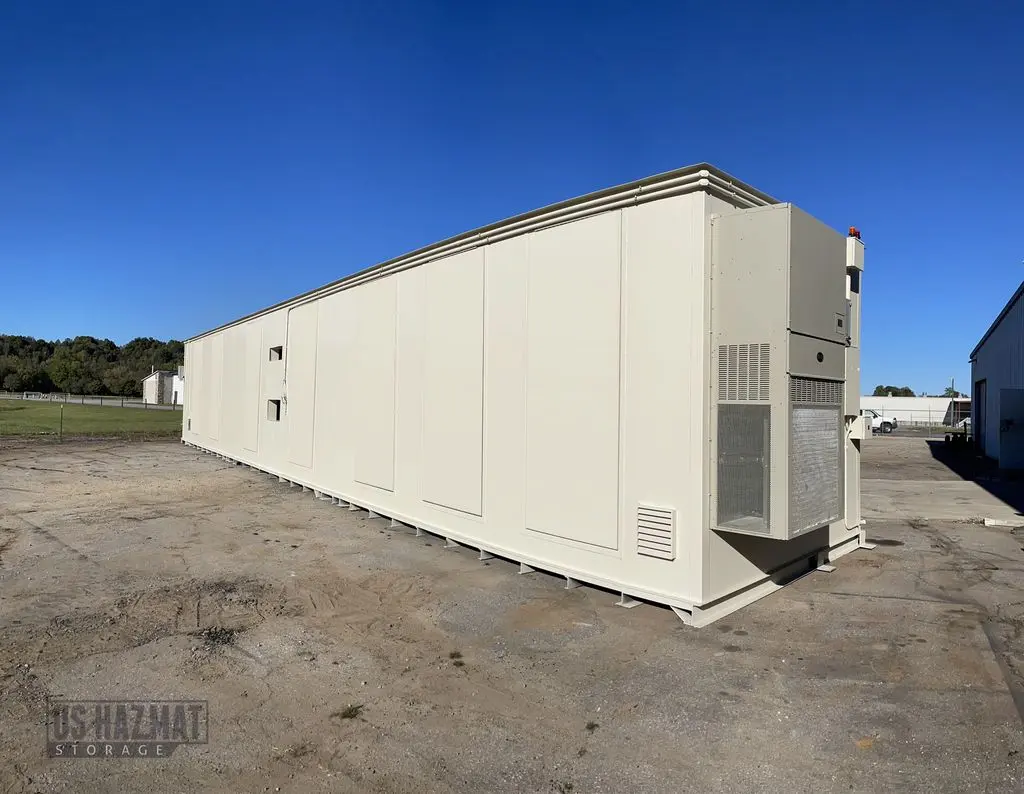
That is why manufacturing quality still sits at the center of outdoor chemical storage. The building must be selected around the chemical class, container type, volume, access pattern, climate exposure, and separation needs. US Hazmat Storage lists solutions such as FireSAFE-4X, FireSAFE-2X, ChemSAFE-X, BoxSAFE-C, and modular PanelSAFE containment structures for different chemical storage needs.
For non-fire-rated applications, US Hazmat Storage also lists customizable chemical storage buildings with mechanical exhaust, secondary spill containment, security, lifting access, and drum or barrel capacity options. Its IBC tote storage page also references custom-manufactured units, forklift access options, static grounding, ventilation, coatings, and secondary containment.
Smart monitoring only becomes valuable after the physical questions are answered correctly:
- What chemicals are being stored?
- Are flammables, corrosives, oxidizers, or pesticides involved?
- What does each SDS say about storage conditions?
- Are materials compatible with each other?
- Are containers drums, IBC totes, pallets, or smaller packages?
- Does the building need fire-rated construction?
- Will employees need forklift, roll-up door, or walk-in access?
- Is the site exposed to extreme heat, cold, wind, or heavy rain?
Once those answers are clear, monitoring can be specified around real risk instead of generic technology.
What to Monitor in an Outdoor Chemical Storage Building
Not every site needs the same monitoring package. A paint and solvent operation may care most about ventilation, vapor risk, and temperature. A pesticide or corrosive storage operation may prioritize containment, humidity, access, and container condition. A remote yard may need security and power-status alerts more than anything else.
| Monitoring Point | Why It Matters | Practical Use |
| Temperature | Some chemicals are sensitive to heat, cold, or freeze-thaw cycles | Helps flag climate conditions that may require review |
| Humidity | Moisture can affect packaging, labels, corrosion, and certain materials | Supports maintenance and housekeeping planning |
| Ventilation status | Ventilation helps control vapor accumulation in applicable storage areas | Confirms fans or exhaust systems are operating as expected |
| Sump or leak detection | Spills can become environmental, safety, or cleanup issues | Alerts teams before containment reaches a critical point |
| Door access | Unauthorized or after-hours entry creates security and safety concerns | Creates a record of access events |
| Power status | Monitoring, ventilation, lighting, and climate control may rely on power | Helps teams respond to outages quickly |
| Vapor detection | Certain operations need early awareness of airborne hazards | Supports investigation and evacuation decisions when applicable |
EPA hazardous waste regulations under RCRA cover hazardous waste identification, classification, generation, management, and disposal. EPA’s Risk Management Program also focuses on preventing accidental releases at facilities that use certain extremely hazardous substances. For regulated facilities, monitoring can support stronger prevention practices, but the equipment still has to fit the broader compliance framework.
Modularity Makes Smart Storage Easier to Scale
The best outdoor chemical storage plan is rarely a one-and-done purchase. Chemical inventories change. Production lines expand. A facility adds a new solvent, coating, cleaning agent, resin, pesticide, or waste stream. A building that worked for five drums may not work for palletized totes two years later.
Modular storage helps teams adjust without rebuilding the entire site. It can support phased capacity, dedicated segregation by chemical class, better access control, and cleaner traffic flow around production areas. Modular design also makes it easier to separate incompatible materials rather than forcing every chemical into one crowded room.
This is where smart chemical monitoring becomes more practical. Instead of one large blind spot, each outdoor chemical storage unit can have monitoring aligned with its contents and risk profile. A flammable liquids building may need one monitoring strategy. A non-flammable pesticide building may need another. A corrosive storage structure may need a different containment and inspection logic.
NFPA 400 consolidates safeguards for the storage, use, and handling of hazardous materials across facilities, while OSHA and EPA requirements may also apply depending on the materials and operation. A modular approach helps teams design around those differences instead of treating every chemical category the same.
A Practical Checklist Before Adding Smart Monitoring
Smart monitoring should be specified after the storage fundamentals are clear. Before investing in sensors, alerts, or dashboards, review the basics:
- Build the chemical inventory from current SDS records.
- Separate materials by compatibility, not convenience.
- Confirm whether the application requires fire-rated or non-fire-rated construction.
- Review secondary containment needs for drums, totes, and pallets.
- Identify temperature, ventilation, humidity, spill, and access risks.
- Confirm power availability and backup needs.
- Decide who receives alerts and what action they must take.
- Document inspection routines so sensor data supports the safety program.
- Review local fire code and authority having jurisdiction expectations.
- Avoid using monitoring as a substitute for engineered storage design.
For outdoor chemical storage, this checklist keeps the technology in its proper place. The building protects the materials. The monitoring system improves visibility. The safety program turns that visibility into action.
Smarter Outdoor Chemical Storage Starts with a Better-Built System
The future of outdoor chemical storage will not be defined by sensors alone. It will be defined by chemical storage systems that combine durable manufacturing, compliant design, modular layouts, secondary containment, controlled access, and smart monitoring that helps teams act before problems grow.
For industrial facilities, that is the real value: fewer blind spots, clearer records, better maintenance planning, and a storage environment designed around the actual materials on site. A connected alert is useful, but it is strongest when it belongs to a building engineered for the job.
US Hazmat Storage supports that next step with custom hazardous material storage buildings built around site conditions, storage volume, access needs, and risk management goals. For teams planning new capacity or improving an existing storage area, the right starting point is a technical review of the building itself, then a monitoring plan that fits the system.
FAQ
What is outdoor chemical storage?
Outdoor chemical storage means placing hazardous or regulated materials in engineered exterior buildings, lockers, or containment systems designed for site-specific chemical risks.
Does smart monitoring make chemical storage compliant?
No. Smart monitoring supports visibility and documentation, but compliance still depends on proper design, containment, classification, training, and code review.
What should smart chemical monitoring track?
Common points include temperature, humidity, ventilation status, leak detection, door access, sump levels, vapor alerts, and power status.
When does a facility need fire-rated chemical storage?
Fire-rated storage depends on chemical class, quantity, location, fire code, insurance expectations, and authority having jurisdiction review.
Can outdoor chemical storage be customized?
Yes. Buildings can be customized for drums, totes, pallets, ventilation, containment, access, climate control, fire rating, and site layout.