
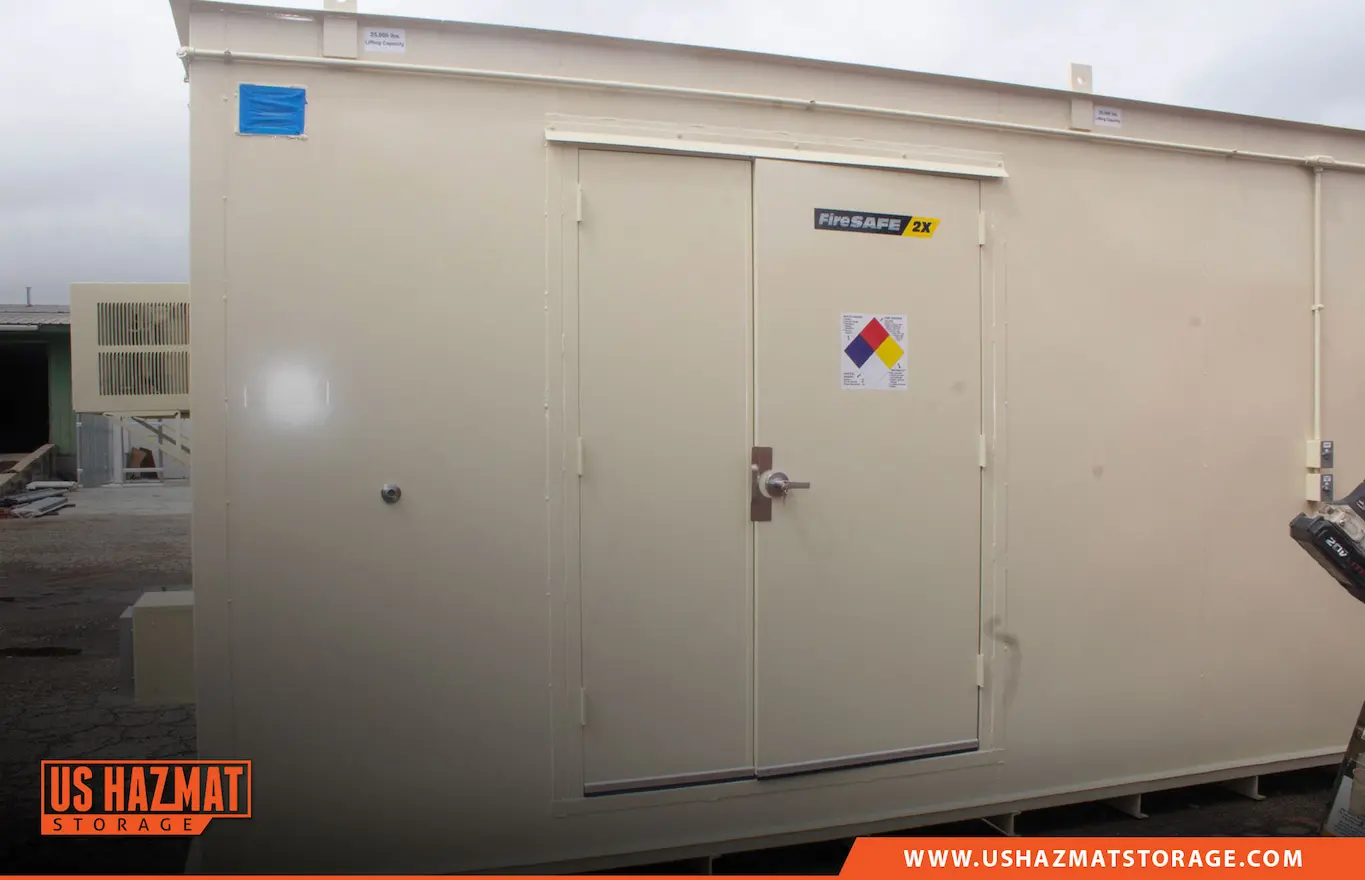
Fire rated lockers can look similar from the outside, but the difference between a 2-hour and 4-hour rating can matter a lot when flammable liquids, hazardous chemicals, high-value inventory, worker safety, and fire code compliance are involved. The choice is not only about buying the “stronger” locker. It is about matching the fire rating to the hazard, location, volume, chemical class, insurance expectations, and the requirements of the Authority Having Jurisdiction.
For many facilities, the question starts simply: is a 2-hour fire rated locker enough, or does the site need a 4-hour fire rated locker? The answer depends on what is being stored, where the locker is placed, how close it is to buildings or property lines, whether dispensing happens near the unit, and what local fire officials require.
At US Hazmat Storage, we approach fire rated lockers as part of a full chemical storage system. Fire rating matters, but it is only one piece. Containment, ventilation, labeling, grounding, separation, access control, and emergency planning all have to work together.
What a Fire Rating Actually Means
A fire rating is not a promise that nothing inside the locker will ever be affected during a fire. It is a standardized way to describe how a tested assembly performs under defined fire exposure conditions for a certain period of time.
In practical terms, a 2-hour fire rated locker is designed around a two-hour fire-resistance standard. A 4-hour fire rated locker is designed around a longer four-hour fire-resistance standard. That longer rating generally supports stronger separation, higher-risk storage conditions, or locations where additional fire endurance is needed.
The key word is assembly. Fire resistance is not only about one panel or one door. The full construction matters, including:
- Wall and roof assembly
- Door construction
- Frame design
- Seals and penetrations
- Ventilation openings
- Electrical penetrations
- Firestopping details
- Overall structural integrity
That is why businesses should avoid treating fire rated lockers as generic storage sheds. A true fire-rated chemical storage solution should come with documentation showing the rating, construction details, and intended use.
When 2-Hour Fire Rated Lockers May Be Enough
A 2-hour fire rated locker may be appropriate when the facility stores flammable or combustible materials in controlled quantities, the unit can be placed with proper separation, and the local fire authority accepts the rating for the application.
These lockers can be a strong fit for operations such as:
- Maintenance shops with limited chemical inventory
- Manufacturing support areas
- Paint and coating storage with controlled volumes
- Automotive or equipment service facilities
- Facilities moving chemicals out of occupied buildings
- Sites that need outdoor flammable chemical storage with documented fire resistance
The main advantage is balance. A 2-hour locker can provide serious fire-rated protection without the added cost and weight of a 4-hour design. For many businesses, that balance is practical and compliant when paired with proper handling procedures and approved containers.
But the rating should never be chosen in isolation. If the stored material is highly flammable, if volumes are large, if the locker sits close to a building, or if local code requires a higher rating, a 2-hour design may not be sufficient.
When 4-Hour Fire Rated Lockers Make More Sense
A 4-hour fire rated locker is usually considered when the risk profile is higher or when the facility needs stronger fire separation. This may be driven by chemical type, stored volume, location, exposure to adjacent buildings, insurance requirements, or local fire code interpretation.
A 4-hour design may make more sense when:
- The locker stores larger quantities of flammable liquids
- The site has limited separation distance
- The unit is near critical infrastructure
- Chemicals have a higher fire or vapor hazard
- The facility has strict insurance or corporate safety standards
- Local authorities require a stronger rating
- The business wants additional risk reduction for severe fire exposure
The added rating can be especially valuable for facilities that cannot easily relocate chemical storage away from occupied buildings or property lines. It may also support stronger emergency planning because the unit is designed for a longer fire-resistance period.
The tradeoff is cost and complexity. 4-hour fire rated lockers typically involve heavier construction, higher material costs, and more planning around delivery, placement, and installation. For some sites, that investment is justified. For others, it may be more protection than the actual hazard requires.
Fire Rated Lockers and NFPA 30 Compliance
NFPA 30 is a key reference point for flammable and combustible liquid storage. It helps shape how facilities think about storage quantity, classification, protection, separation, fire control, and safe handling. OSHA standards also reference fire safety expectations for flammable liquids in workplace settings.
Fire rated lockers can support compliance, but they do not create compliance by themselves. The locker must be part of a larger plan that accounts for:
- Chemical classification
- Container type and approval
- Maximum allowable quantities
- Separation from ignition sources
- Ventilation requirements
- Secondary containment
- Emergency response planning
- Fire suppression or extinguisher placement
- Employee training
- Hazard communication and SDS access
A fire-rated locker is a protective structure. It is not a substitute for proper chemical management. If the wrong chemicals are stored together, if containers are unlabeled, if vents are blocked, or if employees are not trained, the rating alone cannot solve the risk.
Chemical Type Should Drive the Decision
The contents of the locker matter more than the label on the outside. A facility storing lower-risk combustibles does not have the same exposure as a site storing highly volatile flammable liquids. A few small approved containers do not create the same risk as multiple 55-gallon drums or IBCs.
Before choosing between 2-hour and 4-hour fire rated lockers, review:
- Flash points listed on Safety Data Sheets
- Whether materials are flammable, combustible, corrosive, oxidizing, or reactive
- Total stored volume
- Container sizes and types
- Whether chemicals are opened, dispensed, or only stored
- Compatibility between chemicals
- Spill potential
- Vapor generation risk
This inventory should happen before equipment selection. Buying the locker first and trying to force the chemical program to fit later often creates compliance gaps.
Site Location Can Change the Required Rating
The same locker can be appropriate in one location and inadequate in another. Placement matters.
A locker positioned far from occupied structures, property lines, ignition sources, and critical equipment may face different requirements than one located near a building wall, loading area, production line, or high-traffic zone.
Important site questions include:
- How close is the locker to buildings?
- How close is it to property lines?
- Are there nearby ignition sources?
- Is the unit near vehicle traffic?
- Can emergency responders access it?
- Is ventilation directed away from doors, windows, and air intakes?
- Is the locker exposed to heat, direct sun, or severe weather?
- Is the ground level and suitable for the unit?
A 4-hour locker may be selected because the site has less room for ideal separation. A 2-hour locker may be acceptable when the location already reduces exposure. The best choice comes from combining fire rating with site planning.
Fire Suppression, Ventilation, and Containment Still Matter
Fire rating is one layer of protection. It does not replace other engineered safety features.
A strong fire-rated chemical storage setup may also include:
- Built-in spill containment sump
- Chemical-resistant interior surfaces
- Explosion-proof electrical components where required
- Mechanical ventilation when required by code or chemical type
- Grounding and bonding for dispensing operations
- Fire suppression options
- Self-closing or properly rated doors
- Clear hazard signage
- Secure access control
Some facilities focus too much on the hour rating and forget the operational details. That is risky. A 4-hour locker with poor ventilation or incompatible chemical storage can still create serious hazards. A 2-hour locker with excellent placement, containment, labeling, and procedures may perform better as part of a complete safety system than a higher-rated unit used incorrectly.
Cost Difference Between 2-Hour and 4-Hour Fire Rated Lockers
Cost should matter, but it should not be the first filter. The cost difference between 2-hour and 4-hour fire rated lockers usually reflects stronger construction, additional materials, engineering, and rating requirements.
| Cost Factor | Why It Changes |
| Wall and roof assembly | Higher fire ratings usually require more robust construction |
| Door and frame rating | Doors must support the overall fire-rated assembly |
| Penetrations and vents | Openings must be designed without compromising the rating |
| Size and capacity | Larger lockers require more material and engineering |
| Fire suppression options | Added systems can increase cost |
| Electrical classification | Explosion-proof or rated components may be required |
| Delivery and placement | Heavier units may require more planning and equipment |
A lower upfront price can become expensive if the locker fails inspection, has to be relocated, or does not meet insurance requirements. A higher rating can also be unnecessary if the hazard and site do not require it. The right investment is the one that fits the risk.
Common Mistakes When Comparing Fire Rated Lockers
Many compliance problems begin before the locker is delivered. The wrong assumptions lead to the wrong equipment.
Common mistakes include:
- Assuming 4-hour is always required
- Assuming 2-hour is always enough
- Choosing by price instead of hazard classification
- Ignoring local fire marshal requirements
- Forgetting chemical compatibility
- Treating fire rating as a replacement for ventilation
- Overlooking secondary containment
- Placing lockers too close to ignition sources
- Storing unlabeled or poorly documented chemicals
- Buying a unit without rating documentation
These mistakes are avoidable when the decision starts with the chemical inventory, site conditions, and code review.
Documentation You Should Ask For
A fire-rated locker should come with paperwork that supports the claim. If the rating is not documented, the facility may struggle during inspection, insurance review, or internal safety audits.
Ask for:
- Fire rating documentation
- Engineering drawings or product specifications
- Containment capacity details
- Ventilation specifications
- Electrical classification information, if applicable
- Chemical compatibility guidance
- Installation requirements
- Maintenance recommendations
- Applicable compliance references
- Warranty and inspection information
Documentation does not only satisfy inspectors. It helps your safety team train employees, maintain the unit, and prove that the equipment was selected intentionally.
How to Choose Between 2-Hour and 4-Hour Fire Rated Lockers
Use this decision path before buying:
| Question | If Yes | If No |
| Are you storing larger quantities of flammable liquids? | Consider 4-hour or engineered review | 2-hour may be enough |
| Is the locker close to buildings or property lines? | Consider higher fire rating or relocation | 2-hour may fit better |
| Does the fire marshal require a specific rating? | Follow AHJ direction | Continue risk review |
| Are chemicals highly volatile or high hazard? | Consider 4-hour and added protection | Evaluate 2-hour options |
| Are you dispensing from drums or containers? | Review ventilation, grounding, and handling needs | Storage-only may be simpler |
| Does insurance require stronger protection? | Consider 4-hour | Match rating to hazard and code |
This table is not a substitute for code review. It is a practical way to frame the conversation before selecting equipment.
Why the Authority Having Jurisdiction Matters
The Authority Having Jurisdiction, often the local fire marshal or code official, has a major role in approving chemical storage arrangements. A locker that appears suitable on paper may still need adjustments based on local interpretation, site layout, fire access, or local amendments.
That is why early coordination matters. Waiting until after purchase or installation can lead to delays, relocation costs, or equipment changes. A better approach is to confirm expectations before the unit arrives.
US Hazmat Storage helps businesses think through these questions before equipment selection. The goal is to avoid guessing and build a storage setup that is easier to defend during inspection.
Fire Rated Lockers Should Protect More Than Chemicals
The purpose of fire rated lockers is not only to store drums, containers, or chemical inventory. The larger purpose is to reduce risk to people, property, operations, and emergency responders.
A properly selected locker can help:
- Move hazardous materials away from occupied buildings
- Reduce fire spread risk
- Support emergency response planning
- Improve inspection readiness
- Protect inventory and equipment
- Reduce employee exposure to hazardous storage areas
- Strengthen compliance documentation
- Lower operational uncertainty
That is why the 2-hour vs. 4-hour decision deserves careful attention. The rating affects more than the unit. It affects the entire safety plan.
Choosing the Right Rating Starts With the Right Review
The difference between 2-hour and 4-hour fire rated lockers is not just two extra hours on a specification sheet. It is a decision about risk tolerance, chemical hazards, site placement, fire exposure, code expectations, and long-term safety.
A 2-hour locker may be the right fit for facilities with manageable volumes, proper placement, and accepted local conditions. A 4-hour locker may be the stronger choice when hazards are higher, separation is limited, or fire officials and insurers expect added protection.
At US Hazmat Storage, we help facilities move from uncertainty to a clearer equipment decision. Our team can review your chemical inventory, storage goals, site conditions, and compliance concerns, then help match your operation with the right fire-rated chemical storage buildings and locker options. If your site is comparing fire rated lockers, the next step is not guessing. It is choosing a storage system that matches the real risk.
FAQ
What are fire rated lockers?
Fire rated lockers are chemical storage units designed with fire-resistance-rated construction to help protect hazardous or flammable materials during fire exposure.
What is the difference between 2-hour and 4-hour fire rated lockers?
A 2-hour locker is designed around a two-hour fire-resistance rating, while a 4-hour locker is designed for longer rated fire resistance.
Do I always need a 4-hour fire rated locker?
No. The right rating depends on chemical type, quantity, placement, local code, fire marshal requirements, and insurance expectations.
Are fire rated lockers enough for OSHA or NFPA compliance?
Not by themselves. Compliance also depends on labeling, quantity limits, ventilation, containment, separation, training, SDS access, and proper handling.
Can I store 55-gallon drums in fire rated lockers?
Yes, if the locker is designed for drum storage and the stored chemicals, capacity, containment, and code requirements are properly reviewed.
How can US Hazmat Storage help?
US Hazmat Storage can help evaluate chemical storage needs, fire rating options, containment requirements, and fire-rated chemical storage buildings.