
The question facilities teams usually bring to drum storage is a purchasing question: what size, what configuration, how fast can it ship. The question that should come first is a regulatory one: what does a spill containment drum shed have to accomplish under SPCC, OSHA 29 CFR 1910.106, and NFPA 30 for this specific quantity of material, on this site, with this drainage situation. The purchasing answer changes significantly depending on how the regulatory answer lands. Buy the unit first and you might be retrofitting containment that wasn’t sized for your actual drum count, or specifying ventilation that doesn’t match your material’s flash point.
The compliance case for a purpose-built spill containment drum shed isn’t complicated. It is, however, specific. US Hazmat Storage works with EHS managers and facility planners who need to arrive at the right specification before anything ships, not after the inspector has been on-site.
Why the Containment Volume Number Is the Starting Point, Not the Ending Point
SPCC (40 CFR Part 112) and EPA secondary containment guidance set the baseline containment volume requirement at 110% of the largest single container’s capacity. For 55-gallon drums, that number looks simple: 60.5 gallons of containment capacity for a single drum. It stops being simple the moment you add more drums.
NFPA 30 and EPA guidance both allow aggregated containment across multiple containers, but the calculation method isn’t uniform across all applicable codes, and state-level spill prevention requirements sometimes push the percentage higher. Some state environmental agencies require 125% or 150% containment, and a shed specified to federal minimums may still require a variance or additional bunding to pass a state environmental inspection. The containment volume in the product sheet is the floor, not always the ceiling.
The other variable that changes the volume calculation is the material itself. Aqueous solutions with low flash points, certain corrosives, and oxidizers introduce additional EPA and RCRA considerations that affect how containment volume is computed and what the containment surface must be made of. Knowing the specific materials going into the spill containment drum shed before sizing it is not optional. It’s the calculation.
What NFPA 30 Requires That Most Product Pages Don’t Mention
NFPA 30 (2021 edition) governs the storage of flammable and combustible liquids in a way that directly affects how a spill containment drum shed must be configured. The flash point of the material determines the storage category: Class I flammables (flash point below 100°F), Class II combustibles (100-140°F), and Class III combustibles (above 140°F) each carry different maximum allowable quantities and separation distance requirements.
Maximum allowable quantity (MAQ) inside a storage building without automatic sprinkler protection is 120 gallons for Class I liquids in a non-sprinklered structure. That’s two full 55-gallon drums and one partial drum. If the facility plans to store more than two full drums of a Class I liquid inside the spill containment drum shed without sprinkler protection, the configuration is already out of code before the first drum rolls in. NFPA 30 also sets separation distances from property lines, from other storage areas, and from ignition sources, and those requirements apply to the shed as a structure on the site, not just to the drums inside it.
Ventilation requirements under NFPA 30 follow from the same flash point categorization. Class I liquid storage requires mechanical or natural ventilation sufficient to prevent vapor accumulation above 25% of the lower flammable limit. A passive gravity vent system works for many configurations, but the ventilation rate has to be calculated against the internal volume of the spill containment drum shed and the volatility of the stored material. A single static roof vent on a tightly sealed building may not be sufficient.
The Drum Rack Inside the Shed Is a Structural and Compliance Decision
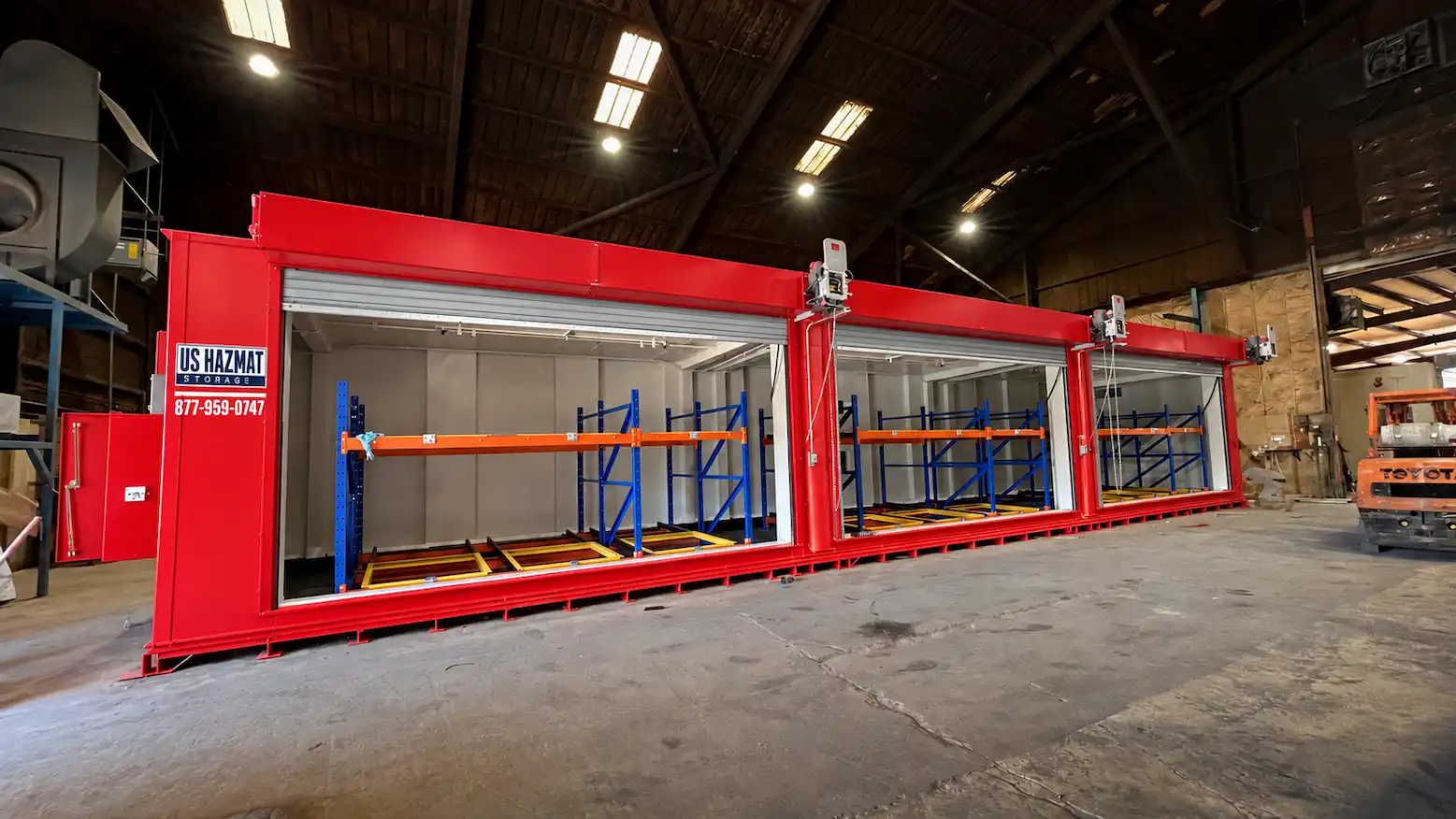
Drum rack configuration affects the containment calculation directly. Stacked drums increase the drum count per footprint but change the fall-arrest and structural loading requirements. Palletized drums on the floor are more accessible and lower the tip-over risk, but the containment sump under the rack needs to be sized for the actual number of drums that can be positioned over it, including any secondary pallets stacked against the wall.
For a 55-gallon drum storage configuration, the position of drum racks relative to the containment sump determines whether the containment math works in practice. A drum rack that overhangs the sump boundary means a spill event doesn’t necessarily route all released material into the containment volume, even if that volume is correctly sized on paper. The sump has to be under every position where a drum can fail, not just under the center position. That’s the kind of specification detail that doesn’t appear in a standard product comparison but determines whether the containment system functions as designed during an actual release event.
Secondary consideration for drum rack selection inside a spill containment drum shed: weight loading. A steel drum rack loaded with full 55-gallon drums of a dense liquid (hydrochloric acid at 9.67 lbs/gallon, for example) imposes concentrated point loads on the shed floor that have to be within the floor’s rated load capacity. That calculation belongs in the specification before the rack goes in, not during the post-installation structural review.
Gas Cylinder Locker Integration: When the Shed Has to Handle Multiple Hazard Classes
Some facilities co-locate drum storage and gas cylinder storage in proximity because the operational workflow demands it. The regulatory answer to whether a gas cylinder locker can share a structure or adjacency with a liquid drum containment shed depends entirely on the hazard classes involved.
OSHA 29 CFR 1910.101 and the Compressed Gas Association standards require that compressed flammable gas cylinders be stored at minimum 20 feet from flammable liquid storage, or separated by a noncombustible barrier of at least 5 feet in height, without exception. A gas cylinder locker positioned adjacent to a spill containment drum shed storing Class I flammables is a code violation unless that barrier is in place and documented. The same separation standard applies when the cylinders contain oxidizing gases, because the oxidizer-flammable proximity creates a different but equally serious hazard profile.
If the operational requirement genuinely demands co-location, the solution is a purpose-built duplex structure with a common wall rated to isolate the two hazard classes and separate ventilation for each compartment. That’s a custom configuration, not a standard product, and it requires engineering documentation specific to the materials stored.
Oil Drum Containment System: Where the EPA Threshold Changes the Specification
The EPA’s oil pollution prevention rule (40 CFR 112) has a threshold that matters for drum storage planning: facilities with aggregate aboveground oil storage above 1,320 gallons are required to have a Spill Prevention, Control, and Countermeasure (SPCC) plan. Fifty-five-gallon drums of petroleum-based oil count toward that aggregate, and a facility storing 24 or more full 55-gallon drums of oil has crossed that threshold.
What that means for the oil drum containment system inside a spill containment drum shed: the containment structures and procedures have to be described in the SPCC plan and inspected on the schedule the plan requires. The spill containment drum shed is not just a storage solution in that context. It’s an inspection-documented element of a federally mandated spill prevention system. That changes how the containment volume, the containment material, the berm height, and the drainage system get specified, because those elements have to match the descriptions in the SPCC plan exactly.
US Hazmat Storage’s secondary containment resource on calculating containment for 55-gallon drums walks through the volume calculation methodology for drum counts from single units to full-building configurations, which is directly relevant to SPCC plan documentation requirements.
Sizing a Spill Containment Drum Shed: What the Footprint Decision Actually Controls
The footprint of a spill containment drum shed controls more than drum count. It controls the aisle width for drum handling equipment, the door width for pallet jack and hand truck access, the ability to rotate drums out of storage for FIFO inventory management, and the emergency egress path if a spill event occurs while personnel are inside.
OSHA 29 CFR 1910.176 governs material handling and storage, including the requirement that aisles and passageways be kept clear and marked. A drum storage footprint that leaves less than 36 inches of clear aisle between drum positions and the shed wall doesn’t meet the handling equipment access standard. That’s not a design preference. It’s a measurement that has to be incorporated into the footprint spec from the beginning.
Door configuration on a spill containment drum shed has its own set of requirements. A single person-door that opens inward is an egress hazard in a liquid spill emergency where the floor of the containment sump may have liquid on it. Standard practice in compliant drum storage structures is an outward-opening door, wide enough for a loaded drum cart, with a threshold that doesn’t require lifting the drum over a raised sill.
Ventilation, Electrical Classification, and the Interplay Between Them
The ventilation specification and the electrical classification of a spill containment drum shed are linked, and specifying one without the other creates a compliance gap. If the shed stores Class I flammable liquids and the ventilation system is passive (natural airflow through vents), the interior of the shed is classified as a hazardous location under NEC Article 500 if the ventilation rate is insufficient to prevent vapor accumulation. That classification requires explosion-proof electrical fittings, explosion-proof lighting, and listed wiring methods.
If the ventilation system is mechanical and designed to maintain vapor concentrations below the hazardous threshold, the NEC classification may not apply to the general interior space; the areas immediately around drum openings and vent connections still carry a local classification that requires listed electrical equipment in those zones. The ventilation system itself, if electrically powered, has to be listed for the environment it’s installed in, including the motor, the fan blades if they’re inside the classified zone, and the wiring between them.
This interplay is why a spill containment drum shed specified with “ventilation included” and “lighting included” in the product sheet doesn’t necessarily mean those components are appropriate for the stored material. It means those components exist. Their suitability for the specific hazard class and stored material has to be verified against the actual product listing and the NEC classification of the space.
What Compliant Spill Containment Drum Shed Delivery and Site Prep Actually Involves
A compliant spill containment drum shed doesn’t begin with the drum storage configuration. It begins with the site. The foundation has to be level, load-rated for the combined weight of the structure and full drums, and either sealed to prevent groundwater infiltration into the containment sump or drained in a way that routes any effluent to an appropriate collection system. An open drain from a containment sump that routes to the storm system is an EPA violation regardless of whether a spill is occurring.
Anchor requirements for a freestanding spill containment drum shed depend on local wind load standards and, in some jurisdictions, seismic zone classifications. A structure that isn’t anchored or is anchored to a base that can’t hold the calculated wind load is a structural failure waiting for the right weather event. That’s a site prep item, not a product-level item, and it has to be resolved before the shed arrives.
US Hazmat Storage provides delivery and installation guidance that covers foundation requirements, anchor specifications, and site drainage considerations for the specific structure being installed. These aren’t afterthoughts in the installation manual. They are the conditions that determine whether the structure performs as designed after it’s in the ground. Contact US Hazmat Storage to see live inventory and request pricing now.
FAQ
How much containment volume does a spill containment drum shed need?
The federal baseline under EPA SPCC guidance is 110% of the volume of the largest single container. For 55-gallon drums, that means a minimum of 60.5 gallons of containment capacity per drum, with some multi-drum configurations requiring containment for the aggregate volume. State regulations vary and may require higher percentages. The specific material stored also affects the calculation.
Does a spill containment drum shed need to meet NFPA 30 requirements?
Yes, if the shed stores flammable or combustible liquids. NFPA 30 governs maximum allowable quantities, ventilation requirements, separation distances from ignition sources and property lines, and construction standards. The specific requirements depend on the flash point classification of the stored material.
Can I store gas cylinders in the same structure as a spill containment drum shed?
Not without a rated separation barrier. OSHA 29 CFR 1910.101 and CGA standards require a minimum 20-foot separation between compressed flammable gas storage and flammable liquid storage, or a noncombustible barrier of at least 5 feet in height. A purpose-built duplex structure with separate compartments can accommodate both requirements in a single footprint.
What electrical standards apply inside a spill containment drum shed?
NEC Article 500 hazardous location classification applies if vapor concentrations from the stored material can exceed 25% of the lower flammable limit under normal or abnormal conditions. Insufficient ventilation is the most common reason an otherwise standard storage structure ends up requiring explosion-proof electrical components. Ventilation rate has to be verified against the stored material’s volatility and the structure’s internal volume.
How do I calculate secondary containment volume for multiple 55-gallon drums?
The baseline formula is: number of drums times 55 gallons times 1.1 (110%). For 10 drums of a single material, that’s 605 gallons of containment volume. If drums contain different materials, the calculation uses the volume of the largest single container, not the aggregate, under some code interpretations. Your SPCC plan and the applicable state regulations determine which method applies.