
Secondary Containment For 55 Gallon Drums often becomes a priority only after the storage area has already changed. A facility may start with two drums on a pallet, then add waste containers, maintenance chemicals, used oil, or extra inventory during a busy season. The setup can look manageable, but the containment requirement may no longer match the real risk in the room or yard.
The calculation itself is not the hard part. The challenge is knowing what to include before choosing a pallet, berm, pad, or engineered storage system. Drum count, rated container capacity, outdoor rain exposure, freeboard, displacement, chemical compatibility, and the applicable EPA framework can all affect the final answer. Missing one detail can leave a facility with containment that looks adequate but falls short during an inspection or spill review.
This guide breaks down Secondary Containment For 55 Gallon Drums in practical terms for facility managers, EHS teams, safety officers, and procurement teams. US Hazmat Storage helps organizations think through these requirements before storage changes become compliance problems, so containment decisions are based on real materials, real volumes, and real site conditions.
First Decide Which EPA Framework Applies to Your Drums
Before doing the math, identify which regulatory framework applies to the drums. Two federal programs shape many containment decisions, and they are not the same.
The first is the RCRA hazardous waste container standard at 40 CFR 264.175, mirrored at 265.175 for interim status facilities. This rule applies to containers holding hazardous waste and includes the capacity language many teams use when discussing secondary containment for 55 gallon drums.
The second is the SPCC rule at 40 CFR Part 112, which applies to oil and petroleum products at covered facilities. SPCC generally applies when a facility has more than 1,320 gallons of aggregate aboveground oil storage in containers of 55 gallons or larger. In that setting, containment is often framed around holding the largest single container plus enough freeboard for precipitation.
This is where assumptions create problems. A drum of used oil, a drum of hazardous waste solvent, and a drum of raw chemical product may sit near each other, but they may not answer to the same program. The material, regulatory status, site use, and facility plan decide which rule leads.
When the answer is unclear, confirm it with your EHS team, fire marshal, engineer, insurer, or authority having jurisdiction before treating one formula as universal.
The Core Sizing Rule for Secondary Containment
Under 40 CFR 264.175, a containment system must hold the greater of these two amounts:
- 100 percent of the volume of the largest single container in the storage area
- 10 percent of the total volume of all containers in the storage area
You calculate both numbers, then use the larger one.
The regulation also expects the containment system to be designed so spilled liquid can be controlled. That includes a base that is free of cracks or gaps, compatible with the stored material, and sloped or drained so containers do not sit in accumulated liquid unless they are properly elevated.
The reason the rule works this way becomes clear once you calculate secondary containment for 55 gallon drums in real quantities. With a small number of drums, the largest single container is the controlling risk. Once the storage area grows, 10 percent of the total stored volume can become the larger number.
Worked Examples for Secondary Containment for 55 Gallon Drums
The crossover point for 55 gallon drums is ten drums. At ten drums, the total volume is 550 gallons. Ten percent of that is 55 gallons, which equals one full drum. Once an eleventh drum is added, the 10 percent calculation becomes greater than the largest-container calculation.
| Drums Stored | Total Volume | 10% of Total | Largest Container | Required Capacity |
| 2 | 110 gal | 11 gal | 55 gal | 55 gal |
| 4 | 220 gal | 22 gal | 55 gal | 55 gal |
| 10 | 550 gal | 55 gal | 55 gal | 55 gal |
| 12 | 660 gal | 66 gal | 55 gal | 66 gal |
| 20 | 1,100 gal | 110 gal | 55 gal | 110 gal |
This table is useful because it shows how quietly a compliant setup can become undersized. A pad designed for four drums may still meet the basic capacity rule when six drums are present. But if the area creeps to twelve drums, the required capacity rises to 66 gallons.
Nothing about the pad changed. The operation changed.
That is why drum containment should be checked when inventory patterns shift, not only when new equipment is installed.
Use Drum Capacity, Not Current Fill Level
One of the most common mistakes is sizing containment based on how much liquid is currently inside the drums. That may feel practical, but it is not the right way to plan.
A 55 gallon drum counts as a 55 gallon container, even if it usually holds less. The system must account for the rated capacity of the container because a full drum could arrive, be staged, leak, or fail.
This matters for secondary containment for 55 gallon drums because fill levels often change during normal operations. A drum that is half full today may be replaced by a full drum tomorrow. A waste container may slowly fill over the month. A receiving team may place a new sealed drum in the same area without recalculating anything.
If the containment system was sized around partial fill levels, it can become inadequate the moment the inventory changes. Rated container capacity is the safer planning basis.
Add Freeboard for Outdoor Drum Storage
Indoor containment is mostly about the largest-container-versus-10-percent calculation. Outdoor containment has another variable: rain.
For uncovered outdoor storage, the system must either keep precipitation out or provide enough additional capacity to hold rainwater, run-on, and the required spill volume. This extra capacity is commonly called freeboard.
Many facilities design freeboard around a specific storm event, often a 24-hour, 25-year storm for the site. State, local, stormwater, or facility-specific requirements may call for a different approach. Some programs also use a 110 percent practice, where the system holds 110 percent of the largest container to provide extra margin.
For outdoor secondary containment for 55 gallon drums, freeboard is not a small detail. A sump that can hold the required spill volume on a dry day may overflow after heavy rain. If that water has contacted chemical residue, oil, or hazardous waste, the facility may now have a contaminated water management issue.
A roof, canopy, or enclosed storage structure can reduce precipitation exposure and make long-term outdoor drum storage easier to manage.
Account for Drum Displacement in Curbed or Bermed Areas
Containment capacity is not always the same as the empty volume shown on a drawing. If drums sit directly inside a curbed or bermed area, they take up space that would otherwise hold spilled liquid.
This is called displacement, and it is easy to overlook.
A basic volume formula for a rectangular containment area is:
Length (ft) x Width (ft) x Wall Height (ft) x 7.48 = Gallons
That gives the gross containment volume. From there, subtract the space occupied by anything inside the containment pool below the wall height. That may include drums, pallets, racks, pumps, or equipment.
A standard 55 gallon drum has a footprint of about 2.8 square feet. On a pad with a 6-inch curb, each drum sitting directly on the floor can displace roughly 10 gallons of usable containment capacity. Eight drums could remove about 80 gallons of available volume before any spill happens.
Raised grating changes the calculation. It keeps drums above accumulated liquid and prevents the drum footprint from consuming the containment volume below. That is one reason engineered spill pallets and containment platforms are designed with elevated surfaces.
Where Facilities Get Secondary Containment for 55 Gallon Drums Wrong
The math is simple enough. The problems usually come from how the storage area is used day to day.
Common mistakes include:
- Counting only the drums currently present, not the likely peak inventory
- Forgetting to recalculate when drum count increases
- Sizing containment to partial fill levels instead of container capacity
- Ignoring freeboard for outdoor storage
- Forgetting displacement in curbed or bermed areas
- Storing incompatible materials in the same sump
- Assuming federal minimums are the only requirements
- Letting receiving, maintenance, or waste areas grow without review
The biggest issue is that containment rarely fails because someone did the formula wrong once. It fails because the operation changes and nobody updates the storage plan.
A facility may add drums during a busy season, move materials outdoors, switch chemical vendors, delay waste pickup, or combine products in a shared area for convenience. Each change can affect the containment strategy.
Do Not Ignore Chemical Compatibility
Capacity is only one part of containment planning. Compatibility matters too.
Two drums may each be properly contained on their own, but the shared sump may become unsafe if both leak at the same time. Acids, bases, oxidizers, flammables, corrosives, and reactive materials should not be grouped together casually.
When planning secondary containment for 55 gallon drums, review Safety Data Sheets and separate incompatible materials before choosing a shared containment system. In some cases, separate pallets, divided sumps, or different storage buildings may be the better choice.
Containment should prevent a release from spreading. It should not create a place where incompatible chemicals can meet.
Turning the Calculation Into a Storage Decision
Once the required capacity is known, the next question is practical: what kind of containment system fits the site?
The answer depends on:
- Drum count
- Chemical type
- Indoor or outdoor placement
- Fire risk
- Need for ventilation
- Forklift access
- Weather exposure
- Spill response procedures
- Worker access
- Inspection routines
- Local code expectations
- Future storage growth
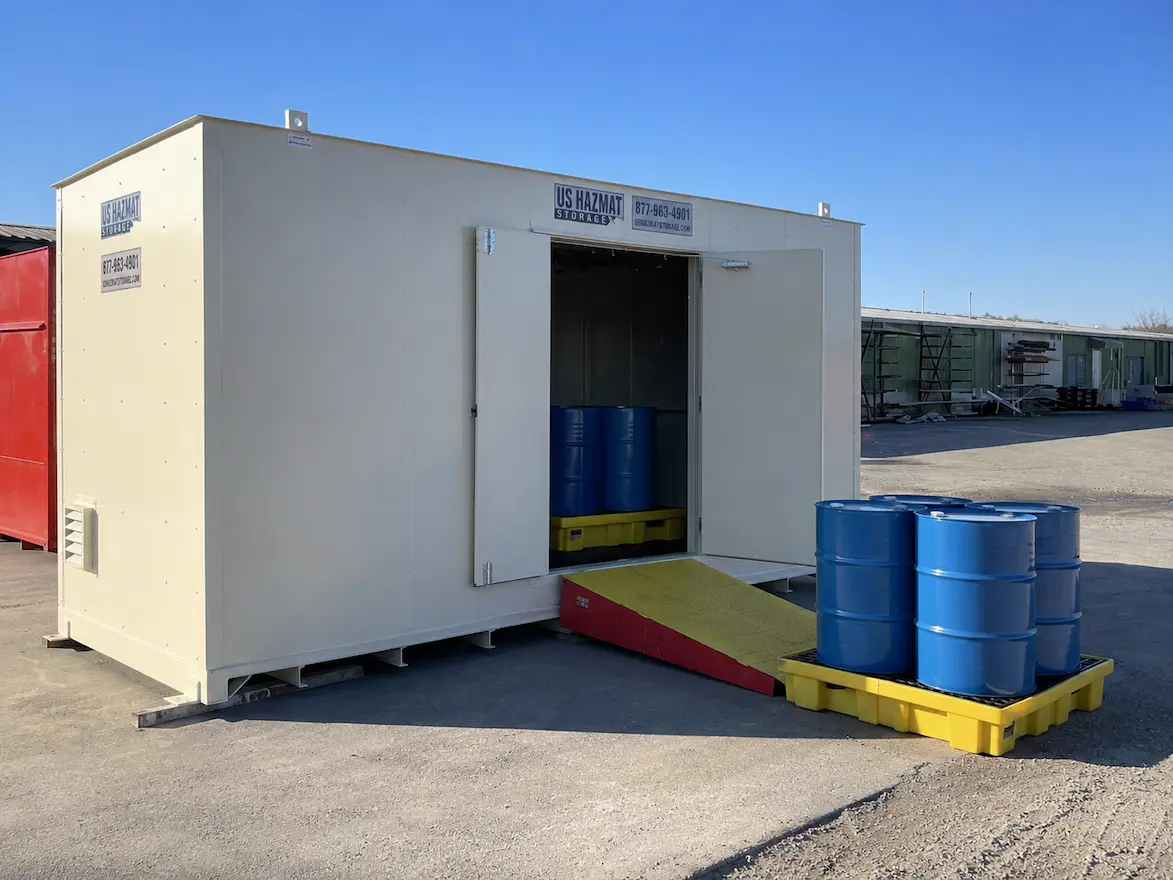
A small indoor operation may only need a compliant drum pallet. A larger outdoor operation may need a covered containment system, a fire-rated chemical storage building, or a climate-protected structure. A site storing flammable liquids may need a very different solution than a site storing nonflammable maintenance chemicals.
US Hazmat Storage helps facilities move from the calculation to the right engineered storage decision. That means looking at the real chemicals, real volumes, site layout, workflow, and compliance expectations before recommending a containment approach.
Build Secondary Containment Around the Failure You Are Preventing
Secondary containment for 55 gallon drums is not just a box to check before an inspection. It is a safeguard against the failure you are trying to control: a drum leak, a spill, outdoor rainwater contamination, incompatible materials mixing, or a storage area growing beyond its original design.
The most reliable approach is to calculate both required values, use rated container capacity, add outdoor freeboard, subtract displacement where needed, and confirm requirements with your EHS team and authority having jurisdiction.
If your facility is adding drums, moving containers outside, preparing for an inspection, or comparing containment options, now is the time to review the storage plan. Contact US Hazmat Storage to discuss your drum containment requirements and evaluate engineered storage options built around your materials, site conditions, and compliance needs.
FAQ
How much secondary containment do I need for 55 gallon drums?
Hold the greater of one full drum or 10 percent of all drums combined. For up to ten 55 gallon drums, that minimum is 55 gallons.
When does the 10 percent rule become larger than one drum?
At eleven drums. Ten percent of eleven 55 gallon drums is 60.5 gallons, which exceeds the 55 gallon largest-container requirement.
Do I size containment based on how full the drums are?
No. Use rated container capacity. A 55 gallon drum counts as 55 gallons even when it is only partially filled.
Does outdoor drum storage need extra containment?
Yes. Outdoor storage may need freeboard for rain, run-on, or stormwater unless the containment area is covered or protected from precipitation.
What is drum displacement?
Drum displacement is the space drums occupy inside a containment area. That space cannot hold spilled liquid and should be subtracted from usable capacity.
Is the EPA number the maximum requirement?
No. Federal rules are usually the minimum. States, local authorities, fire marshals, insurers, or facility policies may require more capacity.