
The catalog presents lab storage cabinet options by size, color, and number of shelves. None of those attributes determine whether the unit is compliant for the specific material being stored. The chemical does. Acetonitrile, methanol, concentrated nitric acid, and hydrogen peroxide each require a different cabinet configuration, different construction materials, different ventilation approach, and in some cases a different regulatory basis entirely. A lab storage cabinet that satisfies NFPA 30 for flammable solvent storage is not appropriate for oxidizing acids, and vice versa. Picking the enclosure before identifying the chemical is the ordering error that produces cabinets that fail inspections.
This distinction matters more than most laboratory purchasing processes acknowledge. US Hazmat Storage supports laboratory managers, EHS coordinators, and procurement teams who need to identify the right specification before the unit arrives, not after the next OSHA inspection.
NFPA 30 and What It Actually Requires of a Lab Storage Cabinet for Flammables
NFPA 30, the Flammable and Combustible Liquids Code, is the baseline regulatory reference for cabinet specifications holding Class I, II, or III liquids. The standard sets construction requirements for listed flammable storage cabinets that most buyers assume are met by any metal cabinet labeled “flammable storage.” They are not.
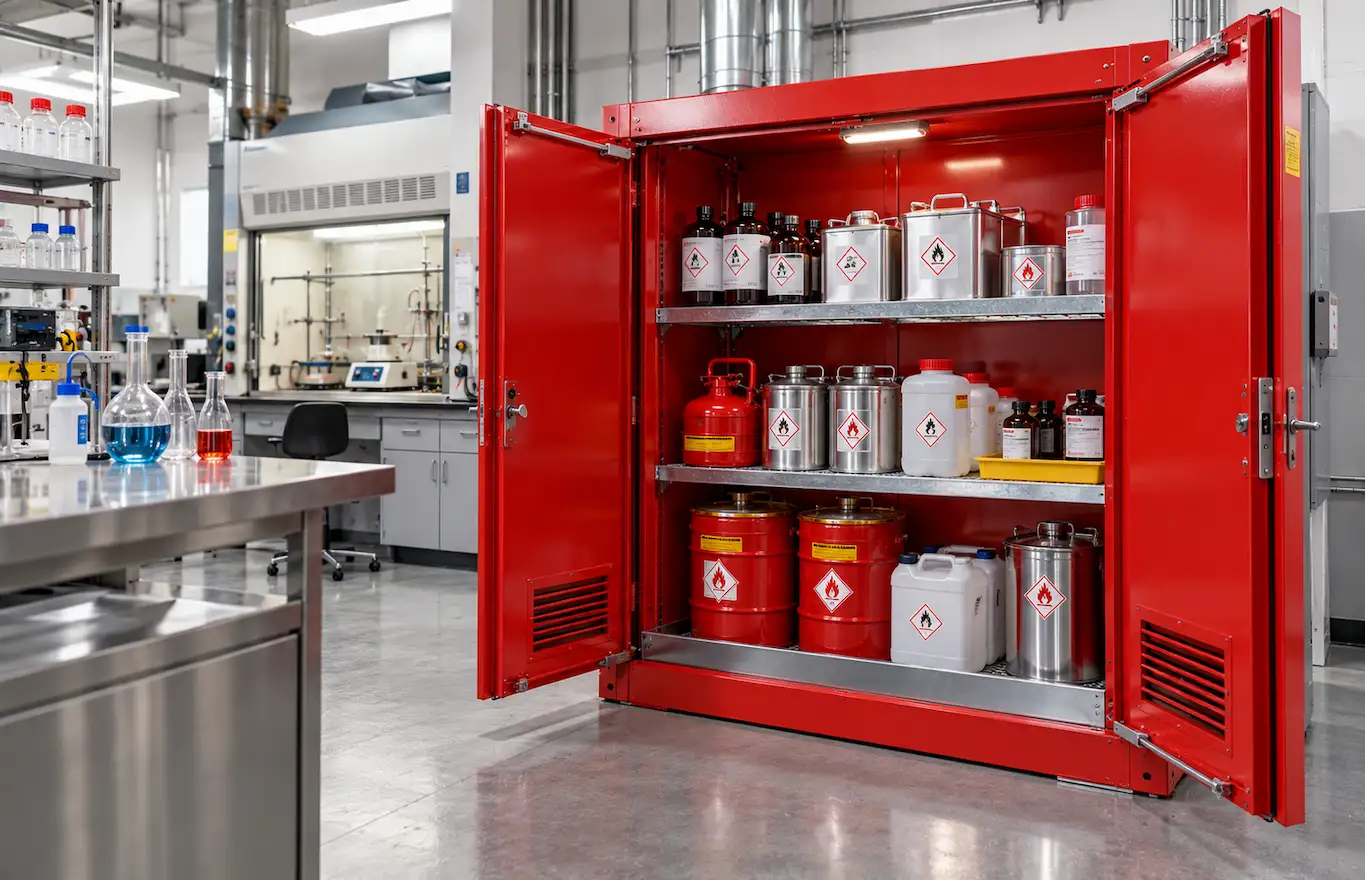
A compliant flammable storage unit under NFPA 30 requires double-wall steel construction with a 1.5-inch air space, a liquid-tight lower lip of at least 2 inches to contain minor spills, self-closing doors, and a listing from a recognized testing laboratory confirming that the cabinet maintains its integrity for a minimum 10-minute fire exposure. The listing is the compliance basis, not the label on the door. A steel cabinet that resembles a listed unit but lacks the listing mark is not an acceptable substitute under NFPA 30, and using it as one is a citable violation under OSHA 29 CFR 1910.106(d)(3).
Maximum quantity limits inside a listed lab storage cabinet are 60 gallons for Class I or Class II liquids, or 120 gallons for Class III liquids. Those are per-cabinet limits, not per-room limits, and they apply regardless of how many cabinets are in the space. Multiple cabinets don’t multiply the allowable quantity without limit. NFPA 30 sets room and building limits that govern the aggregate quantity regardless of how many individual units are present.
Acetonitrile Storage: Where the Classification Gets More Specific
Acetonitrile, also called methyl cyanide, is a Class IB liquid according to NFPA 30. It has a flash point of 35°F and an autoignition temperature of 975°F. Because of these numbers acetonitrile goes into the cabinet type as many common lab solvents such as methanol and ethanol. A standard listed flammable storage cabinet is therefore suitable for acetonitrile under NFPA 30.
Acetonitrile stands out from those solvents because it is highly toxic and because of extra rules that apply. OSHA’s Hazard Communication Standard lists acetonitrile as a health hazard. Therefore any storage area for acetonitrile must provide SDS access, proper labeling and clear signage. Under RCRA waste acetonitrile is a listed waste (U003) instead of just a characteristic waste. That difference changes how spills and expired stock must be handled. The cabinet that holds acetonitrile must be built to control the flammability risk and positioned to reduce the toxicity risk. It should be kept away from HVAC intakes, from drain connections and, in a place where a release will not travel toward people.
US Hazmat Storage’s acetonitrile chemical storage resources cover storage building configurations for larger acetonitrile quantities where a single cabinet is insufficient, including ventilation design and secondary containment approaches for this specific solvent.
What “Explosion Panel” Construction Means and When It Applies
A lab storage cabinet with an explosion panel, also described as a pressure relief panel or blow-out panel, is designed to vent an internal pressure event to the exterior of the cabinet rather than allowing the cabinet body to rupture at an unpredictable point. The panel is typically a scored or weakened wall section positioned to direct the pressure release away from personnel.
Explosion panel construction applies when the material stored has a high enough vapor pressure at ambient temperature that an ignition event inside the cabinet could produce a rapid pressure rise sufficient to rupture a standard enclosure. This is more common in cabinets used for highly volatile Class IB solvents in environments where the cabinet interior temperature may rise significantly, such as in proximity to process heat sources or in non-air-conditioned spaces.
An explosion panel does not make a cabinet explosion-proof. Explosion-proof is an NEC Article 500 listing category for equipment designed for hazardous classified locations where flammable vapors may be present in the surrounding atmosphere. A standard lab storage cabinet with an explosion panel is designed to manage an internal event and makes no provision for the surrounding atmosphere. If the lab space itself is classified under NEC Article 500, the storage cabinet is a component that has to fit within the location’s classification requirements, which is a separate analysis from the explosion panel question.
Burglar-Proof Doors and Physical Security in Laboratory Storage
Physical security for a lab storage cabinet is a regulatory requirement in specific contexts, not just a purchasing preference. DEA Schedule I and II controlled substances require storage in a securely locked, substantially constructed cabinet under 21 CFR 1301.75. The regulation doesn’t define “substantially constructed” with precise engineering parameters, but DEA inspection guidance has consistently indicated that a standard laboratory metal cabinet with a basic cam lock does not satisfy the requirement. A heavy-gauge steel cabinet with a double-locking mechanism, hardened steel shackles, and pry-resistant door frames is what the requirement points toward in practice.
Burglar-proof door construction on a laboratory cabinet typically means door frames that extend fully behind the cabinet face frame (preventing door removal by hinge manipulation), multi-point locking that engages the door at top, center, and bottom rather than at a single latch point, and a locking mechanism rated against forced entry tools. Not all lab storage cabinet lines offer these features, and the difference between a standard cam lock and a security-rated mechanism isn’t always apparent in product photography.
Physical security and flammable storage are not mutually exclusive requirements. A cabinet holding controlled substance solvents used in pharmaceutical or forensic laboratory settings may need to satisfy both DEA physical security requirements and NFPA 30 flammable storage construction requirements simultaneously. That narrows the specification to cabinets that are both listed under NFPA 30 and meet the DEA physical security standard, and that intersection isn’t large in the standard catalog.
The Freezing Point of Bleach and Why It Matters for Corrosive Lab Storage
Sodium hypochlorite solutions, known as bleach freeze around 19°F when they are 10% strong and at lower temperatures when they are stronger. In lab settings where bleach is stored close to walls in rooms that are not heated or where the HVAC system might stop the freezing point is important. When bleach freezes and then thaws bleach breaks down faster. Bleach loses chlorine that is needed for cleaning and bleach may produce chlorine gas inside a sealed container.
A lab storage cabinet that holds bleach and other hypochlorite solutions must deal with both the nature of bleach and the need to keep it from freezing. Bleach‑resistant cabinets are built from materials that can handle acid and oxidizer vapors. Common choices are polyethylene or high‑density polyethylene (HDPE) or steel that has a lining for oxidizing chemicals. Regular carbon steel, even if it is painted or covered with epoxy will rust when it is exposed to bleach vapor all the time.
Generally storing corrosive chemicals in a lab cabinet means choosing a cabinet material that matches the particular type of chemistry that is stored. For example hydrochloric acid vapor attacks steel faster, than acid mist. Nitric acid is both an acid and an oxidizer many organic coatings do not work on it. Ammonia can damage copper fittings and brass hardware. The corrosive storage specification for a laboratory environment needs to account for all the materials that will be stored, not just the primary chemical, because incompatible vapor mixtures inside a single enclosure create hazards that the individual SDS sheets don’t describe in combination.
Ventilation Inside a Lab Storage Cabinet: When Passive Isn’t Enough
Most listed flammable storage cabinets include vent openings on both sides, typically covered with bungs or plugged ports. The default configuration is unvented (plugs in place) because NFPA 30 and OSHA guidance both note that opening cabinet vents without connecting them to an exhaust system can draw lab room air into the cabinet and create a higher vapor concentration inside than would otherwise develop. An unvented listed lab storage cabinet is actually the appropriate configuration in many laboratory settings.
Vented cabinet configurations are appropriate when the enclosure is connected directly to the laboratory exhaust system through a dedicated duct, creating negative pressure inside the enclosure that draws vapors out before they accumulate. That configuration requires a duct connection, a compatible exhaust system with adequate capacity, and a fire damper in the ductwork between the cabinet and the exhaust system so that a fire event inside the cabinet doesn’t propagate through the ductwork. Installing a duct connection without the fire damper creates a scenario where a compliant cabinet becomes a fire propagation pathway.
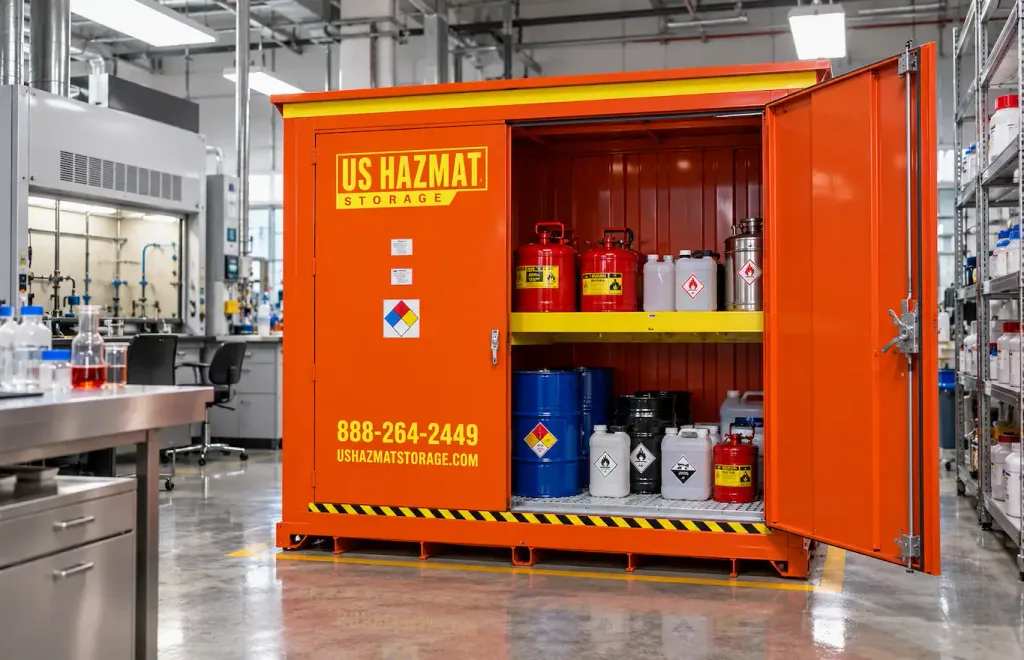
A fire-rated hazmat locker is the appropriate solution when the stored quantity exceeds what a standard lab storage cabinet can hold compliantly, or when the storage location requires a structure that’s separate from the occupied laboratory space entirely.
Temperature-Sensitive Chemicals and Refrigerated Lab Storage
Several classes of laboratory chemicals require storage below ambient temperature for stability or safety reasons. Flammable solvents with very low flash points, certain organic peroxides, and temperature-sensitive reagents fall into this category. Standard domestic or commercial refrigerators are not appropriate for flammable chemical storage because the internal electrical components (compressor, thermostat, light switch) are ignition sources that can ignite accumulated vapors inside the compartment.
A flammable material refrigerator is a specifically listed appliance: spark-free interior, no interior lighting that activates when the door opens, vapor-tight compressor compartment, and a listed alarm if temperature rises above the set point. Using a standard refrigerator for flammable chemical storage is a citable OSHA violation under 1910.106 as well as a significant fire risk. That standard doesn’t change based on the quantity stored. Even a small quantity of a Class IB solvent in a standard refrigerator creates the vapor accumulation and ignition source combination that the listing requirement exists to prevent.
The same chemical classification logic that governs lab storage cabinet selection applies to refrigerated storage: the chemical’s flash point, vapor pressure, and regulatory classification determine which storage configuration is required, and no amount of quantity reduction makes a non-compliant enclosure compliant.
Segregation Inside the Lab: Which Chemicals Cannot Share a Lab Storage Cabinet
Chemical segregation requirements apply inside individual storage units as well as between storage areas. OSHA’s Hazard Communication Standard and the chemical compatibility principles in NFPA 400 and laboratory safety literature both prohibit storing incompatible materials in proximity where a spill or container failure could bring them into contact.
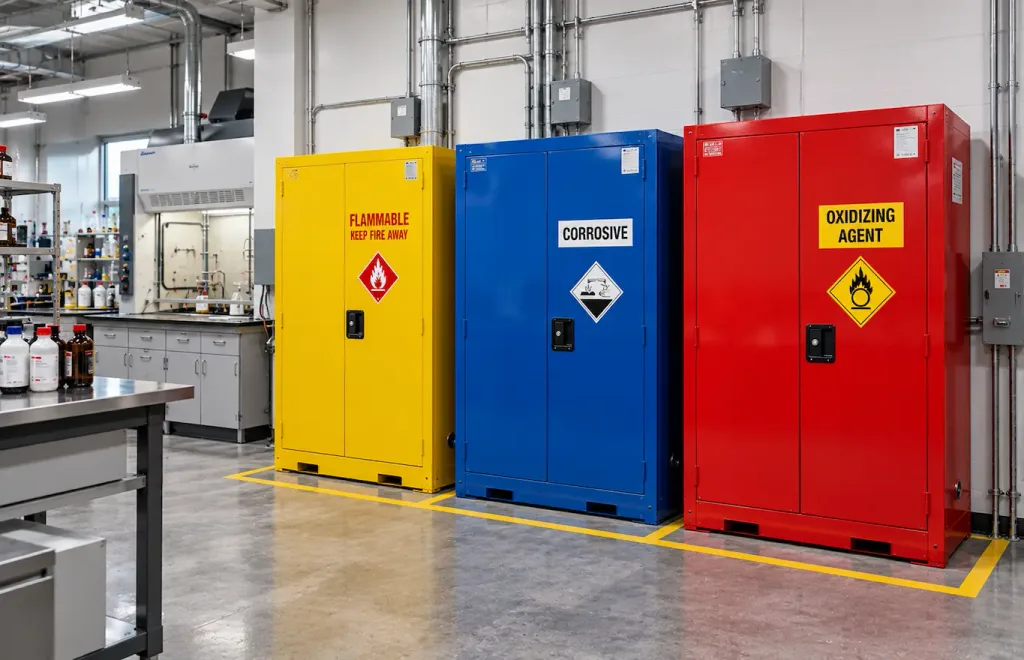
Acids and bases must be stored separately; a spill of each in the same enclosure produces a violent reaction and potential heat generation. Flammable solvents cannot share a lab storage cabinet with oxidizing acids (nitric acid, perchloric acid), because the combination creates a fire and explosion risk from the oxidizer’s interaction with the organic material. Cyanide compounds cannot share space with acids, because acid contact releases hydrogen cyanide gas. Water-reactive materials require dry, segregated storage away from all aqueous solutions.
The practical implication for a multi-chemical laboratory: one lab storage cabinet per chemical hazard class is typically the minimum compliant configuration. Acid cabinets, base cabinets, flammable solvent cabinets, and oxidizer cabinets are distinct units, not different shelves in a shared enclosure. The additional unit cost is the cost of a compliant storage configuration, not an upgrade.
How to Build the Right Specification for a Lab Storage Cabinet
The specification sequence for a lab storage cabinet is clear. First list every chemical that will be stored in the lab storage cabinet. Second find the hazard class and the rules that apply to each chemical for the lab storage cabinet. Third set the amount of each chemical that can be kept in the lab storage cabinet. Fourth check if the storage area has a zone classification under the NEC for the lab storage cabinet.
Finally choose a cabinet type and a listing category that meet all these requirements at the time for the lab storage cabinet. This sequence creates a specification for the lab storage cabinet. If you buy a cabinet by looking at its size and price you might end up with a lab storage cabinet that is not compliant.
US Hazmat Storage partners, with laboratory facilities, pharmaceutical sites, research institutions and industrial chemical operations. We help them develop storage specifications that stand up to OSHA inspections, fire marshal reviews and the everyday demands of a working laboratory.Contact US Hazmat Storage to compare options with a free consultation.
FAQ
What makes a lab storage cabinet NFPA 30 compliant for flammable solvents?
A compliant flammable storage unit requires double-wall steel construction with a minimum 1.5-inch air space, a liquid-tight lower lip of at least 2 inches, self-closing doors, and a listing from a recognized testing laboratory confirming 10-minute fire resistance. The listing mark on the lab storage cabinet is the compliance basis. A cabinet that looks like a listed unit but isn’t listed doesn’t satisfy NFPA 30 or OSHA 1910.106.
Can a single cabinet hold both acids and flammable solvents?
No. Oxidizing acids are incompatible with flammable organic solvents. Storing them in the same enclosure creates a combined fire and reactivity hazard from the interaction of the oxidizer with the organic material. Separate cabinets for acids, bases, and flammable solvents are the minimum compliant configuration in a multi-chemical laboratory setting.
When does a lab storage cabinet need an explosion panel?
Explosion panels are specified for storage cabinets holding highly volatile Class IB solvents where a rapid internal pressure event is a realistic scenario, particularly in locations with elevated ambient temperatures or proximity to heat sources. An explosion panel is not the same as explosion-proof construction, which is an NEC Article 500 classification for equipment used in atmospheres where flammable vapors are present in the surrounding space.
What physical security standard applies to a lab storage cabinet for controlled substances?
DEA regulations at 21 CFR 1301.75 require securely locked, substantially constructed storage for Schedule I and II controlled substances. DEA inspection guidance indicates a heavy-gauge steel cabinet with multi-point locking and pry-resistant door frames. A standard cam lock on a light-gauge metal cabinet doesn’t satisfy that standard, even if the cabinet is otherwise appropriate for the chemistry stored.
Can any refrigerator be used to store flammable chemicals in a laboratory?
No. Standard domestic and commercial refrigerators have internal electrical components that are ignition sources for accumulated vapors. Flammable chemical storage requires a specifically listed flammable material refrigerator with spark-free interior construction, no interior lighting on a standard switch, and a vapor-tight compressor compartment. Using a standard refrigerator for flammable chemicals is a citable OSHA violation under 1910.106 regardless of the quantity stored.