
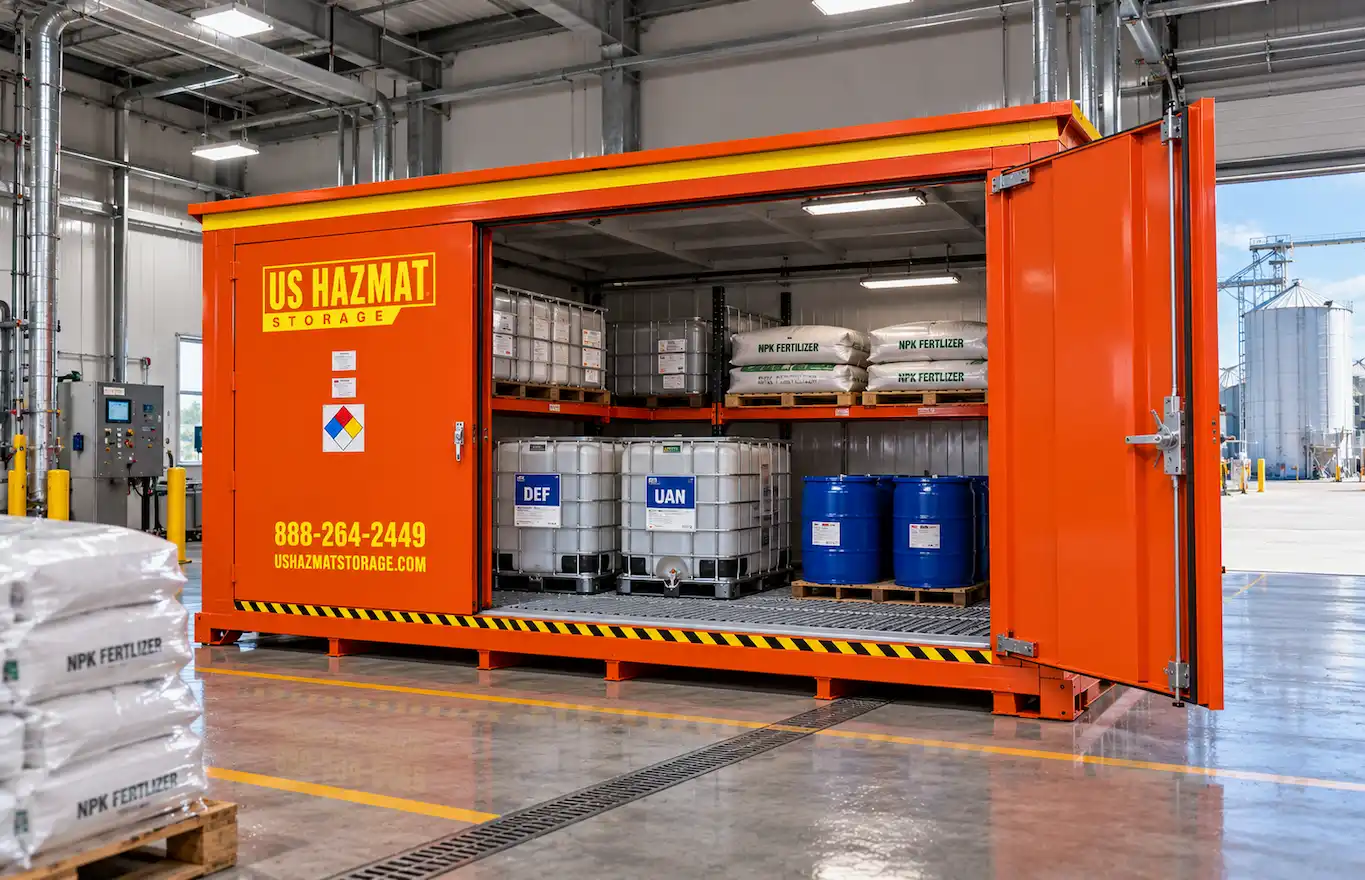
Procurement teams shopping for fertilizer buildings usually start with footprint and price. Both are reasonable inputs. Neither is the first question. The first question is what exactly is being stored, because ammonium nitrate, liquid anhydrous ammonia, granular urea, and blended NPK fertilizers each trigger a different regulatory framework, a different set of construction requirements, and in some cases a different federal agency with authority to inspect and fine the facility. A building that’s suitable for one material may be a code violation for another, even if the two look identical on a pallet.
The spec sheet for a storage structure doesn’t resolve that. It describes what the structure is. The regulatory framework describes what the structure has to be for the specific material on-site. US Hazmat Storage works with agricultural operations, distribution facilities, and industrial sites that need to get the structure right before the first delivery arrives, not after the first inspection.
Why Material Classification Drives Everything Else in Fertilizer Buildings
The EPA’s Risk Management Program (40 CFR Part 68) and OSHA’s Process Safety Management standard (29 CFR 1910.119) both have threshold quantities that trigger enhanced planning and inspection requirements. Anhydrous ammonia crosses the EPA RMP threshold at 10,000 pounds, roughly the equivalent of a modest-sized bulk storage tank. Ammonium nitrate crosses different thresholds under OSHA PSM and EPA RMP, and the Department of Homeland Security’s Chemical Facility Anti-Terrorism Standards (CFATS) adds a third layer of federal oversight specifically for ammonium nitrate above 400 pounds at a concentration of 33% or higher.
Knowing where your material falls in that classification framework changes what fertilizer buildings need to provide structurally. A structure that meets NFPA 30 requirements for flammable liquid storage doesn’t automatically address EPA RMP secondary containment requirements for liquid ammonia. A building rated for general agricultural chemical storage may not satisfy CFATS physical security requirements for high-concentration ammonium nitrate. The material classification question isn’t a paperwork exercise. It’s what determines whether a specific building model is appropriate at all.
NFPA 400: The Hazardous Materials Code That Most Buyers Miss
Most conversations about fertilizer buildings reference NFPA 30 (flammable liquids) or OSHA 1910.106. Fewer reference NFPA 400, the Hazardous Materials Code that governs the storage of oxidizing materials, including many fertilizers. Ammonium nitrate is classified as an oxidizer under NFPA 400, and the code sets explicit requirements for construction materials, separation distances, and incompatible material segregation that are distinct from the requirements that apply to flammable liquids.
NFPA 400 prohibits storage of ammonium nitrate in the same building as combustible materials, including wood framing. The floor of any fertilizer storage structure holding oxidizers must be constructed of non-combustible material. Combustible materials (packaging, pallets, any organic material) accelerate the decomposition of ammonium nitrate under heat, which is how localized incidents become uncontained events. These aren’t construction preferences. They’re hard requirements under a code that applies regardless of whether the local AHJ references it explicitly.
Fertilizer buildings that are intended to hold oxidizing materials need to be specified against NFPA 400 from the beginning, not retrofitted toward it after a permit review or an inspection finding. The cost difference between a compliant structure and a non-compliant one is far lower at the specification stage than at the construction stage.
The Corrosive Storage Locker Problem That Liquid Fertilizers Create
Liquid fertilizers stored in fertilizer buildings introduce a corrosion problem that granular products don’t. Nitrogen solutions, like UAN (urea-ammonium nitrate) at 28% or 32% can wear away steel, galvanized steel and copper over time. If you build a storage building with steel and don’t protect it properly the parts that touch the fertilizer will start to rust. That includes the floor, the sump, door thresholds and any spot where liquid splashes or runs off.
To keep the building safe you need either a coating that’s made to handle chemical contact or a liner that keeps the steel from touching the fertilizer at all. These are not common in farm storage buildings you buy off the shelf. The problem gets worse if the building also holds fertilizers or tank additives. The coating needed for acid exposure is different from what’s needed for alkaline or neutral nitrogen products. You can’t just use any coating. It has to match the chemicals inside..
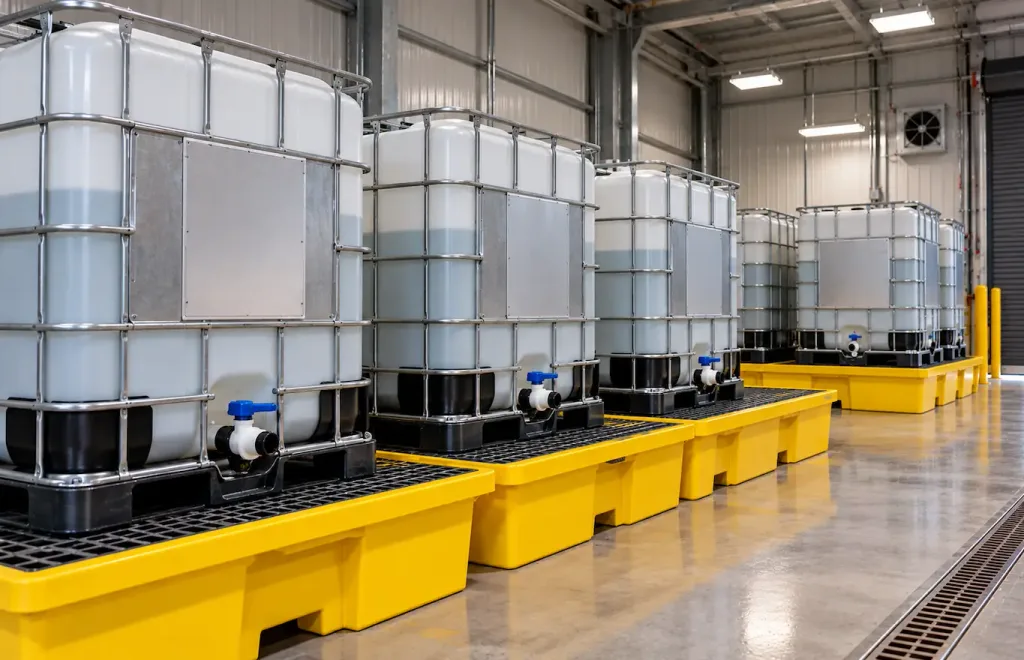
Secondary containment in a structure holding corrosive liquid fertilizers has its own material requirements. A concrete sump that isn’t coated for chemical resistance will absorb and hold contaminants, creating a soil and groundwater release pathway that continues after a visible spill has been cleaned up. The containment system has to be part of the structure specification, not an afterthought installed after the building is in place.
Pesticide Storage and the Separation Requirements That Apply to CoLocated Materials
Farmers often keep pesticides and fertilizers in the same building because they use both during field work. That makes sense for operations.. Whether it’s safe or allowed depends on the exact types of pesticides and fertilizers involved.
The EPA under FIFRA says pesticide storage must keep water, food and animal feed from contamination. That’s the rule.. The real concern is chemical compatibility. Some herbicides and fungicides don’t mix well with fertilizers that contain oxidizers. Storing them together can cause chemical reactions. These risks might not be listed on either the pesticide label or the fertilizer safety data sheet by themselves.
OSHA’s Hazard Communication Standard, 29 CFR 1910.1200 says incompatible chemicals must be stored separately. How “separate” is defined depends on the chemicals, how much is stored and how the building is laid out. For some combinations a wall dividing the building into sections might be enough. For others you need different buildings for fertilizers and pesticides. The safety data sheet, for each product lists which materials it shouldn’t be stored with. Checking these lists before deciding how to set up storage is not optional. It’s required.
Construction Standards: What Non-Fire-Rated Means and What It Doesn’t
Non-fire-rated doesn’t mean unrated. Fertilizer buildings specified as non-fire-rated structures still have to meet applicable building code requirements for occupancy classification, structural load, ventilation, and electrical installation. The “non-fire-rated” designation refers specifically to the absence of the 2-hour or 4-hour fire-resistive construction required for flammable liquid storage under NFPA 30. It isn’t a statement that the structure has no construction requirements.
For non-flammable fertilizer products stored outside their oxidizer classification thresholds, US Hazmat Storage’s non-fire-rated chemical storage buildings provide a compliant and cost-effective structure that satisfies EPA secondary containment requirements, OSHA general industry standards, and local building code requirements without the premium cost of fire-rated construction. The appropriate specification depends on the material and quantity, which is why the material classification question comes before the construction type question.
Structural loading requirements for fertilizer buildings are often underestimated. A big container of fertilizer such as a tote or an IBC is much heavier than the same volume of dry fertilizer. For example a 275‑gallon IBC that holds UAN at 10.6 pounds per gallon will weigh about 2,900 pounds when it is full. If you place four of those IBCs next to each other on a concrete slab the total weight approaches the maximum that a typical residential foundation can support. Therefore when designing or choosing storage buildings, for farm chemicals it is important to consider the weight that the containers will hold, not just the basic size of the structure.
Ventilation Requirements for Fertilizer Buildings Holding Ammonia-Based Products
Anhydrous ammonia and liquid nitrogen solutions stored in fertilizer buildings release vapor under ambient conditions, and those vapors accumulate in enclosed spaces. OSHA’s permissible exposure limit (PEL) for ammonia is 50 parts per million as an 8-hour time-weighted average. The IDLH (Immediately Dangerous to Life and Health) concentration is 300 ppm. Both can be exceeded quickly in a poorly ventilated enclosed structure holding bulk liquid ammonia or high-concentration UAN solutions.
Ventilation requirements for storage structures holding ammonia-releasing products follow OSHA 29 CFR 1910.111 for anhydrous ammonia and NFPA 400 for oxidizing materials. Natural ventilation through low and high wall vents can be adequate for lower-volume operations, but the ventilation rate calculation has to be performed against the actual vapor pressure and quantity of the stored product. Mechanical ventilation with continuous air movement and an ammonia detector tied to an alarm system is the appropriate specification for any structure where personnel regularly work inside.
US Hazmat Storage’s agrochemical and pesticide storage solutions address ventilation, containment, and construction requirements for agricultural chemical storage across a range of material types and regulatory contexts.
Physical Security and CFATS Compliance for Ammonium Nitrate Storage
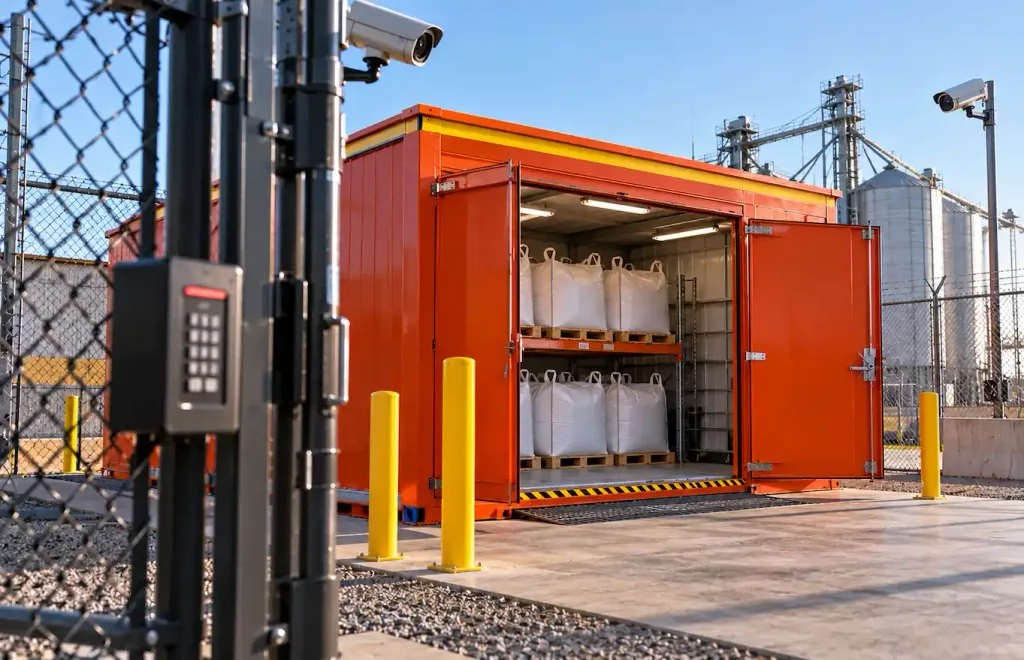
The Department of Homeland Security’s Chemical Facility Anti-Terrorism Standards place ammonium nitrate in the category of chemicals of interest at concentrations above 33% and quantities above 400 pounds. Standard fertilizer buildings with a padlock on the door do not satisfy CFATS physical security requirements at those thresholds.
CFATS-regulated facilities are required to submit a Top-Screen assessment to DHS, which then determines whether the facility needs to develop a Site Security Plan. The physical security components of that plan specify perimeter security, access control, and surveillance requirements that directly affect how fertilizer buildings at those facilities have to be constructed and secured. A structure ordered from a standard product line without CFATS review may require significant modification or replacement once the security plan is finalized.
The CFATS threshold for ammonium nitrate is a quantity that many agricultural operations reach seasonally, not just year-round. Seasonal storage during planting season that exceeds the threshold still triggers the reporting requirement. The regulatory clock doesn’t run only during peak storage months.
Sizing Fertilizer Buildings: The Capacity Calculation That Has to Come First
The sizing sequence for fertilizer buildings runs: total material volume, divided into storage categories by material type and incompatibility, mapped against maximum allowable quantities under applicable codes, adjusted for secondary containment volume requirements, and then configured against site constraints. That sequence produces a footprint specification that the structure has to meet. Working backward from a standard structure size to see if the operation fits is the wrong order.
Secondary containment volume for bulk liquid fertilizer storage follows EPA SPCC requirements if the total aboveground oil-equivalent storage is above the SPCC threshold, or state-level secondary containment rules if the facility doesn’t cross that federal threshold. Either way, the containment sump or berm has to be designed for 110% of the largest single container’s volume, and the containment surface has to resist the specific chemicals being stored, as liquid UAN and anhydrous ammonia have different material compatibility requirements. A quick way to begin that math: use the secondary containment calculator at US Hazmat Storage as a starting framework before scaling to tote or bulk tank configurations.
What the Site Assessment Needs to Cover Before the Building Order Goes In
Fertilizer buildings don’t exist independently of the site they’re placed on. Foundation requirements, drainage routing, setback distances from property lines and occupied structures, utility connections for lighting and ventilation, and access for delivery and loading equipment are all site-specific variables that affect what the structure has to be, where it can go, and what prep work is needed before installation.
NFPA 400 and local fire codes set minimum separation distances from fertilizer storage to other structures, property lines, and ignition sources. Those distances vary by material type and quantity. A structure placed without confirming those setbacks may pass the initial building permit but fail the fire marshal inspection. Confirming the separation distances before selecting the site location prevents a scenario where the structure is compliant in isolation but non-compliant on the specific parcel.
US Hazmat Storage provides site assessment guidance as part of the specification process for storage structures, including foundation requirements, drainage, and delivery access planning. Contact US Hazmat Storage to speak with an expert about your specific requirements.
FAQ
Do fertilizer buildings need to be fire-rated structures?
Not always. It depends on the specific material being stored. Non-oxidizing, non-flammable fertilizers stored in compliant quantities may be held in non-fire-rated fertilizer buildings. Oxidizing materials including ammonium nitrate require construction that meets NFPA 400 requirements, which include non-combustible construction but don’t necessarily require the 2-hour fire-rated assemblies that NFPA 30 mandates for flammable liquid storage. The material classification determines the applicable construction standard.
What’s the minimum secondary containment requirement for liquid fertilizer storage?
The EPA SPCC baseline is 110% of the largest single container’s volume. State environmental regulations may require higher percentages. The containment surface must be resistant to the specific liquid fertilizer being stored, as liquid UAN and anhydrous ammonia have different material compatibility requirements. Secondary containment for corrosive liquid fertilizers requires coating or lining the containment surface rather than using bare concrete.
Can pesticide storage and fertilizer storage share the same building?
Only if the specific products involved are chemically compatible. Many herbicides and fungicides are incompatible with oxidizing fertilizers, and co-locating them creates a reactive hazard. OSHA’s Hazard Communication Standard requires that incompatible chemicals be stored separately. Cross-checking the SDS incompatibility section for each material pair before finalizing storage configuration is a regulatory requirement, not an optional precaution.
What ventilation rate does a fertilizer building need for ammonia products?
The ventilation rate depends on the quantity of product, the vapor pressure of the specific material, and the internal volume of the structure. OSHA’s PEL for ammonia is 50 ppm as an 8-hour TWA. The calculation for the ventilation rate needed to maintain concentrations below that threshold has to be performed against the actual storage conditions. For most bulk ammonia storage, mechanical ventilation with ammonia detection and alarming is the appropriate specification.
What CFATS reporting is required for ammonium nitrate storage?
Facilities storing ammonium nitrate at or above 400 pounds at a concentration of 33% or higher must complete a DHS Top-Screen assessment. DHS then determines whether a Site Security Plan is required. Seasonal storage above the threshold still triggers the reporting requirement. The reporting clock runs on the quantity present on-site, not the operational calendar of the facility. Any fertilizer buildings holding ammonium nitrate above those thresholds fall under CFATS review.