
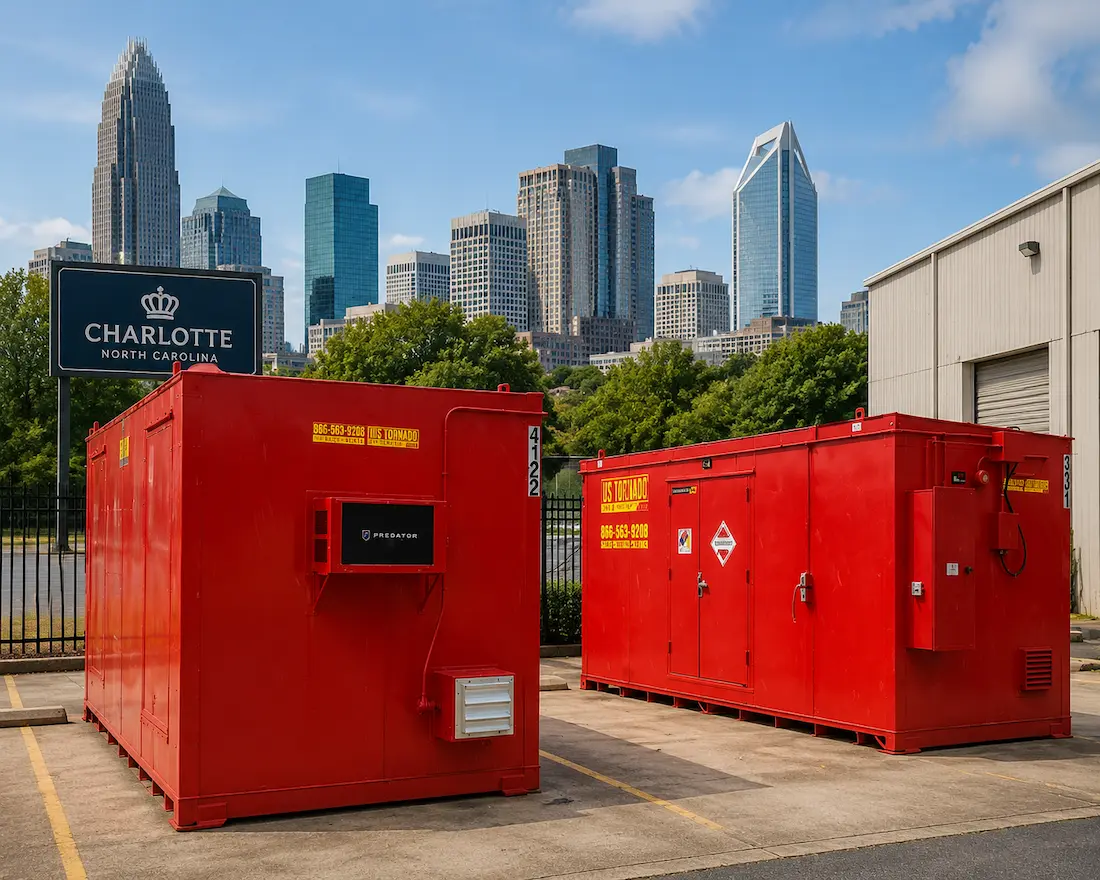
Charlotte sits in a part of North Carolina that most residents do not associate with tornado country, and that perception creates a planning gap. Mecklenburg County sees two to three tornadoes in an average year, and the region has recorded EF2 and EF3 events that produced significant structural damage across residential and commercial areas around above ground magazine in Charlotte.
The Charlotte metro also sits in the path of weakening but still dangerous tropical systems that push inland after Gulf and Atlantic landfalls, delivering sustained high winds and sudden severe weather that do not always come with adequate warning time.
An above ground magazine Charlotte buyers most commonly specify is an above-grade storm shelter structure rated for community or large-group occupancy that addresses both threat profiles, when built to the right standard.
US Hazmat Storage works with facility managers, school administrators, and community organizations in the Charlotte area who are evaluating storm shelter options, and the gap we see most consistently is not in the product itself. It is in the specification process that happened before anyone called a shelter manufacturer.
What “Above Ground Magazine” Means in the Storm Shelter Context
The term “above ground magazine Charlotte” as used in the storm shelter industry refers to an above-grade modular or prefabricated shelter structure designed to resist tornado and high-wind events at the community or group level. It is distinct from a residential safe room, which FEMA P-320 addresses separately, and from below-grade cellar-style shelters that have historically dominated the southeastern U.S. market.
An above ground magazine in Charlotte is typically specified for schools, community centers, faith-based organizations, mobile home communities, and other facilities where a group of people needs reliable protection and where the access speed and ADA accessibility of an above-grade structure are meaningful operational advantages.
The governing technical standards for these structures are FEMA P-361, Safe Rooms for Tornadoes and Hurricanes, which provides the primary federal guidance on design performance criteria, and ICC 500-2020, the Standard for the Design and Construction of Storm Shelters, which provides the engineering standard that most jurisdictions and engineers of record reference when specifying and permitting community shelter installations.
ICC 500 Chapter 3 covers community shelters for more than 16 occupants, and its requirements for wind loading, debris impact resistance, foundation anchorage, and ventilation define what an above-grade structure must demonstrate to qualify as a compliant shelter rather than simply a sturdy building.
Charlotte buyers evaluating shelter options need to confirm that the structure has been tested and rated to the debris impact standard in ICC 500, that the anchorage system has been engineered for the soil conditions and wind loads applicable to the Charlotte site, and that the product documentation supports a permit application to Mecklenburg County Code Enforcement.
Charlotte’s Wind and Weather Profile: Why It Matters for Shelter Specification
The above ground magazine Charlotte sites must be designed for is governed by a moderate but real tornado risk compared to the central plains states, but “moderate” in the context of community shelter planning does not mean the threat is manageable without a rated structure. FEMA P-361 uses an EF5 wind speed design standard for community shelters regardless of geographic location, because the purpose of a community shelter is to provide near-absolute protection for the people inside it.
The Charlotte area’s hurricane exposure is a secondary wind threat that shelter specifications sometimes underestimate. When tropical systems weaken to tropical storm strength and track inland through the Carolinas, sustained winds in the 50-to-70-mph range are common, and gusts can exceed 90 mph in built areas without the topographic exposure that coastal locations provide.
A Charlotte above ground magazine specified solely to a tornado design standard, without evaluation of the combined wind and rain exposure that tropical remnants produce, may meet ICC 500 technically while leaving ventilation, drainage, and door sealing provisions that underperform in the horizontal rain conditions these systems bring.
Elevation and drainage are Charlotte-specific siting variables that above-ground shelter installations need to address directly. The Charlotte region’s clay soils retain moisture and do not drain rapidly after heavy rainfall events. An above ground magazine sited in a low area without adequate drainage can accumulate standing water around the structure’s perimeter during the same weather events that would drive occupants inside it.
The foundation design must account for this, and the site selection process should confirm that access paths to the shelter remain passable under the precipitation conditions that accompany the most likely threat scenarios.
ICC 500 Requirements That Determine Whether a Structure Qualifies
ICC 500-2020 Section 304 governs above-ground community storm shelters and sets the performance criteria that separate a compliant above ground magazine from a reinforced building that happens to look like one. The wind load design requirement for community shelters is 250 mph, which corresponds to the upper range of EF5 tornado wind speeds.
The debris impact test requires that the shelter wall and door assemblies resist penetration by a 15-pound 2×4 timber projectile traveling at 100 mph, simulating the wind-borne debris conditions during a significant tornado event.
The door assembly deserves specific attention in any Charlotte above ground magazine specification because it is both the most operationally critical component and the most common point of failure in non-compliant shelter structures. ICC 500 requires that shelter doors meet the same debris impact test as the wall assemblies, and that the door design prevent wind-driven rain from entering the shelter interior during the peak event.
Occupancy calculations under ICC 500 use a floor area allocation of five square feet per person for standing occupancy in a community shelter. A large group storm shelter intended to serve 100 people requires a minimum of 500 square feet of usable floor area under this calculation, and seating occupancy uses a 10-square-foot allocation.
These numbers directly affect structure size selection and interact with the access time requirement: FEMA P-361 guidance recommends that occupants reach the shelter within the available warning time, which for many Charlotte tornado events may be five minutes or less.
Mecklenburg County Permitting and What Charlotte Requires
Securing a permit for an above ground magazine in Charlotte requires filing with Mecklenburg County Code Enforcement, and for community shelter structures, engineered drawings prepared by a licensed North Carolina professional engineer are typically required as part of the permit application. The drawings must demonstrate compliance with the NC State Building Code, which is based on the 2018 IBC, and must address the wind load design, foundation anchorage, and occupancy provisions applicable to the structure’s classification and intended use.
FEMA P-361 guidance recommends that community shelter projects engage the local AHJ early in the design process rather than at the permit application stage. Local interpretation of code requirements for storm shelters, particularly regarding foundation design and the relationship between the NC Building Code and ICC 500 criteria, can affect the engineering approach in ways that are not resolved by reading the published standards.
A shelter designed and permitted in another North Carolina county may require additional engineering documentation to receive a permit in Mecklenburg County if the soil conditions, wind exposure category, or occupancy classification differ.
Funding through FEMA’s Hazard Mitigation Grant Program is available for qualifying community shelter projects in North Carolina, including the Charlotte metro area. HMGP funding requires that the shelter meet FEMA P-361 criteria and that the project be submitted through the NC Division of Emergency Management.
For Charlotte organizations considering this path, engaging both Mecklenburg County Code Enforcement and NC Emergency Management early in the project planning, before selecting a shelter product, prevents scope mismatches between the funded design and the permitted installation.
Above-Ground vs. Below-Grade: Why Charlotte’s Conditions Favor Above-Grade
Below-grade storm shelters have a long history in the southeastern United States. They offer a low profile that reduces wind load exposure and, when properly constructed, provide solid protection from above-grade wind events. In Charlotte’s specific conditions, the below-grade option carries disadvantages that the above ground magazine configuration avoids.
Charlotte’s clay-heavy soils and the region’s high groundwater table in many residential and commercial areas create flooding risk in below-grade structures during the same storm events that would motivate shelter use. A shelter that accumulates water during the event it is designed to protect against is a failed shelter regardless of its wind rating.
ADA accessibility is the other meaningful advantage of the above ground magazine configuration for Charlotte community facilities. Schools, community centers, faith organizations, and public facilities serving Charlotte’s population need shelter options that include people with mobility limitations, and a below-grade shelter with a hatch-style entry creates an access barrier that an above-grade structure with a compliant door and approach path does not.
FEMA P-361 recommends that community shelters be accessible to all intended occupants without specialized assistance, and the above-grade configuration is the more reliable path to that outcome in most Charlotte facility types.
Our community storm shelter solutions include above-ground configurations sized and engineered for large group storm shelter applications, built to ICC 500 criteria, and specified to support the Mecklenburg County permitting process. The capacity range and configuration options cover the majority of Charlotte community facility shelter needs, from small-group installations at neighborhood facilities to multi-hundred-person structures serving schools and community centers.
Siting, Access, and the Operational Details That Determine Real-World Protection
An above ground magazine Charlotte installs must meet ICC 500 wind and debris criteria, but one sited 400 feet from the building it serves does not provide the protection its rating describes. FEMA P-361 guidance on shelter siting emphasizes that the travel path from the occupied building to the shelter must be assessable within the available warning time, and that the path itself must not expose occupants to wind-borne debris during the approach.
In Charlotte facilities with multiple buildings or dispersed occupancy, the shelter siting plan is a separate specification task from the shelter product selection, and it requires a site-specific evaluation.
Lighting, signage, and communication provisions inside an above ground magazine are operational elements that ICC 500 addresses but that Charlotte buyers sometimes treat as secondary to the structural specification.
Backup lighting that activates automatically when power is lost, clearly posted occupancy capacity and emergency procedure signage, and a communication system that connects the shelter interior to the facility’s emergency management system all determine how well the shelter functions as a protective environment rather than simply as a rated structure.
Maintenance and annual inspection of the shelter, including door hardware, anchorage connections, ventilation provisions, and interior systems, is a recurring obligation that both ICC 500 and FEMA guidance address.
Charlotte’s climate, with its combination of summer heat, humidity, and occasional ice and freeze events in winter, creates conditions where door seals, mechanical fasteners, and ventilation components can degrade faster than in more temperate climates.
Getting the Specification Right Before the Season Starts
An above ground magazine Charlotte organizations specify correctly to ICC 500, properly permitted through Mecklenburg County, sited for the access time and drainage conditions of the specific facility, and maintained to the inspection standard its design requires is a reliable protection resource for the people it serves.
One selected based on a product brochure, installed without a permit review, and sited without a travel-time analysis provides a structure without a demonstrated compliance basis, which is a different thing entirely.
US Hazmat Storage works with Charlotte-area organizations and facilities working through the storm shelter specification process and want to confirm the right configuration before making any commitment. If your facility is evaluating a large group storm shelter solution and needs experienced input on the ICC 500 specification, the Mecklenburg County permit process, or FEMA P-361 siting requirements, contact US Hazmat Storage and speak with an expert about your specific requirements.
FAQ
What is an above ground magazine in the storm shelter context?
In the storm shelter industry, “above ground magazine in Charlotte” refers to an above-grade prefabricated or modular shelter structure rated for community or group occupancy. It is designed to resist tornado and high-wind events per ICC 500 and FEMA P-361 performance criteria, distinct from residential safe rooms or below-grade cellars.
What standards govern above ground magazine Charlotte installations?
ICC 500-2020, the Standard for the Design and Construction of Storm Shelters, and FEMA P-361, Safe Rooms for Tornadoes and Hurricanes, are the primary governing documents. Mecklenburg County Code Enforcement applies the NC State Building Code, which is based on the 2018 IBC, as the local permit standard.
Does Charlotte require a permit for a community storm shelter installation?
Yes. A building permit from Mecklenburg County Code Enforcement is required, and community shelter structures typically require engineered drawings prepared by a licensed North Carolina professional engineer demonstrating compliance with the NC State Building Code and applicable wind load and occupancy provisions.
What is the wind load design requirement for a community shelter under ICC 500?
ICC 500-2020 requires community storm shelters to be designed for 250 mph wind loads. This corresponds to the upper range of EF5 tornado wind speeds and applies regardless of geographic location, including Charlotte’s moderate tornado risk zone.
Can FEMA funding help pay for a Charlotte community storm shelter?
Yes. FEMA’s Hazard Mitigation Grant Program provides funding for qualifying community shelter projects in North Carolina. Projects must meet FEMA P-361 criteria and be submitted through the NC Division of Emergency Management. Engaging NC Emergency Management early in the project planning is essential for successful HMGP applications.
Why is above-ground shelter preferred over below-grade in Charlotte?
Charlotte’s clay soils and high groundwater table in many areas create flooding risk in below-grade shelters during the same storm events that prompt shelter use. Above-grade structures also provide ADA-accessible entry that a hatch-style cellar does not, which is a meaningful factor for schools, community centers, and public facilities.
How many square feet does a large group storm shelter need per person?
ICC 500 uses a five-square-foot-per-person allocation for standing occupancy in community shelters and ten square feet for seating occupancy. A shelter serving 100 people at standing occupancy requires a minimum of 500 square feet of usable interior floor area.
What maintenance does an above ground magazine require after installation?
ICC 500 and FEMA P-361 both call for regular inspection of door hardware, anchorage connections, ventilation provisions, and interior systems. Charlotte’s climate, including summer heat and humidity and occasional winter freeze events, can degrade door seals and mechanical fasteners faster than in more temperate regions, making an annual inspection program tied to the shelter’s design documentation essential.