
Security fire doors in Charleston operate under a code stack which most facility managers only have a partial understanding of at the time of purchase. The minimum requirements are set by the International Building Code (IBC), NFPA 80 and the South Carolina Fire Prevention Code. Charleston then has its own amendments and there’s the additional layer of the Authority Having Jurisdiction (AHJ) review process which can be a complete surprise to those who have simply specified from the national codes. Getting a security fire door in Charleston specified correctly means you have to have a good grasp of how all those layers interact before you go and get a permit.
US Hazmat Storage works with SC facility managers, contractors and EHS people who need fire rated chemical storage buildings and door assemblies specified to the full code stack that applies in the Charleston area.
Why Security Fire Door in Charleston Specifications Fail at Inspection
Security fire door in Charleston specs fail for a very predictable set of reasons. The door and frame assembly are not from the same fire rating test. The hardware is not listed for the door’s rated assembly. The installation is not in accordance with the conditions of the listing. Or the gap tolerances as specified in NFPA 80 Section 4.8 are not maintained after installation.
A security fire door in Charleston project which has passed the product selection stage can still fail at inspection if the installation doesn’t conform to the conditions under which the door was tested and listed. NFPA 80 requires that fire door assemblies be installed in accordance with the manufacturer’s instructions and the conditions of the listing. Any field modification (cutting, drilling, substitution of hardware etc) not specifically covered by the listing will void the fire rating of the assembly.
The Charleston area AHJ, which could be the City of Charleston Fire Department, the South Carolina Office of State Fire Marshal or a county fire marshal depending on the jurisdiction and occupancy type, does the inspection and will assess the installation against NFPA 80 and the applicable building code. A door that meets the product requirements but is installed incorrectly will generate the same correction as a door that was under-specified from the outset.
IBC and NFPA 80 Rating Requirements for Chemical Storage Buildings
The IBC assigns fire door ratings in accordance with the fire resistance rating of the wall that the door is protecting. For a 2 hour fire rated wall, which is the standard for most of the wall separations in chemical storage buildings, the door assembly has to be 1.5 hours under NFPA 80 Table 4.1.1. For a 1 hour rated wall the door has to be 45 minutes or 1 hour depending on the application. For a 20 minute corridor door the door has to maintain integrity with a temperature rise limit.
A chemical storage building security fire door in Charleston, a Group H hazardous occupancy as per IBC Section 307, has to meet the opening protection requirements for H occupancies. Those requirements are more onerous than for a standard storage occupancy and may require a 3-hour door rating for a 4-hour rated wall, or a 1.5-hour door for a 2-hour rated wall at the boundary between the H area and other occupancies.
The fire resistance rating of the wall and the required door rating have to be established at design, be shown in the drawings and be checked during the permit review. A security fire door in Charleston project was specified after the fact with no reference to the wall rating it’s protecting and this invariably leads to either an under rated or over specified door which the AHJ will pick up during the plan review.
NFPA 80 Hardware Requirements: Latches, Closers, and Coordinators
NFPA 80 Section 4.5 sets the hardware requirements that any security fire door in Charleston assembly must satisfy. Every fire door must have a latch or other positive-latching mechanism that holds the door in the closed position. It must have a door closer (unless it is listed as a self-closing door). It must swing to a closed, latched position when released from any position up to 90 degrees. And it must not be held open by a device that is not listed for use with fire door assemblies.
For a security fire door in Charleston double-leaf configuration, a coordinator is required when both leaves must close in a specific sequence, the active leaf must close after the inactive leaf to allow the latches to engage. A coordinator that fails, or is bypassed, produces a door that cannot latch in both leaves, which creates both a security failure and a fire rating failure simultaneously.
Fire extinguisher cabinet keys and other access hardware mounted on or adjacent to a fire door assembly must be installed in a manner that does not penetrate or modify the door in a way that voids the listing. Surface-mounted hardware that requires through-bolt installation must use hardware that is listed for use with the specific door and rated assembly.
Fire Resistant Chemical Storage: When the Building Itself Is the Door Assembly
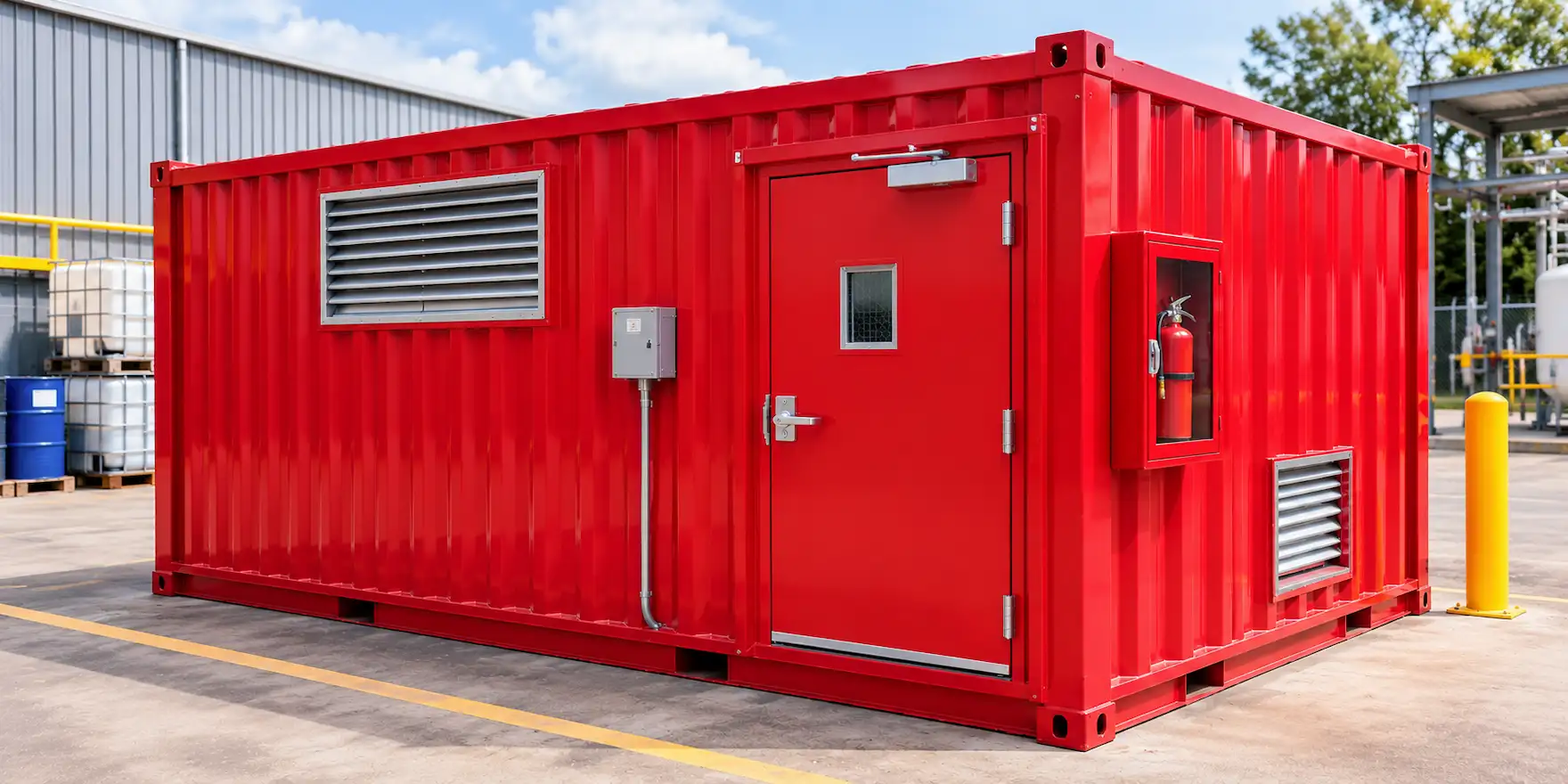
For chemical storage buildings rated under NFPA 30, any security fire door in Charleston facility installs must match the fire resistance rating of the entire building envelope, not function as an isolated opening protective. A fire resistant chemical storage building rated at 2-hour construction must have walls, roof, floor, and opening protections all rated to the equivalent standard. A 2-hour rated wall with a non-rated or under-rated door creates a code violation that invalidates the building’s fire protection classification.
Every security fire door in Charleston code section addresses must be tested and listed as an assembly, not as individual components. A listed door in an unlisted frame, or a listed frame with unlisted hardware, is not a compliant assembly regardless of the individual component ratings. The assembly listing number must appear on the certification label attached to the door and frame, and that label must be visible after installation.
US Hazmat Storage’s fire-rated chemical storage buildings are designed as complete assemblies with door and frame configurations that carry the NFPA 80 assembly listing documentation, so the opening protective meets the same rating as the building envelope it’s installed in.
SC Fire Prevention Code and Charleston AHJ Requirements
South Carolina adopts the International Fire Code (IFC) with state-specific amendments through the South Carolina Fire Prevention Code. For any security fire door in Charleston project, the SC Fire Prevention Code references NFPA 80 as the standard for installation, inspection, testing, and maintenance. The South Carolina amendments to IFC don’t substantially modify the NFPA 80 requirements for door assemblies, but they do affect the inspection frequency and documentation requirements.
NFPA 80 Section 5.2 requires that fire door assemblies be inspected and tested annually. In South Carolina, that inspection must be documented and records must be available for AHJ review. For a security fire door in Charleston hazardous materials facility, the annual NFPA 80 inspection documentation may be requested by the Charleston area fire marshal during routine hazmat facility inspections.
The City of Charleston enforces the IBC through the Charleston Fire Department and Building Inspections office, which means every security fire door in Charleston permit application is reviewed against both IBC and NFPA 80. Projects in unincorporated Charleston County fall under Charleston County Building Inspections. Projects at state-regulated facilities fall under the South Carolina Office of State Fire Marshal regardless of local jurisdiction.
Fire Rated Hollow Metal Door: Construction and Labeling Requirements
A fire rated hollow metal door is the most common door type used in a security fire door in Charleston chemical storage assembly. The hollow metal construction is rated under UL 10C or NFPA 252. The certification label attached to the door must identify the testing standard, the fire rating in hours, the temperature rise classification (if applicable), and the assembly listing number.
A fire rated hollow metal door for a security fire door in Charleston application must have a label that is permanently attached (not a sticker that can be removed), legible, and placed on the hinge stile of the door where it is accessible for inspection. NFPA 80 Section 4.1.4.1 requires that labels be maintained throughout the life of the door. A door with a missing, damaged, or illegible label is treated as an unlisted door regardless of its actual construction.
The maximum gap tolerances for a fire rated hollow metal door under NFPA 80 Section 4.8 are: clearance at the bottom of the door to the floor or sill not to exceed 3/4 inch, clearance between the top of the door and the frame not to exceed 1/8 inch, and meeting edge clearance not to exceed 1/8 inch for the clearance between the door edge and the frame. These tolerances must be maintained over time. Building settlement, door sag, and frame movement can cause gaps to exceed NFPA 80 limits even in correctly installed assemblies.
Security Hardware: Electrified Locks and Access Control Integration
A security fire door in Charleston installation with integrated access control creates a code intersection between NFPA 80, NFPA 72, and IBC Section 1010. Electrified locking hardware on a fire door must be fail-safe or fail-secure depending on the occupancy and egress requirements, and the choice between fail-safe and fail-secure must be documented and approved by the AHJ.
NFPA 80 Section 4.5.4 requires that electrically controlled locking hardware on fire doors be connected to the fire alarm system such that the hardware releases when the fire alarm activates. This requires coordination between the door hardware contractor, the fire alarm contractor, and the building’s fire alarm system installer to verify that the interconnection is correct and that the door releases on alarm signal. A security fire door in Charleston installation with access control that is not connected to the fire alarm system is an NFPA 80 violation.
Electromagnetic locks (maglocks) on fire doors require an NFPA 80 listed maglock and a listed armature plate. Maglocks that are not specifically listed for fire door applications are not permitted on fire-rated assemblies regardless of their holding force rating.
US Hazmat Storage’s custom hazmat locker configurations include door and access control integration options designed around the NFPA 80 and NFPA 72 interconnection requirements, so the security hardware and fire rating function as a coordinated assembly rather than separate systems.
Inspection, Testing, and Maintenance Under NFPA 80
NFPA 80 Section 5.2 requires annual inspection and testing of every security fire door in Charleston facility operates. The inspection covers: label visibility and legibility, clearance gaps within tolerances, hardware operation (latch engagement, closer function, coordinator sequence if present), no field modifications that void the listing, and no obstructions to door swing or closure. The inspection must be conducted by a person knowledgeable about fire door requirements and the results must be documented.
For a security fire door in Charleston hazardous materials facility, the annual NFPA 80 inspection documentation should be maintained alongside the facility’s SPCC plan, emergency action plan, and other regulatory compliance documentation. The Charleston area fire marshal may request inspection records as part of the facility’s hazmat permit review or following a complaint or incident.
Doors that fail the annual inspection must be taken out of service or repaired before the next use. A fire door that is propped open, has a blocked closer, or has gaps exceeding NFPA 80 tolerances is a life safety violation regardless of whether it has been inspected.
Closing: AHJ Coordination Is Not Optional in Charleston
A security fire door in Charleston project that is specified from a national standard alone will face corrections at the AHJ review stage. The Charleston Fire Department, Charleston County Building Inspections, and the SC Office of State Fire Marshal each apply the code with local authority. That means the plan review comments, inspection results, and correction notices you receive are based on how the AHJ interprets NFPA 80 in the context of your occupancy and site, not on a uniform national standard that ignores local conditions.
US Hazmat Storage works with Charleston area facilities to deliver every security fire door in Charleston project requires, from fire-rated chemical storage buildings to complete door assemblies specified to the full code stack from the design phase forward. Contact our specialists for a custom recommendation and avoid the correction cycle that starts when a national-standard specification meets a local AHJ review.
FAQ
What fire rating is required for a chemical storage building security fire door in Charleston?
The required rating of the door is a function of the fire resistance rating of the wall that it is protecting. Under NFPA 80 Table 4.1.1 and the IBC a 2-hour rated wall requires a 1.5 hour door assembly. A 1-hour rated wall requires either a 45 minute or 1-hour door depending on the application. For Group H (hazardous occupancy) buildings under IBC Section 307 the wall and door ratings are governed by the specific occupancy subclass.
Does a security fire door in Charleston installation require an annual inspection?
Yes. NFPA 80 Section 5.2 requires annual inspection and testing of all fire door assemblies. The inspection must include the condition of the label, gap tolerances, operation of the hardware and no field modifications. The results of the inspection must be documented. South Carolina’s adoption of NFPA 80 via the SC Fire Prevention Code means that this requirement is enforceable by the Charleston area AHJ.
Can access control hardware be fitted to a fire rated door?
Yes, as long as the hardware is listed for use with fire door assemblies and the electrified locking device is connected to the fire alarm system to release on alarm activation in accordance with NFPA 80 Section 4.5.4. Maglocks must be specifically listed for use with fire doors. The fail safe / fail secure configuration must be approved by the AHJ in accordance with egress requirements under IBC Section 1010.
What are the gap tolerances for a fire rated hollow metal door under NFPA 80?
NFPA 80 Section 4.8 specifies maximum clearances: bottom clearance to floor or sill not to exceed 3/4″, top clearance between door and frame not to exceed 1/8″, and meeting edge clearance between the door edge and the frame not to exceed 1/8″. These clearances must be maintained throughout the life of the assembly and are checked during the annual inspection.
Which authority has jurisdiction over a security fire door in Charleston project?
Jurisdiction is based on location and type of occupancy. The City of Charleston has jurisdiction via the Charleston Fire Department and Building Inspections. Unincorporated Charleston County is under the Charleston County Building Inspections. State regulated facilities are under the South Carolina Office of State Fire Marshal irrespective of the local municipality. The appropriate AHJ must be identified prior to design.