
If your business stores even a few gallons of gasoline, paint thinner, acetone, or industrial solvents, you’re already operating under a specific set of federal rules — whether you realize it or not. Navigating OSHA flammable storage requirements can feel overwhelming, especially for small business owners who are juggling payroll, customers, permits, and a dozen other responsibilities. Yet non-compliance can lead to catastrophic fires, worker injuries, and five- to six-figure fines that can sink a small operation overnight.
The good news: OSHA’s rules, while technical, are entirely manageable when broken down into a clear, actionable checklist. This guide from the team at US HazMat Storage walks you through every core requirement small businesses must meet, how to identify which flammables you’re actually storing, and the practical equipment decisions that separate a compliant shop from a liability.
Whether you operate an auto body shop, a print facility, a contracting business, a landscaping operation, a cleaning service, or a manufacturing plant, this is the resource you’ll want to keep bookmarked.
Why OSHA Flammable Storage Compliance Matters for Small Businesses
It’s tempting to assume OSHA’s focus lies on massive industrial facilities with hundreds of employees. The reality is the opposite. Small businesses account for a significant share of OSHA citations each year, and flammable storage violations rank among the most commonly cited across virtually every industry.
The Real Cost of Non-Compliance
Beyond the immediate risk of fire, explosion, or chemical exposure, non-compliance carries tangible financial and legal consequences:
- OSHA penalties ranging into the tens of thousands of dollars per violation
- Willful or repeat violations that can exceed six figures
- Insurance premium increases or policy cancellation
- Business interruption during investigations
- Personal liability for owners in some negligence cases
- Permanent damage to customer trust and local reputation
According to the Occupational Safety and Health Administration, fire-related workplace incidents involving flammable liquids continue to cause preventable injuries every year. Most of those incidents trace back to storage shortcuts — improper cabinets, missing signage, overstocked areas, or proximity to ignition sources.
Who Needs to Comply?
Nearly every small business that handles flammable liquids is covered under OSHA 29 CFR 1910.106 — the federal standard governing flammable liquids. This includes:
- Automotive shops and detailers
- Paint, coating, and refinishing businesses
- Print shops and graphic production facilities
- Dry cleaners and laundromats using solvents
- Landscapers and lawn care companies with fuel inventory
- Construction and remodeling contractors
- Manufacturing and fabrication shops
- Maintenance departments in larger commercial facilities
- Hardware stores and paint retailers
- Agricultural operations with fuel or chemical storage
If your operation stores, mixes, dispenses, or uses any flammable or combustible liquid, compliance isn’t optional — it’s a baseline expectation of doing business legally and safely.
Understanding OSHA’s Classifications of Flammable Liquids
Before you can store flammables correctly, you need to know what you actually have. OSHA groups these liquids by flash point — the lowest temperature at which they produce enough vapor to ignite. Getting the classification right affects every other decision on your checklist.
Class I Flammable Liquids
Class I liquids are the most dangerous category because they produce ignitable vapors at typical room temperatures or below. They’re subdivided into three classes:
- Class IA — Flash point below 73°F and boiling point below 100°F (e.g., ethyl ether, pentane)
- Class IB — Flash point below 73°F and boiling point at or above 100°F (e.g., gasoline, acetone, methanol)
- Class IC — Flash point at or above 73°F and below 100°F (e.g., xylene, mineral spirits, some paints)
Class II and Class III Combustibles
Class II and III liquids are technically “combustibles,” but OSHA groups them under many of the same storage rules:
- Class II — Flash point at or above 100°F but below 140°F (e.g., diesel fuel, kerosene, some cleaners)
- Class IIIA — Flash point at or above 140°F but below 200°F (e.g., fuel oil, some lubricants)
- Class IIIB — Flash point at or above 200°F (e.g., many vegetable and mineral oils)
Quick Reference: Flammable vs. Combustible
| Class | Flash Point | Examples | Storage Priority |
| IA | <73°F, BP <100°F | Ethyl ether, pentane | Highest |
| IB | <73°F, BP ≥100°F | Gasoline, acetone | Highest |
| IC | 73–99°F | Xylene, mineral spirits | High |
| II | 100–139°F | Diesel, kerosene | Moderate |
| IIIA | 140–199°F | Fuel oil | Moderate |
| IIIB | ≥200°F | Motor oil, veg oil | Lower |
Your Safety Data Sheets (SDS) list the flash point of every chemical you store. If you can’t find an SDS, contact the manufacturer — it’s a required document, not a nice-to-have.
The Core OSHA Flammable Storage Requirements Checklist
Here’s the practical checklist small business owners can work through this week. Each item ties back to a specific OSHA requirement under 29 CFR 1910.106 and related standards.
Container Requirements
Not all containers are created equal, and using a non-approved container is one of the most frequent small-business violations.
- Use only approved safety containers (FM-approved, UL-listed, or DOT-compliant)
- Metal safety cans with spring-loaded lids and flame arrestors for Class I liquids
- Maximum container sizes depend on liquid class and container type
- Label every container clearly with the product name and hazard class
- Never reuse food or beverage containers for flammables — a leading cause of workplace poisonings
Storage Cabinet Specifications
When you store more than 25 gallons of flammables outside of approved containers, OSHA requires flammable storage cabinets that meet strict construction standards:
- Steel walls, top, and bottom of at least 18-gauge sheet metal
- Double-wall construction with a 1.5-inch air space
- Self-closing, self-latching doors
- Riveted, welded, or constructed to prevent vapor leakage
- Yellow color with “FLAMMABLE — KEEP FIRE AWAY” signage
Quantity Limits by Cabinet
| Cabinet Type | Max Gallons (Class I, II, IIIA) |
| Single flammable storage cabinet | 60 gallons Class I or II / 120 gallons total |
| Per fire area (storage room) | Higher limits, with ventilation required |
| Room with automatic sprinklers | Significantly expanded limits |
| Outdoor flammable locker | Typically 200–1,000+ gallons per unit |
The National Fire Protection Association, whose standards OSHA frequently incorporates by reference, provides additional guidance on spacing, grounding, and sprinkler protection that goes beyond basic OSHA language.
Ventilation and Electrical Requirements
Flammable vapors are often heavier than air and can accumulate at floor level — which is why ventilation matters as much as containment.
- Storage rooms for Class I liquids require at least 1 CFM per square foot of ventilation
- Exhaust must vent directly outside, away from ignition sources
- All electrical equipment must be rated for Class I, Division 1 or 2 locations
- Lighting fixtures, switches, and outlets inside storage rooms must be explosion-proof
- Eliminate all ignition sources within 25 feet of storage areas
Signage, Access, and Distance Rules
Even the best cabinet fails when surrounded by the wrong environment.
- Post clear “Flammable — Keep Fire Away” signs
- Include “No Smoking” signage at all entrances and storage points
- Maintain clear aisles and emergency egress paths
- Keep flammable storage at least 50 feet from property lines where possible
- Separate flammables from oxidizers, corrosives, and reactive materials
Fire Protection and Emergency Preparedness
- Install appropriate Class B fire extinguishers within 10 feet of storage
- Conduct monthly visual inspections and annual maintenance on extinguishers
- Train employees on spill response and evacuation procedures
- Maintain a written Hazard Communication Plan
- Keep SDS sheets accessible to all employees at all times
- Document employee training and refresh annually
Building Your Compliant Storage System: What Small Businesses Need
OSHA’s rules get easier the moment you invest in the right equipment. Trying to retrofit a wood cabinet or a repurposed shed almost never passes inspection and often costs more than starting with compliant gear.
Indoor Flammable Safety Cabinets
A dedicated flammable safety cabinet is the cornerstone of small business compliance. Look for:
- FM-approved or UL-listed certification
- Appropriate capacity for your stored volume
- Self-closing, self-latching doors
- Vent bungs (with or without flame arrestors depending on your setup)
- Leak-tight sump to contain spills
Outdoor Chemical Storage Lockers and Buildings
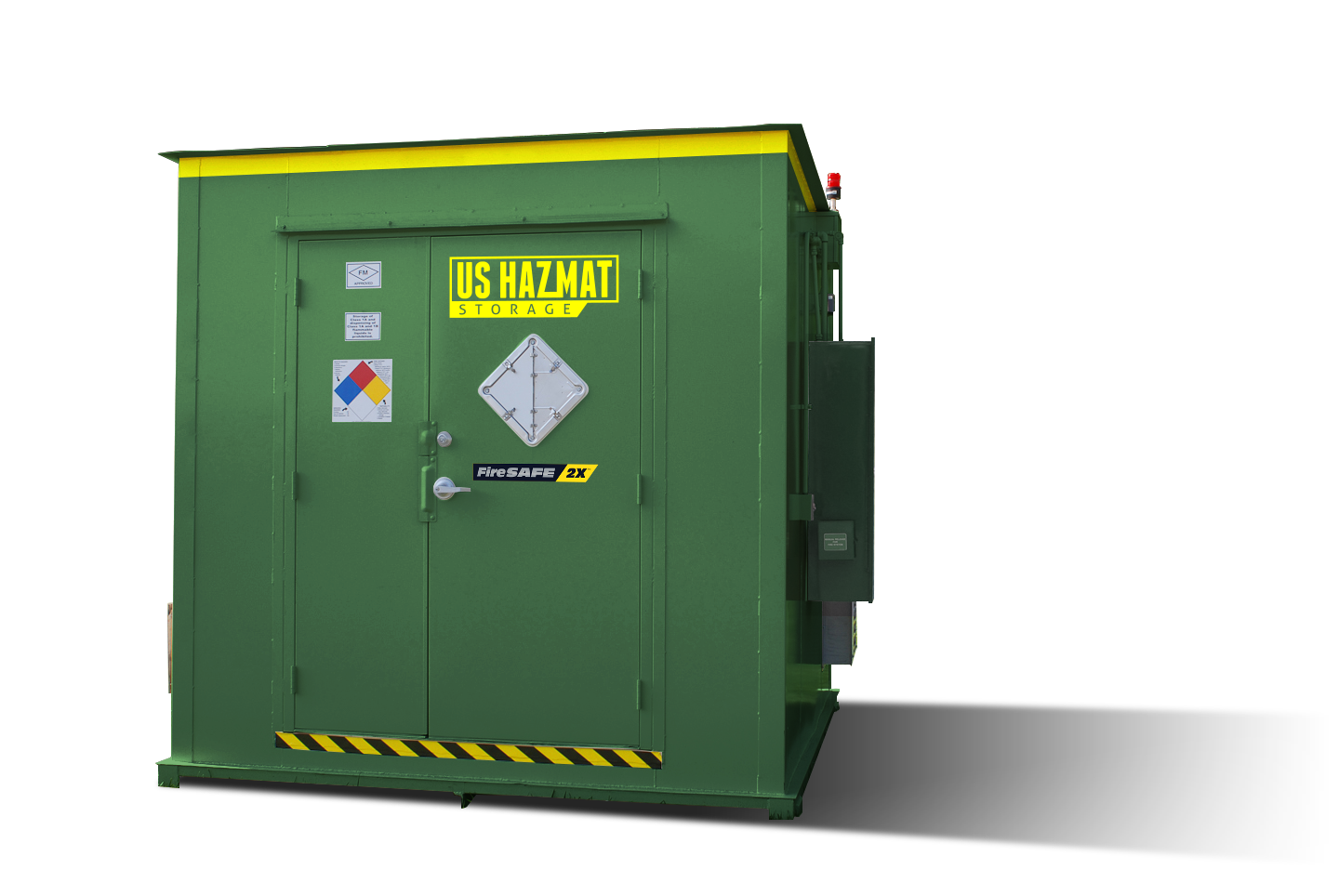
For businesses storing larger volumes — or lacking the indoor square footage to comply — outdoor chemical lockers and fire-rated storage buildings offer an excellent solution. These engineered units are prebuilt to meet OSHA, NFPA, and EPA standards, often with:
- 2-hour or 4-hour fire ratings
- Built-in containment sumps
- Climate control options
- Explosion relief panels
- Integrated ventilation and grounding
Because each business has unique volumes, chemicals, and site conditions, many small business owners find it valuable to consult directly on equipment selection. The experts at US HazMat Storage provide detailed technical guidance on OSHA flammable storage requirements tailored to your specific operation — avoiding the expensive guessing game of generic equipment purchases.
Secondary Containment, Spill Kits, and PPE
A complete compliance system also includes:
- Secondary containment pallets or berms for drums and totes
- Absorbent spill kits sized appropriately for your largest container
- Personal protective equipment (gloves, goggles, chemical-resistant aprons)
- Grounding and bonding equipment for dispensing operations
- Properly rated fire extinguishers and optional automatic suppression
Common OSHA Violations and How to Avoid Them
Understanding where other businesses trip up helps you avoid the same pitfalls.
Top Violations Small Businesses Face
- Using non-approved containers (plastic jugs, soda bottles, food containers)
- Exceeding maximum quantity limits in a single cabinet
- Missing or illegible labels and signage
- Flammables stored near ignition sources, heaters, or electrical panels
- Blocked emergency exits or fire extinguisher access
- No written Hazard Communication Plan
- Untrained employees handling flammables
- Storing incompatible chemicals together
How to Prepare for an OSHA Inspection
OSHA inspectors can arrive unannounced, often triggered by an employee complaint, accident report, or routine industry targeting. Being ready year-round is the only real strategy.
- Conduct internal audits quarterly using this checklist
- Keep all SDS sheets digitized and organized
- Document every training session with dates and signatures
- Photograph storage areas monthly as an audit record
- Test emergency eyewash stations weekly
- Maintain a spill-response log if any incidents occur
- Designate a compliance point person to liaise with inspectors
When inspectors arrive, a calm, organized, documented operation is your strongest defense. Most “surprise” inspections go smoothly when the systems have been in place for months.
Frequently Asked Questions About OSHA Flammable Storage
1. How much flammable liquid can I store without a safety cabinet?
OSHA generally allows up to 25 gallons of flammable liquid to be stored outside of an approved cabinet or storage room, provided it’s in approved safety containers. Beyond 25 gallons, a compliant flammable storage cabinet is required, and beyond 60 gallons per cabinet, multiple cabinets or a dedicated storage room becomes necessary.
2. Do I need a permit to store flammable liquids at my business?
Permit requirements vary by state, county, and fire jurisdiction. While OSHA regulates worker safety, local fire marshals often have additional rules and may require permits, inspections, or registrations — especially for outdoor storage or quantities above certain thresholds. Always check with your local fire authority.
3. Can I store flammables in a regular metal cabinet?
No. A standard metal cabinet does not meet OSHA’s double-wall, 18-gauge, self-closing, vapor-tight specifications. Only cabinets specifically designed and certified (typically FM-approved or UL-listed) qualify as compliant flammable storage cabinets.
4. What’s the difference between OSHA, NFPA, and EPA requirements?
OSHA focuses on worker safety, NFPA develops voluntary fire safety codes that are often adopted by state and local jurisdictions, and the EPA regulates environmental protection and hazardous waste. A fully compliant small business typically meets all three sets of standards simultaneously, and most high-quality storage equipment is designed to comply with all three.
5. Do I need flammable storage for just a few small containers?
If your total storage is well under 25 gallons and you use approved safety cans, you may not need a full cabinet. However, best practice — and many state or local codes — still recommend a small flammable cabinet for any regular storage to prevent fires, theft, and accidental contamination.
6. Can I store flammables outside in a shed?
Only if the shed meets OSHA, NFPA, and local fire code requirements, which standard garden sheds almost never do. Properly engineered outdoor chemical storage lockers or fire-rated storage buildings are designed specifically for this purpose and are the only code-compliant option for outdoor storage.
7. What are the signage requirements for flammable storage?
Every cabinet, room, and area where flammables are stored must display clear “Flammable — Keep Fire Away” signage along with “No Smoking” warnings. Containers must be labeled with the product name and hazard class, and storage areas should include Hazard Communication signs identifying the types of chemicals present.
8. How often should I train employees on flammable storage procedures?
OSHA requires initial training before employees begin work with hazardous chemicals, additional training whenever new chemicals are introduced, and refresher training on a regular basis. Most businesses aim for annual refresher training, with documentation kept on file for at least three years.
Protect Your Business, Your Employees, and Your Future
OSHA compliance isn’t a burden — it’s a shield. Every cabinet, sign, label, and training session you put in place reduces the probability of a devastating fire, a painful injury, a lawsuit, or a crippling fine. For small businesses operating on thin margins, that kind of protection is priceless.
The team at US HazMat Storage has spent years helping small businesses across the United States build storage systems that pass inspection the first time, protect workers every day, and scale with your growth. From compact indoor safety cabinets to full-size outdoor chemical lockers and fire-rated storage buildings, every solution is engineered to meet or exceed OSHA, NFPA, and EPA standards.If you’ve been meaning to tighten up your flammable storage, now is the right moment — before an inspection, before an incident, before an insurance renewal. Our specialists can help you assess your current setup, identify gaps, and recommend the most cost-effective path to full compliance. Contact US Hazmat Storage today and let our experts turn your OSHA flammable storage checklist into a finished, inspection-ready reality