
When most facility managers think about chemical storage, their minds jump straight to flammables — gasoline, solvents, paint thinners. But some of the most damaging workplace incidents each year involve a very different class of substance: corrosives. Acids, caustics, and oxidizing chemicals can eat through concrete floors, destroy structural steel, cause severe burns, and release toxic fumes — yet they’re routinely stored in cabinets never designed to contain them. That’s exactly why purpose-built corrosive storage lockers have become essential infrastructure for any facility serious about safety and compliance.
This guide from US HazMat Storage walks you through how corrosives differ from flammables, why fire-rated cabinets are often the wrong choice for these materials, the specific features that define a truly compliant corrosive locker, and how to choose the right solution for your operation — whether you run a lab, a water treatment plant, a manufacturing line, or a distribution warehouse.
Understanding Corrosives: Why They Need Their Own Storage Strategy
Corrosives make up a massive category of industrial chemicals, yet they often receive less storage attention than their flammable cousins. The assumption that a chemical cabinet is a chemical cabinet is not only wrong — it’s one of the leading causes of preventable chemical incidents in small and mid-sized facilities.
What Qualifies as a Corrosive Chemical?
According to OSHA’s Hazard Communication Standard, a corrosive is defined as a chemical that causes visible destruction of, or irreversible alterations in, living tissue by chemical action at the site of contact. In practical terms, this covers two major groups:
- Acids — sulfuric, hydrochloric, nitric, acetic, phosphoric, chromic
- Bases (alkalis/caustics) — sodium hydroxide, potassium hydroxide, ammonium hydroxide
- Oxidizing corrosives — hydrogen peroxide (concentrated), bleach at high concentrations, nitric acid
- Other reactive corrosives — bromine, fluorosilicic acid, hydrofluoric acid
These materials aren’t just hazardous to people. They degrade metals, concrete, wood, plastics, gaskets, and electrical components. Storing them incorrectly doesn’t just risk a single accident — it slowly destroys your facility from the inside out.
Why Corrosives Don’t Belong in Flammable Cabinets
Flammable safety cabinets are engineered specifically to contain fire and prevent vapor ignition. They’re typically made of painted steel with vapor seals and self-closing doors. That’s brilliant for flammables and disastrous for corrosives. Here’s why:
- Acid and caustic vapors corrode the interior steel walls
- Rusted cabinets lose structural integrity within months
- Vapor buildup can’t escape in a sealed flammable cabinet
- Mixing acids and bases in the same cabinet risks violent reactions
- Flammable cabinet finishes are not rated for chemical resistance
Using the wrong cabinet creates the illusion of compliance while quietly increasing risk. A true corrosive storage locker is designed from the ground up with different materials, ventilation assumptions, and internal layouts.
Common Corrosives by Industry
| Industry | Typical Corrosives Stored |
| Laboratories & universities | Hydrochloric acid, sulfuric acid, sodium hydroxide |
| Water & wastewater treatment | Sodium hypochlorite, ferric chloride, caustic soda |
| Metal finishing & plating | Chromic acid, nitric acid, alkaline cleaners |
| Battery manufacturing | Sulfuric acid, potassium hydroxide |
| Semiconductor | Hydrofluoric acid, ammonium hydroxide |
| Agriculture | Fertilizers, ammonia solutions, acidic cleaners |
| Cleaning & janitorial services | Bleach, caustic degreasers, descalers |
| Food & beverage processing | Peracetic acid, sanitizing agents, caustic CIP chemicals |
Why Corrosive Storage Lockers Matter for Non-Flammable Materials
One of the most misunderstood aspects of chemical storage is the relationship between fire-rating and chemical safety. Many facility managers assume that if a storage unit is fire-rated, it must be safer for all chemicals. In the case of corrosives, the opposite is often true.
The Case for Non-Fire-Rated Design
Because corrosives are typically non-flammable, they don’t require fire-rated construction in most regulatory contexts. A non-fire-rated corrosive storage locker is designed to optimize for what actually threatens corrosive materials: vapor containment, material compatibility, secondary spill containment, and proper ventilation.
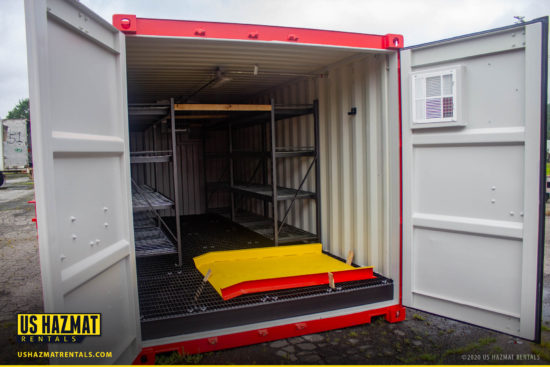
This is exactly why many facilities turn to engineered non-fire-rated chemical storage buildings for their corrosive inventory. The investment goes toward corrosion-resistant interiors, upgraded ventilation, and robust containment — not fire-rated panels that add cost without addressing the real risk profile of acids, bases, and oxidizers.
Regulatory Framework at a Glance
Corrosive storage intersects with several federal and voluntary standards:
- OSHA 29 CFR 1910.1200 — Hazard Communication Standard, including labeling and SDS requirements
- OSHA 29 CFR 1910.132–138 — PPE requirements for corrosive handling
- EPA 40 CFR Part 264 — RCRA hazardous waste management for treatment, storage, and disposal facilities
- NFPA 400 — Hazardous Materials Code, covering quantities, separation, and storage design
- DOT 49 CFR — Transportation requirements when corrosives are shipped or received
The U.S. Environmental Protection Agency enforces significant portions of these rules under the Resource Conservation and Recovery Act (RCRA), with penalties that can exceed $100,000 per day for serious violations at large facilities.
Key Features of Quality Corrosive Storage Lockers
Not every chemical cabinet is actually built for corrosives. The difference shows up in the details — materials, drainage, ventilation, and engineering decisions you may not notice until something goes wrong.
Construction Materials That Resist Chemical Attack
The single most important specification in a corrosive storage locker is material compatibility. Ordinary painted steel will not survive prolonged exposure to acid or caustic vapors. Quality lockers use purpose-built materials:
- Polyethylene (HDPE) — excellent resistance to most acids and bases, ideal for small to mid-size lockers
- Stainless steel (316) — strong resistance to many corrosives, excellent for outdoor lockers and mixed inventory
- Fiberglass-reinforced plastic (FRP) — lightweight, highly resistant, popular for custom builds
- Lined carbon steel — epoxy or specialty coatings applied over steel for specific chemical profiles
- Polypropylene — especially effective against hydrofluoric acid and certain fluorides
The correct material depends entirely on what you’re storing. A locker ideal for sulfuric acid may be inappropriate for hydrofluoric acid. This is exactly why expert consultation matters more for corrosives than for almost any other category.
Ventilation and Vapor Management
Unlike flammable cabinets, which are often sealed to contain vapors, corrosive lockers require active or passive ventilation to prevent vapor accumulation. Key design elements include:
- Powered exhaust fans rated for corrosive environments
- Vent ducts constructed of compatible materials (PVC, FRP, stainless)
- Air intake louvers positioned to promote cross-flow
- Exhaust terminations positioned away from occupied spaces and air intakes
- Optional scrubbers for high-concentration operations
Proper ventilation doesn’t just protect workers — it dramatically extends the service life of the locker itself by preventing interior surfaces from becoming saturated with corrosive vapors.
Secondary Containment Requirements
Every corrosive storage locker must be designed to contain spills — because containers leak, get knocked over, or fail over time. EPA guidelines typically require secondary containment capacity of at least 10% of total stored volume, or 110% of the largest container, whichever is greater.
Effective containment features include:
- Integrated leak-tight sumps
- Containment pallets and berms
- Drain-free floor pans with chemical-resistant coatings
- Spill kits and neutralizing agents nearby
- Visual spill indicators for remote or infrequent monitoring
Material Comparison Chart
| Material | Acid Resistance | Base Resistance | Durability | Cost |
| Polyethylene (HDPE) | Excellent | Excellent | High | Low–Moderate |
| Polypropylene | Excellent (incl. HF) | Very Good | Moderate | Moderate |
| 316 Stainless Steel | Good–Excellent | Excellent | Very High | High |
| FRP | Excellent | Excellent | High | Moderate–High |
| Lined Carbon Steel | Varies | Varies | Moderate | Moderate |
Compatibility Rules: What You Can (and Can’t) Store Together
One of the most dangerous mistakes in chemical storage is treating all corrosives as interchangeable. A poorly organized locker can turn an ordinary workday into a toxic gas event or a violent exothermic reaction.
The Acid-Base Separation Principle
Acids and bases should never share a storage compartment. A single spill that causes them to mix can release enormous amounts of heat, toxic gases, and splashing corrosive liquid. Best practices include:
- Dedicated lockers or compartments for acids only
- Separate lockers or compartments for bases only
- Physical barriers — not just shelves — between the two
- Secondary containment that prevents cross-contamination
- Clear labeling and color-coded signage
Oxidizers and Reducers
Oxidizing corrosives (like nitric acid or concentrated hydrogen peroxide) should never be stored with organic acids (like acetic acid) or with flammable materials. The combination can cause spontaneous ignition or explosive reactions. Many facilities maintain three distinct storage zones:
- Acid locker (non-oxidizing)
- Base/caustic locker
- Oxidizer locker (separated from both acids and organics)
Additional Incompatibility Examples
- Hydrofluoric acid should be isolated from glass and most metals
- Nitric acid should never be stored with ammonia or amines
- Sodium hypochlorite (bleach) must be separated from ammonia-based cleaners
- Concentrated acids should be stored below eye level to prevent splash injuries
- Reactive metals (sodium, potassium) require completely separate storage from aqueous corrosives
A knowledgeable storage vendor can help map your inventory into a compliant, logical layout — often identifying incompatibilities the facility team didn’t realize existed.
Choosing the Right Corrosive Storage Locker for Your Facility
Selecting a corrosive storage locker isn’t just about picking a size. It’s about matching the unit to your chemistry, your environment, your workflow, and your growth plans.
Assessing Your Chemical Inventory
Before choosing a locker, compile:
- A complete inventory of corrosive chemicals stored, used, and received
- Maximum volumes of each chemical at any given time
- Container types and sizes (drums, totes, carboys, small bottles)
- Frequency of access and dispensing
- Existing Safety Data Sheets for every material
- Any planned future chemicals or process changes
This upfront analysis determines locker size, materials, ventilation specs, and layout — and prevents the expensive mistake of outgrowing your locker within a year.
Indoor vs. Outdoor Placement
Corrosive lockers are available in both indoor and outdoor configurations. Outdoor placement is often preferred for large-volume storage because it:
- Removes corrosive vapors from occupied indoor spaces
- Simplifies ventilation design
- Reduces the impact of a potential spill on production areas
- Allows greater total storage capacity
- Often reduces insurance and fire marshal concerns
Indoor lockers remain essential when chemicals are used in tight integration with a production line, when climate control is required, or when outdoor space simply isn’t available.
Capacity Planning and Future-Proofing
A common mistake is sizing a locker to today’s inventory without room for growth. Best practices include:
- Sizing for 25–50% more capacity than current needs
- Including modular expansion options where possible
- Planning for the largest container size you may ever receive
- Leaving aisle space for safe access and emergency response
- Budgeting for containment upgrades if inventory profiles change
Frequently Asked Questions About Corrosive Storage Lockers
1. Why can’t I store corrosives in a regular flammable safety cabinet?
Flammable cabinets are designed to contain fire and vapors, not to resist chemical attack. Their painted steel interiors rust quickly when exposed to acid or caustic vapors, and the sealed design can trap hazardous vapors. Corrosive storage lockers are built from chemical-resistant materials and engineered for the specific demands of acids, bases, and oxidizers.
2. Do corrosive storage lockers need to be fire-rated?
In most cases, no. Because corrosives are typically non-flammable, fire-rated construction isn’t required and adds unnecessary cost. The priority for corrosive storage is chemical compatibility, ventilation, and spill containment — which is why non-fire-rated chemical storage buildings are often the ideal solution.
3. Can I store acids and bases in the same locker?
You should never store acids and bases together without substantial physical separation. An accidental mix can release heat, toxic gases, and splashing liquid. Best practice is to use separate dedicated lockers or clearly separated compartments with independent containment sumps.
4. What’s the best material for a corrosive storage locker?
It depends on what you’re storing. Polyethylene is excellent for most common acids and bases, 316 stainless steel works well for mixed outdoor storage, polypropylene is essential for hydrofluoric acid, and FRP offers strong performance across a wide range of chemicals. A specialist can help you match materials to your specific inventory.
5. How much secondary containment capacity do I need?
EPA guidance generally requires a minimum of 10% of total stored volume or 110% of the largest container, whichever is greater. Many facilities build in additional margin to cover spills during transfers and decanting operations.
6. Do I need ventilation in my corrosive storage locker?
Yes, in most cases. Corrosive vapors accumulate over time and can damage the locker interior, harm workers during access, and create regulatory issues. Even passive ventilation is typically required; active exhaust is recommended for high-volume or high-concentration operations.
7. How often should corrosive storage lockers be inspected?
Daily visual checks, weekly detailed inspections, and formal monthly audits are industry best practice. Inspectors should look for container leaks, corrosion on interior surfaces, containment sump accumulation, ventilation performance, and signage integrity. Documentation supports both OSHA and EPA compliance.
8. Can a corrosive storage locker be used outdoors year-round?
Yes, when the locker is specifically designed for outdoor service. Features to look for include UV-resistant materials, weatherproof seals, temperature-appropriate ventilation, and (in some climates) insulation or heating to prevent freezing of aqueous solutions. A specialist vendor can recommend the right configuration for your regional climate.
Protect Your People, Your Facility, and Your Bottom Line
Corrosive chemicals don’t announce their damage with flames and smoke. They work quietly — rusting steel beams, weakening concrete, harming respiratory systems, and creating the conditions for a major incident long before anyone realizes a problem exists. The right corrosive storage locker isn’t a luxury; it’s a structural investment that protects every other asset in your operation.
At US HazMat Storage, we’ve spent years helping facilities across the United States design compliant, durable, and practical corrosive storage solutions. Whether you need a compact indoor polyethylene unit for a small lab or a large-capacity outdoor non-fire-rated chemical storage building for an industrial site, our specialists can match your inventory, workflow, and regulatory requirements with the right engineered solution.If your current storage setup has unresolved questions — mismatched cabinets, missing containment, uncertain ventilation, or growing inventory — this is the moment to address it. Every month without a proper solution is another month of quiet risk. Contact US HazMat Storage today and let our team help you secure your facility with corrosive storage lockers engineered for the job, built to last, and designed to keep your people, your equipment, and your compliance record intact for years to come.