
Above-ground storm shelters are often preferred because access matters during real severe weather. When a tornado warning is active, people are not thinking in perfect conditions. They may be moving quickly from a jobsite, school, church, plant floor, office campus, transport center, or public facility. Some may be older adults. Some may use wheelchairs, walkers, carts, or mobility aids. Some may be employees trying to get an entire group into protection with only minutes to spare.
That is where shelter design becomes more than an engineering conversation. It becomes a community safety conversation. A shelter can be strong on paper and still create problems if people cannot reach it quickly, enter it safely, or use it without confusion. FEMA guidance matters because safe rooms and storm shelters are expected to protect against extreme winds and debris, but access is what allows that protection to help people in time.
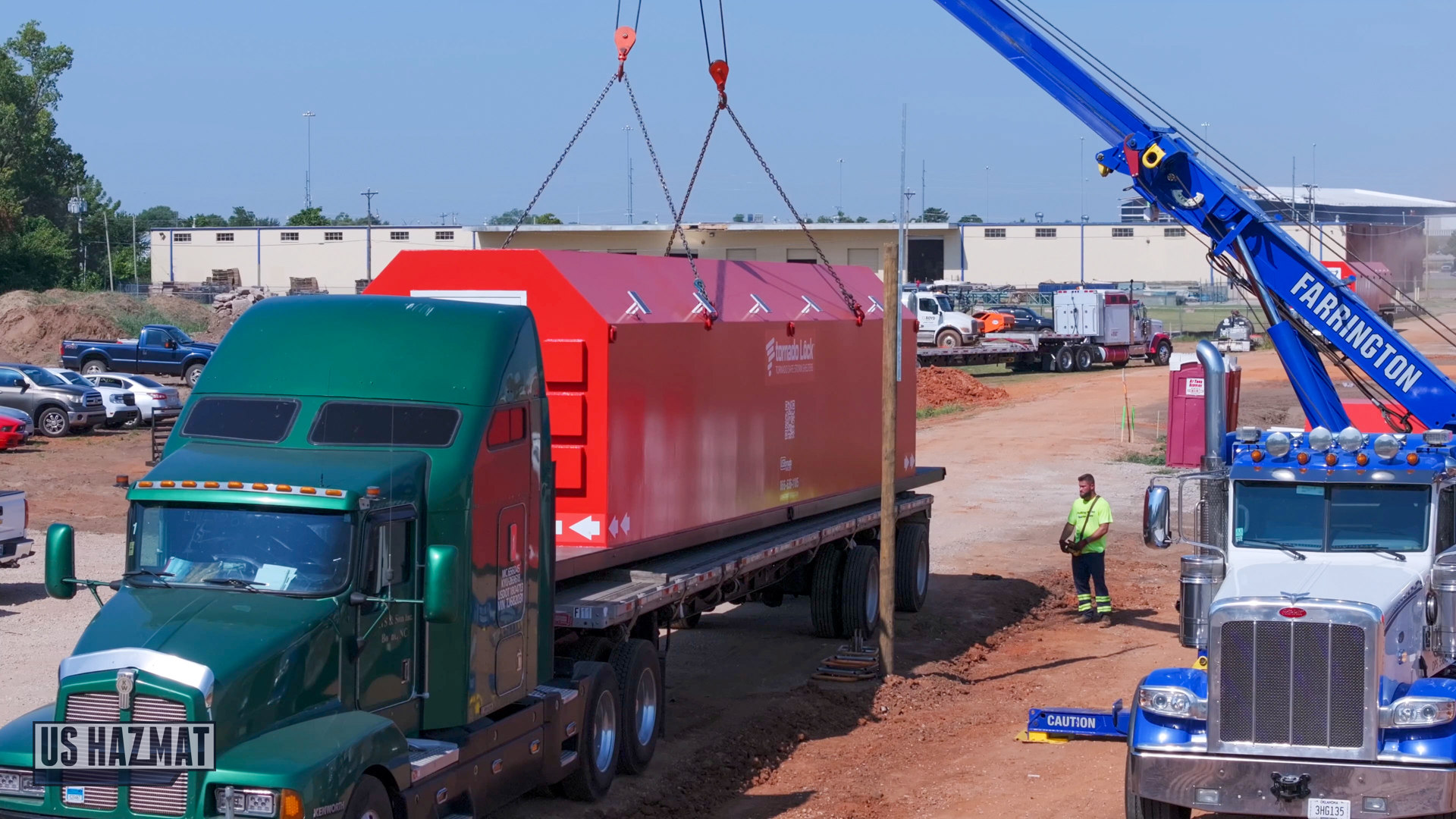
At US Hazmat Storage, this is exactly why our community storm shelters are built around practical deployment, group protection, and severe weather readiness. The company’s BoxSAFE TX shelters are described as mobile tornado shelters with anchoring options, customizable capacities, and construction intended for schools, churches, civic centers, transport centers, stadiums, theme parks, malls, job sites, and more.
Above-Ground Storm Shelters Make Access Faster When Time Is Limited
The biggest advantage of above-ground storm shelters is simple: people can get inside faster.
Underground shelters can be effective, but they often require stairs, tight entry points, hatches, or elevation changes. That can slow people down, especially in a group setting. Above-ground units can be placed where people already gather, work, park, or pass through during normal operations.
That matters for:
- schools and campuses
- factories and industrial sites
- construction projects
- churches and community centers
- stadiums and event venues
- malls and public-facing facilities
- transport hubs
- remote work sites
In these settings, shelter access cannot depend on perfect mobility or perfect timing. It has to work for real people in a stressful moment.
FEMA’s residential safe room guidance states that an above-ground safe room can be just as safe as a below-ground or in-ground safe room when it meets FEMA P-361 requirements. That point is important because accessibility does not have to mean compromising protection.
Why Accessibility Changes the Storm Shelter Decision
Accessibility is not only about wheelchair access. It is about whether the shelter works for the whole population that may need it.
A shelter may need to serve employees, customers, students, visitors, contractors, elderly residents, parents with children, and people with temporary injuries. If the path to safety includes stairs, narrow entries, uneven ground, or complicated doors, the shelter may become harder to use exactly when it matters most.
Here is the practical difference:
| Shelter Access Factor | Why It Matters During Severe Weather |
| Ground-level entry | Helps people enter faster with less physical strain |
| Wider doors | Supports mobility aids, group movement, and easier flow |
| Visible placement | Makes the shelter easier to locate under pressure |
| Flexible site placement | Allows shelters near work areas or gathering points |
| Reduced stair dependency | Helps protect people with limited mobility |
| Group capacity planning | Supports community, jobsite, school, or facility use |
For community storm shelters, this is not a side detail. It is part of the life safety plan.
Above-Ground Storm Shelters Fit Community Safety Planning Better
Community safety planning is different from residential shelter planning. A homeowner may only need to protect one household. A school, jobsite, or business may need to move dozens or hundreds of people quickly.
That is one reason above-ground storm shelters often make more sense for shared protection. They can be positioned closer to the people who need them. They can be planned around evacuation routes, parking areas, employee zones, classroom areas, or public access points. They can also be easier to identify, inspect, and maintain because they are visible and accessible.
US Hazmat Storage’s community shelter page describes BoxSAFE TX shelters as able to accommodate small contractor groups up to hundreds of people, depending on the unit and site needs. It also notes that these shelters can be used in schools, churches, civic centers, transport centers, stadiums, sporting events, theme parks, malls, and job sites.
That kind of flexibility matters. Severe weather protection should fit the site, not force the site into an awkward safety plan.
FEMA Compliance Starts With Protection, but It Cannot Ignore Use
FEMA and ICC 500 guidance focus on serious performance expectations. FEMA’s safe room resources state that FEMA guidance references ICC 500, the Standard for the Design and Construction of Storm Shelters. That relationship matters because FEMA guidance and ICC 500 criteria help shape expectations for wind protection, debris impact resistance, siting, design, and construction.
For facility owners, the compliance conversation should include two questions:
- Can the shelter protect people from the hazard?
- Can people realistically reach and use the shelter in time?
The first question is about engineering. The second is about operations. Both matter.
US Hazmat Storage states that its BoxSAFE TX shelters are certified by Texas Tech National Wind Institute in strict accordance with FEMA 320, FEMA 361, and ICC-500 standards for wind-rated impact of 250-mph-ground-speed tornado events. The same page lists FEMA P-361, ICC 500, and IBC compliance among its design features.
That is why FEMA compliant storm shelters should not be evaluated only by strength. They should also be evaluated by access, placement, capacity, and how the shelter works in a real emergency plan.
Severe Weather Shelters Need to Work for More Than One Scenario
A strong shelter is not only useful during the most dramatic storm event. It becomes part of a broader safety system.
On job sites and industrial campuses, a shelter may need to serve crews during tornado warnings, high wind events, or dangerous weather transitions. In community settings, it may need to serve visitors who do not know the property well. In schools or public venues, it may need to support organized movement under staff direction.
That is why above-ground storm shelters are often easier to integrate into daily operations. They are visible. They can be included in drills. They can be checked more easily. They can be placed where the site safety team can manage movement and accountability.
US Hazmat Storage notes that its work site shelters can include air conditioning, heating, lighting, and options that allow the space to double as a meeting, cool-down, or warm-up facility while still offering tornado shelter protection.
That dual-use practicality can make investment easier to justify, especially for businesses and project managers who need safety infrastructure to fit real operations.
Above-Ground Storm Shelters Reduce Common Access Barriers
The easier a shelter is to reach, the more likely people are to use it correctly.
Common barriers include:
- stairs that slow group movement
- hatch-style doors that are hard to manage
- underground entries that feel intimidating
- flooding concerns in low-lying sites
- limited visibility during emergency movement
- poor placement far from active work zones
- cramped entrances for mobility devices
Above-ground storm shelters help reduce many of those barriers because they can be planned at the same level where people already move. That is especially important for community storm shelters where the user group is mixed.
This does not mean every above-ground shelter is automatically the right choice. The shelter still needs proper engineering, anchoring, capacity planning, and compliance review. FEMA has also published separate foundation and anchoring guidance for safe rooms, and ICC 500 includes anchoring-related design requirements, which reinforce the importance of site-specific installation.
The stronger approach is not “above ground no matter what.” It is “above ground when access, site conditions, and engineered protection align.”
Planning Checklist for Accessible Community Storm Shelters
Before choosing a shelter, decision-makers should look at how people will actually move during an emergency.
Use this checklist as a starting point:
- Who needs protection on the site?
- How many people may need shelter at peak occupancy?
- Are there visitors, customers, students, or contractors?
- Does the site include people with mobility limitations?
- Can the shelter be placed near primary activity zones?
- Is the entry path clear, visible, and accessible?
- Does the shelter support wheelchair or mobility-aid access?
- Is signage easy to understand during stress?
- Can employees or staff be trained on emergency routing?
- Does the shelter meet relevant FEMA, ICC 500, and local code expectations?
- Is anchoring designed for the site conditions?
- Does the shelter need lighting, ventilation, heating, or cooling?
- Can the shelter be inspected and maintained easily?
This is where the conversation moves from “we need a shelter” to “we need the right shelter for this population, this property, and this risk.”
Above-Ground vs. Underground Storm Shelters
Both shelter types can be valuable. The difference is often how they perform in real-world access and community use.
| Factor | Above-Ground Storm Shelters | Underground Storm Shelters |
| Accessibility | Easier ground-level access | May require stairs or hatch access |
| Group movement | Better for organized entry | Can be slower for large groups |
| Visibility | Easier to mark and locate | Less visible from normal activity areas |
| Mobility support | Easier to plan for wheelchairs and mobility aids | More difficult depending on entry design |
| Placement flexibility | Can be located near work zones or public spaces | Limited by excavation and site conditions |
| Maintenance access | Easier to inspect and service | Can be harder to inspect depending on design |
| Flood considerations | Less exposed to groundwater issues | May require extra attention to water intrusion |
| Community use | Strong fit for schools, worksites, venues, and campuses | More common for smaller or private uses |
The main takeaway is not that one option is always better. The takeaway is that above-ground storm shelters often serve communities better because they reduce access friction while still supporting engineered severe weather protection.
What Businesses and Public Facilities Should Look For
For business owners, facility managers, schools, and safety administrators, accessibility is only one part of the purchasing decision.
Look for shelters that offer:
- FEMA P-361 and ICC 500 aligned design
- third-party testing or verification where applicable
- wind and debris impact protection
- clear anchoring guidance
- capacity options for real occupancy
- climate control options
- lighting and ventilation options
- durable steel construction
- corrosion-resistant coatings
- code-aware documentation
- practical entry and exit flow
- installation support
US Hazmat Storage’s BoxSAFE TX features include heavy-duty steel construction, customizable capacity, climate control options, corrosion-resistant coatings, generator options, explosion-proof lights, fans, and installation flexibility.
That is the kind of detail that matters when a shelter is expected to serve more than a small household. Community protection needs equipment that is easy to deploy, easy to access, and built for serious weather.
When Accessibility Becomes a Life Safety Advantage
Accessibility sounds like a convenience issue until the warning sirens start. Then it becomes a life safety issue.
People need a shelter they can reach. Staff need a shelter they can direct people toward. Facility managers need a shelter that can be included in emergency plans. Safety teams need confidence that the structure is not only compliant, but usable.
That is why above-ground storm shelters are often preferred for community settings. They bring engineered protection closer to the people who need it. They reduce barriers. They support faster movement. They are easier to integrate into real emergency procedures.
At US Hazmat Storage, we believe safety infrastructure should work in the real world, not only on paper. If your organization is planning severe weather protection for employees, visitors, students, contractors, or the public, our community storm shelters can help you build a safer, more accessible path to protection before the next warning arrives.
FAQ
Are above-ground storm shelters safe during tornadoes?
Yes, when properly engineered, anchored, and built to FEMA P-361 and ICC 500 criteria.
Why are above-ground storm shelters more accessible?
They can offer ground-level entry, clearer routes, easier visibility, and better access for people with mobility limitations.
Do community storm shelters need FEMA compliance?
They should be designed around FEMA guidance, ICC 500 criteria, and local code expectations for severe weather protection.
Are above-ground shelters better for schools and job sites?
Often, yes. They can be placed near active areas and support faster movement for larger groups.
Can above-ground storm shelters be customized?
Yes. Capacity, climate control, lighting, ventilation, anchoring, and layout can often be tailored to the site.
Where can I learn more about community storm shelters?
US Hazmat Storage offers community storm shelter solutions for businesses, public facilities, job sites, and group protection needs.