Facilities often treat “temporary” hazmat storage as a short-lived workaround—until inspections, insurance reviews, or fire code enforcement reveal that the risk controls were never upgraded. This guide explains how regulators and fire codes expect you to manage hazardous materials over time, and how an engineered hazardous material storage building helps prevent “temporary drift” into de facto permanent storage.
Why This Topic Matters for Industrial Facilities
“Temporary” and “permanent” hazmat storage are more than operational labels. In practice, the distinction drives how you manage segregation, compatibility, container integrity, secondary containment, emergency access, and documentation. When those controls are treated as optional for temporary staging, the facility can accumulate risk that later shows up as inspection findings—often in areas that are difficult to fix quickly (layout, separation distances, fire-rated construction, ventilation, and containment capacity).
From an EHS and engineering perspective, the biggest problem is not that temporary storage exists; it’s that temporary storage frequently becomes “temporary forever.” Inventory turnover, receiving and transfer cycles, and contractor workflows can extend the holding period beyond what the facility originally planned. Regulators and fire officials typically evaluate storage as a hazard source that must be controlled, and that evaluation is heavily influenced by how your system performs over time—not just on day one.
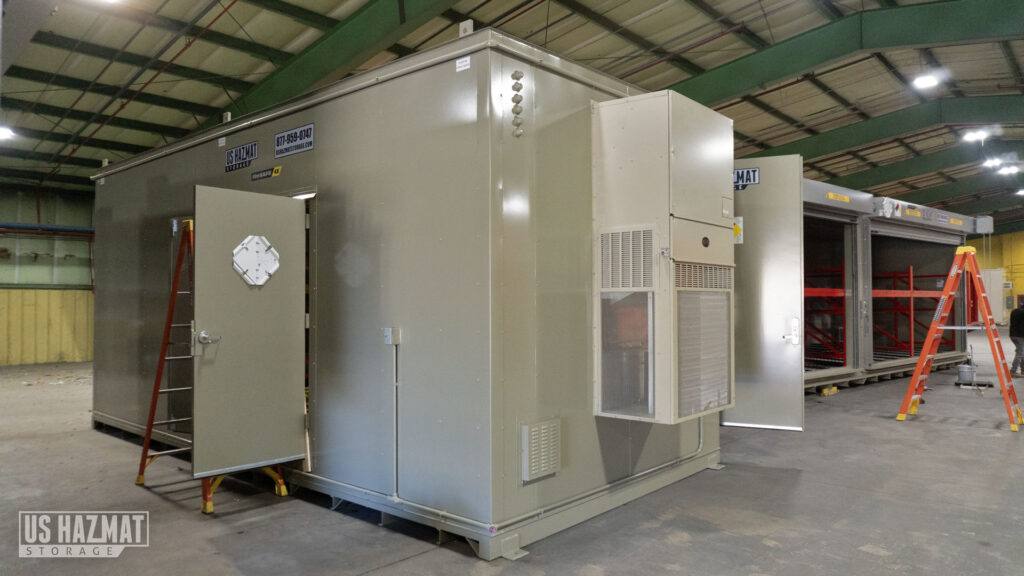
Engineered storage buildings reduce disruption because they standardize the risk controls that inspections look for: fixed segregation concepts, predictable access routes, consistent housekeeping expectations, and containment and fire protection features that are designed for hazardous materials storage. Instead of rebuilding controls every time staging patterns change, you deploy a storage system that is designed to be maintained and verified.
For buyers and project stakeholders, this matters for cost and schedule as well. When “temporary” storage is implemented as an ad hoc area (for example, pallets and totes placed near egress routes or in locations without engineered containment), the downstream costs often show up later as rework: rerouting traffic, adding barriers, upgrading fire protection, or moving materials into compliant structures. A hazardous material storage building is often the fastest path to reducing that rework cycle.
Where Facilities Commonly Get Exposed
Most compliance gaps in temporary vs permanent hazmat storage show up in predictable ways. Temporary staging areas are often set up quickly, using what is available rather than what is designed. That can lead to mismatches between the storage configuration and the hazard profile of the materials being held—especially when multiple hazard classes share the same space.
Common exposure points include:
- Segregation drift: Containers are moved to “make room,” and incompatibles end up closer than intended. Even when SDSs are available, physical layout can fail to reflect compatibility requirements.
- Containment under-sizing: Secondary containment is sometimes treated as “good enough” for small releases, but worst-case release scenarios can exceed the capacity of basins, trays, or improvised containment.
- Container condition and labeling: Temporary staging increases handling frequency, which increases chances of damaged labels, compromised lids, or leaking packaging.
- Fire protection mismatch: Temporary areas may not have the same fire-rated separation, protected pathways, or suppression provisions as permanent storage.
- Emergency access and egress conflicts: Storage may block access to extinguishers, safety showers, or fire department access routes.
- Documentation gaps: SDS availability, inspection logs, and training records can lag behind operational changes—especially when multiple contractors or shifts manage staging.
Another exposure category is the mismatch between the facility’s “operational definition” of temporary and the way compliance is evaluated. In many organizations, temporary means “we don’t store it long.” In compliance terms, temporary means “the controls match the hazard and the time-bound holding plan.” If the time-bound plan changes, the control system must evolve as well.
This is also where the line between hazardous materials storage and hazardous waste accumulation can blur in buyer conversations. For example, some facilities treat certain materials as temporary until disposition, but the holding period and conditions can create expectations for accumulation controls. If you’re operating near those boundaries, it becomes even more important to design storage so it remains compliant even when operational timelines shift.
How Engineered Storage Changes the Risk Profile
Engineered storage buildings change the risk profile by turning hazmat storage into a repeatable system rather than a variable staging practice. A well-designed hazardous material storage building is built around core hazard controls that stay consistent: segregation concepts, containment sizing, fire resistance, and engineered ventilation or protection as required by the materials stored.
In a temporary staging model, the facility often relies on personnel discipline to keep the area compliant: “We’ll keep incompatibles separated,” “We’ll keep containers labeled,” “We’ll keep pathways clear.” Those are important, but they are also vulnerable to shift changes, contractor turnover, and workload spikes. Engineered storage reduces reliance on day-to-day improvisation by embedding the controls into the physical environment.
Key engineered features that help reduce “temporary drift” include:
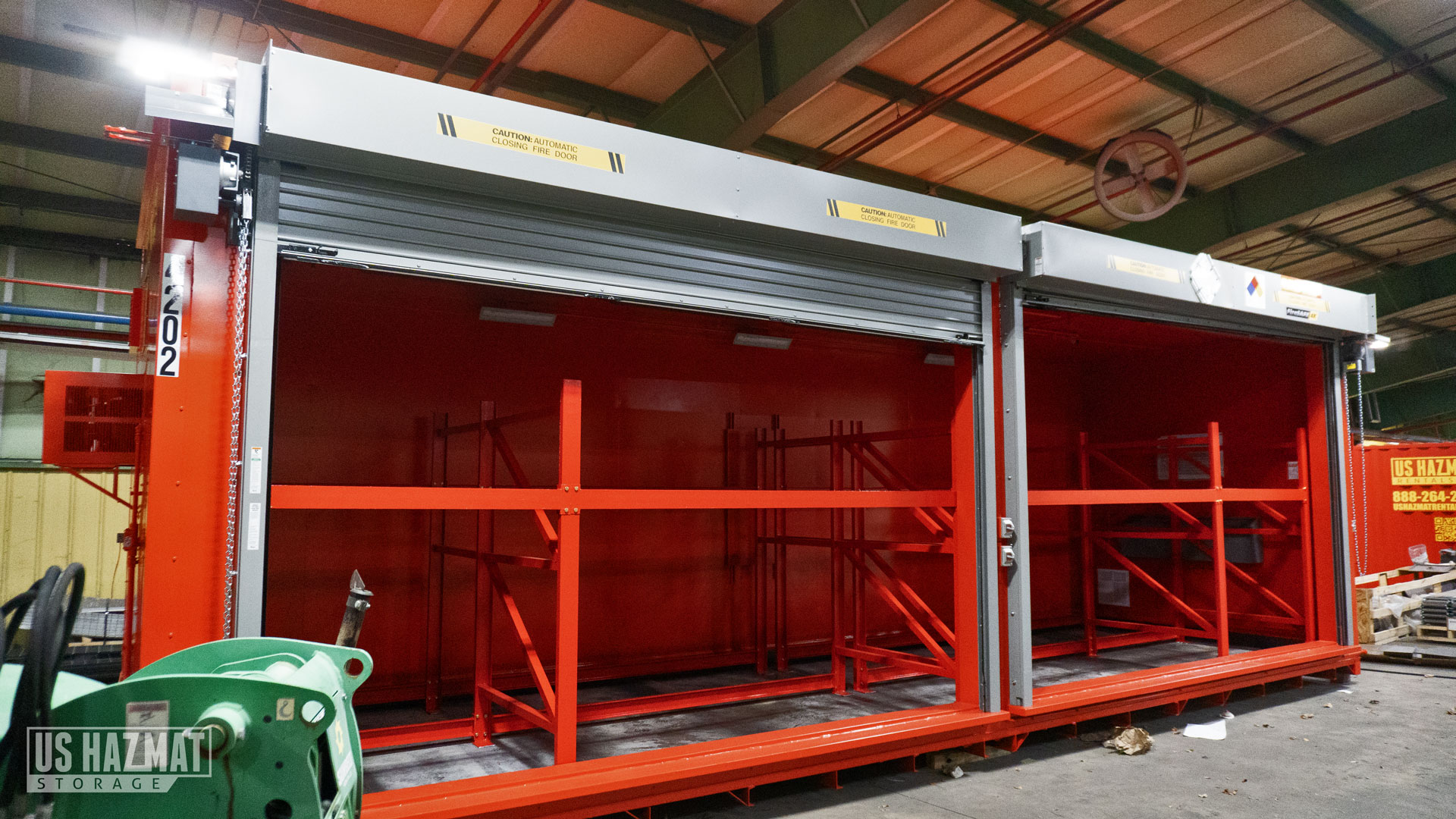
- Fixed segregation and layout: Storage compartments, racks, and aisle rules that make it harder to misplace incompatible materials.
- Engineered secondary containment: Containment systems sized for the release scenarios relevant to the stored containers and configurations.
- Fire-rated construction and separation: Fire-resistance where required to control fire growth and exposure impacts.
- Controlled access and material handling flow: Layouts that support safe receiving, transfer, and retrieval without blocking egress.
- Ventilation and environmental controls when needed: Designed to manage vapor hazards, temperature sensitivity, or conditions that affect container integrity.
- Maintenance-friendly design: Surfaces, drainage, and inspection points designed so housekeeping and inspections are practical and repeatable.
For facilities that frequently adjust inventory—such as construction contractors, manufacturers with changing production batches, or maintenance teams—engineered storage can be the difference between “temporary staging” and a controlled, code-aligned storage system. It’s also a practical way to standardize how you manage high-concern categories like flammables or reactive materials.
To explore engineered options by container type, many teams start with purpose-built systems such as 55 gallon chemical drum storage buildings or tote & pallet storage systems, because the container geometry and handling method strongly influence containment and segregation design.
Key Regulatory Frameworks for Temporary vs Permanent Storage
Temporary vs permanent hazmat storage is evaluated through multiple regulatory lenses: workplace safety (OSHA), environmental requirements (EPA), and fire/life-safety expectations (NFPA and IFC). While the exact applicability can vary by material and facility status, the underlying principle is consistent: hazardous materials must be stored in a way that prevents releases, controls fire hazards, and supports safe emergency response.
Below is a practical overview of how these frameworks affect storage decisions, with plain-language emphasis on what inspectors and fire marshals commonly look for.
OSHA: Workplace hazard communication, container integrity, and safe handling
OSHA’s hazard communication and general duty concepts influence how you manage SDS availability, labeling, employee training, and safe work practices. For storage, OSHA expectations often show up in the basics: containers must be properly labeled, damaged containers must be addressed, and employees must understand compatibility and safe handling limitations.
Temporary staging increases handling frequency and can increase opportunities for label damage or container compromise. Engineered storage buildings help by standardizing storage locations and improving inspection practicality—so labels, container condition, and segregation are easier to verify.
EPA: Hazardous waste vs hazardous materials and accumulation expectations
EPA requirements can apply when the stored items meet the definition of hazardous waste. Even when the material is still a “hazardous material” from an operational standpoint, many facilities manage both streams and must ensure documentation, labeling, and accumulation conditions align with the applicable framework. A common evergreen concept is that accumulation time and conditions drive compliance expectations.
From a buyer standpoint, the practical takeaway is simple: don’t design storage controls that assume a perfect timeline. If your “temporary” plan changes, your storage system should still function as a controlled hazard containment environment.
NFPA and IFC: Fire protection, separation, and storage as a hazard source
NFPA and IFC-style thinking treats storage as a hazard source that must be controlled with separation, fire protection, and appropriate environmental controls. The fire code perspective is especially important when temporary storage is located in areas that were not originally designed for hazardous materials storage—such as near ignition sources, in non-rated spaces, or in configurations that do not maintain required separation and access.
Temporary storage that grows into de facto permanent storage often triggers the same questions: Are you providing the separation and fire-resistance that the hazard requires? Are you maintaining safe access for emergency responders? Are you controlling the consequences of a release?
Common Compliance Failures Between “Temporary” and “Permanent”
Compliance failures often occur at the transition points: when a staging area is created, when inventory patterns change, or when a project timeline slips. The failure mode is rarely one single missing item; it’s a chain of small mismatches that accumulate until the storage configuration no longer matches the hazard.
Here are frequent failure categories that show up during reviews:
1) Treating secondary containment as optional for temporary staging
Improvised containment can be a major weak point. Even if a release seems unlikely, storage must be designed for credible worst-case scenarios. If you’re storing drums, totes, or pallets, you must consider how a container could leak, how liquids could spread, and how drainage and cleanup paths would behave. Permanent storage buildings typically incorporate containment and drainage design so the system is predictable and maintainable.
2) Inadequate fire-rated separation and distance-to-exposure
Temporary staging frequently occurs in spaces that were never intended to be hazardous storage rooms. Without appropriate fire-rated separation, a fire can propagate to adjacent exposures or compromise egress and access. Engineered fire-rated chemical storage buildings are designed to address these concerns with construction and compartmentalization concepts that are difficult to replicate with ad hoc staging.
If fire-rated separation is part of your requirement, you can start with fire rated chemical storage buildings to align the storage enclosure strategy with the hazard and occupancy context.
3) Ventilation and environmental control assumptions
Some materials require controlled conditions to reduce vapor accumulation, corrosion risk, or container degradation. Temporary storage areas may lack ventilation provisions, leading to vapor hazards or accelerated deterioration. Permanent storage buildings can be designed with ventilation and environmental considerations as part of the hazard control strategy.
4) Segregation that depends on “who moved what”
When segregation relies on manual placement rather than engineered layout, the system is vulnerable. A storage building can incorporate fixed segregation concepts—compartments, rack configurations, or layout rules—that make it easier to maintain compatibility boundaries even during high-activity receiving and retrieval.
5) Documentation that doesn’t match the physical reality
Inspections often compare written procedures and logs to what is physically present. If your labels, container condition checks, or inspection frequencies don’t match the storage configuration, you can face findings even when the intent is good. Engineered storage buildings make it easier to standardize inspection points and maintain consistent documentation.
Battery and High-Consequence Materials: Why Time-Driven Storage Matters
Even though this article is about temporary vs permanent hazmat storage broadly, high-consequence categories like lithium batteries and other reactive/flammable materials amplify the importance of time-driven storage controls. The reason is not only the hazard itself; it’s that storage configuration and handling frequency can materially affect risk.
For lithium battery storage and energy storage systems (ESS), fire code and engineering expectations emphasize segregation, protection from ignition sources, and engineered controls that support safe containment of hazards. If your operation treats battery storage as “temporary” during receiving, staging, or project ramp-up, you still need a storage configuration that remains safe even if the holding period extends.
Buyers should ask whether the storage enclosure is designed for the actual workflow: how batteries are received, where they are staged, whether they are stored in charging workflows or separate from charging, and how segregation is maintained. If your facility is evaluating lithium battery storage building compliance, you may also want to review chemical storage buildings as a starting point for engineered storage approaches, then narrow to the battery-specific requirements with a design consultation.
For teams that need to standardize safe storage for multiple container types, pallet and tote systems, drum systems, and compartmentalized lockers can reduce variation in how materials are handled. That consistency is especially valuable when inventory turnover makes “temporary” storage more likely to stretch beyond the original plan.
How to Decide When “Temporary” Should Become Permanent
One of the most defensible compliance strategies is to treat temporary staging as a controlled phase with explicit decision points. Instead of waiting for a problem to appear, define a trigger for upgrading storage controls when operational reality changes.
Consider building a decision framework that includes:
- Holding time tracking: Document actual time-in-storage for each hazard category and container type.
- Inventory variability: If the SKU mix changes frequently, segregation and compatibility verification must be more rigorous.
- Container handling frequency: More transfers increase the chance of container damage and label loss.
- Release consequence assessment: Evaluate what happens if the credible worst-case release occurs during the holding period.
- Fire and access constraints: Confirm whether the staging area can maintain safe access and separation as activity increases.
- Audit and inspection trends: Use recurring inspection findings as a signal that the temporary model is no longer working.
When you identify that “temporary” is becoming de facto permanent, upgrade the storage system so the hazard controls match the duration. This is where engineered storage buildings can reduce disruption: the facility can transition from an ad hoc staging zone to a standardized storage environment without continuing to rely on variable controls.
For procurement and project teams, the decision should also consider lead times and installation planning. A permanent storage building is a capital project; starting early can prevent schedule pressure later when compliance requirements become urgent.
Fire-Rated Storage Explained: 2-Hour vs 4-Hour and What Buyers Should Ask
Fire-rated storage is often discussed as a yes/no requirement, but buyers should understand what fire rating is intended to accomplish: controlling fire growth and limiting the impact to exposures and egress pathways for a defined period. The “right” rating depends on hazard class, configuration, occupancy context, and the code and insurance expectations applicable to the site.
In general terms, a 2-hour or 4-hour fire-resistance approach can be used to provide additional time for fire control and to reduce the likelihood of fire spread to adjacent areas. For facilities that anticipate “temporary” storage becoming longer-term, fire-rated construction provides a stable baseline that doesn’t depend on how busy the staging area becomes.
When evaluating fire-rated chemical storage buildings, ask for clarity on:
- Fire-resistance rating basis: What design assumptions drive the selected rating?
- Compartmentalization and separation: How does the building maintain separation between hazard categories?
- Penetrations and sealing: How are openings, conduits, and access points treated to preserve fire performance?
- Door hardware and access control: Are doors and closures designed to maintain required performance?
- Integration with site emergency planning: How does the building support access and response needs?
These questions matter because temporary staging often lacks consistent fire-rated design. If your materials and activity level are expected to persist, investing in a fire-rated storage building can reduce the probability that your storage configuration will be viewed as out of compliance due to exposure risks.
Inspection & Insurance Readiness for Temporary vs Permanent Storage
Inspection readiness is where engineered storage often delivers the most visible value. When an inspector evaluates storage, they look for alignment between hazard profile, physical configuration, and documentation. Temporary staging areas can fail this alignment because they are frequently reconfigured and managed under variable conditions.
To improve inspection readiness, treat your storage system—temporary or permanent—as an auditable control environment. That means you can demonstrate:
- Clear labeling and SDS access: Containers are labeled and SDSs are accessible to employees and responders.
- Segregation and compatibility: Physical layout supports compatibility boundaries.
- Container integrity: Damaged or leaking containers are identified and managed.
- Housekeeping and access: Aisles and emergency access routes remain clear.
- Secondary containment performance: Containment capacity and condition are maintained.
- Inspection logs and training: Records show routine verification and corrective actions.
Fire marshal and insurance reviewers may also assess emergency access and the ability of responders to locate and control hazards. A storage building designed for hazardous materials typically provides predictable access points, stable layouts, and engineered containment and fire protection features.
If you want a practical way to organize your compliance information and storage planning, you can also explore the Hazmat Storage App for storage guidance and planning support.
Turnkey vs Custom-Built Hazmat Storage: What Buyers Should Compare
When comparing temporary vs permanent hazmat storage solutions, buyers often face a choice: build an ad hoc temporary area and hope the timeline stays short, or invest in an engineered storage building designed to remain compliant as operations evolve. Within engineered buildings, there’s also a choice between custom construction and turnkey delivery.
Turnkey engineered hazmat storage solutions from US Hazmat Storage are designed to reduce schedule and compliance risk by integrating design, engineering, manufacturing, and installation into one coordinated workflow. That integration matters because storage compliance is not only about materials—it’s about how the entire system is assembled, sealed, and verified.
Custom-built approaches can work, but they may introduce variability in timelines, engineering coordination, and installation sequencing. For facilities that need to reduce operational disruption, turnkey delivery can be the fastest path to a compliant storage environment that doesn’t require repeated rework.
When evaluating procurement options, compare:
- Time to engineered solution: How quickly can the facility receive a compliant design and installation plan?
- Compliance-first engineering: Does the solution account for segregation, containment, fire protection, and access as a system?
- Manufacturing quality and consistency: Are components manufactured and assembled under controlled processes?
- Installation and commissioning: Is installation managed to preserve performance and reduce “field surprises”?
- Documentation package: Can you provide the records needed for inspections and insurance reviews?
To see examples of engineered storage systems in real layouts, review the chemical storage building photo gallery. For facilities that need specialized workflow integration (for example, bulk storage and dispensing), you may also evaluate custom duplex modular solutions that can be configured to match operational needs.
Use Case Scenarios: Where Temporary Storage Commonly Becomes Permanent
Different industries experience “temporary drift” in different ways. Below are practical scenarios where engineered storage buildings help maintain compliance as timelines evolve.
Manufacturing and batch production
Manufacturers often receive chemicals, solvents, cleaners, and maintenance materials in batches. During production ramp-up or changeovers, storage patterns can shift weekly. A permanent engineered storage building helps maintain segregation and containment as SKUs and volumes change.
Construction jobsites and contractor staging
Job sites frequently rely on temporary storage for flammables, coatings, adhesives, and fuels. Even when the initial plan is short-term, project delays can extend holding periods. Engineered storage reduces the likelihood that staging areas become noncompliant due to reconfiguration, weather exposure, or blocked access.
Utility and energy facilities
Energy facilities may maintain hazardous materials for maintenance activities, testing, or periodic replenishment. The operational schedule can be seasonal or event-driven. Engineered storage supports consistent hazard controls even when the “temporary” phase lasts longer than expected.
Repair and maintenance operations
Maintenance teams often stage materials near work areas to reduce travel time. Over time, those staging patterns can become de facto permanent. A dedicated hazardous material storage building supports controlled segregation and containment while keeping work zones clear for safe operations.
Mixed material segregation across departments
Facilities that store multiple hazard classes—sometimes across departments—benefit from engineered segregation concepts. Rather than relying on each department to manage compatibility boundaries, a building system can standardize how materials are stored and retrieved.
Request a Compliant Storage Assessment
If your facility is currently using temporary hazmat staging—or if your operational plan could realistically extend beyond a short holding window—US Hazmat Storage can help you design a storage system that stays compliant as conditions change. The fastest way to reduce disruption is to align your physical storage configuration with the controls regulators and fire officials expect: segregation, containment, fire-rated protection where required, and inspection-ready access and documentation.
Request a hazmat storage quote or schedule a chemical storage buildings design consultation to map your materials, handling workflow, and timeline to the right engineered storage approach. If your project includes drums, totes, or palletized materials, we can also help you evaluate purpose-built configurations such as drum storage buildings and tote & pallet storage systems.
For facilities that need to standardize hazardous storage at smaller scales (for example, where space is constrained), consider hazardous storage lockers as a modular approach to segregation and controlled storage. And if you want to visualize what compliant storage looks like in practice, browse the photo gallery and then talk to a hazmat storage engineer about your temporary-to-permanent risk profile.
Conclusion: Prevent “Temporary Drift” with Engineered Storage
Temporary vs permanent hazmat storage is ultimately a risk management question: do your physical controls and documentation remain aligned with the hazard over time? When temporary staging is treated as a short-lived convenience, it often creates the conditions for inspection findings—especially around segregation, containment capacity, fire protection, and access. The best way to prevent temporary drift is to implement engineered storage that remains compliant as operational realities evolve.
US Hazmat Storage designs and delivers turnkey hazardous material storage buildings that standardize safety controls and reduce the need for repeated rework. If you’re planning storage for a project with uncertain timelines—or if your temporary staging is already trending longer—start with a compliant storage assessment. You’ll gain a clearer path to OSHA, EPA, NFPA, and IFC alignment, and you’ll protect both people and operations from avoidable disruption.