
GHS chemical labeling can seem like a small detail until a flammable storage unit is inspected, accessed during an emergency, or used by a worker who needs clear hazard information fast. A label is not just a sticker on a container. It is part of the safety system that tells people what they are handling, how serious the hazard is, and what precautions should guide storage, movement, dispensing, and response.
For facilities that store flammable liquids, solvents, fuels, coatings, aerosols, or other hazardous materials, labeling mistakes can create real operational gaps. A container may be stored in the right building, inside a fire-rated unit, with proper containment and ventilation, but still create risk if the hazard information is missing, outdated, damaged, or inconsistent with the Safety Data Sheet.
At US Hazmat Storage, we look at GHS chemical labeling as part of a complete flammable storage program. The label, the SDS, the storage unit, the site layout, the employee training, and the emergency plan should all tell the same story. When those pieces align, facilities are better prepared for inspections, daily handling, and unexpected incidents.
What GHS Chemical Labeling Actually Means
GHS stands for the Globally Harmonized System of Classification and Labelling of Chemicals. In practical workplace terms, it gives facilities a common language for communicating chemical hazards through standardized label elements, pictograms, hazard statements, signal words, and safety information.
GHS chemical labeling is especially important for flammable storage units because workers often need to identify hazards before opening a door, moving a container, dispensing a liquid, or responding to a spill. A clear label helps reduce guessing.
A complete shipped container label generally includes:
- Product identifier
- Supplier identification
- Signal word
- Hazard statement
- Precautionary statement
- Applicable GHS pictograms
Those elements are not decorative. They help communicate what the chemical is, what hazard class it falls under, how severe the risk may be, and what handling precautions should be followed.
For flammable materials, the flame pictogram is often the most recognizable symbol, but it should not be the only detail safety teams review. The signal word, hazard statement, storage precautions, and SDS sections all matter.
Why Labels Matter Inside Flammable Storage Units
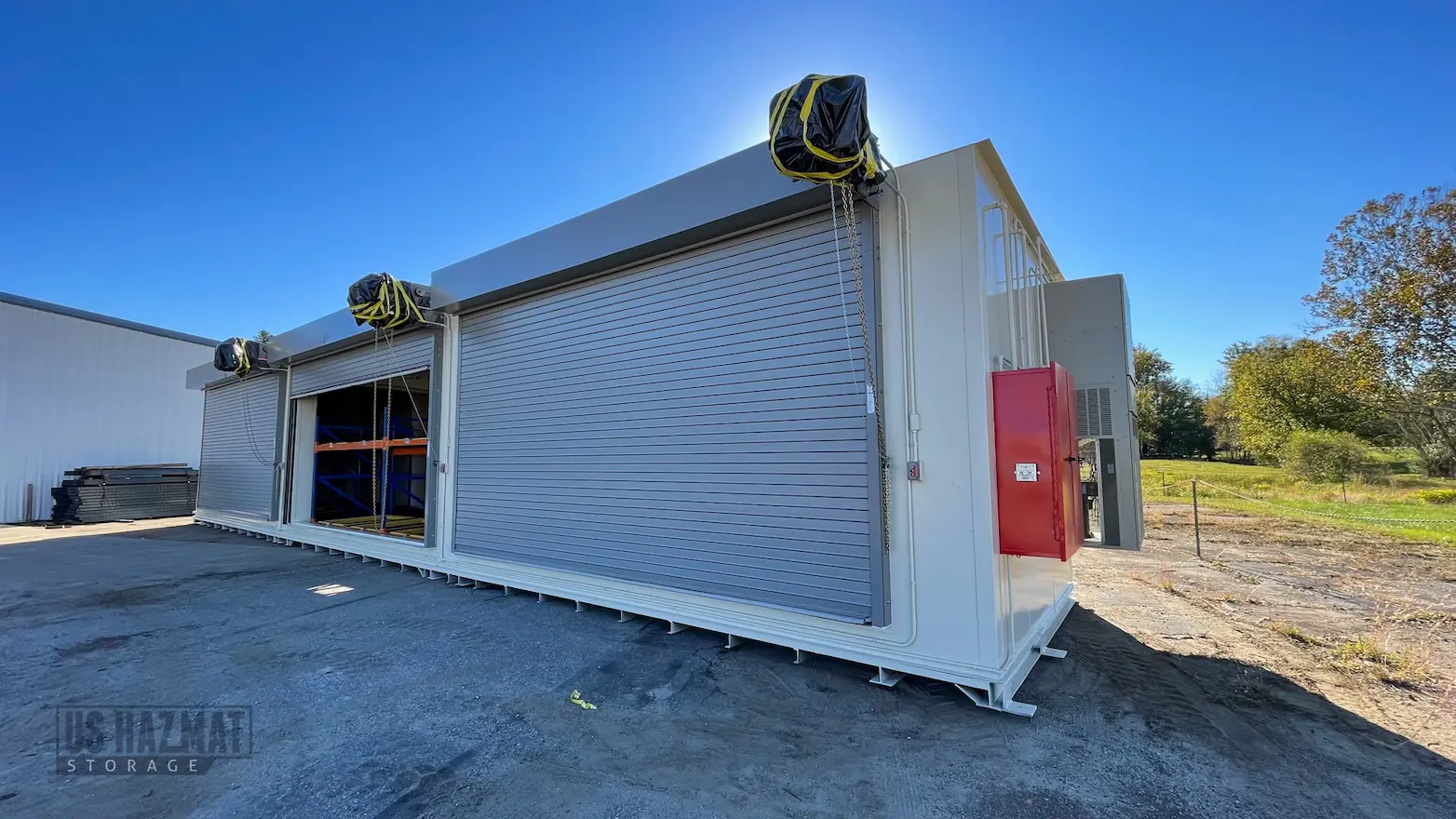
A flammable storage unit is designed to support safer storage, but it does not replace hazard communication. The unit may provide fire-rated construction, secondary containment, ventilation, secure access, and separation from occupied spaces. Still, the materials inside need clear identification.
Without proper GHS chemical labeling, a storage unit can become organized on the outside and confusing on the inside.
Labeling helps answer practical questions such as:
- What chemical is stored in this container?
- Is it flammable, combustible, corrosive, toxic, reactive, or oxidizing?
- Does the container belong in this unit?
- Can it be stored near the other materials present?
- What precautions apply before handling or dispensing?
- What SDS should employees review?
- What should responders know during a spill, leak, or fire event?
The label helps connect the container to the larger chemical storage plan. This is why flammable liquid storage labels should be visible, durable, accurate, and consistent with the facility’s SDS inventory.
The Core Elements of a GHS Label
GHS chemical labeling works because the information follows a recognizable structure. When employees are trained to read that structure, they can identify hazards more quickly and handle containers with more confidence.
| Label Element | What It Communicates | Why It Matters for Flammable Storage |
| Product identifier | The chemical name or product name | Helps match the container to the SDS and inventory list |
| Signal word | The severity level, such as Danger or Warning | Helps workers recognize the seriousness of the hazard |
| Hazard statement | The nature of the hazard | Explains risks such as flammability, vapor hazard, or health exposure |
| Precautionary statement | Recommended prevention and response actions | Supports safer handling, storage, PPE, and emergency response |
| GHS pictograms | Visual hazard symbols | Helps workers quickly recognize major hazard categories |
| Supplier information | Manufacturer or responsible party details | Supports traceability and SDS confirmation |
For flammable storage units, these elements should not be treated as paperwork only. They should guide where chemicals are stored, how containers are separated, and how employees interact with the unit.
GHS Pictograms and Flammable Storage Risk
GHS pictograms provide a fast visual warning, but they must be interpreted correctly. A container with a flame pictogram may require different handling than a container with both flame and health hazard pictograms. A chemical with corrosive and flammable hazards may require even more careful compatibility review.
Common pictograms that may appear around hazardous chemical storage include:
- Flame: flammable liquids, flammable gases, self-reactives, pyrophorics, or similar hazards
- Exclamation mark: irritants, acute toxicity, or less severe health hazards
- Health hazard: carcinogenicity, respiratory sensitization, reproductive toxicity, or target organ effects
- Corrosion: skin corrosion, eye damage, or corrosive to metals
- Skull and crossbones: acute toxicity
- Flame over circle: oxidizers
- Gas cylinder: gases under pressure
- Exploding bomb: explosives, self-reactives, or organic peroxides
- Environment: aquatic toxicity, where applicable
In flammable storage planning, the flame pictogram should never be reviewed alone. Oxidizers, corrosives, and incompatible materials can create serious risks if they are stored too close to flammable liquids. This is where GHS chemical labeling supports chemical compatibility decisions.
GHS Chemical Labeling for Primary and Secondary Containers
Many facilities understand that manufacturer containers need labels. Problems often begin when chemicals are transferred into secondary containers.
A secondary container may be a smaller bottle, day-use container, dispensing container, drum, tote, or container used temporarily during production. If the chemical leaves its original labeled container, the facility should review whether workplace labeling requirements apply.
Secondary container labeling helps prevent common mistakes such as:
- Using an unlabeled bottle near a storage unit
- Transferring solvent into a container that looks like another product
- Storing a small amount of flammable liquid without hazard identification
- Leaving a container near incompatible materials
- Separating the chemical from its SDS reference
- Assuming employees will remember what is inside
This is especially important around flammable storage units because small containers can still create vapor, ignition, spill, and exposure hazards. GHS chemical labeling should make the container’s contents and hazard category clear even when the original packaging is no longer present.
How GHS Chemical Labeling Supports OSHA Flammable Storage Requirements
GHS chemical labeling and flammable storage requirements work together. Labeling helps communicate the hazard. Storage requirements help control how the hazard is managed in the workplace.
For facilities storing flammable liquids, the storage plan may also involve container approval, quantity limits, ignition source control, grounding and bonding, ventilation, secondary containment, fire-rated storage, access control, and employee training.
That is why GHS chemical labeling should be reviewed alongside OSHA flammable storage requirements. A compliant-looking label cannot fix poor storage conditions, and a well-built storage unit cannot fix missing hazard information.
The strongest approach combines:
- Correct chemical classification
- Proper container labeling
- SDS availability
- Compatible storage
- Fire-rated or approved storage equipment where needed
- Clear separation from ignition sources
- Secondary containment
- Employee training
- Routine inspections
When these pieces work together, the facility has a stronger safety and compliance foundation.
A Practical Labeling Checklist for Flammable Storage Units
Before a flammable storage unit is inspected, relocated, expanded, or reorganized, the labeling system should be reviewed.
Use this checklist as a practical starting point:
- Confirm every container has a readable label
- Match each container to an accessible SDS
- Verify product identifiers are consistent across label, SDS, and inventory
- Check that secondary containers are labeled properly
- Review GHS pictograms for each chemical
- Confirm flammable materials are stored away from incompatible chemicals
- Remove old or incorrect labels from reused containers
- Replace labels damaged by moisture, sunlight, chemical exposure, or abrasion
- Make sure labels face outward where practical
- Confirm employees know how to read label elements
- Inspect the storage unit for containers that do not belong
- Review storage conditions listed in the SDS
- Document corrections after inspections
This checklist should not replace a full compliance review, but it helps safety teams catch problems before they become bigger issues.
Documentation Helps During Inspections
Inspectors and internal safety teams often look for consistency. They want to see that chemicals are identified, employees have access to hazard information, and storage areas are managed intentionally.
Good documentation may include:
- Current chemical inventory
- SDS records
- Labeling procedures
- Secondary container labeling policy
- Inspection logs
- Training records
- Storage unit specifications
- Corrective action records
- Compatibility review notes
Documentation does not need to be complicated, but it should be reliable. If a label is replaced, a chemical is removed, or a storage unit is reorganized, the inventory and SDS access system should be updated.
This helps show that GHS chemical labeling is not being handled casually. It is part of the facility’s chemical safety program.
How Storage Unit Design Supports Better Labeling
The design of the flammable storage unit can make labeling easier or harder to maintain. A well-planned unit supports visibility, organization, access, and inspections.
Useful storage design features may include:
- Adequate lighting
- Shelving or racking that keeps labels visible
- Spill containment that does not hide container information
- Clear aisle space for inspection
- Ventilation that supports the stored materials
- Durable flooring and chemical-resistant surfaces
- Access control to prevent untrained handling
- Space planning that avoids overcrowding
Overcrowded storage units often lead to poor labeling visibility. Containers get pushed behind other containers. Labels face the wall. Smaller bottles are placed near drums without clear identification. Over time, the storage area becomes harder to manage.
A safer unit is not only strong. It is organized enough for workers to identify what is inside.
When to Review Your GHS Chemical Labeling System
Labeling should be reviewed any time the chemical program changes. Waiting for an inspection is not a strong strategy.
Review GHS chemical labeling when:
- New chemicals are added
- Containers are transferred or repackaged
- A storage unit is installed or relocated
- SDS information is updated
- A chemical inventory is corrected
- A spill or near miss occurs
- Employees report confusion
- Labels become faded, damaged, or unreadable
- The facility changes suppliers
- The Authority Having Jurisdiction requests documentation
Regular review helps facilities catch issues early. It also helps prevent the slow drift that happens when storage areas are busy and multiple teams use the same chemicals.
Building a Safer Flammable Storage Program Starts With Clear Labels
GHS chemical labeling is not the entire compliance program, but it is one of the most visible parts of it. A clear label helps workers recognize hazards, connect containers to SDS information, understand precautions, and make safer decisions around flammable storage units.
For facilities storing flammable liquids or hazardous chemicals, labeling should never be separated from the bigger storage plan. The label, SDS, inventory, storage unit, compatibility review, employee training, and inspection process should all work together.
US Hazmat Storage helps facilities think through chemical storage as a complete system. From flammable storage units and fire-rated buildings to containment, ventilation, organization, and hazard communication, the goal is to make storage safer, clearer, and easier to defend during review. If your facility is reviewing GHS chemical labeling, the next step is not only replacing labels. It is building a storage system that supports the information those labels communicate.
FAQ
What is GHS chemical labeling?
GHS chemical labeling is a standardized system for communicating chemical hazards through labels, pictograms, signal words, and hazard statements.
Why is GHS chemical labeling important for flammable storage units?
It helps workers identify flammable hazards, match containers to SDS information, and handle chemicals with clearer safety precautions.
Do secondary containers need GHS labels?
Secondary containers often require workplace labeling when hazardous chemicals are transferred from original containers. Facilities should review OSHA HazCom requirements.
What GHS pictogram is used for flammable chemicals?
The flame pictogram is commonly used for flammable materials, but other pictograms may also apply depending on the chemical’s hazards.
Is exterior signage enough for a flammable storage unit?
No. Exterior signage helps identify the storage area, but individual containers still need accurate, readable hazard labels.
How can US Hazmat Storage help?
US Hazmat Storage can help facilities plan safer chemical storage units, containment, organization, labeling visibility, and flammable storage compliance support.