
Fire rated double doors are among the most technically demanding assemblies in any fire-resistance-rated building envelope, and they fail compliance review more often than single-leaf assemblies do, not because of bad materials, but because of coordination gaps between the door hardware, the frame, the latching mechanism, and the rating requirements of the opening. Getting this right requires understanding what the rating actually certifies, what NFPA 80 requires at every component level, and where the local AHJ will look first when they open the inspection checklist.
US Hazmat Storage works with facility planners, EHS directors, and government procurement teams on fire-rated opening specifications for chemical storage buildings, research laboratories, and public facility applications. The patterns that produce failed inspections are remarkably consistent, and most of them were preventable at the specification stage.
What a Fire Rating Actually Certifies
The label on a fire door assembly certifies that the assembly (the door slab, the frame, the hardware, and the installation) performed as a unit during a standardized furnace test. What it does not certify is that any individual component substituted after that test will produce equivalent performance. This distinction matters enormously for fire rated double doors, because the double-leaf configuration introduces interaction points between the two leaves that single-door assemblies do not have.
The inactive leaf of a pair must latch independently before the active leaf can latch against it. If the inactive leaf is not mechanically coordinated with the active leaf’s closing sequence, neither leaf closes in the correct order, and the assembly fails to achieve the positive latching the rating requires. That coordination is not automatic. It requires a specific hardware device (a coordinator) that controls the closing sequence of both leaves. Its absence is one of the most common single reasons fire rated double doors fail inspection.
NFPA 80 governs installation and maintenance requirements for fire door assemblies. The standard requires that every assembly be installed in accordance with its listing, that hardware be listed for the specific rating and configuration, and that the assembly be tested and documented after installation. For double-leaf pairs, the testing requirement includes verification that both leaves latch independently and that the coordinator functions correctly.
The ANSI/UL 10C Positive Pressure Test
Before 2005, most fire door listings were based on a neutral-pressure furnace test that did not replicate the positive pressure conditions that develop on the fire side of a door during an actual structural fire. ANSI/UL 10C changed that. The positive pressure test subjects the assembly to gas pressure differentials that force smoke and hot gases toward gaps between the door slab and the frame, and between the two leaves of a paired assembly.
For fire rated double doors, the positive pressure requirement changes what a compliant meeting-edge seal needs to do. The gap between the two leaves, the meeting edge, must maintain its seal under positive pressure, not just resist flame impingement. Intumescent meeting-edge seals that expand under heat, combined with astragal configurations that maintain continuous contact between the two leaves throughout the gap, are the hardware responses to this requirement.
Specifying a positive-pressure-listed assembly requires confirming that the intumescent sealing at the meeting edge is part of the listed fire rated double doors assembly configuration, not an aftermarket addition.
Hollow Metal Construction: Gauge, Core, and Label Verification
Most fire rated double doors for chemical storage, government facilities, and heavy industrial applications are hollow metal construction. For 90-minute and 2-hour ratings, 16-gauge steel is the standard minimum for the door slab. 14-gauge is the correct specification for applications with high-frequency traffic, physical impact exposure, or corrosive atmospheric conditions.
The internal core material matters too: the mineral board core provides thermal mass that helps maintain the assembly’s integrity over a full 2-hour fire exposure, while honeycomb steel and polystyrene cores serve lighter-duty rating requirements.
The label on the door is the compliance anchor. Each leaf in a paired assembly requires its own independent listing label identifying the manufacturer, the fire-resistance classification, the maximum size, and the handling. Removing or painting over a label is a compliance violation. Specifying fire rated double doors without confirming that both leaves carry appropriate individual labels before installation is a documentation gap that surfaces at the worst possible time : during inspection.
Coordinators, Closers, and the Latching Sequence
Hardware on fire rated double doors is not a separate specification from the door itself. It is part of the listed assembly, and every component that affects the pair’s ability to close, latch, and maintain its seal under fire conditions must be listed for that assembly configuration and rating.
The coordinator ensures the inactive leaf closes before the active leaf. Without it, the active leaf strikes the inactive leaf before it has fully latched, preventing either leaf from achieving positive latch. Door closers on both leaves must be heavy-duty, listed for fire-rated use, and sized to produce enough force to drive both leaves to full latch against the resistance created by the intumescent seals and meeting-edge astragal.
A closer that was adequate for a standard opening may be undersized for the same fire rated double doors paired configuration, particularly once the meeting-edge seals have compressed slightly from initial contact.
Latch hardware on each leaf must be listed for fire-rated use and must be the mechanical type, not a friction or magnetic latch. Electric strikes or electromagnetic hold-opens are permissible in certain fire-rated configurations but require specific integration with the building’s fire alarm system to ensure fail-safe release at detection. That integration is an electrical specification item that must be coordinated with the fire alarm contractor, not just the door hardware supplier, well before the installation phase.
Chemical Storage Applications: Where Regulatory Layers Stack
Chemical storage buildings trigger multiple regulatory frameworks simultaneously, and fire rated double doors at the entry points of those buildings sit at the intersection of all of them. NFPA 80 governs the fire door assembly. NFPA 30 governs the construction requirements for flammable liquid storage buildings, including the fire-resistance ratings required at wall openings. OSHA 29 CFR 1910.106 imposes construction and separation requirements for flammable liquid storage that may be more stringent than the local building code.
None of these frameworks defer to the others. A chemical storage building that satisfies IBC occupancy requirements may still have an opening that does not satisfy NFPA 30 flammable liquid storage requirements if the fire rating of the paired assembly is insufficient for the building’s hazard classification. The correct approach is to identify all applicable regulatory frameworks before specifying fire rated double doors, not to specify to one standard and assume the others are covered.
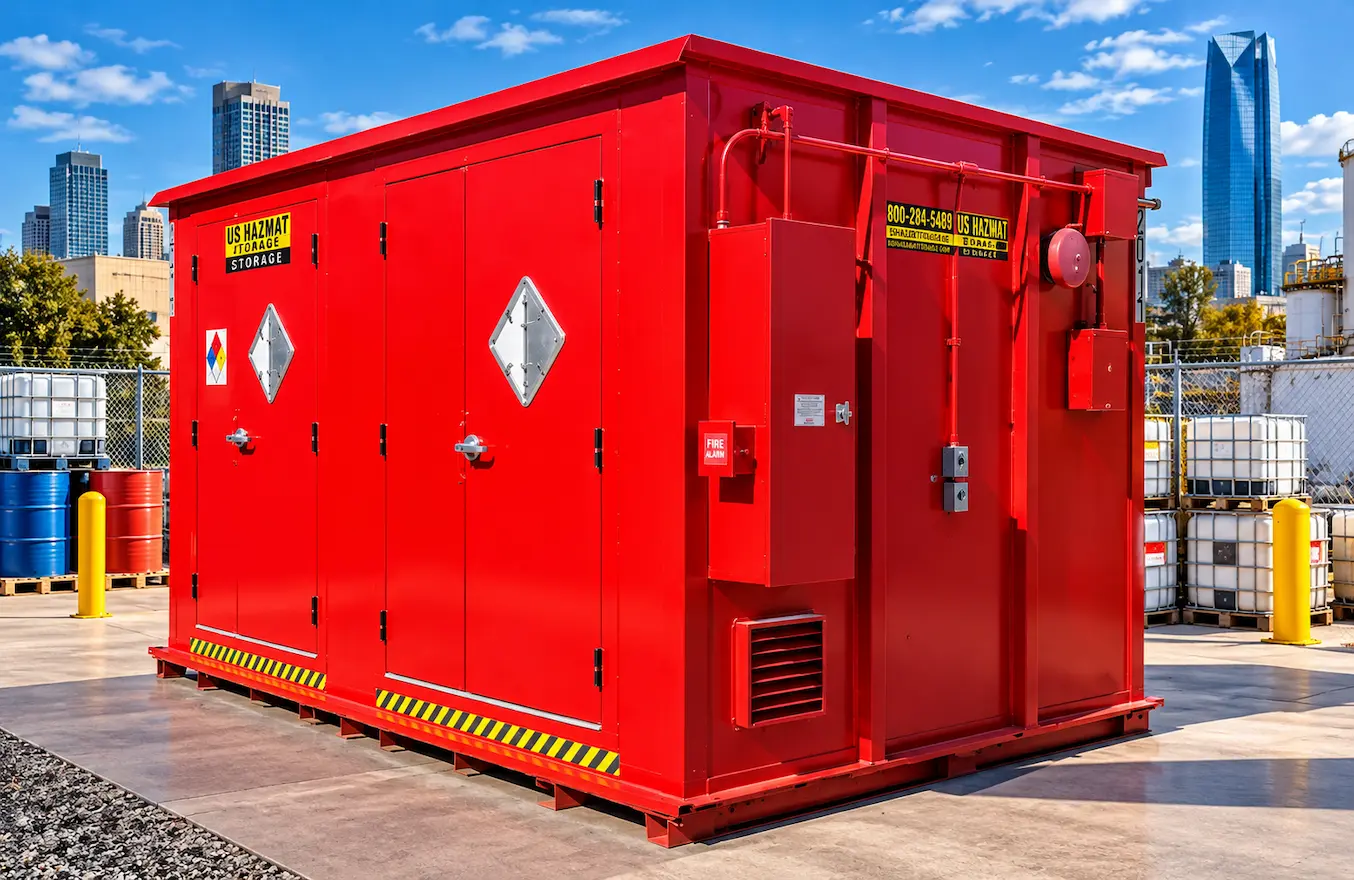
For chemically resistant ventilation systems serving chemical storage spaces, the penetrations through fire-rated walls require listed fire dampers or combination fire/smoke dampers compatible with the wall assembly and opening’s required rating. Those dampers are a separate specification item from the fire door assembly but share the same wall rating requirement and the same AHJ inspection scope. See how these components integrate in practice at US Hazmat Storage’s fire-rated chemical storage buildings.
Government Facilities: Security Ratings and Fire Ratings Together
The best security rated steel doors for government buildings meet a compound specification that fire-rated hollow metal construction addresses in part but does not complete on its own. Federal facilities, correctional facilities, and government chemical storage installations typically require physical security ratings in addition to fire ratings. The SDI grades A250.8 Levels 1 through 4 describe resistance to forced entry, ballistic penetration, and blast pressure, none of which the NFPA 80 listing addresses.
Fire rated double doors at government facility entry points frequently need to satisfy both the NFPA 80 listing requirements and a specific physical security standard simultaneously. Hardware choices that optimize physical security (surface-mounted hinges, multiple-point locking, flush bolt configurations) may conflict with fire door hardware requirements that prioritize reliable self-closing and positive latch.
Specifying these assemblies correctly requires a supplier that understands both frameworks and can document compliance with both.
Frame Tolerances and the Installation Gap That Costs the Most
The frame of a fire rated double door pair is as much a part of the listed assembly as the door slab. NFPA 80 specifies maximum clearance dimensions: the clearance between the door and the frame at the top and latch side cannot exceed 1/8 inch, and the undercut at the bottom cannot exceed the dimension specified for the assembly’s rating. For a double-leaf pair, the clearance at the meeting edge is also governed, and it is the dimension most likely to drift out of specification over time as hardware wears and the building settles.
Frame anchoring must comply with the frame manufacturer’s installation instructions, which are part of the listing. A frame installed in a masonry wall requires different anchoring than one in a metal stud partition. And the fire-rated wall assembly that the frame sits in must carry the rating required by the opening. A fire rated double doors installation in a wall with an insufficient fire-resistance rating does not produce a code-compliant opening, the effective rating is the lower of the two, and the AHJ knows to check both.
Annual Inspection: What NFPA 80 Requires and Where Deferred Maintenance Shows Up
NFPA 80 Section 5.2 requires annual inspection of fire door assemblies, performed by someone knowledgeable in fire doors, with results documented. For fire rated double doors, that documentation must record the condition and function of each leaf independently, coordinator operation, latch function on both leaves, meeting-edge seal condition, label presence and legibility on both leaves, and closing sequence under simulated fire-alarm conditions if the pair is integrated with the alarm system.
Facilities that defer inspection until an AHJ review prompts it often discover that years of accumulated wear have produced a list of deficiencies that cannot be remediated in the window between notice and inspection date. The maintenance requirement exists because the deficiencies it catches: worn coordinators, sagging inactive leaves, compressed seals are exactly the conditions that cause an assembly to fail in an actual fire event. None of those failure modes appear on a visual walk-through without putting hands on the hardware.
Building the Right Fire Rated Double Doors Specification
Every element of a fire rated double doors specification resolved before the permit application saves time and cost downstream. Door hardware substituted during construction because a specified product is unavailable needs re-evaluation for listing compatibility. Frame dimensions field-modified to accommodate a different rough opening may no longer produce the clearances the listing requires. These are not hypothetical failure modes, they are the source of the most common punch-list items on fire-rated opening inspections.
The specification document for a compliant pair should identify: the required fire-resistance classification and UL test standard (UL 10C for positive pressure), door and frame construction requirements (gauge, core, finish), hardware schedule with listed product numbers for every component, meeting-edge seal configuration, coordination device specification, label verification requirement for both leaves, and post-installation inspection requirement with documentation format.
That document is what the contractor installs to, what the inspector checks against, and what the facility uses as the basis for its annual NFPA 80 compliance records.
US Hazmat Storage builds fire-rated chemical storage buildings where the fire rated double doors specification is resolved before the first structural element goes up. If your facility is planning an installation where fire-rated paired openings are part of the code-required configuration, contact us and speak with an expert about your specific requirements.
FAQ
What is the difference between a 90-minute and a 2-hour fire rated double door?
A 90-minute rating means the assembly was tested to maintain its integrity for 90 minutes under UL 10C conditions. A 2-hour rating extends that to 120 minutes. The required rating for a specific opening is determined by the fire-resistance rating of the wall the opening is in: IBC Table 716.1 governs the correlation. Openings in 2-hour walls typically require 90-minute door ratings; openings in 3-hour walls require 3-hour rated assemblies.
Do fire rated double doors require a coordinator on both sides?
A single coordinator on the pull side is the standard configuration. It mechanically controls the sequence so the inactive leaf closes before the active leaf. Some configurations use an overhead concealed coordinator; others use a surface-mounted unit. The specific product must be listed for use with the assembly’s fire rating and opening size.
How does the 2 hour fire rated door price compare for a paired versus single-leaf assembly?
A 2-hour fire rated door price for a standard hollow metal single leaf runs from roughly $1,200 to $3,500 installed depending on size and hardware. A paired configuration at the same rating runs from approximately $3,500 to $8,000 installed, reflecting the additional hardware: coordinator, paired closers, meeting-edge seal system, and independent latch hardware on both leaves. Government and high-security specifications that add physical security ratings push costs higher on both formats.
Can fire rated double doors be used in exterior wall applications?
Some listed assemblies cover exterior use, but that listing is separate from the interior fire-resistance rating. Weather resistance, water infiltration, thermal performance, and corrosion resistance for exterior applications are governed by different standards than NFPA 80. An exterior fire-rated pair needs both the fire-resistance listing and an appropriate exterior performance rating, not all hollow metal fire doors carry both.
What makes fire rated double doors fail annual inspection most often?
The coordinator is the most common failure point, it wears, develops play, and loses the ability to reliably sequence both leaves to full close before latch. The second most common failure is meeting-edge seal degradation: intumescent seals compress over years of use and lose their ability to expand to the required gap-filling dimension. Third is label loss: painted over, removed during refinishing, or simply missing and undocumented. All three are correctable before they become a safety risk if annual inspection is actually performed.