
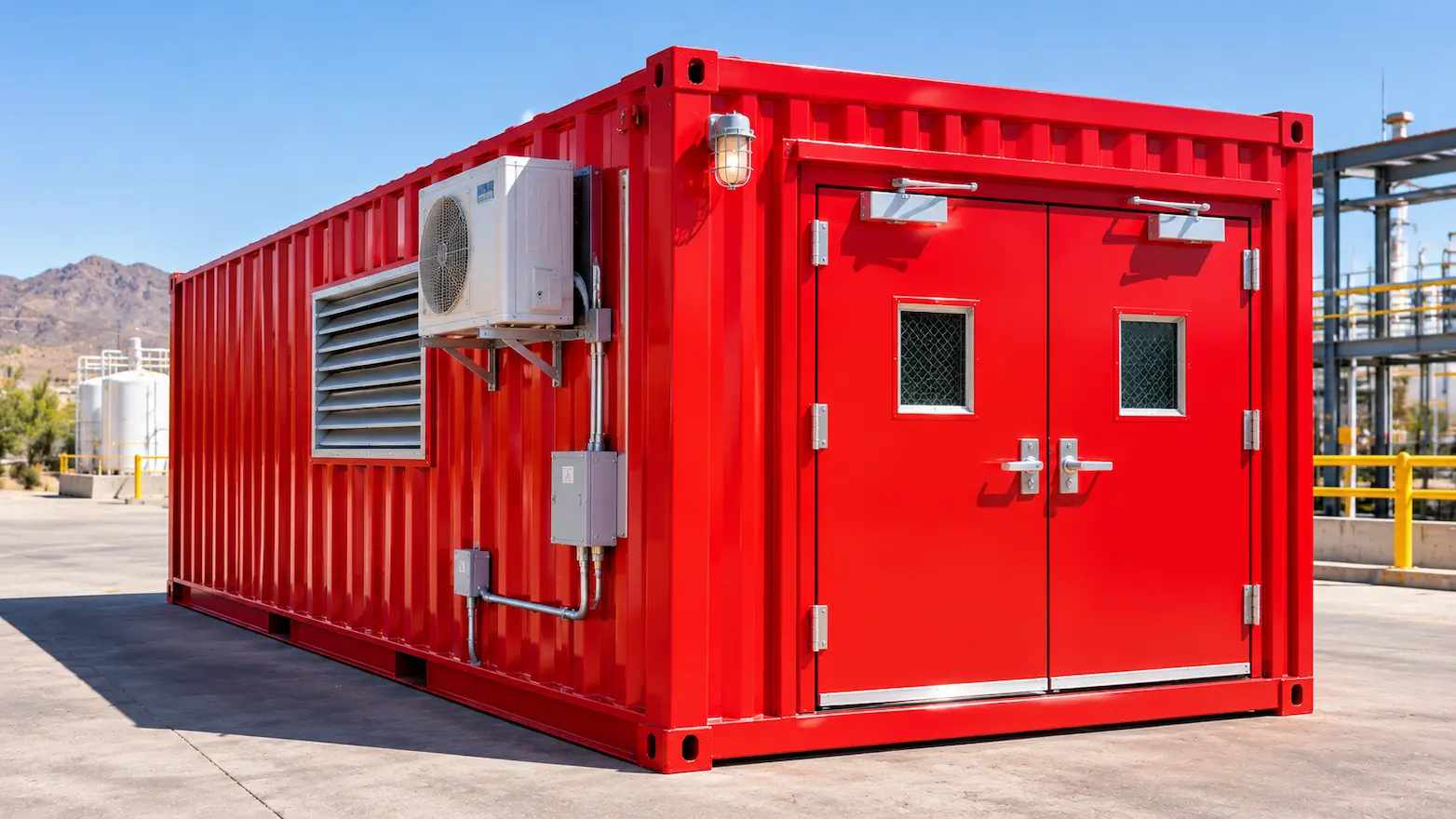
Specifying a fire rated double door in Phoenix is not the same exercise as specifying one in a temperate climate with a single AHJ. The International Building Code, NFPA 80, and Arizona’s own fire prevention framework each contribute a layer of requirements, and the Phoenix Fire Department applies those layers with local amendments that catch facilities off-guard when they’ve only read the national standard.
US Hazmat Storage serves Arizona facility managers, EHS teams, and contractors who need fire-rated chemical storage buildings and door assemblies built to the full code stack from day one.
Why Fire Rated Double Door in Phoenix Permits Get Flagged
The plan review flag for a fire rated double door in Phoenix submission usually traces back to documentation, not the door itself. The assembly listing number is missing from the drawings. The door and frame come from different test assemblies. The coordinator isn’t called out for a double-leaf active/inactive configuration. Any of those gaps gives the Phoenix Fire Department’s plan reviewer grounds to hold the submittal until additional documentation arrives.
An installation that clears procurement and fails at rough-in inspection costs more than one corrected during design. Hardware substitutions, re-testing documentation requests, and revised drawings add weeks to a project and can trigger re-submittal fees. NFPA 80 is unambiguous: fire door assemblies must be installed according to the conditions of their listing.
Phoenix compounds this. Extreme thermal cycling between summer highs above 110°F and cooler winters causes door frames to shift after a compliant installation. A frame that passed inspection with correct gap tolerances can exceed NFPA 80 Section 4.8 limits within a few seasons if it wasn’t specified for Arizona service conditions.
IBC Door Rating Requirements for Chemical Storage in Phoenix
The wall rating drives the door rating. For a 2-hour fire-rated wall, NFPA 80 Table 4.1.1 requires a 1.5-hour assembly. For a 1-hour rated wall, 45 minutes or 1 hour depending on the application. For any fire rated double door in Phoenix project, those ratings are established during design and documented in the construction drawings submitted to the AHJ before anything ships.
Chemical storage buildings classified under IBC Section 307 as Group H occupancies require opening protectives rated to the specific demands of that hazard class. A Group H-2 or H-3 occupancy at a Phoenix industrial site may require a 3-hour assembly at the boundary between the hazardous area and other portions of the building. That determination belongs in the design phase, not after the slab is poured.
Every fire rated double door in Phoenix chemical storage installation with a double-leaf configuration must have both leaves rated identically. A 1.5-hour active leaf paired with an unlisted inactive leaf is not a 1.5-hour assembly under any reading of NFPA 80. Both leaves require the same listing, installed in the same listed frame.
Double-Leaf Hardware: Coordinator, Sequence, and Closer Sizing
The coordinator is what separates a fire rated double door in Phoenix assembly from two independently hung doors that happen to share a frame. NFPA 80 Section 4.5.6 requires a coordinator whenever a double-leaf assembly uses overlapping astragals or when both leaves must latch in sequence for the hardware to engage. The inactive leaf closes first. The active leaf follows and latches against the inactive leaf’s strike.
Bypassing the coordinator is one of the most common field shortcuts at Phoenix industrial facilities, usually because a contractor found the door slow to operate during construction. It is also one of the most cited NFPA 80 violations at annual inspections.
For a fire rated double door in Phoenix assembly where either leaf exceeds 36 inches in width, NFPA 80 Section 4.5.3 requires that closer force stay within rated limits. Phoenix surface temperatures on a west-facing metal door in July can exceed 150°F. A closer specified for standard conditions may bind, fail to reach latching position, or move erratically under those conditions. Closer selection for a Phoenix installation is a specification decision, not a hardware afterthought.
Arizona’s IFC Adoption and the Phoenix AHJ Structure
The regulatory framework for a fire rated double door in Phoenix project starts with the Arizona State Fire Marshal’s adoption of the International Fire Code, published as the Arizona Fire Prevention Code. Arizona’s adoption incorporates state-specific amendments for high-heat environments. The Phoenix Fire Department then enforces the IBC and IFC within city limits under its own local amendments adopted through City Council.
Inside the City of Phoenix, the Phoenix Fire Department is the AHJ for fire-rated assemblies and hazardous materials storage. Outside city limits in unincorporated Maricopa County, the county planning department and the applicable rural fire district or county fire inspector hold that authority.
Code adoption cycles mean that different jurisdictions in the Phoenix metro may be enforcing different IBC/IFC editions at the same time, so confirming the applicable edition with the AHJ before permit submission is part of the process.
Arizona is a state-plan OSHA state. ADOSH, the Arizona Division of Occupational Safety and Health, enforces OSHA standards with authority equivalent to federal OSHA. For any fire rated double door in Phoenix facility regulated under OSHA 1910.106 or 1910.119, ADOSH review is part of the compliance picture alongside the Phoenix Fire Department.
Metal Fire Rated Doors: What Phoenix Conditions Actually Demand
A fire rated hollow metal door is the standard construction type for a fire rated double door in Phoenix chemical storage assembly. It must be listed under UL 10C or NFPA 252, with the certification label permanently affixed to the hinge style of each leaf. That label must carry the testing standard, the hourly rating, the temperature rise classification where applicable, and the assembly listing number.
Phoenix degrades hardware faster than most climates. High UV exposure, humidity swings, thermal cycling, and haboob dust events accelerate wear on door finishes, frame sealants, and hardware. A fire rated double door in Phoenix installation that meets NFPA 80 at commissioning may require more frequent maintenance and hardware replacement than a comparable installation in a moderate climate to stay within annual inspection tolerances.
The 3/4-inch undercut clearance required by NFPA 80 Section 4.8 at the bottom of each door is also a dust entry point during Phoenix dust storms. A listed threshold can reduce that gap while maintaining NFPA 80 compliance, but only when it is specifically listed for the assembly and installed so it does not obstruct the door’s ability to close and latch freely.
US Hazmat Storage’s fire-rated chemical storage buildings are delivered as complete assemblies with door and frame configurations specified for Arizona service conditions, so the opening protective holds its rated performance through the Phoenix climate’s full range of demands.
Accessory Hardware, Wall Penetrations, and What Voids the Listing
Fire extinguisher cabinet keys and other wall-mounted hardware near a fire rated double door in Phoenix assembly are part of the same code question as the door. Any penetration through the fire-rated wall must maintain the wall’s rating at the penetration point. Surface-mounted fire extinguisher cabinets recessed into a fire-rated wall require an assembly rated for that application.
Hardware mounted on the door face, whether signage, access control readers, or additional latching, must be listed for use with that specific fire door assembly. Through-bolt installations create holes in the door face that the listing may or may not permit. When a door listing allows hardware cutouts, it specifies permissible sizes and locations. Work outside those parameters requires either engineering evaluation or a new listing.
For Group H occupancies under IBC Section 1010.1.10, panic hardware is required on both leaves of the double-door assembly. That hardware must be listed for the fire door application and coordinated with the coordinator device so that activating the panic bars on either leaf does not break the closing sequence.
Knox Box Access, Electrified Hardware, and Egress Rules
A fire rated double door in Phoenix installation with electrified locking hardware triggers NFPA 80 Section 4.5.4: the locking device must be connected to the fire alarm system and must release when the alarm activates. That interconnection must be documented and tested during the fire alarm system acceptance procedure, with coordination between the door hardware contractor and the fire alarm installer.
The Phoenix Fire Department requires Knox Box access at hazardous materials facilities for rapid emergency entry. The Knox Box location must be coordinated during permit review. Placing it behind a code-locked gate that must be opened before the box is reachable defeats the purpose of the system.
Where the fire rated double door in Phoenix assembly serves as a primary egress point, IBC Section 1010.1 requires a minimum 32-inch clear opening width measured with the door open 90 degrees, minimum 80-inch height, and hardware that operates with a single motion from the egress side without special knowledge or a key. Those egress requirements apply regardless of fire rating.
US Hazmat Storage’s custom hazmat locker configurations include door hardware and access control integration for smaller-footprint chemical storage applications in Phoenix, with hardware built to NFPA 80 and Phoenix Fire Department access requirements rather than bolted on after the fact.
Annual Inspection: What NFPA 80 Requires Every Year
NFPA 80 Section 5.2 requires annual inspection and testing for every fire rated double door, with both leaves and the frame evaluated as one system. The inspector checks label legibility on each leaf, gap tolerances across all three NFPA 80 Section 4.8 limits (top clearance 1/8 inch, meeting edge 1/8 inch, bottom 3/4 inch), latch engagement on both leaves, coordinator sequence function, closer operation, and confirmation that no unlisted modifications have been made.
Arizona law requires that documentation be available for AHJ review. The Phoenix Fire Department may request those records during routine hazmat facility inspections. ADOSH may request them separately at facilities where the door protects a process regulated under OSHA 1910.106 or 1910.119.
A coordinator failure means both leaves must be treated as non-compliant until the repair is complete and the sequence re-verified. That is not a paperwork issue. It is a life safety citation and a potential ADOSH enforcement action at a site with regulated chemical storage.
Closing: Specify to the Full Stack Before the Permit Goes In
Getting a fire rated double door in Phoenix installation right starts before the permit application, not after the first red-line comment arrives. The Phoenix Fire Department, Maricopa County, ADOSH, and the applicable municipal AHJ each have authority over different aspects of the same assembly.
A specification that only reads NFPA 80 will miss Arizona-specific amendments, local ordinance requirements, and the climate-driven performance demands that a Phoenix installation faces throughout its service life.
US Hazmat Storage works with Phoenix area facilities on fire-rated chemical storage buildings and door assemblies built to the complete code stack from day one. Speak with an expert about your specific requirements and avoid the correction cycle that starts when a national-standard spec meets a Phoenix AHJ review.
FAQ
What fire rating is required for a fire rated double door in Phoenix chemical storage building?
A 2-hour rated wall requires a 1.5-hour door assembly under NFPA 80 Table 4.1.1 and the IBC. Group H hazardous occupancies under IBC Section 307 may require higher ratings depending on the occupancy subclassification. Both leaves of the assembly must carry the same listed rating.
Does a fire rated double door in Phoenix project require a coordinator?
Yes, when the assembly uses overlapping astragals or when both leaves must latch in sequence. NFPA 80 Section 4.5.6 mandates a coordinator in those configurations. A bypassed or failed coordinator voids the assembly’s compliance and is one of the most common annual inspection violations found at Phoenix industrial sites.
Who is the AHJ for fire door projects in the Phoenix area?
The Phoenix Fire Department holds that authority within city limits. Unincorporated Maricopa County falls under the county planning department and the applicable fire district. ADOSH enforces OSHA standards at facilities where the door assembly protects regulated chemical storage. Each jurisdiction may be on a different IBC/IFC adoption cycle.
How often does a fire rated double door in Phoenix installation need inspection?
Annual inspections are required under NFPA 80 Section 5.2. Both leaves, the frame, all hardware, and the coordinator sequence must be tested each cycle. Records must be maintained and are subject to review by the Phoenix Fire Department and ADOSH.
How does Phoenix’s climate affect fire rated hollow metal door performance?
Surface temperatures on west-facing metal doors can exceed 150°F in summer. That range causes closers to underperform, frames to shift, and gap tolerances to drift over time. Hardware and closer selection must account for high-temperature service conditions and may require more frequent maintenance than manufacturers’ standard recommendations.