
Storage tank fire protection in Boston is not a single code requirement from a single agency. It is a layered obligation that runs through MA OSHA under 454 CMR, the Massachusetts Comprehensive Fire Safety Code at 527 CMR, the Boston Fire Department’s Fire Prevention Division, and MA DEP environmental requirements that carry some of the strictest hazardous material discharge thresholds in the region.
A facility in Boston’s Seaport District, along the Mystic River corridor, or near the Port of Boston faces a compliance picture shaped by urban density, waterway proximity, and a BFD inspection program that treats above-ground storage tanks as a priority category.
Getting the fire protection specification wrong in this environment does not produce a corrective notice on a timeline that works in your favor. It produces a BFD stop-work order, a MA DEP liability exposure, or both. US Hazmat Storage works with facility managers and EHS teams throughout the Boston metro area, and the pattern we see consistently is that the operations with the cleanest inspection records built the fire protection system before they filled the tank, not after.
What Makes Boston’s Regulatory Stack Different From the Federal Baseline
Massachusetts is a state-plan OSHA state, which means that private-sector employers in Boston do not operate under federal OSHA directly. They operate under MA OSHA, enforced by the Massachusetts Department of Labor Standards under 454 CMR.
For storage tank fire protection in Boston, the relevant MA OSHA provision is 454 CMR 10.00, which governs flammable and combustible liquids and incorporates NFPA 30 by reference. A facility that believes federal OSHA compliance is sufficient in Boston has an incomplete picture of its actual obligations.
The Massachusetts Comprehensive Fire Safety Code, 527 CMR 1.00, is the second layer. Based on NFPA 1 with Massachusetts amendments, it is administered at the state level by the MA State Fire Marshal and locally in Boston by the BFD Fire Prevention Division. For above-ground storage tanks, 527 CMR 9.00 sets the specific requirements for tank construction, placement, secondary containment, and fire protection systems.
The BFD issues Permits to Store Hazardous Materials for tanks above threshold quantities, and those permits require documentation of the fire protection system before the permit is granted, not as a follow-up condition.
MA DEP adds the environmental accountability layer through MGL Chapter 21E, the Massachusetts Oil and Hazardous Material Release Prevention and Response Act. Boston’s proximity to the Charles River, Boston Harbor, and the interconnected storm drain and tidal waterway network means that any release from an above-ground storage tank carries potential MGL 21E liability that is independent of the fire protection violation.
Fire Protection Systems: What NFPA 30 and 527 CMR Require for Boston ASTs
NFPA 30 defines the fire protection requirements for above-ground flammable and combustible liquid storage tanks by tank size, liquid class, and location. For tanks storing Class I flammable liquids, which includes most common industrial solvents, fuels, and process chemicals, NFPA 30 Chapter 22 sets the minimum distances from property lines, buildings, and other tanks, the secondary containment volume requirements, and the fire protection system specifications that apply at different storage volumes.
Storage tank fire protection for Boston sites must satisfy NFPA 30 as adopted by MA, which the BFD enforces with local amendments.
For tanks above the thresholds specified in NFPA 30 Chapter 22, fixed fire protection systems become mandatory rather than advisory. NFPA 15, the standard for water spray fixed systems, governs tank cooling and fire suppression systems that protect the tank shell and surrounding equipment during a fire event.
NFPA 11 covers foam systems, appropriate for tanks storing hydrocarbons where a flammable liquid surface fire requires vapor suppression rather than simple cooling. The storage tank fire protection Boston decision between water spray, foam, or a combined system depends on the stored material, tank configuration, and the BFD’s local interpretation of the applicable NFPA standard for the specific installation.
Boston’s urban density introduces an exposure protection variable that does not appear in suburban or rural tank installations. When a storage tank is located within the exposure distance of an adjacent building, another tank, or a public way, NFPA 30’s requirements call for either increased setback distances or supplemental fire protection to compensate for the reduced separation.
Fire-Rated Chemical Storage Buildings as an Integrated Approach
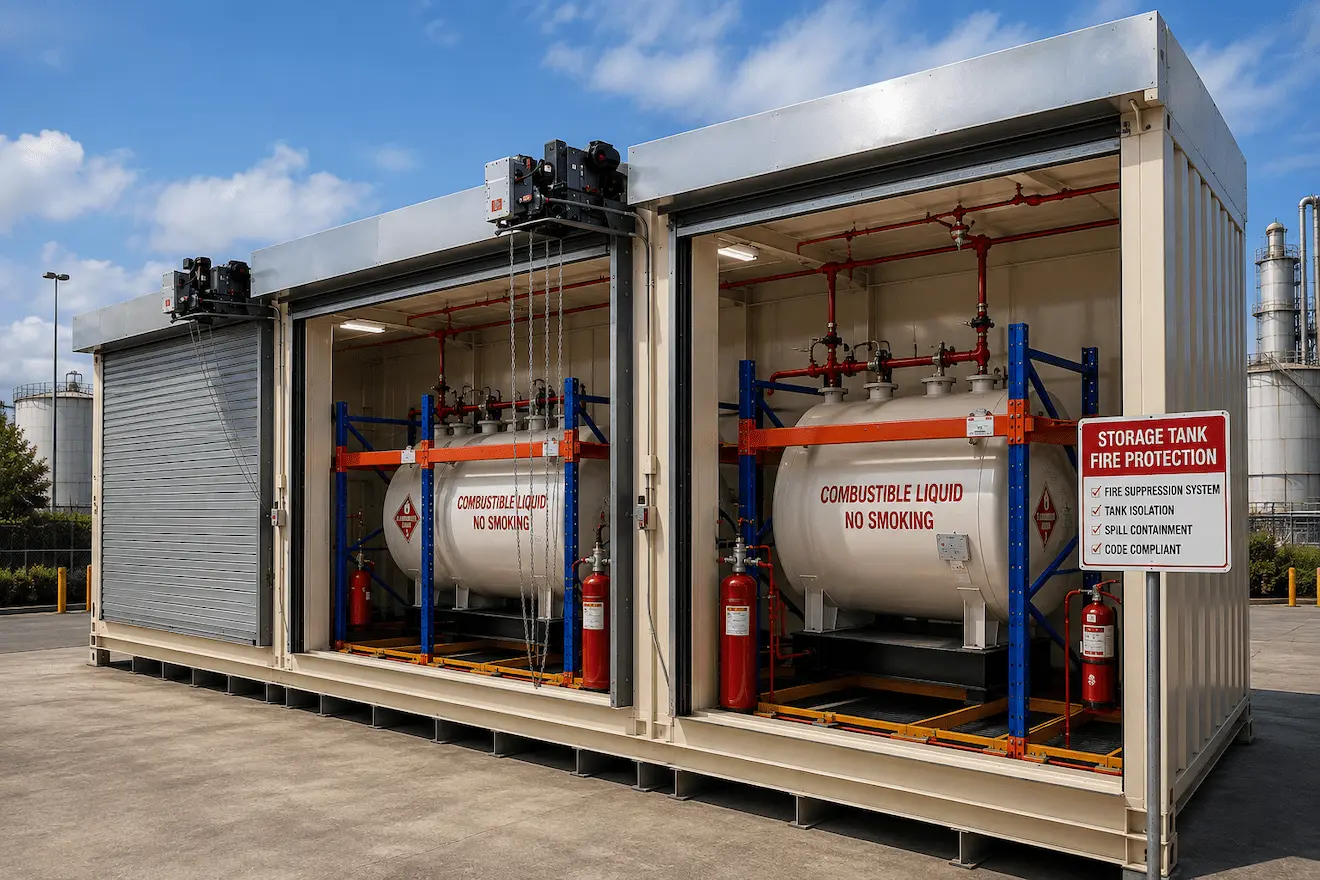
Not every Boston facility stores chemical materials in a freestanding above-ground tank. Many operations, particularly in the Cambridge and Waltham biotech corridor just outside the city, and in Boston’s own emerging life sciences district, store flammable solvents, reagents, and specialty chemicals in quantities that call for a fire rated building rather than an open-air tank with a standalone fire protection system.
Under the Massachusetts State Building Code, 780 CMR, a building used to store flammable or combustible liquids in quantities that classify the occupancy as H-2 or H-3 under the International Building Code must meet specific fire resistance ratings for walls, floors, and roofs, as well as automatic suppression system requirements that depend on the occupancy and the floor area.
A fire rated building is central to storage tank fire protection in Boston: when it satisfies both 780 CMR and 527 CMR simultaneously, it is a structure an EHS manager can walk a BFD inspector through with confidence. One that meets only one of those frameworks is a variance request in progress.
For operations that need storage tank fire protection in Boston on a temporary or transitional basis, a blast-resistant module rental offers a code-recognized path to interim compliant storage while a permanent fire rated building is under permit review or construction.
These modular structures carry independent structural and fire ratings, can be sited in compliance with BFD setback requirements, and are removable when the permanent solution is complete.
Our fire-rated chemical storage buildings cover both permanent and interim configurations engineered for the regulatory requirements that govern Boston and the surrounding MA DEP enforcement zone.
Specialized Chemical Storage: Hypochlorite and High-Oxidizer Applications
Storage tank fire protection in Boston extends beyond flammable liquids into chemical categories with distinct fire protection profiles. An on-site high-strength hypochlorite system, used in water treatment operations throughout the Boston metro area, stores sodium hypochlorite at concentrations that classify it as an oxidizer rather than a flammable liquid.
Oxidizer storage requires fire protection infrastructure calibrated to prevent contamination with incompatible materials, not to suppress a flammable vapor fire. Mixing hypochlorite with organic materials or certain acids can produce chlorine gas or initiate a violent reaction, and the fire protection system for hypochlorite storage must address that reaction risk rather than a conventional flammable liquid fire scenario.
The BFD and MA DEP both maintain separate guidance for oxidizer storage as part of Boston storage tank fire protection compliance, and the hazardous material storage permit application for a hypochlorite system requires different documentation than a flammable liquid permit.
Quantity limits, separation distances from combustible materials, and the secondary containment material compatibility requirements for hypochlorite differ from those that apply to fuel or solvent storage. Specifying the fire protection system for a hypochlorite installation using flammable liquid storage criteria is a common error that produces a permit rejection from the BFD rather than an approval.
NFPA 400, the Hazardous Materials Code, and the BFD’s local interpretation of the MA Fire Safety Code govern incompatible chemical segregation in Boston. Getting a site plan reviewed by a qualified EHS professional and the BFD before any tank or storage building is placed avoids a costly redesign after the permit application is submitted.
The BFD Permit Process and What It Actually Requires
Obtaining a Permit to Store Hazardous Materials from the Boston Fire Department Fire Prevention Division is not a form-submission exercise. It is a documentation-intensive review that requires a site plan showing tank location, setback distances to property lines and structures, secondary containment design with volume calculations, fire protection system specifications with the applicable NFPA standard references, and a material inventory with SDS files for every stored chemical.
For storage tank fire protection in Boston above certain thresholds, a licensed fire protection engineer’s stamp on the system design is required before the BFD will accept the application.
The BFD Fire Prevention Division conducts a site inspection after the permit application is reviewed and before the permit is issued. That inspection validates that the field installation matches the approved drawings, that the secondary containment is in place, and that the fire protection system is operational.
A storage tank in service before the BFD permit is issued sits outside the Boston storage tank fire protection framework entirely, and the BFD has authority to order it emptied and the facility shut down until the permit process is completed.
Scheduling the BFD pre-application meeting before the Boston storage tank fire protection is purchased, not after, is the practice that avoids the redesign cycle. The BFD’s local interpretation of 527 CMR, NFPA 30, and the applicable NFPA fire protection standards can affect the system design in ways that a specification built solely from the published codes will not anticipate. The meeting costs nothing and can save the equivalent of months of redesign and permit delay.
Boston storage tank fire protection: Getting the Full Picture Before Any Equipment Decision
Boston storage tank fire protection is a specification that should be complete before any tank, storage building, or fire protection equipment is ordered. The compliance picture, MA OSHA under 454 CMR, the MA Fire Safety Code under 527 CMR, the BFD permit process, the MA DEP liability exposure under MGL 21E, and the site-specific variables introduced by Boston’s urban density and waterway proximity, does not simplify after the equipment is in the ground. It compounds.
US Hazmat Storage serves Boston-area facilities with fire-rated storage solutions and compliance guidance built for this regulatory environment. If your operation is planning above-ground tank storage or a fire-rated chemical storage building in the Boston metro area and wants to confirm the right fire protection configuration before committing, contact US Hazmat Storage and compare options with a free consultation.
Any final storage tank fire protection configuration should be reviewed by a licensed fire protection engineer, the BFD Fire Prevention Division, and where MA DEP obligations apply, an environmental compliance specialist before any commitment is made.
FAQ
What state agency enforces OSHA requirements for Boston storage tank fire protection?
In Massachusetts, private-sector employers fall under MA OSHA, enforced by the Department of Labor Standards under 454 CMR, not federal OSHA directly. MA OSHA can set requirements more stringent than the federal baseline and does so in several areas relevant to flammable liquid storage.
Does a Boston above-ground storage tank require a BFD permit?
Yes. The Boston Fire Department Fire Prevention Division requires a Permit to Store Hazardous Materials for above-ground tanks storing regulated materials above threshold quantities. The permit requires fire protection system documentation and a site inspection before it is issued.
What is 527 CMR and how does it apply to storage tank fire protection in Boston?
527 CMR is the Massachusetts Comprehensive Fire Safety Code, based on NFPA 1 with Massachusetts amendments. It governs above-ground flammable liquid storage under 527 CMR 9.00 and is enforced locally in Boston by the BFD Fire Prevention Division alongside NFPA 30 requirements.
When is a fire rated building required instead of a standalone tank fire protection system?
When stored quantities classify the occupancy as H-2 or H-3 under the Massachusetts State Building Code, 780 CMR, a fire rated building with rated wall and roof assemblies and automatic suppression is required. The BFD pre-application review will clarify the applicable occupancy classification for your specific storage volume.
Can a blast-resistant module rental serve as interim chemical storage in Boston?
Yes, if the specific unit meets 527 CMR and the applicable NFPA standards for the stored materials. Confirm the unit’s ratings with the BFD Fire Prevention Division before siting it. A non-compliant interim structure creates its own permit problem rather than solving the storage gap.
How does hypochlorite storage differ from flammable liquid storage for BFD permit purposes?
Sodium hypochlorite is an oxidizer, not a flammable liquid. Its BFD permit application, quantity limits, segregation requirements, and secondary containment specifications differ from those for flammable liquids. Using flammable liquid storage criteria for a hypochlorite system is a common error that produces a permit rejection.
Does MA DEP have authority over storage tank fire protection decisions in Boston?
Yes. Through MGL Chapter 21E, MA DEP can hold facility operators liable for releases from above-ground storage tanks regardless of whether a fire code violation was the cause. Facilities near Boston Harbor, the Charles River, or storm drain systems that connect to tidal waterways face heightened MA DEP exposure.
What does a licensed fire protection engineer need to stamp for a Boston storage tank permit?
For tanks above NFPA 30 thresholds, the BFD requires a licensed fire protection engineer to stamp the fire protection system design, including the system type, coverage specifications, activation logic, and compliance references to the applicable NFPA standards, before accepting the permit application.