
A steel fire door gets specified in the early stages of a chemical storage building project and forgotten until an inspector arrives and asks to see the annual inspection records. That gap between specification and maintenance is where most compliance findings in this category originate. The door itself is rarely the problem.
The problem is that the door’s rating, hardware, clearances, and self-closing mechanism have drifted from the conditions required by NFPA 80 over months of daily use, and nobody caught it because nobody had a written inspection procedure tied to the door. Steel fire doors in hazardous material storage environments carry a heavier compliance obligation than their commercial counterparts.
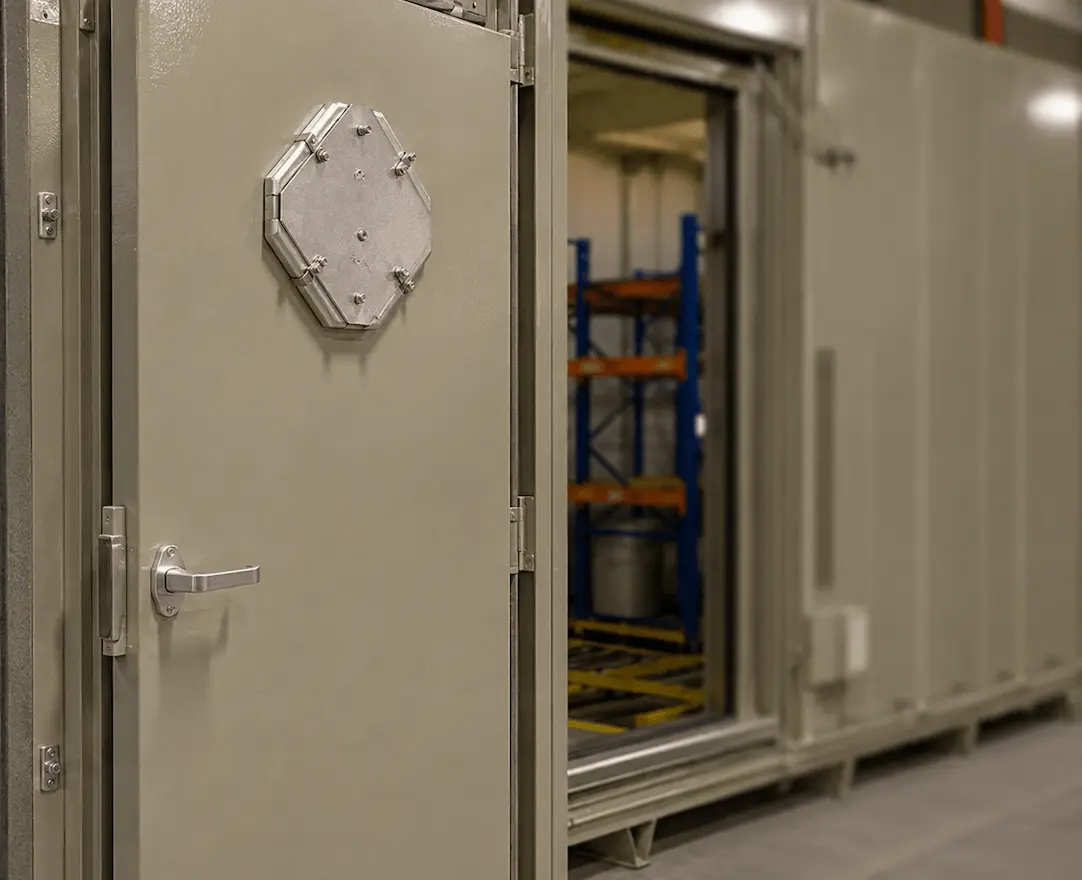
US Hazmat Storage builds fire-rated chemical storage solutions where the door is specified, installed, and documented as part of the compliance system, not as a hardware afterthought. Understanding what that means in practice starts with understanding what a steel fire door actually is, and what it is not.
What a Steel Fire Door Is Actually Tested To Do
A steel fire door is not rated by how long it keeps fire out. It is rated by how long it maintains the integrity of a fire barrier, which is a meaningfully different standard. The UL 10C test, Positive Pressure Fire Tests of Door Assemblies, subjects the door assembly to elevated temperatures and positive pressure differential that simulate conditions on the fire side of a door during an active building fire.
The door passes or fails based on whether it maintains its integrity, whether it prevents the passage of hot gases and flame, and whether it can be opened after the test period without excessive distortion. A steel fire door that passes the UL 10C test for a given rating period has demonstrated that it can serve its function as an opening protective in a rated fire barrier wall for that duration under those conditions.
The rating period, whether 20 minutes, 45 minutes, 60 minutes, or 90 minutes, corresponds to the fire resistance rating of the wall the door is installed in, not to an independent assessment of the door’s protection value. A 90 minute fire door goes into a wall rated for 90 minutes of fire resistance. Installing a 60-minute door in a wall that requires 90-minute protection is not a conservative choice. It is a code violation that invalidates the entire wall assembly’s rating.
A steel fire door rated for the same period as a wood-core door will outlast it significantly in an industrial setting, and the door label, which must remain legible and intact for the assembly’s listing to remain valid, holds up better on steel than on composite materials.
Rating Periods and What They Mean for Chemical Storage Buildings
Chemical storage buildings classified as H-2 or H-3 occupancies under the International Building Code face specific fire door rating requirements that follow from the occupancy classification and the construction type of the building. For walls rated at 1.5 hours, which is common in H-2 occupancies where highly flammable materials are stored, a 90 minute fire door is required at each opening.
NFPA 30 references fire door requirements for openings in the fire-rated walls of flammable liquid storage rooms at Section 9.4.2.2. Those openings must be protected by self-closing fire doors with the rating appropriate to the wall assembly. For most flammable liquid storage room configurations under NFPA 30, the wall carries a two-hour fire resistance rating, which places the opening protective requirement at the 90 minute fire door level under NFPA 80’s fire rating correlation table. This is why the 90-minute rating appears so consistently in industrial chemical storage specifications, and why a steel fire door specified without confirming the wall assembly’s actual rating can produce a mismatch that an inspector will find.
The fire door rating also determines which hardware is permissible. Closer requirements, latch type, hinge material, and coordinator specifications all vary by rating period under NFPA 80. Specifying a door by rating alone, without specifying the complete assembly including all required hardware, is one of the most common ways a fire door installation fails its first inspection without the door itself being defective.
NFPA 80: The Standard That Governs Installation, Not Just the Door
NFPA 80, Standard for Fire Doors and Other Opening Protectives, determines whether a listed steel fire door is actually in compliance once it leaves the factory. A door can carry a valid UL label and still fail an NFPA 80 inspection because of how it was installed, what hardware was used, how it was modified after installation, or how it has been maintained.
NFPA 80 Section 4.1 requires that fire door assemblies be installed in accordance with the manufacturer’s instructions and the door’s listing. Modifications to a listed assembly, including adding a vision light, cutting a hole for a pass-through, or replacing any listed hardware with unlisted substitutes, require either a field modification listing from the original testing laboratory or a new listing of the modified assembly.
Painting over the door label, which NFPA 80 Section 4.1.5.1 prohibits, is the most frequently cited violation in routine inspections because it appears minor and occurs gradually over successive maintenance cycles. Once the label is illegible or missing, the door’s listing cannot be verified in the field, and the assembly is treated as unlisted regardless of its actual construction.
These clearances exist because gaps above the maximum size allow hot gases to pass through during a fire event. In chemical storage environments where forklift traffic, pallet impacts, and repeated thermal cycling affect the door frame over time, clearance verification belongs in the annual inspection procedure, not only in the original installation checklist.
Hardware: What NFPA 80 Requires and Why It Matters
Every hardware component on a steel fire door is part of the listed assembly. Hinges must be steel and rated for the door’s weight and frequency of use. The door closer must return the door to the fully latched position every time from any open position. The latch must engage the strike positively under the door’s own weight without manual assistance, which is why friction catches and magnetic holders are not permitted on fire doors that must be self-latching.
Intumescent seals, which expand when exposed to heat and seal the gap between the door and frame, are required on many fire door assemblies and particularly important on a steel fire door in chemical storage buildings where the gap between door edge and frame may allow vapor migration under normal conditions.
For blast resistant module specifications that incorporate a steel fire door, the hardware requirements become more complex because the door must satisfy both the fire rating requirements of NFPA 80 and the structural requirements of the blast rating simultaneously. Blast-rated hardware, including reinforced hinges, heavy-duty closers, and positive-latching mechanisms rated for overpressure loading, must be compatible with the fire door assembly’s listing.
A dual-rated door assembly, tested and listed for both fire resistance and blast resistance, is the appropriate solution for chemical storage structures near process areas with deflagration risk. These assemblies are specified in the structural design phase of the building, not sourced as standard hardware additions to a listed steel fire door after the fact.
Annual Inspection Requirements Under NFPA 80
NFPA 80 Section 5.2 requires that fire door assemblies be inspected and tested annually, and that inspection results be documented in writing. The checklist covers the door label, frame condition, clearances, hardware function, closing and latching performance, and the condition of any glazing or seals.
Facilities that cannot produce current annual inspection records for their steel fire door assemblies during an OSHA or fire marshal inspection face citations regardless of the door’s physical condition, because the documentation requirement is independent of the hardware condition requirement.
The annual inspection can be performed by a qualified individual employed by the facility, a third-party service, or the door manufacturer’s authorized provider. What NFPA 80 requires is that the person be knowledgeable in the standard’s requirements and that results be recorded and retained. The written record must be traceable to the specific door inspected, must include the date and inspector’s identity, and must describe any deficiencies found and corrective actions taken.
OSHA inspectors cite NFPA 80 compliance as part of the flammable liquid storage inspection protocol under 29 CFR 1910.106. The connection is direct: the fire resistance of the storage room wall depends on the opening protectives maintaining their rated condition. A steel fire door that is wedged open, fails to latch, has a missing label, or has been modified without a field listing undermines the rated wall assembly and produces an OSHA citation alongside the NFPA 80 finding.
Our fire-rated chemical storage buildings are engineered with the door assembly, wall rating, ventilation, and containment specified together as a system.
The Steel Fire Door as Part of a Complete Storage System
A steel fire door does not function in isolation. It is one component of a fire-rated wall assembly, which is one element of a compliant fire-rated chemical storage building. Specifying the door correctly means specifying the wall assembly it belongs to, the rating that wall assembly requires, the hardware that completes the listed assembly, and the inspection program that keeps it compliant over its service life.
When a facility needs a storage solution where the steel fire door, the wall assembly, and the building permit all align with NFPA 30, NFPA 80, and the local AHJ’s requirements, the configuration has to be designed that way from the beginning. Retrofitting a compliant fire door into a storage structure not designed for it is possible in some cases and produces a variance request in others, and the difference is not always apparent until the permit application is submitted.
If your operation is evaluating a fire-rated storage configuration and wants to confirm the door assembly, wall rating, and inspection requirements before committing, contact US Hazmat Storage and get your compliance checklist and a quote in one call. Any final fire door assembly specification should be reviewed by a qualified fire protection engineer, your AHJ, and the building code official with jurisdiction over your site before any installation commitment is made.
FAQ
What is a steel fire door rated for in a chemical storage building?
A steel fire door is rated for how long it maintains the integrity of a fire barrier wall under UL 10C test conditions. In chemical storage buildings classified H-2 or H-3, a 90 minute fire door is typically required at openings in 1.5-hour rated walls.
What does NFPA 80 require for steel fire door inspections?
NFPA 80 Section 5.2 requires annual inspection and written documentation of the door label, clearances, hardware function, and closing performance. Facilities unable to produce current records face citations regardless of the door’s physical condition.
Can a steel fire door be modified after installation?
Only with a field modification listing from the original testing laboratory or a new assembly listing. Unauthorized modifications, including adding hardware, cutting openings, or painting over the label, void the assembly’s listing and produce NFPA 80 violations.
Why is a 90 minute fire door required in flammable liquid storage rooms?
NFPA 30 Section 9.4.2.2 requires fire-rated opening protectives in the walls of flammable liquid storage rooms. Most of those walls carry a two-hour fire resistance rating, which correlates to a 90 minute fire door requirement under NFPA 80’s rating correlation table.
What happens if a steel fire door is wedged open in a chemical storage room?
A steel fire door propped or wedged open fails its self-closing requirement under NFPA 80, undermines the rated wall assembly’s integrity, and generates both an NFPA 80 violation and a potential OSHA 29 CFR 1910.106 citation during flammable storage inspections.
Can a blast resistant module specification include a fire-rated door?
Yes. Dual-rated assemblies tested and listed for both fire resistance per NFPA 80 and blast resistance are available for chemical storage structures near process areas with deflagration or explosion risk. These assemblies must be specified during the building design phase, not added after installation.
What is the difference between UL 10C and UL 10B for fire door testing?
UL 10C tests under positive pressure differential, simulating real building fire conditions where the fire side of the door has higher pressure. UL 10B tests under neutral pressure, an older standard. Most current fire codes require UL 10C-listed assemblies for new installations.
What clearances does NFPA 80 specify for a steel fire door?
NFPA 80 sets maximum clearances between the door and frame on the hinge, latch, and head sides, and between the door bottom and the floor or threshold. Specific dimensions are published in NFPA 80 Section 4.8. Gaps exceeding these clearances allow hot gas passage and produce inspection findings.