Safer Chemical Storage Starts With a Better Plan
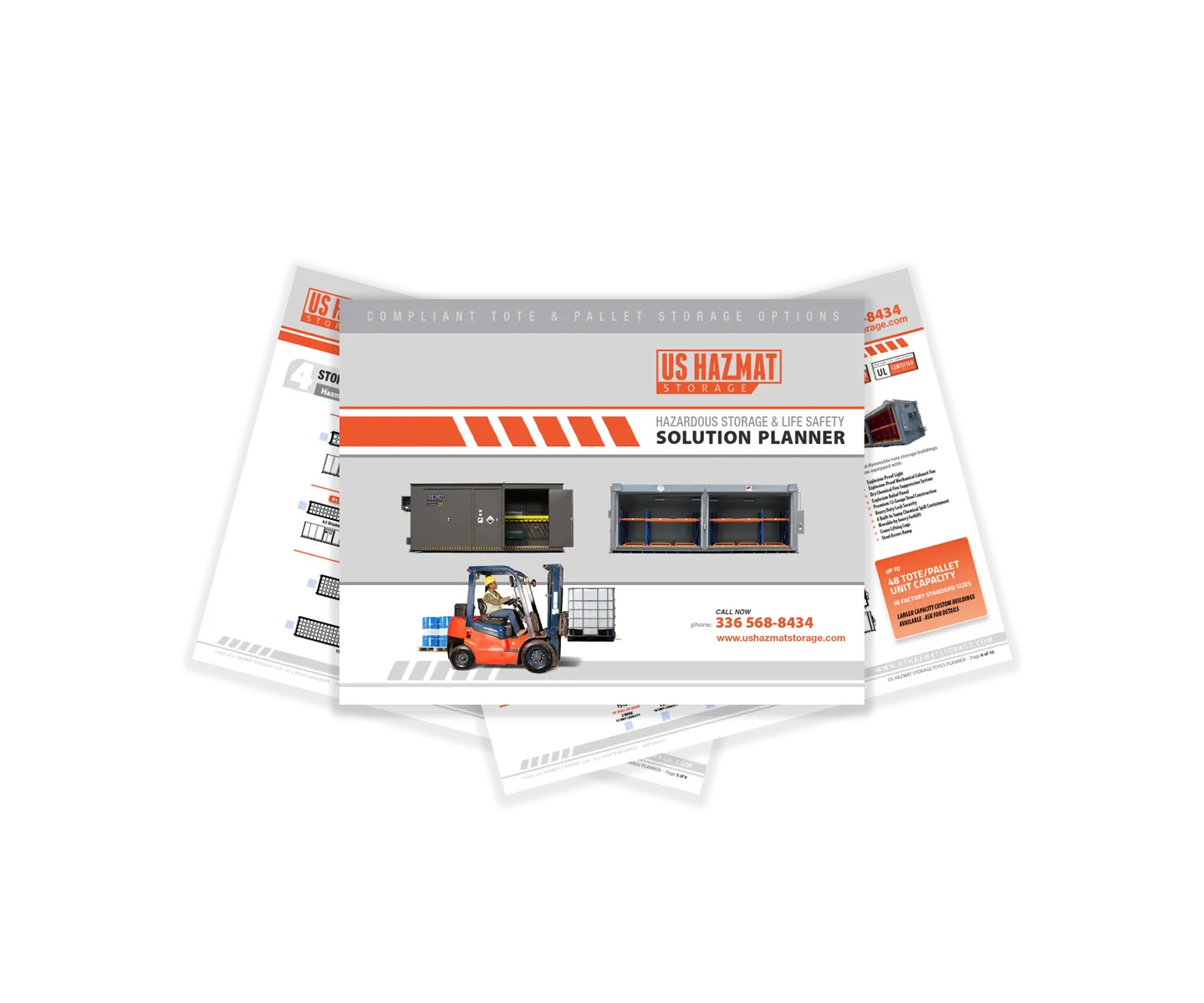
Fire ratings, secondary spill containment, ventilation, chemical compatibility, and facility footprint all shape the right storage solution. Get our Chemical Storage Building Planner and start your project with the right questions answered first.
- 2-hour & 4-hour fire-rated construction options
- Engineered to OSHA, EPA & NFPA 30 requirements
- Custom-engineered to your facility and workflow
Prefer to talk? 877-959-0747
What's Inside the Chemical Storage Planner
The planner is a short project-intake worksheet, not a brochure. Fill in what you're storing and how, and a Sales Engineer prices a compliant building to your exact spec.
- Storage unit dimensions and capacity charts for drums, totes, and pallets
- Compliance and component selections: fire rating, explosion-proofing, ventilation, and climate control
- Delivery timeline and intended-use details so we can scope your project correctly
Everything a Compliant Chemical Storage Project Depends On
Safety & Risk Reduction
Protect employees, facilities, assets, and the environment.
Compliance Planning
Navigate OSHA, EPA, NFPA, and applicable fire-code requirements.
Operational Efficiency
Evaluate capacity, accessibility, material handling, and workflow.
Custom Engineering
Fire-rated, non-fire-rated, containment & specialized configurations.
Purchasing Confidence
Reduce specification uncertainty before you request a quote.
Built for Every Stakeholder in the Decision
Plan for compliance and reduce risk.
Storage that works with your facility.
Identify requirements before procurement.
Make informed purchasing decisions.
What Goes Into a Compliant Chemical Storage Building
Fire Rating & NFPA 30 Compliance
Most flammable and combustible liquid storage falls under NFPA 30 and the fire code adopted by your local authority having jurisdiction (AHJ). Depending on quantity, container type, and proximity to other structures or property lines, a building may need a 2-hour or 4-hour fire rating, or may not need a fire rating at all. Getting the rating right before you request a quote avoids re-specifying a building mid-project.
Secondary Containment & EPA Requirements
Hazardous material storage is typically required to contain a spill without releasing it into the surrounding environment. That usually means a containment sump sized to hold the volume of the largest container plus a safety margin, with chemically resistant flooring and coatings suited to what's being stored. Containment sizing is one of the first things a Sales Engineer will ask about on a quote request.
Ventilation & Electrical Classification
Flammable storage buildings generally need continuous or triggered mechanical ventilation to keep vapor concentrations below hazardous thresholds, and any electrical components inside may need to meet hazardous (classified) location standards depending on what's stored. These requirements can change the building's internal layout, so they're worth settling early rather than after a quote is already in hand.
Capacity & Facility Footprint
Building size follows what goes inside it — drums, totes, pallets, or mixed loads — not the other way around. Oversizing adds cost and footprint you don't need; undersizing means outgrowing the building before the project pays for itself. Inventory type, container count, and expected growth are the main inputs here.
Site, Delivery & Installation
Where the building goes affects what it needs: site prep, pad or foundation requirements, utility runs, and clearance for delivery equipment all factor into the final design. Standard lead times vary by configuration; emergency and rush delivery options exist for time-sensitive projects.
Who Regulates Chemical Storage Buildings
Depending on what you store and where, a project can touch OSHA (worker safety, e.g. 29 CFR 1910.106 for flammable liquids), the EPA (spill prevention and containment), NFPA (fire and life safety codes), and your local fire marshal or building department. None of these bodies publish a single master checklist — a quote tailored to your materials, quantities, and site is the way to confirm what applies to your specific project.
Start Your Chemical Storage Project With a Plan, Not a Guess
Get Your Chemical Storage PlannerOr call 877-959-0747