
drum storage buildings · custom-engineered storage
Drum Storage Buildings Compared by Capacity
Drum storage buildings in our fleet range from compact walk-ins holding a modest row of drums to large buildings with pallet bays for palletized drums. The useful comparison is drum capacity at your handling method: upright drums pack tightly, palletized drums need forklift.
- Drums, totes, and IBCs
- EPA secondary containment
- Sized to your container count and traffic path
Prefer to talk? 877-959-0747
How we specify drum storage buildings
Matching capacity to your count
Drum storage buildings in our fleet range from compact walk-ins holding a modest row of drums to large buildings with pallet bays for palletized drums.
Features across the range
Every size shares a welded sump, grating, vents and lockable doors.
Choosing and ownership
We recommend a size, help place it and supply AHJ drawings.
Custom design and integration
drum storage buildings storage
Matching capacity to your count
Drum storage buildings in our fleet range from compact walk-ins holding a modest row of drums to large buildings with pallet bays for palletized drums. The useful comparison is drum capacity at your handling method: upright drums pack tightly, palletized drums need forklift aisles and racked drums need dispensing space. Buyers comparing buildings get the clearest answer by telling us their peak drum count and how drums are moved.
Features across the range
Every size shares a welded sump, grating, vents and lockable doors. Larger buildings add roll-up doors and pallet bays. Options include explosion-proof electrical, explosion relief, fire-rated walls, heating, cooling and wet or dry fire suppression with UL listed components. Shelving can be added for pails and smaller containers stored alongside drums.
Choosing and ownership
We recommend a size, help place it and supply AHJ drawings. Quote or purchase, and swap sizes on storage if your count changes. Our engineers confirm that the chosen drum storage building fits the pad, the forklift path and the distance your AHJ expects from other structures. If your count grows beyond one building, a second can be placed with matching options and the same layout.
Comparing buildings by drum capacity
Drum storage buildings range from compact walk-ins that hold a few pallets of drums to long multi-bay buildings holding many pallets along both walls. Comparing them by capacity starts with your peak drum count by hazard class. Each size has a practical capacity for upright drums, palletized drums and racked drums, and those numbers differ because aisles, pallet footprints and rack depth use space differently. A building that holds a certain number of drums upright on the grating may hold fewer when the same drums are on pallets with forklift aisles. We show capacity for each layout so you compare sizes on the method you will actually use.
Small buildings: a step up from lockers
Smaller drum buildings suit sites with modest counts that need walk-in access to reach every drum and room to dispense. They fit on modest pads and can often be moved by forklift. They work well for a single department or a single hazard class.
Mid-size buildings: mixed handling
Mid-size buildings hold enough drums for most plants' main storage. They can combine pallet bays for incoming stock with racks for drums in use and a dispensing station. Two or more sump sections allow incompatible groups to share the building.
Large buildings: consolidation
Large multi-bay buildings consolidate drums from across a site into one managed space. They typically need forklift access through wide doors, heavier grating, mechanical ventilation and often fire-rated walls because of the quantity stored. One large building can replace several scattered lockers and outdoor areas.
Features that scale with size
As buildings get larger, ventilation moves from passive vents to mechanical exhaust, electrical requirements grow, sump capacity rises with total volume and approvals become more detailed. Fire rating and suppression with UL listed components are more often required. Factor these into the comparison, not just floor area.
Several smaller or one larger
Sometimes two mid-size buildings serve better than one large one: they can sit near different users, separate incompatibles by distance and keep operating if one is being cleaned. One large building is simpler to inspect and manage. We help weigh the options for your site.
Leaving room for growth
Choose a size with modest headroom for new products or larger deliveries. If growth is uncertain, quote the size you need now and swap later.
Comparing quote and purchase across sizes
Larger buildings carry higher purchase prices, which makes quoting first more attractive when the long-term need is unclear. Smaller buildings are often bought outright.
Questions that narrow the choice
Four questions usually settle which drum storage building fits. How many drums at peak, by hazard class? How will drums be handled: dolly, forklift or both? Will product be dispensed inside? How close must the building sit to other structures? The answers set capacity, door size, grating rating, interior layout and whether fire-rated construction is needed. With those four answers, the range of buildings narrows to one or two sizes, and the remaining choice is about options and budget rather than guesswork.
Matching options to contents
Flammable contents add grounding, rated electrical and ventilation; corrosives add resistant linings; water-based products in cold climates add heat. Choosing options by contents keeps cost in line with risk across any size.
Prefabricated drum storage buildings: weeks, not a capital construction project
Prefabricated construction is how US Hazmat Storage delivers drum storage buildings in weeks, not the months or years of traditional hazard-storage design and construction. Each building is custom designed, engineered, and manufactured to the client's material storage requirements, facility integration, and process workflow. Planning, permitting, and approval move with a purpose-fabricated package. The benefits of working with us are cost, speed, and experience. Contact us at 877-959-0747 to learn how a process workflow compliant unit fits the plant you already run.
Class I/II/III classified areas and UL listed components for drum storage buildings
US Hazmat Storage specifies drum storage buildings for Class I, Class II, and Class III classified areas when the inventory requires that occupancy. Lighting, sensing, gauges, heat, air conditioning, and fire suppression can all be furnished as UL listed components. Explosion-proof electrical is laid out to the classified area. We do not call the building itself UL listed — the listed devices go into a custom-engineered enclosure designed to help meet NFPA, EPA, OSHA, and IFC storage compliance for those classified areas. Name the liquids and the area classification in the quote so the component package matches the process.
Share your peak drum count to compare drum storage buildings.
The building
How the unit is specified
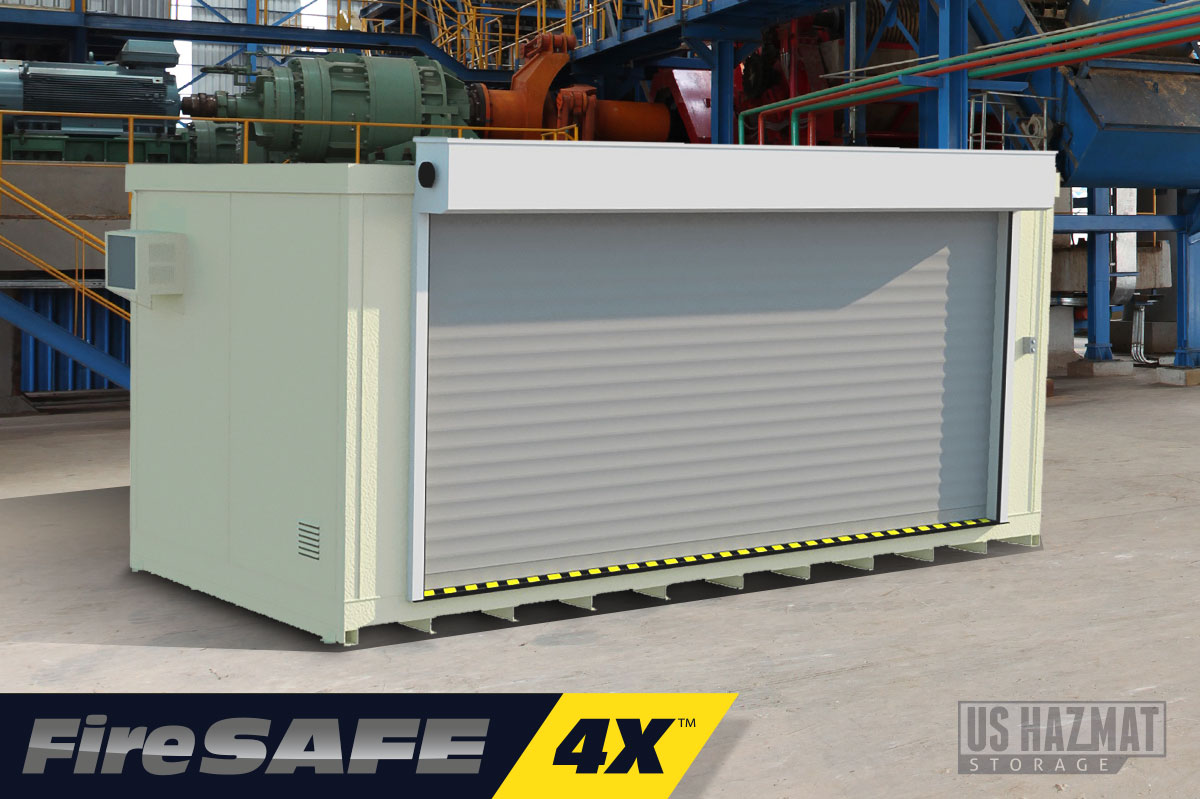
Every building is designed around how you handle the load and what the site requires. Small-container shelving, 55-gal drums, palletized material, or totes — then fire-rated walls, climate control, and fire suppression if you need them. Secondary spill containment is in every building.


Building options
Every building includes EPA secondary spill containment under the load.
Material handling
Designed to suit the client: shelving, drums, pallets, or totes. Fits any building above.
- Small container shelving
- 55-gal drums
- Palletized loads
- Totes / IBCs
- Pails and buckets
Materials stored
Any of these can go in any building. Name anything else in the quote.
- Chemical
- Flammable liquid
- Combustible liquid
- Toxin
- Battery
- Paints and coatings
- Flavorant
Before you request a quote
Questions about this drum storage buildings
What sizes are available?
From compact walk-ins to large pallet buildings.
How do I choose?
Share your peak drum count and handling method.
Quote or purchase?
Both.
How do I compare sizes?
By practical capacity for the layout you will use: upright, palletized or racked.
When is mechanical ventilation needed?
Usually in larger buildings or with flammable contents; your AHJ confirms.
Is one large building better than two small ones?
It depends on users, separation needs and site layout.
Can I start with a smaller building and add another?
Yes. A matching second building can be added beside the first as drum counts grow, keeping layouts and procedures consistent.
Do you sell the drum storage buildings containers themselves?
No. We design and sell the storage building or locker around containers you already use. We do not sell drums, totes, tanks, or cylinders.
Can you match drum storage buildings to our plant workflow?
Yes. Layout starts from your chemical list, container counts, forklift or pallet path, and how operators load the unit. We custom engineer the building to that process.
What do you need for a quote?
Name, work email, phone, company, the materials, a working container count, and any AHJ, setback, or fire-rating notes. Call 877-959-0747.
Is a drum storage buildings unit custom-engineered?
Yes. Each building is purpose-designed, fabricated, and sold for permanent storage compliance. Prefabricated construction is planned in weeks, not a years-long site-built room.
Can lighting, HVAC, and fire suppression be UL listed?
Yes. Lighting, sensing, gauges, heat, air conditioning, and fire suppression can all be furnished as UL listed components. We do not call the building itself UL listed.
Do you meet Class I, II, and III classified area storage?
Yes. Buildings are designed for storage compliance in Class I, Class II, and Class III classified areas when the inventory requires that occupancy.