
Arc flash safety is not an abstract compliance topic, it is about real people going home with their skin intact, their eyesight protected, and their careers uninterrupted. Electrical workers operate in environments where one wrong assumption, one skipped step, or one untrained decision can turn routine work into a life-altering incident within milliseconds. That is why arc flash training must be practical, credible, and rooted in real-world experience not generic safety theory.
This article is written with a people-first mindset. It explains arc flash training requirements the way an experienced electrical safety professional would explain them on a jobsite or in a safety meeting. It aligns with OSHA expectations, follows NFPA 70E guidance, and focuses on what actually keeps workers safe, not just what looks good on paper.
Understanding Arc Flash in the Real World
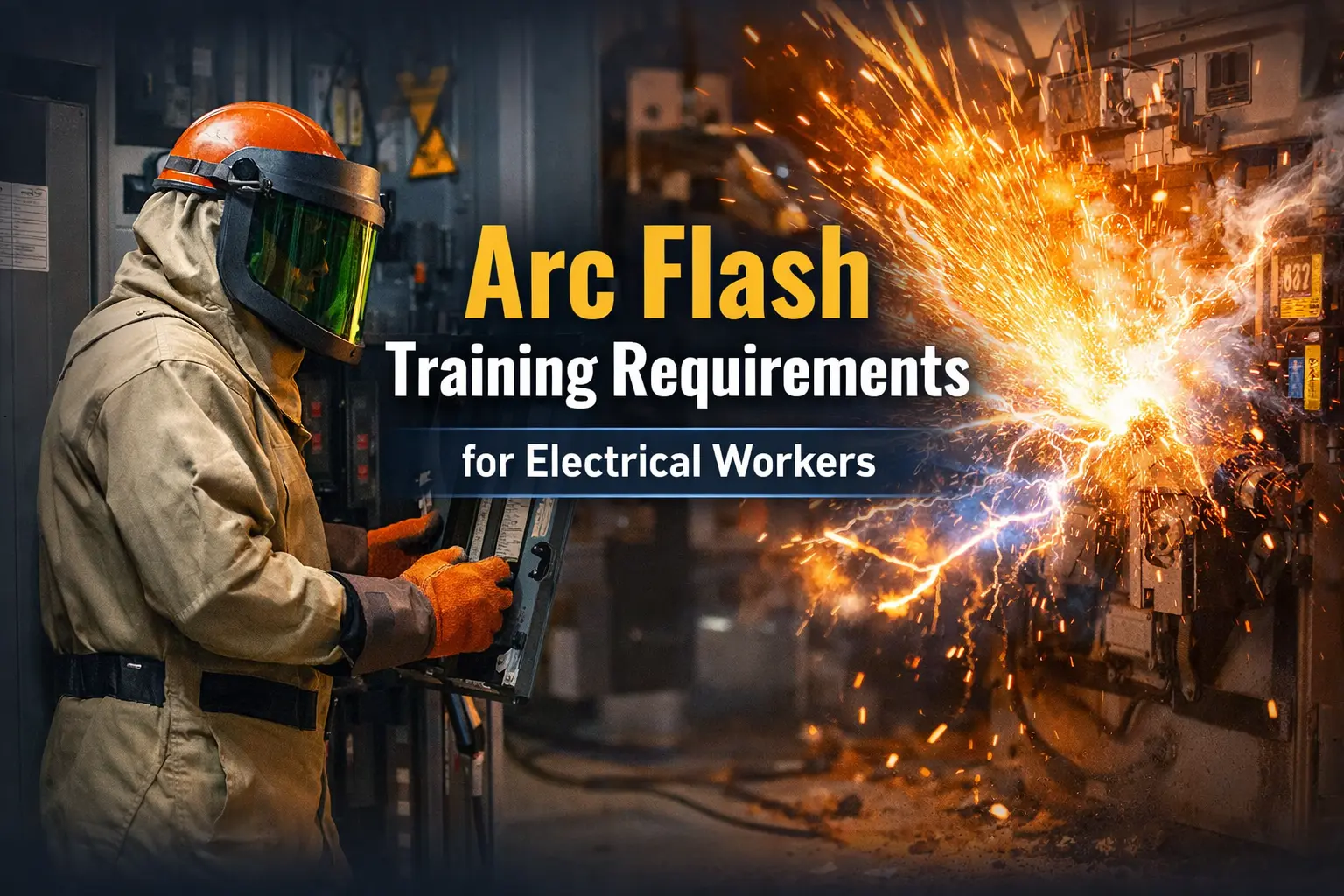
An arc flash occurs when electrical energy is suddenly released through the air due to a fault, equipment failure, or human error. The resulting explosion produces extreme heat, intense light, pressure waves, and molten metal. Temperatures can exceed 35,000°F in less than a second.
What makes arc flash especially dangerous is how unpredictable it can be. Equipment may appear normal, properly enclosed, and well maintained yet still present a serious arc flash risk when energized work is performed. Training exists because experience alone is not enough. Even seasoned electricians have been seriously injured when hazards were misunderstood or underestimated.
Why Arc Flash Training Is a Requirement, Not a Suggestion
Arc flash training is required because electrical hazards cannot be eliminated entirely but they can be controlled. Regulators expect employers to ensure workers understand those hazards and know how to manage them safely.
OSHA requires employers to protect workers from electrical hazards under both General Industry and Construction standards. While OSHA does not issue a single regulation titled “arc flash,” enforcement history clearly shows that OSHA relies on NFPA 70E as a recognized industry standard. When incidents occur, investigators look closely at training records, worker qualifications, and hazard awareness.
If employees are exposed to energized electrical equipment without proper arc flash training, employers face serious citations, legal liability, and more importantly the human cost of preventable injuries.
Who Must Receive Arc Flash Training
Arc flash training is not limited to electricians alone. Anyone who may be exposed to energized electrical equipment must be evaluated.
Qualified electrical workers are the primary group requiring in-depth arc flash training. These individuals perform tasks such as troubleshooting, testing, maintenance, and repair on electrical systems where exposure to arc flash hazards is possible.
Unqualified workers also require training when they work near electrical hazards. This includes maintenance staff, operators, supervisors, engineers, and contractors who may enter electrical rooms or work around energized equipment. Their training focuses on hazard recognition, safe distances, warning labels, and understanding when work must stop.
A key principle of people-first safety is clarity. Workers must know whether they are qualified to perform a task and if not, they must be empowered to step away without pressure.
What Arc Flash Training Must Actually Cover
Effective arc flash training goes beyond definitions and charts. It teaches workers how to think before they act.
Training must explain the difference between shock hazards and arc flash hazards, and why protecting against one does not automatically protect against the other. Workers need to understand how arc flash energy is released and how distance, equipment condition, and task type affect risk.
A major focus is hazard identification. Workers must know how to read arc flash warning labels, understand incident energy values, and recognize abnormal conditions such as loose connections, corrosion, unusual sounds, or damaged insulation.
Safe work practices are central to training. Employees must understand when energized work is permitted, how to establish an electrically safe work condition, and why de-energization is always the preferred option. When energized work is unavoidable, training must emphasize planning, authorization, and risk assessment.
Personal protective equipment is another critical component. Workers must know how to select arc-rated clothing, face protection, gloves, and tools appropriate for the task, not just rely on PPE categories without understanding their limits.
The Meaning of a “Qualified Person” Under NFPA 70E
NFPA 70E does not define a qualified person by job title or years of service. Qualification is based on training, knowledge, and demonstrated ability.
A qualified person must understand the construction and operation of the equipment they work on. They must be trained to recognize electrical hazards, determine approach boundaries, and apply appropriate protective measures.
Arc flash training is a cornerstone of this qualification. Without it, an employer cannot reasonably claim that a worker is prepared to make safe decisions around energized equipment. From a liability standpoint, this distinction matters.
How Often Arc Flash Training Is Required
Arc flash training is not a one-time event. NFPA 70E requires retraining at least every three years, and sooner when conditions change.
Refresher training is required when new equipment is installed, procedures are updated, job duties change, or safety standards are revised. It is also critical after incidents, near misses, or audit findings.
From a human perspective, refresher training keeps hazards visible. From a compliance perspective, it demonstrates that safety is an ongoing commitment rather than a checkbox exercise.
Training Methods That Actually Work
The most effective arc flash training connects directly to the work employees perform. Classroom instruction alone is rarely enough.
Strong programs use real equipment examples, site-specific hazards, and realistic scenarios. Workers should be encouraged to ask questions, challenge assumptions, and discuss situations they have actually encountered.
Hands-on demonstrations such as PPE inspection, job planning exercises, or label interpretation greatly improve understanding and retention. This practical approach aligns with how adults learn and how safety decisions are made in the field.
Employer Responsibilities and Documentation
Employers are responsible for ensuring arc flash training is provided, documented, and kept current. Records should clearly show who was trained, when training occurred, and what topics were covered.
During OSHA inspections or incident investigations, training documentation is often a primary focus. Clear records help demonstrate due diligence and a genuine commitment to worker protection.
Beyond paperwork, employers must verify competence. Observations, audits, and open safety discussions help confirm that training is being applied correctly on the job.
The Real Cost of Inadequate Arc Flash Training
When arc flash training is inadequate, the consequences are severe. Injuries can include deep burns, permanent scarring, vision loss, and long-term disability. Lives and careers can be changed in an instant.
Organizations also suffer through downtime, legal costs, increased insurance premiums, and damage to their reputation. These outcomes are preventable when training is taken seriously.
People-first safety recognizes that behind every incident statistic is a worker, a family, and a future that deserves protection.
Building a People-First Arc Flash Training Program
An effective arc flash training program is integrated into a broader electrical safety system. It aligns with arc flash studies, equipment labeling, lockout/tagout procedures, and job planning practices.
Training should be updated as systems evolve and delivered by instructors with real electrical experience. Workers are far more likely to trust and apply training when it reflects real-world conditions.
Most importantly, a strong program creates a culture where workers feel supported in making safe choices even when that means stopping work.
Final Perspective
Arc flash training requirements exist because the risk is real and the consequences are permanent. For electrical workers, training is not about memorizing rules, it is about developing the judgment needed to work safely around powerful energy sources.
When arc flash training is practical, credible, and truly people-first, it does more than meet OSHA and NFPA 70E expectations. It protects lives, builds trust, and sets the foundation for a safer electrical workplace.