
Acetone (CH₃COCH₃), a simple yet versatile organic solvent, is widely used in laboratories, industries, and household applications. Understanding its boiling point, chemical structure, physical and chemical properties, and practical uses is crucial for chemists, researchers, and safety professionals. In this comprehensive guide, we’ll explore acetone from a scientific perspective while emphasizing safety, industrial applications, and environmental impact.
What is Acetone?
Acetone, also known as propanone, is the simplest ketone, represented by the molecular formula CH₃COCH₃. It appears as a colorless, volatile liquid with a distinctive sweet odor. Acetone is miscible with water, alcohol, and most organic solvents, making it one of the most commonly used solvents in chemical synthesis and industrial processes.
Key characteristics of acetone include:
- Molecular Formula: CH₃COCH₃
- Molar Mass: 58.08 g/mol
- Appearance: Colorless liquid
- Odor: Sweet, pungent
- Density: 0.7845 g/cm³ at 25°C
Molecular Structure of Acetone
Understanding the structure of acetone helps explain its physical and chemical properties, including its boiling point. Acetone consists of three carbon atoms arranged in a chain with a carbonyl group (C=O) in the center:
O
||
CH3 – C – CH3
- The carbonyl group (C=O) makes acetone a highly polar molecule.
- Polarity allows acetone to form hydrogen bonds with water, explaining its high solubility.
- The tetrahedral geometry around carbon atoms ensures stability and reactivity in organic reactions.
This structure underpins acetone’s behavior as a solvent and its volatility, which directly relates to its boiling point.
Boiling Point of Acetone
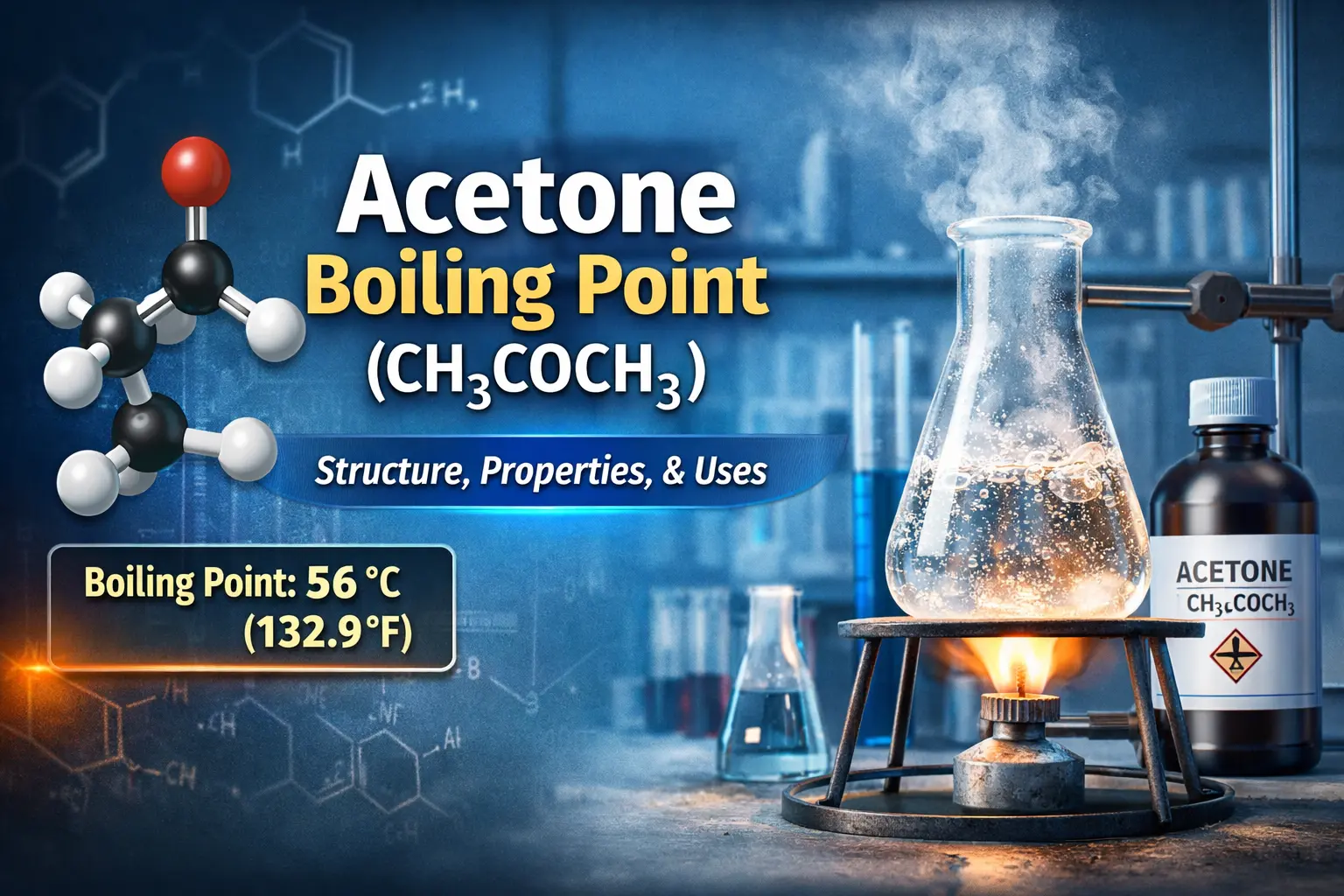
The boiling point of acetone is 56.05°C (132.9°F) at standard atmospheric pressure (1 atm).
Several factors contribute to acetone’s relatively low boiling point:
- Molecular Weight: Low molecular weight leads to weaker van der Waals forces.
- Polarity: While acetone is polar, it cannot form hydrogen bonds with itself, unlike alcohols.
- Volatility: Acetone evaporates quickly, making it a fast-drying solvent.
Why is the Boiling Point Important?
- Industrial Use: Boiling point determines distillation methods for purifying acetone.
- Laboratory Applications: Volatility is critical in reactions requiring rapid solvent evaporation.
- Safety Considerations: Low boiling point increases flammability risk; proper storage is essential.
Physical Properties of Acetone
Acetone’s physical properties make it one of the most versatile solvents in chemistry and industry. Below is a detailed overview:
| Property | Value |
| Molecular Weight | 58.08 g/mol |
| Boiling Point | 56.05°C (132.9°F) |
| Melting Point | -94.7°C (-138.5°F) |
| Density | 0.7845 g/cm³ at 25°C |
| Refractive Index | 1.3588 |
| Solubility | Miscible with water, ethanol, ether |
| Vapor Pressure | 24 kPa at 20°C |
Key Insights:
- Volatility: Acetone evaporates quickly, which is advantageous for industrial drying processes.
- Miscibility: Its ability to mix with polar and non-polar solvents enhances chemical reactions.
- Flammability: Acetone is highly flammable (flash point -20°C). Safety protocols are critical.
Chemical Properties of Acetone
Acetone’s chemical behavior is dominated by its carbonyl group, making it reactive in various organic transformations.
1. Ketone Reactivity
Acetone participates in nucleophilic addition reactions, a hallmark of ketone chemistry. Common reactions include:
- Aldol condensation: Formation of β-hydroxy ketones under basic conditions.
- Reduction: Converts acetone to isopropanol using reducing agents like NaBH₄.
2. Oxidation
Under controlled conditions, acetone can undergo oxidation to produce acetic acid or other oxygenated compounds.
3. Solvent Behavior
Acetone is excellent for dissolving plastics, resins, oils, and fats due to its polarity and low viscosity.
Industrial and Laboratory Uses of Acetone
Acetone’s versatility extends across industries and laboratories. Below is an in-depth analysis of its applications:
1. Solvent in Organic Synthesis
- Used to dissolve resins, adhesives, and paints.
- Plays a role in chemical reactions, particularly those involving polar substrates.
2. Pharmaceutical Industry
- Acts as a precursor for vitamin synthesis and other pharmaceuticals.
- Used in tablet coating and drug formulation.
3. Cleaning Agent
- Removes oils, grease, and residues in laboratories and electronics manufacturing.
- Common in nail polish remover and cosmetic products.
4. Industrial Cleaning and Manufacturing
- Used in plastics, fiber, and textile industries for surface preparation.
- Plays a role in paint stripping and degreasing metals.
5. Laboratory Applications
- Fast-evaporating solvent for chromatography and spectroscopy experiments.
- Essential in sample preparation for analytical chemistry.
Safety and Handling of Acetone
Due to its high flammability and volatility, acetone requires careful handling.
Safety Guidelines:
- Storage: Keep in a cool, ventilated area away from ignition sources.
- Personal Protective Equipment (PPE): Wear gloves, goggles, and lab coats.
- Fire Safety: Use acetone-compatible fire extinguishers (CO₂ or dry powder).
- Spill Management: Use inert absorbents and ensure proper ventilation.
Following safety guidelines not only protects workers but also maintains regulatory compliance in industrial and laboratory settings.
Environmental Impact
Although acetone is biodegradable and less toxic than many solvents, large-scale disposal can cause environmental concerns.
- Air Pollution: Acetone vapors contribute to volatile organic compounds (VOCs).
- Water Contamination: Direct disposal into water bodies should be avoided.
- Safe Disposal: Use approved chemical waste management protocols.
Factors Affecting Acetone Boiling Point
Several external and molecular factors can influence acetone’s boiling behavior:
- Pressure: Reduced pressure lowers the boiling point, enabling vacuum distillation.
- Purity: Impurities or mixtures with water can slightly increase or decrease the boiling point.
- Chemical Additives: Salts and solutes affect vapor pressure and boiling behavior.
Understanding these factors is crucial for industrial distillation and laboratory applications.
Acetone vs. Other Solvents
Compared to ethanol, methanol, or hexane, acetone offers unique advantages:
- Faster evaporation rate than ethanol and water.
- Better solubility for a wide range of organic compounds.
- Lower toxicity than some aromatic solvents like benzene.
However, acetone is highly flammable, requiring stricter storage and handling.
Frequently Asked Questions (FAQs)
Q1: Why is acetone’s boiling point low?
- Acetone has weak intermolecular forces and cannot hydrogen bond with itself, leading to a lower boiling point compared to alcohols.
Q2: Can acetone dissolve plastics?
- Yes, acetone can dissolve many plastics, including polystyrene, making it useful in chemical processing but potentially hazardous for certain materials.
Q3: Is acetone safe to use in homes?
- In small amounts (e.g., nail polish remover), acetone is generally safe if used in well-ventilated areas. Large-scale exposure requires professional handling.
Conclusion
Acetone (CH₃COCH₃) is a cornerstone of modern chemistry, valued for its low boiling point, polarity, and versatility. From industrial cleaning to laboratory synthesis, its applications are vast, but proper safety and environmental awareness are essential. Understanding its structure, properties, and practical uses ensures effective utilization while minimizing risks.
By mastering the fundamentals of acetone, chemists and professionals can harness its potential across industries while adhering to safety, regulatory, and environmental standards.