
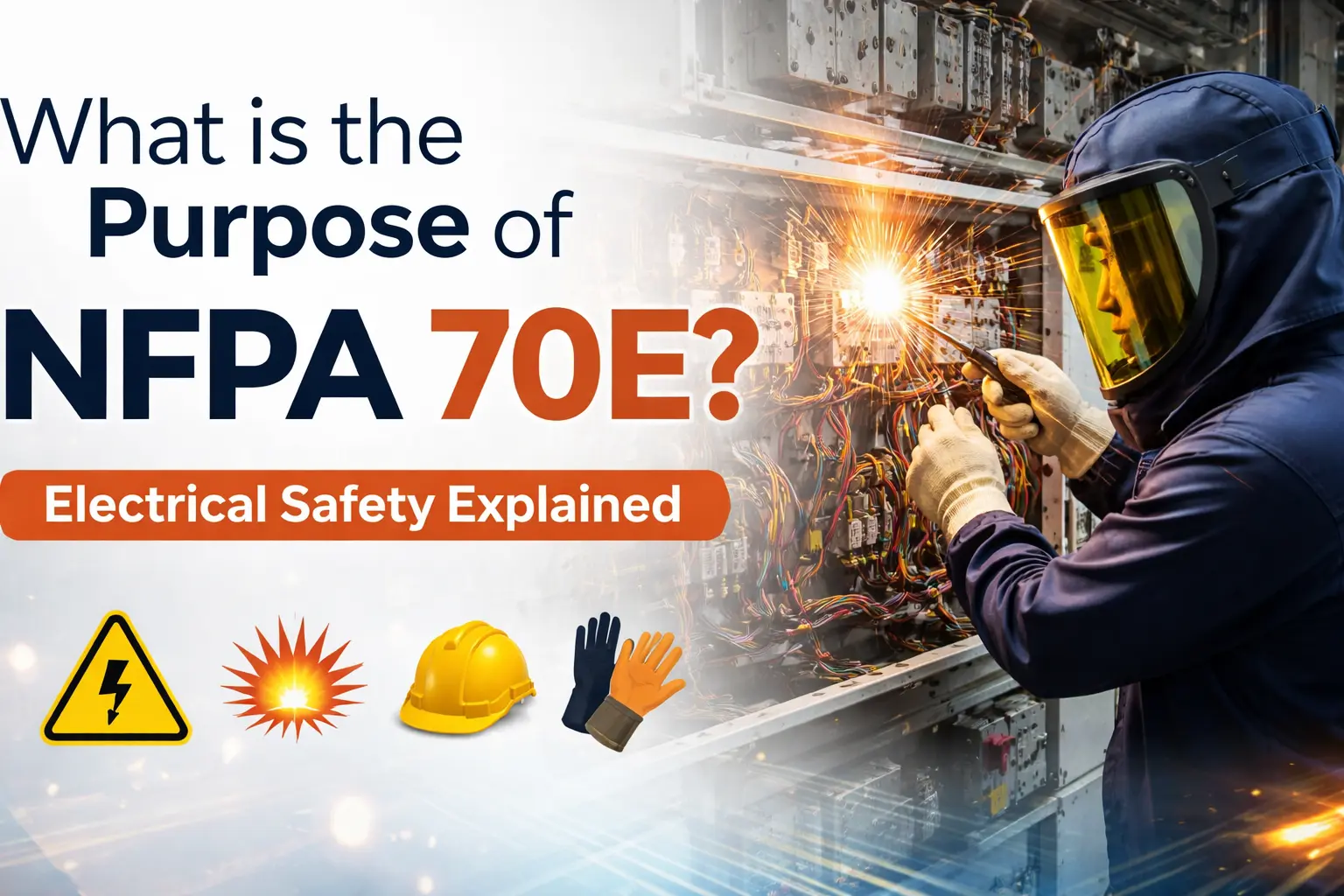
Electrical energy powers modern industry, but it also presents one of the most serious workplace hazards. Arc flashes, arc blasts, electric shock, and thermal burns continue to cause severe injuries and fatalities every year. This is where NFPA 70E plays a critical role.
The purpose of NFPA 70E: Standard for Electrical Safety in the Workplace is to protect workers from electrical hazards by establishing clear, enforceable safety practices. It provides a structured framework for identifying electrical risks, reducing exposure, and creating a culture of electrical safety across industrial, commercial, and utility environments.
This article explains why NFPA 70E exists, what problems it solves, how it is applied, and why compliance matters for both safety and liability.
Understanding NFPA 70E: A Brief Overview
NFPA 70E is a consensus standard developed by the National Fire Protection Association (NFPA). Unlike the National Electrical Code (NEC), which focuses on installation safety, NFPA 70E is entirely focused on workplace electrical safety.
It applies to:
- Electrical maintenance and repair
- Troubleshooting energized equipment
- Industrial facilities, data centers, manufacturing plants, utilities, and commercial buildings
- Qualified and unqualified electrical workers
Core objective:
Prevent electrical injuries, fatalities, and property damage by controlling electrical hazards before work begins.
The Primary Purpose of NFPA 70E
At its core, NFPA 70E exists to answer one question:
How can electrical work be performed with the lowest possible risk to human life?
To achieve this, the standard focuses on six key purposes.
-
Preventing Electrical Injuries and Fatalities
Electrical incidents are often catastrophic. Arc flash temperatures can exceed 35,000°F, causing:
- Severe burns
- Hearing damage
- Vision loss
- Fatal trauma
NFPA 70E establishes mandatory safety requirements to prevent:
- Electric shock and electrocution
- Arc flash and arc blast injuries
- Secondary injuries from pressure waves and molten metal
By defining safe work practices, NFPA 70E directly reduces the likelihood and severity of electrical accidents.
-
Establishing an Electrical Safety Program
One of the most important purposes of NFPA 70E is the requirement for a documented electrical safety program.
This program must include:
- Hazard identification procedures
- Risk assessment processes
- Employee training requirements
- Job planning and work permits
- Auditing and continuous improvement
Rather than relying on individual judgment, NFPA 70E promotes systematic, repeatable safety processes.
This shifts electrical safety from a reactive approach to a proactive risk management system.
-
Defining Energized vs. De-Energized Work
NFPA 70E makes one principle absolutely clear:
Electrical conductors and circuit parts must be placed in an electrically safe work condition whenever possible.
The standard:
- Strongly discourages energized work
- Requires justification when equipment cannot be de-energized
- Mandates Energized Electrical Work Permits (EEWP)
This ensures that live electrical work is rare, controlled, and justified, not routine or convenient.
-
Standardizing Arc Flash Risk Assessment
A critical purpose of NFPA 70E is to provide a clear methodology for arc flash risk assessment.
This includes:
- Identifying arc flash hazards
- Estimating incident energy exposure
- Establishing arc flash boundaries
- Selecting appropriate PPE
NFPA 70E provides two compliant methods:
- Incident Energy Analysis
- PPE Category Method
This standardization removes guesswork and ensures consistent protection across facilities.
-
Defining PPE Requirements Based on Risk
NFPA 70E does not promote “more PPE” – it promotes the right PPE for the actual hazard.
The purpose is to:
- Match PPE levels to calculated incident energy
- Prevent under-protection and over-protection
- Improve worker comfort, compliance, and mobility
It specifies:
- Arc-rated clothing requirements
- Face shields, hoods, gloves, and footwear
- Voltage-rated tools and insulating equipment
This risk-based PPE approach is one of the most practical and impactful aspects of the standard.
-
Clarifying Roles, Responsibilities, and Training
Another core purpose of NFPA 70E is accountability.
The standard clearly defines:
- Qualified persons vs. unqualified persons
- Training requirements for each role
- Employer responsibilities for enforcement and documentation
Workers must be trained to:
- Recognize electrical hazards
- Understand approach boundaries
- Properly use PPE and tools
- Respond to electrical emergencies
This ensures that electrical safety is not assumed-it is verified.
Why NFPA 70E Matters for OSHA Compliance
Although NFPA 70E is not a federal law, it is widely recognized by OSHA as the accepted industry standard for electrical safety.
OSHA frequently:
- References NFPA 70E in citations
- Uses it to establish “recognized hazards”
- Evaluates employer negligence based on NFPA 70E compliance
In practical terms:
- Following NFPA 70E helps demonstrate due diligence
- Ignoring it increases legal and financial risk
For many organizations, NFPA 70E compliance is both a safety necessity and a liability safeguard.
The Difference Between NFPA 70E and NEC (NFPA 70)
A common misunderstanding is confusing NFPA 70E with the NEC.
NFPA 70 (NEC) |
NFPA 70E |
| Installation safety | Workplace safety |
| Applies to electrical systems | Applies to electrical work |
| Enforced by inspectors | Enforced by employers |
| Prevents fires and failures | Prevents worker injuries |
Both standards work together, but NFPA 70E exists solely to protect people.
Industries That Rely on NFPA 70E
NFPA 70E is essential in environments where electrical exposure is unavoidable, including:
- Manufacturing and industrial plants
- Chemical processing facilities
- Oil and gas operations
- Data centers and critical infrastructure
- Utilities and power generation
- Commercial and institutional facilities
In high-risk industries, NFPA 70E compliance is often a contractual requirement, not just a best practice.
How NFPA 70E Supports a Culture of Safety
Beyond technical rules, the deeper purpose of NFPA 70E is cultural change.
It encourages:
- Planning before work begins
- Open communication about hazards
- Empowering workers to stop unsafe tasks
- Continuous evaluation and improvement
When implemented correctly, NFPA 70E transforms safety from a checklist into a shared responsibility.
Common Misconceptions About NFPA 70E
It’s only for electricians.
False. Anyone working near electrical hazards can be affected.
PPE alone makes work safe.
False. NFPA 70E prioritizes hazard elimination, not just protection.
It’s optional.
False. Ignoring it exposes employers to OSHA citations and lawsuits.
Understanding these misconceptions is essential to applying the standard correctly.
The Real-World Purpose of NFPA 70E
Ultimately, the purpose of NFPA 70E is simple but powerful:
- Protect human life
- Reduce preventable injuries
- Create consistent electrical safety practices
- Hold employers accountable
- Ensure workers go home safely
Every requirement in the standard-risk assessments, permits, training, PPE serves this single mission.
Final Thoughts
NFPA 70E is not just a technical document. It is a life-saving framework built on decades of real-world electrical incidents and lessons learned.
Organizations that truly understand and implement NFPA 70E don’t just meet compliance requirements they demonstrate leadership, responsibility, and respect for their workforce.
In an industry where a single mistake can be fatal, NFPA 70E exists to ensure that safety is planned, not hoped for.