
When working with chemicals, fuels, or hazardous materials, seconds matter during an emergency. Firefighters, safety officers, and emergency responders must instantly understand what dangers they’re facing often before they even step out of the truck. That’s exactly why the NFPA Fire Diamond, formally known as NFPA 704, exists.
You’ve likely seen the four-colored diamond posted on chemical storage buildings, tanks, laboratories, or industrial facilities. But understanding what each color and number truly means and how it affects real-world safety decisions is critical, not just for compliance, but for saving lives.
This guide breaks down NFPA 704 in a clear, professional, and practical way, so facility managers, EHS professionals, contractors, and emergency responders can use it correctly and confidently.
What Is the NFPA Fire Diamond (NFPA 704)?
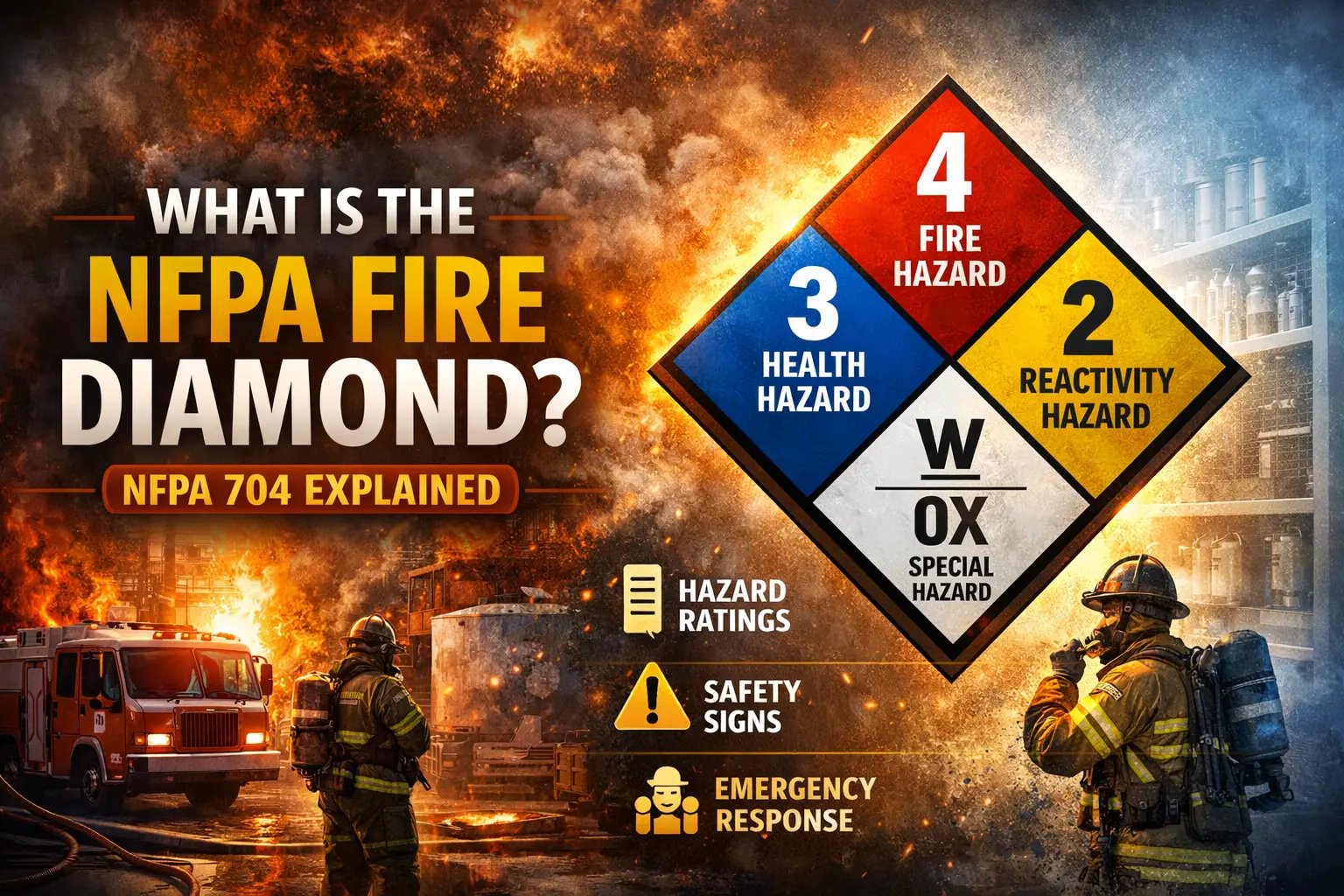
The NFPA Fire Diamond is a standardized hazard identification system developed by the National Fire Protection Association (NFPA). Its official designation is NFPA 704: Standard System for the Identification of the Hazards of Materials for Emergency Response.
The system uses a diamond-shaped symbol divided into four colored quadrants, each communicating a different type of hazard:
- Blue – Health Hazard
- Red – Fire (Flammability) Hazard
- Yellow – Reactivity (Instability) Hazard
- White – Special or Specific Hazards
Each quadrant contains a numerical rating from 0 to 4, with 4 representing the most severe hazard.
The primary purpose of NFPA 704 is rapid hazard recognition during emergencies, not routine workplace labeling.
Why NFPA 704 Matters in Real Emergencies
NFPA 704 is designed for first responders, not chemists reading Safety Data Sheets. During fires, spills, or explosions, responders may not have time to review documentation.
The fire diamond allows them to quickly answer critical questions:
- Can this material explode if heated?
- Will exposure cause serious injury?
- Does water make the situation worse?
- Is specialized PPE required?
One glance at the diamond can determine tactical decisions, such as evacuation distance, suppression method, and responder protection.
Understanding Each Section of the NFPA Fire Diamond
Blue Quadrant: Health Hazard
The blue section indicates the health risk posed by exposure whether through inhalation, skin contact, or ingestion.
Health Hazard Ratings:
- 0 – No significant health risk
- 1 – Slight irritation or minor injury
- 2 – Temporary incapacitation or residual injury
- 3 – Serious or permanent injury
- 4 – Life-threatening or fatal exposure
Expert insight:
A high blue rating doesn’t always mean immediate danger but it signals that protective equipment and controlled response are essential.
Red Quadrant: Fire (Flammability) Hazard
The red section shows how easily a substance will ignite under normal conditions.
Flammability Ratings:
- 0 – Will not burn
- 1 – Must be preheated to burn
- 2 – Ignites when moderately heated
- 3 – Ignites at ambient temperatures
- 4 – Extremely flammable; ignites readily
Materials with a 3 or 4 rating require strict storage controls, ventilation, and ignition source management.
Yellow Quadrant: Reactivity (Instability) Hazard
The yellow section reflects how unstable a substance is especially under heat, pressure, or shock.
Reactivity Ratings:
- 0 – Stable under all conditions
- 1 – Unstable if heated
- 2 – Violent chemical change possible
- 3 – Detonation possible with strong ignition
- 4 – Readily detonates or explodes
This quadrant is critical for emergency planning, as high-reactivity materials may require isolation rather than suppression.
White Quadrant: Special Hazard Information
The white section does not use numbers. Instead, it displays symbols or abbreviations for unique hazards.
Common symbols include:
- W – Reacts dangerously with water
- OX – Oxidizer
- SA – Simple asphyxiant gas
- COR – Corrosive (used in some facilities)
These symbols override assumptions responders might otherwise make especially regarding water use.
How NFPA 704 Differs From OSHA and GHS Labels
A common mistake is assuming NFPA 704 replaces OSHA or GHS labeling. It does not.
System |
Purpose |
| NFPA 704 | Emergency response hazard recognition |
| OSHA HazCom / GHS | Workplace communication and training |
| SDS | Detailed chemical safety information |
NFPA 704 is not required on individual containers and is typically used on:
- Chemical storage buildings
- Tanks and vessels
- Process areas
- Hazardous material storage rooms
Where NFPA Fire Diamonds Are Required or Expected
NFPA 704 signage is commonly required or strongly recommended in:
- Hazardous material storage buildings
- Chemical warehouses
- Fuel storage facilities
- Laboratories
- Manufacturing plants
- Fire-rated chemical storage units
Local fire marshals and AHJs (Authorities Having Jurisdiction) often enforce proper placement, visibility, and accuracy of NFPA diamonds.
Common NFPA Fire Diamond Mistakes to Avoid
Even experienced facilities make errors that can compromise safety:
- Using outdated hazard ratings
- Posting NFPA diamonds indoors instead of exterior access points
- Confusing GHS pictograms with NFPA symbols
- Failing to update signage after chemical changes
- Using generic ratings instead of material-specific data
Incorrect NFPA signage is worse than none at all, because it misleads responders.
How to Determine the Correct NFPA Ratings
NFPA ratings are typically derived from:
- Safety Data Sheets (SDS)
- NFPA 704 Annex guidance
- Manufacturer hazard evaluations
- Professional EHS assessments
For mixed or stored materials, the highest hazard rating should be displayed, not an average.
NFPA 704 and Chemical Storage Compliance
NFPA 704 works alongside other fire and safety standards, including:
- NFPA 30 – Flammable and Combustible Liquids Code
- NFPA 45 – Fire Protection for Laboratories
- OSHA 29 CFR 1910 regulations
- EPA and local fire codes
Facilities storing flammable or reactive chemicals must ensure NFPA fire diamonds match the actual hazards present, especially when using fire-rated or explosion-proof storage buildings.
Why Emergency Responders Rely on NFPA 704
Firefighters are trained to interpret NFPA diamonds instantly. The system allows them to:
- Select proper extinguishing agents
- Decide between offensive or defensive strategies
- Identify evacuation distances
- Choose correct PPE
- Avoid catastrophic reactions
In high-risk situations, NFPA 704 can be the difference between control and catastrophe.
Final Thoughts: NFPA Fire Diamond Is More Than a Sign
The NFPA Fire Diamond is not just a compliance requirement – it’s a critical communication tool that protects lives, property, and emergency personnel.
When used correctly, NFPA 704:
- Enhances emergency preparedness
- Reduces responder risk
- Supports regulatory compliance
- Demonstrates professional safety management
If your facility stores hazardous materials, accurate NFPA 704 signage is non-negotiable. It’s not about passing inspections-it’s about ensuring the right decisions are made when it matters most.